








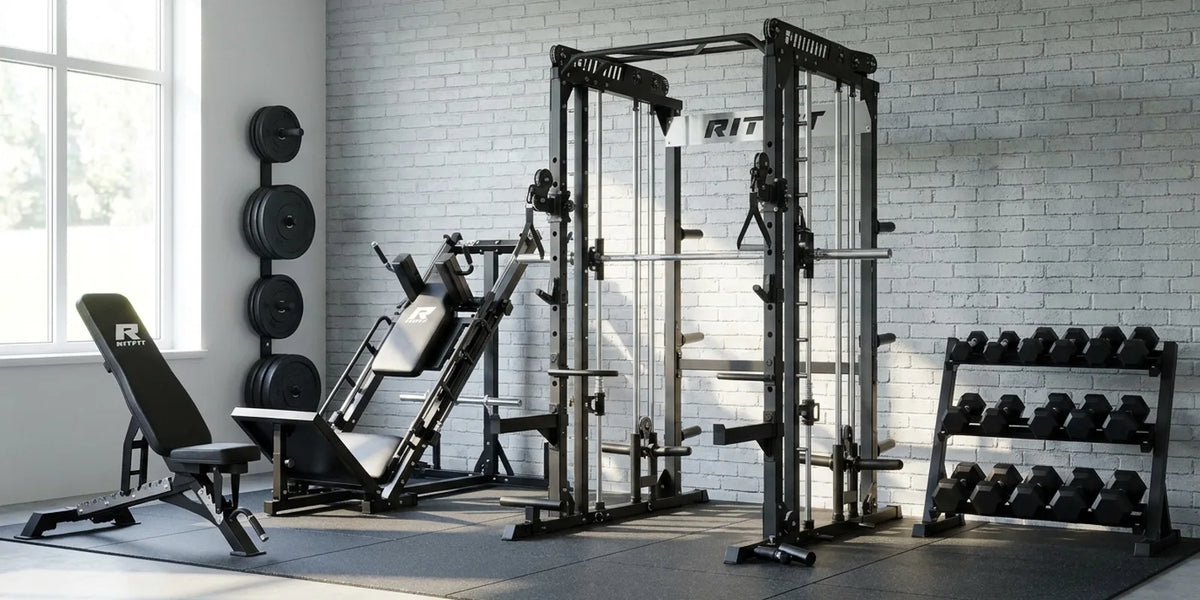
The 3D Smith machine vs regular Smith machine comparison comes down to one mechanical difference, bar-path freedom.
A regular Smith machine locks the bar to a fixed vertical rail, while a 3D Smith machine adds controlled front-to-back travel on a second rail.
This guide breaks down the mechanics, the research behind fixed and free bar paths, and a RitFit-only decision matrix.
You will learn how each bar path changes squats, presses, and rows, what solo lifters and beginners should weigh, and how listed prices and upgrade paths compare across the RitFit line.
Quick Answer: The 3D Smith machine vs regular Smith machine choice comes down to bar-path freedom, because a regular Smith machine locks the bar to one fixed vertical rail while a 3D Smith machine adds controlled front-to-back travel. Pick the fixed rail for maximum stability and budget value, or the 3D path for a more natural squat, press, and row groove.
Key Takeaways
- Mechanics: A regular Smith machine locks the bar to one fixed vertical rail on linear bearings, while a 3D Smith machine adds controlled front-to-back travel on a horizontal rail.
- Bar path feel: The fixed rail sets one groove for every rep, and the 3D system lets the bar drift fore or aft so squats, presses, and rows follow a more natural path.
- Research context: Peer-reviewed EMG work compared fixed and free barbell squat paths and reported activation differences, but no study tested 3D Smith machines directly.
- RitFit lineup: The M1 PRO uses a fixed vertical rail and lists at $1,299.99, the M2 3D lists at $2,199.99, and the P9 pairs its 3D bar with dual cables and a 198 lb weight stack.
- Upgrade paths: Both lines grow with you, from a bolt-on weight stack on the fixed-rail side to modular rack, cable, and weight stack add-ons on the 3D side.
What Is a Regular Smith Machine?
A regular Smith machine is a strength station that locks a barbell to a fixed vertical rail. Linear bearings or guide rods let the bar slide up and down, and rotating hooks plus safety stops catch a failed rep.
- Fixed vertical rail: The bar travels one straight line, so the machine, not you, controls the bar path.
- Linear bearing system: Bearings or steel rods guide the carriage, which keeps the movement smooth under heavy loads.
- Hooks and safety stops: You twist the bar to re-rack at any height and set stops below your working range, so no spotter is needed.
- Stable groove: Because the path never changes, beginners can rehearse squat, bench, and row patterns without balancing a free barbell.
In the RitFit line, the fixed-rail family includes the RitFit M1 PRO Smith machine and the compact RitFit PSR05 2.0 Smith machine, and you can browse the full range in the RitFit Smith machines collection.
What Is a 3D Smith Machine?
A 3D Smith machine adds horizontal travel to a guided vertical bar path. The bar stays on rails within its travel range, so 3D describes the machine path, not unrestricted free-weight movement, as the 3D Smith machine guide on the RitFit blog explains.
- Second rail: A horizontal rail lets the carriage drift fore or aft while it still tracks vertically.
- Natural bar path: Your squat, press, or row can follow a slight arc instead of one straight groove.
- Still guided: Hooks and safety stops work the same way as on a fixed rail, so you keep solo-lifting safety.
- Travel range: On the RitFit P9, the 3D bar offers about 20.6 inches of front-to-back travel.
A 3D system sits between a fixed rail and a free barbell, and that added travel is the first thing many lifters notice under load.
What Are the Key Differences Between 3D and Regular Smith Machines?
The core differences between 3D and regular Smith machines are bar path, stabilization demand, starting position, and typical buyer. Both styles keep hooks and safety stops, so solo safety is equal on paper.
| Feature | Regular Smith Machine | 3D Smith Machine |
|---|---|---|
| Bar path | Fixed vertical rail on linear bearings | Vertical rail plus front-to-back travel |
| Stabilization demand | Lowest, the rail supports the bar | Slightly higher, you control fore and aft drift |
| Starting position | One fixed groove for every rep | Shift fore or aft within the travel range |
| Solo safety | Hooks and safety stops, no spotter | Same hooks and safety stops, no spotter |
| Typical buyer | Beginner, budget, or stability-first lifter | Lifter seeking a more natural bar path |
Both styles still require proper safety stop setup before heavy sets, so the safety row describes the mechanism, not a substitute for checking your stops.
Free weights sit at the far end of this scale, with the highest stabilization demand of all three options.
What Does Research Say About Fixed and Free Bar Paths?
Published comparisons of fixed and free barbell squat paths report real differences, with clear limits. None of this research tested 3D Smith machines directly, so treat the findings as direction, not a verdict.
A 2025 study examined acute neuromuscular fatigue, hormonal responses, and recovery in males after high-volume Smith machine back squat versus horizontal leg press sessions[1]. The work shows the Smith machine squat is a measurable, demanding training modality, so program heavy volume with the same respect you give a free barbell.
A peer-reviewed study using textile electrodes found differences in lower-limb muscle activation during loaded squats when comparing fixed and free barbell movement paths[2]. In plain terms, changing the bar path changes what your legs do, which is exactly the lever a 3D rail pulls.
The honest boundary is that none of this work tested a 3D Smith machine, and results still vary by training experience. Use the research to understand the principle, then let your goals, space, and budget make the final call.
Why Do Solo Lifters and Beginners Choose Regular Smith Machines?
Solo lifters and beginners choose regular Smith machines for the fixed groove, built-in safety, and lower cost. The fixed vertical rail removes balance from the equation while you learn squat, bench, and row mechanics.
- No spotter needed: Rotating hooks and adjustable safety stops catch a failed rep at any point in the set.
- Repeatable groove: One fixed bar path lets you drill technique with the same setup every session.
- Confidence under load: Less balancing demand means more attention on depth, bracing, and tempo.
- Lower entry price: Fixed-rail machines typically list below 3D models, which keeps the barrier low for a first serious home gym.
Guided machines also hold their own next to classic gym equipment, and a peer-reviewed study compared quadriceps activation and overall perceived effort profiles between the leg press and the Smith machine[3].
"The smith machine is great because it's going to take a lot of the pressure out of your shoulders because it's supporting itself and you can do a little bit more weight on here. So it can help you break some barriers too, and also if you don't have a spotter you can utilize the tabs, put that right here so if you drop it it'll just bounce and then you won't hurt yourself."
Jeff Cavaliere, MSPT, CSCS, Physical Therapist and Strength Coach, former Head Physical Therapist for the New York Mets, via Athlean-X on YouTube
Why Do Lifters Upgrade to a 3D Smith Machine?
Lifters upgrade to a 3D Smith machine for a more natural bar path without giving up guided safety. The front-to-back travel lets a squat, press, or row follow the arc your joints prefer instead of one straight groove.
- Natural movement: The bar can drift fore or aft, so your body settles into its own groove instead of adapting to the machine.
- Comfortable setup: Small path adjustments let you find your own start position rather than forcing one groove on every rep.
- More variety: Slight path changes add training variety for squats, presses, rows, romanian deadlifts, and calf raises.
- Bridge to free weights: The 3D path trains some of the stabilization a free barbell demands, which eases the later transition.
If you already own a rack or train with a partner, the 3D upgrade adds less, so weigh it against your current setup first.
Which RitFit Smith Machine Should You Choose?
Your goals, space, and budget pick the model, so match the bar path first and the price second. Every price below is a listed figure, so check the current product page before you buy.
| Model | Bar Path | Listed Price | Key Specs | Best Fit |
|---|---|---|---|---|
| RitFit M1 PRO | Fixed vertical rail, linear bearing | $1,299.99 listed | 352 lb Smith capacity, 33 lb bar, 11 height settings, 20.9 sq ft footprint, 1,600 lb frame | Budget builds and solo beginners |
| RitFit M2 3D | Vertical plus front-to-back 3D travel | $2,199.99 listed | 2.36 by 2.36 inch 13-gauge uprights, about 23 sq ft | Natural bar path seekers who want modular growth |
| RitFit P9 | 3D Smith bar with horizontal travel | See current product page | About 20.6 inches of travel, dual cables in 1:1 and 2:1 ratios, 198 lb built-in weight stack, 19.8 sq ft footprint, 1,600 lb rated frame | All-in-one 3D training with cables |
Listed specs come from RitFit product pages and brand guides, and both prices and availability can change at any time.
Choose the RitFit M1 PRO for a fixed-rail budget build
The RitFit M1 PRO Smith machine is the value anchor, pairing the fixed vertical rail and linear bearing system with a bolt-on weight stack upgrade path in a garage-friendly footprint. Choose it when stability, simplicity, and price matter more than bar-path freedom.
"Great machine for the price"
Jade, Verified Buyer, RitFit Pink M1 PRO Multi-Functional Smith Machine Home Gym Package
Choose the RitFit M2 3D for a natural bar path
The RitFit M2 3D is the dedicated 3D pick, built on 2.36 by 2.36 inch 13-gauge uprights with modular rack, cable, and weight stack upgrades. Choose it when you want the natural bar path and clear room to expand.
"Best Piece of equipment that I've ever owned. Very smooth!"
Jacob S. Verified Buyer, RitFit M2 Multi-Functional Modular Home Gym Smith Machine Tailored to All Fitness Levels
Choose the RitFit P9 for 3D training with built-in cables
The RitFit P9 combines its 3D Smith bar with dual cables in 1:1 and 2:1 ratios and a 198 lb built-in weight stack. Choose it when you want one station that covers guided barbell work and cable training together.
The short version is simple: the M1 PRO is best for budget solo builds, the M2 3D is best for lifters chasing a natural groove, and the P9 is best for one-station cable plus barbell training.
Is a 3D Smith Machine Worth the Price Gap?
The 3D upgrade is worth it when path freedom and upgrade headroom matter more than the price gap. Across the RitFit line, the M2 3D lists at $2,199.99 while the fixed-rail M1 PRO lists at $1,299.99, so the gap buys travel and heavier uprights.
- What the gap buys: The higher listed price trades the single groove for front-to-back travel, 13-gauge uprights, and a broader upgrade ecosystem.
- When to skip it: If you train solo, value stability, and plan mostly squat, bench, and row work, the fixed rail already delivers.
- Hidden value: A 3D machine can delay a future power rack purchase, because guided work covers most of what home lifters use a rack for.
- Budget check: Sales and bundle offers can narrow the gap, so check the current product page before you decide.
Age and life stage also shape the pick, and our guide to the best Smith machines for your 30s at home breaks that angle down.
How Do You Plan Long-Term Upgrades for Either Style?
Plan upgrades by line, because fixed-rail machines grow through weight stacks while 3D lines add rack, cable, and stack modules. Knowing the path before you buy prevents paying twice for capacity you will outgrow.
- Fixed-rail path: The M1 PRO grows through its dedicated weight stack set, so you add resistance without adding floor space.
- 3D path: The M2 3D line supports modular rack, cable, and weight stack upgrades, including the WSM2 weight stack set for M2 3D.
- Rack and cable option: Lifters who want free barbell work later can add the RitFit M3 power rack, which combines rack and cable stations in one frame.
- Space planning: Budget footprint for attachments before you buy, because cable arms and stacks change your floor plan.
Whichever style you pick, the strength machines collection shows the full ecosystem for future additions.
FAQs About 3D Smith Machines and Regular Smith Machines
Is a 3D Smith machine better than a regular Smith machine?
Neither is universally better, because the right choice depends on your training goals, experience, and budget. A regular Smith machine keeps the bar on one fixed vertical rail, which suits beginners and solo lifters who value maximum stability. A 3D Smith machine adds controlled front-to-back travel, which feels more natural for squats, presses, and rows.
Can you lift heavy on a 3D Smith machine without a spotter?
Yes, guided training is the core purpose of both Smith styles. The bar stays connected to the machine through hooks and safety stops, so you can bail a failed rep instead of dropping free weights. Always set the safety stops to your working height, and learn the hook rotation before your first heavy set.
Which RitFit Smith machines use a 3D bar?
The RitFit M2 3D series and the RitFit P9 power cage carry 3D Smith bars, while the M1 PRO uses a fixed vertical rail with a linear bearing system. The M2 3D lists at 2,199.99 dollars, and the P9 pairs its 3D bar with a dual cable system in 1:1 and 2:1 ratios.
Do 3D Smith machines cost more than regular Smith machines?
Across the RitFit line, 3D models generally list higher than fixed rail machines with similar features. The M2 3D lists at 2,199.99 dollars, while the fixed rail M1 PRO lists at 1,299.99 dollars with a weight stack upgrade path. Prices can change, so check the current product page before you decide.
Does a 3D Smith machine replace a power rack?
Not completely, but it covers most of what home lifters use a rack for. Both machines support squats, presses, and rows with hooks and safety stops, and the P9 combines a 3D Smith bar with dual cables and a power cage frame. If you compete in powerlifting or want free barbell work, keep a rack.
Is a 3D Smith machine good for beginners?
Yes, as long as you learn the safety features first. The guided bar keeps the load on rails, and the hooks let you end a failed rep. The extra front-to-back travel feels more natural than a fixed rail, but it also means you should practice the bar path with lighter loads before you add weight.
Is the Smith machine bar path the same on every machine?
No, and that difference is the whole point of this comparison. A regular Smith machine locks the bar to one fixed vertical rail with a linear bearing system. A 3D Smith machine adds a horizontal rail, so the bar can drift forward and backward within its travel range while you lift.
Conclusion
The 3D Smith machine vs regular Smith machine decision hinges on bar-path freedom, not quality.
Choose the fixed rail for stability, simplicity, and the lowest listed price, or choose 3D travel when a natural squat, press, and row groove plus upgrade headroom justify the gap.
Set your safety stops either way, and check current product pages for live pricing.
Ready to start? Browse the RitFit discount guide for current offers before you order your machine.
Disclaimer
This article is for general fitness information only and does not provide medical, physical therapy, or professional training advice. Consult a qualified professional before starting any new training program, and always follow the manufacturer's instructions and weight capacity limits for your equipment.
References
1. Kotikangas J, Walker S, Häkkinen K, Peltonen H. Acute neuromuscular fatigue, hormonal responses, and recovery in males during high-volume resistance exercises: Smith machine back squat vs horizontal leg press. Eur J Appl Physiol. 2025;125(10):2921-2938. PMCID: PMC12479625
2. Svensson F, Aasa U, Strong A. Textile electromyography electrodes reveal differences in lower limb muscle activation during loaded squats when comparing fixed and free barbell movement paths. Front Sports Act Living. 2022;4:1021323. PMCID: PMC9745169
3. Migliaccio GM, Dello Iacono A, Ardigò LP, et al. Leg Press vs. Smith Machine: Quadriceps Activation and Overall Perceived Effort Profiles. Front Physiol. 2018;9:1481. PMCID: PMC6206431





