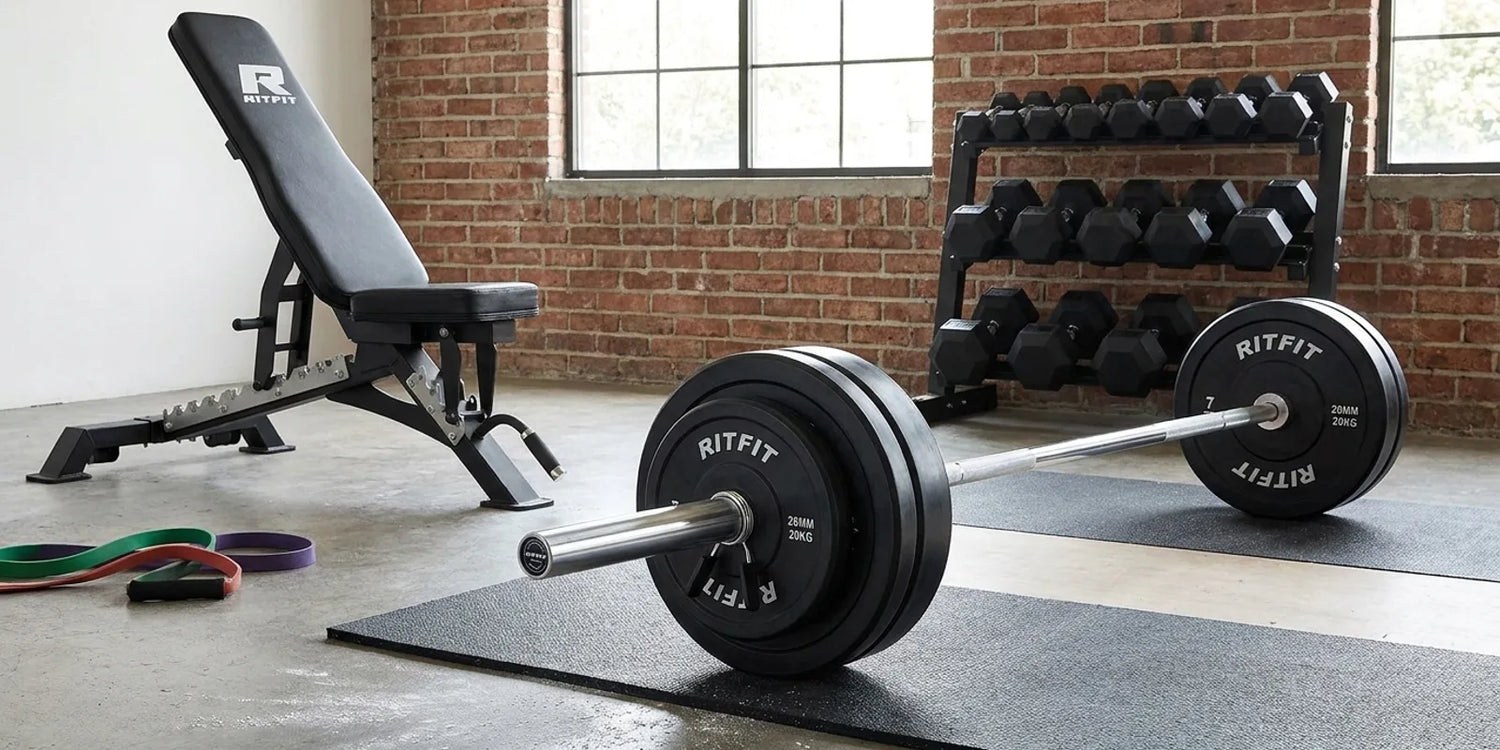
A 7 ft barbell is the men's standard Olympic bar: about 20 kg (44 lb), roughly 86.5 inches end to end, with a 28 mm shaft and 50 mm rotating sleeves. Those numbers decide what plates fit, which rack it suits, and how the bar feels under load.
This guide answers the questions shoppers ask first: how much a 7 ft barbell weighs, how long it really measures, whether it fits your rack and bench, and how a 7 ft Olympic bar differs from a 7 ft standard bar. Specs, capacity, and buying advice follow.
Quick Answer: A 7 ft barbell is a 20 kg (44 lb) Olympic bar about 86.5 inches long, with a 28 mm shaft and 50 mm rotating sleeves. It takes 2 inch Olympic plates, fits a standard 48 inch power rack, and versions sold as 7 ft standard use 1 inch sleeves and usually weigh less.
Key Takeaways
- Weight: A men's 7 ft Olympic barbell weighs about 20 kg, which is 44 lb, while a 15 kg women's Olympic bar weighs about 33 lb.
- Length: The 7 ft label is a category name, and a men's Olympic bar actually measures about 86.5 inches (220 cm) end to end.
- Rack fit: A 7 ft bar fits a standard 48 inch rack, sits on a competition width bench, and needs roughly 10 ft of clear floor with plates loaded.
- Sleeve size: Olympic bars use 50 mm (2 inch) sleeves for 2 inch plates, while standard bars use 25 mm (1 inch) sleeves and take 1 inch plates.
- Capacity is separate from weight: Most 7 ft Olympic bars are rated from 1000 to 2000 lb of load, far above what a home lifter will ever put on the bar.
- Best all-rounder: One 7 ft Olympic bar covers squats, presses, deadlifts, and Olympic lifts, which is why it is the default first bar for a home gym.
What Is a 7 Ft Barbell? Weight, Length, and Sleeve Size
A 7 ft barbell is a barbell built to the men's Olympic bar standard, and that standard fixes its weight, length, and sleeve diameter. The men's bar weighs 20 kg, runs a little over 7 feet end to end, and uses 50 mm sleeves that accept the same 2 inch plates found in most commercial gyms.
- One bar, every lift: A 7 ft bar handles back squats, bench presses, deadlifts, overhead presses, barbell rows, and Olympic lifts such as the snatch and clean, so you do not need a separate bar for each movement.
- Universal plates: The 50 mm sleeves accept standard 2 inch Olympic plates, the same plates used in most commercial and home gyms, so the bar plays well with plates, bumpers, and collars from any brand.
- Resistance training payoff: An ACSM overview of reviews found that resistance training improves strength, hypertrophy, power, and physical function versus no exercise, with strength enhanced by heavier loads (about 80% of 1RM and above), full range of motion, 2 to 3 sets, and at least 2 sessions per week [1].
A 7 ft bar belongs in any home gym built around a power rack or squat stand, because it gives you the full range of compound movements that drive progress. If you are still equipping your space, start by reviewing our barbells and the wider range of strength training gear in the Olympic barbells collection.
How Much Does a 7 Ft Barbell Weigh?
A 7 ft Olympic barbell made for men weighs about 20 kg, which rounds to 44 lb. A women's Olympic bar weighs 15 kg (about 33 lb) and is shorter, while a 7 ft standard barbell with 1 inch sleeves is built for lighter loads and usually weighs less than a 20 kg Olympic bar.
| Bar type | Sleeve diameter | Typical bar weight | Plates it takes |
|---|---|---|---|
| Men's 7 ft Olympic barbell | 50 mm (2 in) | 20 kg (about 44 lb) | 2 inch Olympic plates |
| Women's Olympic barbell | 50 mm (2 in) | 15 kg (about 33 lb) | 2 inch Olympic plates |
| 7 ft standard barbell | 25 mm (1 in) | Lighter than a 20 kg Olympic bar, varies by model | 1 inch standard plates |
| RitFit 7FT Olympic Barbell | 2 in | About 20 kg (45 lb) | 2 inch Olympic plates |
Men's and women's Olympic bar weights follow the standard bar specifications used across the industry, and the RitFit 7FT Olympic Barbell states about 20 kg with 500, 700, and 1000 lb capacity options.
- Bar weight counts toward your load: A 20 kg bar is 44 lb before you add anything, so a pair of 45 lb plates puts 134 lb on the bar.
- Standard bars sit at the lighter end: A 7 ft standard bar with 1 inch sleeves is built for lighter work, so it is usually the lighter of the two bars.
- Weight is not capacity: How heavy the bar is and how much it can hold are two different numbers, and the second one is much larger.
Check the spec sheet for the exact figure on any bar you are considering, because two bars sold as 7 ft can differ by several pounds. If your plates have 2 inch holes, the barbells and weight plates collection shows the sleeves and plates that pair together.
How Long Is a 7 Ft Barbell in Inches and Centimeters?
A barbell sold as 7 ft measures about 86.5 inches (220 cm) from end to end, even though 7 ft is exactly 84 inches (213 cm). The label is a category name rather than a tape measurement, and the real length includes the sleeves that carry the plates.
- Nominal label: 7 ft is the name shoppers use, and it equals 84 inches or 213 cm.
- Measured length: A men's Olympic bar runs about 86.5 inches (220 cm) overall, which is a little over 7 ft.
- Shaft between the sleeves: Roughly 52 inches, and this is the part that has to clear your rack uprights.
- Loadable sleeve: About 16 inches on each side, which sets how many plates you can stack.
So a 7 ft barbell is longer than its name suggests, and that difference matters when you measure a wall or a rack before ordering. Our 7ft Olympic barbell guide walks through the same dimensions on a specific bar.
7 Ft vs 6 Ft vs 8 Ft Barbell: Which Length Fits Your Gym?
A 7 ft barbell is the default for a home gym because it fits a standard 48 inch rack, sits on a competition width bench, and leaves enough sleeve length to load heavy. Drop to a 6 ft bar only if your rack is narrower than 48 inches or your room is very tight.
| Bar length | Rack width it suits | Loadable sleeve | Who it suits |
|---|---|---|---|
| 6 ft | Narrow racks, around 36 in | Shorter, so fewer plates per side | Tight rooms and lighter loads |
| 7 ft | Standard 48 in racks | About 16 in each side | Squats, presses, deadlifts, and Olympic lifts |
| 8 ft and longer specialty bars | Depends on the bar | Depends on the bar | Lifters whose room and rack already handle a 7 ft bar |
Rack widths and sleeve dimensions reflect the standard men's Olympic bar sizing described in industry barbell buying guides.
- Bench fit: A 7 ft bar rests on a standard bench with the sleeves clear of the frame, so your hands land inside the uprights where they should.
- Floor space: Allow about 10 ft of clear floor for the bar plus loaded plates, which is the number most garages run short on.
- 6 ft trade-off: A shorter bar is easier to fit, but its shorter sleeves hold fewer plates per side and it suits lighter work.
- Going longer: An 8 ft bar adds length you have to walk around, so it only makes sense once a 7 ft bar already fits with room to spare.
For most home gyms the 7 ft bar is the right call, because it keeps your rack, plates, and bench on standard sizing as your training progresses.
7 Ft Olympic Barbell vs 7 Ft Standard Barbell
A 7 ft Olympic barbell and a 7 ft standard barbell are the same length but not the same bar. The Olympic bar has 50 mm (2 inch) sleeves for 2 inch plates and is built for heavy compound lifts, while the standard bar has 25 mm (1 inch) sleeves for 1 inch plates and suits lighter loads.
| Feature | 7 ft Olympic barbell | 7 ft standard barbell |
|---|---|---|
| Sleeve diameter | 50 mm (2 in) | 25 mm (1 in) |
| Plates it takes | 2 inch Olympic plates and bumper plates | 1 inch standard plates |
| Typical bar weight | About 20 kg (44 lb) on a men's bar | Usually lighter, varies by model |
| Typical shaft | 28 mm to 29 mm with Olympic and powerlifting marks | Thinner shaft, usually without competition marks |
| Best for | Squats, presses, deadlifts, and Olympic lifts | Light presses, curls, and beginner sets |
Olympic and standard bar dimensions follow the sleeve and plate sizes used across the industry.
- Plates decide the bar: If your plates have 2 inch holes you need an Olympic bar, and if they have 1 inch holes you need a standard bar.
- Collars do not cross over: An Olympic collar will not hold a 1 inch plate securely, so match collars to the bar rather than to the plate stack.
- Buy for the next year: If bumpers or heavy squats are in your plans, an Olympic bar saves you from replacing a standard bar later.
Most home gyms end up on the Olympic standard, because it opens up the widest range of plates, bumpers, and attachments. If you are unsure which bar you already own, measure the sleeve: 2 inches means Olympic and 1 inch means standard.
7 Ft Barbell Specifications: Weight, Length, and Sleeves
A men's 7 ft Olympic barbell weighs 20 kg (44 to 45 lb), runs about 7.2 ft long with a 28 mm shaft, and carries rotating 50 mm (2 inch) sleeves. Every number on the spec sheet exists to tell you how stiff, grippy, and durable the bar is under load.
| Spec | Men's 7 Ft Bar | Women's Olympic Bar |
|---|---|---|
| Weight | 20 kg (44 to 45 lb) | 15 kg (about 33 lb) |
| Length | About 7.2 ft (86.5 in) | About 6.6 ft |
| Shaft diameter | 28 mm | 25 mm |
| Sleeve diameter | 50 mm (2 in) | 50 mm (2 in) |
Men's and women's Olympic bar dimensions as commonly specified across the industry and in barbell buying guides.
Because both bar sizes use the same 50 mm sleeves, your plates, bumpers, and collars carry over no matter which bar you choose.
Most home lifters start with the men's 20 kg bar, while the lighter women's bar suits lifters with smaller hands or those doing high-volume Olympic work. If you are comparing options, the RitFit 7FT Olympic Barbell is a solid all-purpose starting point, and our guide to the best Olympic barbell for women covers the lighter bar in depth.
Shaft Diameter and Whip: 28 mm vs 28.5 mm vs 29 mm
Shaft diameter sets how stiff a 7 ft barbell feels and how much it flexes under load, which lifting coaches call whip. A 28 mm shaft is the men's weightlifting standard with more flex, 28.5 mm is the all-purpose middle ground, and a stiffer 29 mm shaft is the powerlifting standard preferred for heavy squats and bench presses.
- 28 mm: The IWF men's weightlifting standard; more whip helps time snatches and cleans.
- 28.5 mm: The all-purpose Goldilocks diameter, thick enough for heavy squats and bench yet thin enough for a secure deadlift grip.
- 29 mm: The IPF powerlifting standard; maximum stiffness and less whip, ideal for heavy squats and bench but slightly harder to grip on high-rep deadlifts.
A 28.5 mm shaft is the best single-bar compromise because it supports every lift competently.
If you exclusively powerlift, consider a 29 mm bar; if you focus on Olympic lifting, a 28 mm bar gives you the whip you want.
A 2024 study found that a traditional Olympic barbell and a safety squat bar produced similar peak force and perceived exertion during high-intensity back squats, with the Olympic barbell allowing slightly higher average velocity [2].
The standard bar length is a little over 7 feet, has '2-inch'/50mm diameter sleeves for loading the plates on, and weighs 20kg/44.1lbs. For home gym purposes, a 28.5 or 29mm bar will be the most durable and provide the best service over time.
Mark Rippetoe, Strength Coach and Author of Starting Strength, How to Build a Home Gym
Sleeves, Knurling, and Finish: What Matters for Grip and Spin
Sleeve spin, knurling, and finish determine how the bar feels on fast lifts and how it survives years of heavy training. Bushing sleeves offer simpler, durable rotation favored for powerlifting, while needle bearings spin faster and smoother for Olympic lifts.
- Spin: Needle bearings provide faster, smoother rotation favored in the snatch and clean and jerk; bronze bushings are simpler, quieter, and favored for powerlifting and general strength training.
- Knurling: Knurling is the textured crosshatch grip pattern on the shaft; a medium knurl suits general training, while a more aggressive knurl helps heavy pulls but can feel sharp during high-rep work.
- Finish: Durable coatings such as black zinc, cerakote, or stainless steel resist rust and hold up better in humid garages than cheaper painted or chrome finishes.
For a single-bar home gym, look for medium knurling with dual Olympic and powerlifting marks so you can bench and squat in the correct positions, plus a rust-resistant finish. Collars keep plates from sliding off the sleeves, so pick up a pair of Olympic barbell clamps from the barbell accessories collection when you order your bar.
How Much Weight Can a 7 Ft Barbell Hold
Most 7 ft Olympic barbells are rated from 1000 to 2000 lb of static load before permanent bending, which is far above what almost any home lifter will ever load. That means a mid-range rating is more than enough for home use, so you do not need to chase the highest capacity number.
- Rating meaning: Capacity is the static load a bar can hold before permanent bending, not what you should routinely squat.
- Home reality: Even strong recreational lifters rarely exceed 400 to 500 lb on a loaded bar, so a 1000 lb rating leaves a massive safety margin.
- What matters more: Finish and warranty protect your investment longer than a headline capacity figure you will never approach.
If you plan to lift very heavy for years, a bar rated near the top of the range gives you peace of mind and headroom for growth. A bar stand keeps the loaded bar off the floor and protects the sleeves, which is why many home gyms add a barbell stand alongside the bar.
Will a 7 Ft Barbell Fit Your Rack and Space
Yes, a 7 ft bar fits a standard 48 inch wide power rack, because it has about a 52 inch span between the sleeves, leaving the sleeves just outside the uprights. Measure your rack width first, then confirm you have a few extra inches of clearance on each side to load plates and add collars.
- Rack width: A 48 inch rack pairs with a 7 ft bar; a narrower 36 inch rack may suit a shorter bar better.
- Sleeve length: Each loadable sleeve is about 16 inches, which sets how many plates you can stack per side.
- Room size: You need the bar length plus room to move; allow roughly 10 ft of clear floor space for a 7 ft bar and loaded plates.
- Guided alternative: If your room cannot take a 7 ft bar plus plate clearance, a guided machine keeps the bar path fixed inside a smaller footprint.
If your rack is narrower than 48 inches or your room is very tight, a 6 ft bar may fit better, but it suits lighter loads only. For most home setups the 7 ft bar is the right choice because it keeps your rack and bar purchase future-proof as your training progresses.
The video below shows one garage gym example of a guided bar path for a tight space.
Choosing the Best 7 Ft Barbell for Your Goals
Pick the bar that matches your training style, not the most expensive one. Within the RitFit line, a general-purpose 7 ft Olympic bar with a 28.5 mm shaft and rotating sleeves is the best all-rounder, while heavier-duty capacity options suit lifters who push high loads and want extra headroom.
| Lifter Profile | Recommended RitFit Bar | Why |
|---|---|---|
| First bar for general strength | RitFit 7FT Olympic Barbell | One bar covers squats, presses, rows, and deadlifts with a standard 28 mm shaft and rotating sleeves. |
| Heavy squats and deadlifts | RitFit 7FT higher-capacity option | Extra capacity rating gives headroom for progressive overload without bending. |
| Olympic lifting focus | RitFit 7FT Olympic Barbell | Rotating sleeves support the snatch and clean and jerk alongside strength work. |
Recommendations stay within the RitFit barbell product line so any choice pairs correctly with your rack, plates, and collars.
Adding a band loop above the knees during barbell squats can increase gluteus medius activation without altering squat depth or knee kinematics [3], a useful accessory trick once your bar and rack are in place. If you want to see the bar in action, watch how the RitFit training barbell is used in the video below.
Is a 7 Ft Barbell Worth the Investment
A quality 7 ft Olympic barbell is one of the best value purchases in a home gym because one bar unlocks the full range of compound lifts, and a durable bar lasts for years with simple maintenance. It is worth buying well once rather than replacing a cheap bar that rusts or bends.
- Cost per use: A mid-range bar used for multiple lifts a week amortizes to pennies per workout over several years.
- Long-term savings: A sturdy bar with a rust-resistant finish avoids the replacement cycle of budget bars.
- Pair with basics: The bar works with plates, bumpers, and collars you already own or add over time, so it does not lock you into a brand.
If you are starting out, a quality 7 ft bar plus a pair of clamps is the strongest first purchase, and you can add specialty bars, bumpers, and a rack later as your training grows. The RitFit 7FT Olympic Barbell sits squarely in this value sweet spot for most home gyms.
"Great quality barbell. First time building a home gym and I think this was worth adding when I purchased my rack from RitFit."
Caitlyn L. Verified Buyer, RitFit 7FT Olympic Barbell Bar 2'' Weight Lifting Bar
Common Mistakes When Buying a 7 Ft Barbell
The most common buying mistakes are overpaying for capacity you will never use, choosing the wrong shaft diameter for your lifts, and ignoring the finish that determines how long the bar lasts. Avoiding these three errors gets you the right bar the first time.
- Chasing the capacity number: A 1000 lb rating already covers home use; paying extra for 2000 lb buys nothing you will feel.
- Wrong shaft for your style: A 29 mm power bar feels stiff and grippy for heavy squats but is harder to hold on high-rep deadlifts; a 28 mm bar whips more for Olympic lifts.
- Ignoring finish and spin: Cheap painted bars rust in garages and stiff sleeves reduce spin, hurting fast lifts over time.
- Skipping collars: Training without clamps risks plates sliding off the sleeves on overhead and dynamic lifts.
- Buying the wrong sleeve size: A 1 inch bar will not take 2 inch Olympic plates, so check your plate holes before you order.
Also avoid assuming a 7 ft bar fits every rack. Always measure your rack width before ordering, and pair the bar with the right clips for barbell so your plates stay locked in place during every set.
How to Maintain Your 7 Ft Barbell
Basic maintenance keeps a 7 ft barbell smooth and rust-free for years: wipe the bar down after sessions, oil the sleeves occasionally, and store it off the floor. A few minutes of care protects your investment and keeps the sleeves spinning freely.
- Wipe down: Sweat and chalk corrode steel, so wipe the shaft and sleeves dry after each workout.
- Oil the sleeves: A light coat of bar oil or 3-in-1 on the sleeve bushings keeps rotation smooth.
- Store properly: Keep the bar on a stand or rack, off concrete and away from damp walls.
- Watch the knurl: A little chalk is fine, but avoid leaving the bar wet or dirty where moisture collects.
With simple care, a good 7 ft bar lasts a decade or more. If you are also refining your technique, our guides on the barbell row form, the barbell snatch, and barbell squat vs hack squat help you get the most from the bar you buy.
FAQs About 7 Ft Barbells
What is the standard weight and length of a 7 ft barbell?
A men's 7 ft Olympic barbell weighs 20 kg, about 44 to 45 lb, and runs roughly 7.2 ft or 86.5 inches end to end. It has a 28 mm shaft and rotating 50 mm sleeves. The women's bar is 15 kg with a thinner 25 mm shaft and a shorter length.
Will a 7 ft barbell fit my power rack?
Usually yes.
A 7 ft bar has about a 52 inch span between the sleeves, so it fits a standard 48 inch wide rack with the sleeves resting just outside the uprights.
Measure your rack width first, then leave a few inches of clearance on each side for loading plates and adding collars.
How much weight can a 7 ft barbell hold?
Capacity is the static load a bar can handle before permanent bending, and most Olympic bars are rated from 1000 to 2000 lb. That is far above what most home lifters ever load, so a mid-range rating is plenty for home use. Prioritize finish and warranty over a huge headline number.
What shaft diameter should I choose for a 7 ft barbell?
Match the shaft to your lifts. A 28 mm shaft is the men's weightlifting standard with more whip, a 28.5 mm all-purpose diameter suits most home lifters, and a stiffer 29 mm power bar suits heavy squats and bench. Avoid 32 mm specialty squat bars unless you specifically need one.
Do I need collars for a 7 ft barbell?
Yes, collars keep the plates from sliding off the sleeves during lifts, which protects you and your floor.
They also stop plates shifting when the bar is stored.
A pair of quality Olympic clamps is a small investment that makes any barbell safer and easier to train with.
Is a 7 ft barbell better than a 6 ft barbell?
For most home gyms yes.
A 7 ft bar fits standard 48 inch racks and handles every major lift including squats, presses, and deadlifts.
A 6 ft bar only makes sense if your rack is narrower than 48 inches or your room is very tight, but it suits lighter loads only.
What is the difference between a 7 ft Olympic barbell and a 7 ft standard barbell?
Sleeve diameter is the difference. A 7 ft Olympic barbell has 50 mm or 2 inch sleeves that take Olympic plates and bumper plates, while a 7 ft standard barbell has 25 mm or 1 inch sleeves that take 1 inch plates. Olympic bars are heavier and rated for heavier loads.
Can a 7 ft barbell fit on a standard bench press?
Yes. A 7 ft bar is about 52 inches between the sleeves, and most bench press uprights sit inside that span, so the bar rests on the rack with the sleeves clear of the frame. Your hands still land inside the uprights where they need to be.
Conclusion
A 7 ft barbell is the most versatile single strength tool you can own, combining a 20 kg (44 to 45 lb) Olympic bar with a 28 mm shaft and rotating 50 mm sleeves. Choose a 28.5 mm all-purpose shaft for most setups, confirm your rack is 48 inches wide, and pair the bar with quality collars.
Start with a quality 7 ft bar plus a pair of clamps, then add plates, bumpers, and a rack as your training grows. Explore the full range of barbells and strength gear at https://www.ritfitsports.com/pages/ritfit-sales.
Disclaimer
Barbell specifications and capacity ratings are provided for general information and vary by model and manufacturer. Always follow the manufacturer's load guidance and inspect your equipment regularly.
References
1. Currier BS, D'Souza AC, Fiatarone Singh MA, et al. American College of Sports Medicine Position Stand. Resistance Training Prescription for Muscle Function, Hypertrophy, and Physical Performance in Healthy Adults: An Overview of Reviews. Med Sci Sports Exerc. 2026;58(4):851-872. PMCID: PMC12965823
2. Staheli N, Cowley JC, Lawrence MM. Comparison of Olympic and Safety Squat Bar Barbells on Force, Velocity, and Rating of Perceived Exertion During Acute High-Intensity Back Squats in Recreationally Trained Men. Int J Exerc Sci. 2024;17(7):1120-1133. PMCID: PMC11385282
3. Foley RCA, Bulbrook BD, Button DC, Holmes MWR. Effects of a Band Loop on Lower Extremity Muscle Activity and Kinematics During the Barbell Squat. Int J Sports Phys Ther. 2017;12(4):550-559. PMCID: PMC5534145