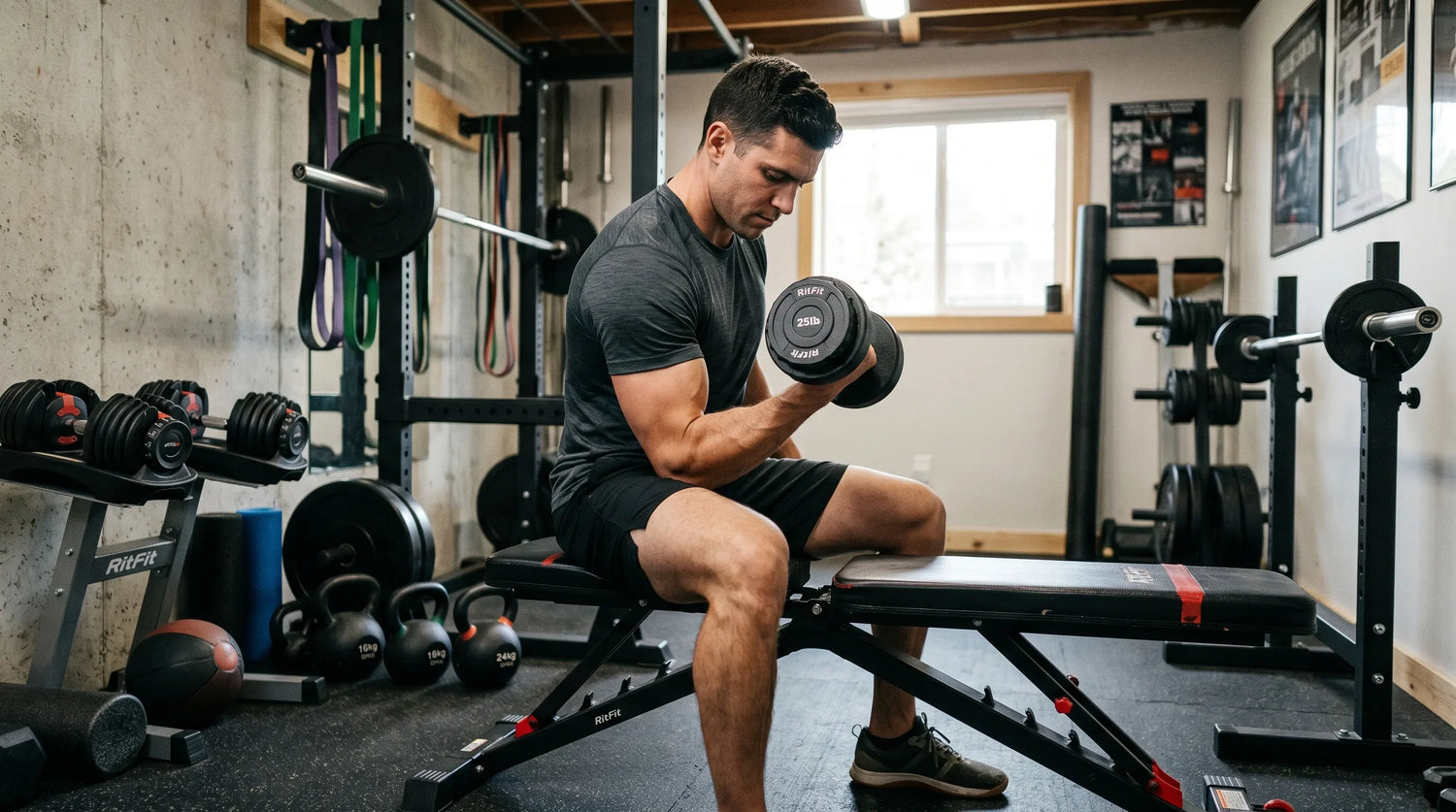
The average bicep curl for men is about 103 lb on a barbell and about 52 lb per dumbbell for a one-rep max, based on community-reported lifting data. These numbers describe an intermediate lifter, not a beginner.
Updated for 2026, this guide breaks down average curl weights by experience level, explains why barbell and dumbbell numbers differ, and shows the form and training factors that move them. Use it to set realistic goals, not to judge yourself.
Table of Contents
Key Takeaways
- Average male barbell curl: Around 103 lb for a one-rep max, which Strength Level rates as intermediate.
- Average male dumbbell curl: Around 52 lb per dumbbell for a one-rep max, also intermediate.
- Beginners start lower: About 38 lb on a barbell and about 14 lb per dumbbell is a realistic starting target.
- Barbell numbers look bigger: A barbell loads both arms at once, so the total moves far more weight than one dumbbell.
- Form beats ego: Strict tempo and full range of motion build the biceps better than heavier weight with swing.
What Is the Average Bicep Curl Weight for Men
The average bicep curl for a man depends on the tool and the rep target. For a single hard effort, community data points to roughly 103 lb on a barbell and 52 lb per dumbbell.
- Barbell one-rep max: According to Strength Level, the average male barbell curl is about 103 lb, or 47 kg.
- Dumbbell one-rep max: Strength Level lists the average male dumbbell curl at about 52 lb, or 23 kg, per dumbbell.
- Working sets matter more: Critical Body estimates that for sets of 8 to 10 reps a regular lifter curls about 80 lb on a barbell and about 35 lb per dumbbell.
These figures come from aggregated user logs, not a laboratory, so treat them as a reference range rather than a fixed rule. Standards are commonly tabulated across body weights from about 110 lb to 270 lb.
Average Curl Weight by Experience Level
Curl strength climbs steadily with training age. Strength Level groups lifters into five tiers based on how many people they out-curl.
- Beginner: Stronger than about 5% of lifters, roughly 38 lb barbell or 14 lb per dumbbell, after about 1 month of practice.
- Intermediate: Stronger than about 50% of lifters, near the 103 lb barbell average, usually after at least 2 years of regular training.
- Advanced and elite: The top tiers belong to lifters who have curled consistently for many years with progressive overload.
If you are early in your training, aim for the beginner band first. A jump from 14 lb to 23 kg per dumbbell can take years of steady work.
| Level | Barbell Curl 1RM | Dumbbell Curl 1RM |
|---|---|---|
| Beginner | About 38 lb, 17 kg | About 14 lb, 6 kg |
| Intermediate, average | About 103 lb, 47 kg | About 52 lb, 23 kg |
Barbell vs Dumbbell Curl, Why the Numbers Differ
A barbell number always looks much larger than a dumbbell number. That gap is mostly math, not a sign that one tool is superior.
- Both arms share the load: FitnessVolt competition data indicates the average intermediate barbell curl is about 198% of the dumbbell curl, because the bar loads both arms together.
- The bar has weight too: An Olympic barbell normally weighs 20 kg, or 44 lb, which is already counted inside the barbell standard.
- Similar muscle reward: A study comparing cable and barbell preacher curls found similar biceps thickness gains, with the barbell adding strength mainly at the extended elbow position.[1]
Surface EMG research found a straight barbell produced slightly greater biceps activation than an EZ barbell, and that switching tools varies the stimulus.[2] If you want to see this in practice, compare cable curls versus dumbbell curls for the trade-offs.
Form Factors That Change Your Curl Numbers
Your curl weight reflects technique as much as raw strength. Cleaning up form often unlocks more usable load than chasing a heavier dumbbell.
- Control the lowering phase: Research on elbow flexors found a slower eccentric tempo produced larger one-rep max gains than a faster tempo.[3]
- Pin your elbows: Swinging recruits the shoulders and lower back, which inflates the number but starves the biceps.
- Use a full range: Open the arm fully at the bottom and squeeze at the top to load the muscle through its whole stroke.
For a step-by-step breakdown, see our guide on how to do a dumbbell bicep curl. Adding a hammer curl also trains the brachialis underneath the biceps.
How to Build a Stronger Curl at Home
Progress comes from consistent overload, not from testing a max every week. The right equipment makes that progression simple.
- Train in the 8 to 12 range: Pick a load you can curl for 8 to 12 strict reps, then add weight once you pass the top of that range.
- Scale your load easily: A set of adjustable dumbbells lets you nudge the weight up in small steps as you grow.
- Isolate with support: A RitFit Preacher Curl Pad removes momentum and keeps tension on the biceps.
If you train with a bar, a quality barbell for your home gym pairs well with a complete free weight set for a home gym.
FAQs About Average Bicep Curl for Men
What is a good bicep curl weight for the average man?
A good benchmark for the average man is about 103 lb on a barbell and about 52 lb per dumbbell for a single hard rep, based on community data. These figures sit at the intermediate level. Beginners curling near 38 lb on a barbell are still making solid progress.
How much should a beginner man curl?
A beginner man can aim for about 38 lb on a barbell or about 14 lb per dumbbell, according to Strength Level. Start lighter if your form breaks down. The goal in the first month is clean technique and full range of motion, not a heavy number on the bar.
Why is my barbell curl so much heavier than my dumbbell curl?
A barbell loads both arms at the same time, so the total weight is naturally far higher. FitnessVolt data puts the average barbell curl near 198% of the dumbbell curl. A single dumbbell only challenges one arm, which is why each number looks so different.
Is a dumbbell or barbell better for bigger biceps?
Both build the biceps well. Research comparing cable and barbell preacher curls found similar muscle thickness gains across tools. Dumbbells fix side to side imbalances and allow wrist rotation, while a barbell lets you load more total weight. Many lifters rotate both for variety.
How do I increase my bicep curl weight safely?
Train in the 8 to 12 rep range with strict form, then add a small amount of weight once you clear the top of that range. Control the lowering phase, keep your elbows pinned, and progress gradually. Adjustable dumbbells make these small jumps easy to manage.
Does curling heavier always build more muscle?
No. Lifting too heavy usually adds swing and shortens your range of motion, which reduces tension on the biceps. Muscles respond to controlled tension, not momentum. A lighter weight curled with full range and a slow lowering phase often stimulates more growth than a jerky heavy lift.
How does body weight affect average curl numbers?
Heavier lifters tend to curl more in absolute terms. Standards are commonly tabulated across body weights from about 110 lb to 270 lb, and the averages rise as body weight climbs. Comparing yourself within your own weight class gives a fairer picture than a single global average.
How often should men train biceps to improve curls?
Most men progress well training biceps two times per week with a day of rest between sessions. Direct curl work paired with pulling movements is usually enough. Recovery matters as much as effort, so avoid daily heavy curls and let the muscle rebuild between hard sessions.
Should I count the bar weight in my curl number?
Yes. An Olympic barbell normally weighs 20 kg, or 44 lb, and that weight is already included in published barbell curl standards. When you log your curl, add the bar plus the plates. This keeps your numbers consistent with the reference tables you compare against.
Conclusion
The average bicep curl for men lands near 103 lb on a barbell and 52 lb per dumbbell, but those are intermediate reference points, not pass or fail lines. Where you start matters less than how consistently you progress.
Focus on strict form, train in the 8 to 12 rep range, and add weight in small steps. If you are new, build toward the beginner band first and let strength accumulate over months and years.
Disclaimer
This article is for general information and education only, and the curl figures cited come from community-reported data that may not reflect your individual capacity. Consult a qualified coach or healthcare professional before starting a new training program, especially if you have any injury or medical condition.
References
- Nunes JP, Jacinto JL, Ribeiro AS, et al. Placing Greater Torque at Shorter or Longer Muscle Lengths? Effects of Cable vs. Barbell Preacher Curl Training on Muscular Strength and Hypertrophy in Young Adults. International Journal of Environmental Research and Public Health. 2020;17(16). https://pmc.ncbi.nlm.nih.gov/articles/PMC7460162/
- Coratella G, Tornatore G, Longo S, Esposito F, Cè E. Bilateral Biceps Curl Shows Distinct Biceps Brachii and Anterior Deltoid Excitation Comparing Straight vs. EZ Barbell Coupled with Arms Flexion/No-Flexion. Journal of Functional Morphology and Kinesiology. 2023;8(1). https://pmc.ncbi.nlm.nih.gov/articles/PMC9944112/
- Kojić F, Ranisavljev I, Ćosić D, et al. Effects of resistance training on hypertrophy, strength and tensiomyography parameters of elbow flexors: role of eccentric phase duration. Biology of Sport. 2021;38(4):587-594. https://pmc.ncbi.nlm.nih.gov/articles/PMC8670796/