








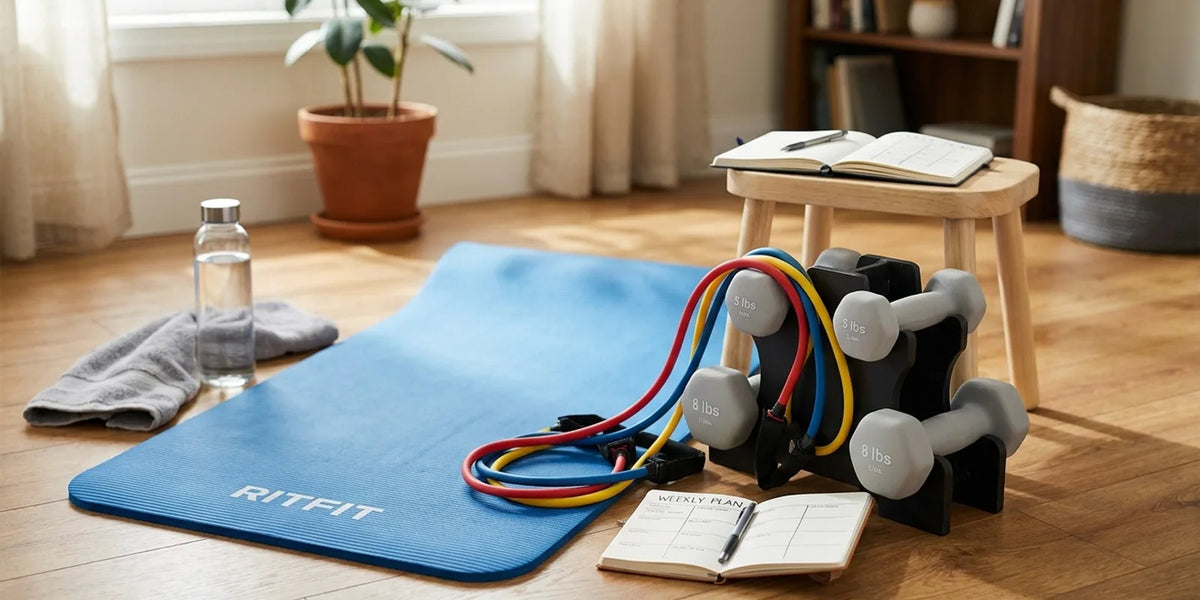
A beginner resistance training workout plan is a structured weekly schedule of strength exercises that builds muscle, strength, and confidence through progressive overload. This 7-day plan gives complete beginners a simple home routine they can follow without guesswork.
It covers three full-body resistance sessions, active recovery days, rest days, weight selection, progression, and substitutions. Follow it with light-to-moderate dumbbells, bands, or bodyweight, and scale any exercise to your level.
Quick Answer: A beginner resistance training 7-day workout plan combines three full-body resistance sessions with active recovery and rest days to build strength safely at home. New lifters train two to three times weekly on nonconsecutive days, using 8-12 repetitions per set, and increase weight only when all reps stay controlled.
Key Takeaways
- Three sessions a week: Beginners build strength best with two to three resistance sessions on nonconsecutive days.
- 8-12 repetitions: A moderate rep range teaches form and drives early strength and muscle gains.
- Progressive overload: Add small amounts of weight only when every rep stays controlled and clean.
- Recovery matters: Rest days are where muscles repair and adapt, so plan them into the week.
- Form beats load: Master movement quality first, then increase the weight gradually.
What Is a Beginner Resistance Training Workout Plan?
A beginner resistance training workout plan is a set weekly structure that uses bodyweight, bands, or weights to challenge your muscles under load. It works every major muscle group two to three times weekly so new lifters learn patterns while building a foundation.
Structured home-based resistance training is an effective and safe way for adults to maintain functional strength without a commercial gym membership [1]. A well designed plan removes the two biggest beginner barriers: deciding what to do and deciding how much to do.
- Training load: Light-to-moderate weight or bands that let you finish every rep with good form.
- Exercise selection: Compound movements like squats, push-ups, rows, and hinges that train multiple muscles at once.
- Structure: Full body sessions repeated across the week with rest days between them.
The goal is consistency over intensity. A simple plan you actually follow beats a perfect plan you skip, so start with the movements below and scale them to your current level.
If you want a version built around a different starting point, see our Beginner Workout Plan For Females.
The 7-Day Beginner Resistance Training Workout Plan for Home
The 7-day beginner resistance training workout plan for home uses three full body sessions with active recovery and rest days in between. Each session takes about 30-40 minutes and needs only a pair of dumbbells, a resistance band, and enough floor space for a mat.
A pilot study found that twice-weekly home-based resistance training improved physical fitness and well-being over eight weeks in middle-aged adults [2]. The schedule below mirrors that sustainable cadence for complete beginners, and pairs well with best full body circuit training workouts for beginners if you want variety.
| Day | Session | Exercise and sets |
|---|---|---|
| 1 | Full Body A | Bodyweight squat 3x10, knee push-up 3x8, reverse lunge 3x8 per leg, dumbbell row 3x10, glute bridge 3x12, plank 3x20 seconds |
| 2 | Active recovery | 20-30 minute walk, light stretching, optional |
| 3 | Full Body B | Goblet squat 3x10, incline push-up 3x8, band row 3x12, light Romanian deadlift 3x10, side plank 3x20 seconds per side |
| 4 | Rest | Full recovery day, no structured training |
| 5 | Full Body C | Dumbbell bench press 3x10, band pull-apart 3x12, step-up 3x8 per leg, standing calf raise 3x15, dead bug 3x8 per side |
| 6 | Active recovery | 30 minute brisk walk or light cardio, optional |
| 7 | Rest | Full rest day for sleep and recovery |
This schedule uses three resistance sessions and four recovery-oriented days for a beginner-friendly weekly volume.
Warm up for five to ten minutes before each session with light cardio and dynamic stretches. Rest 60-90 seconds between sets, and keep every rep smooth and controlled rather than rushed.
How Many Days a Week Should Beginners Train?
Beginners should train resistance two to three days per week on nonconsecutive days, which gives muscles time to recover while building a consistent habit. The CDC recommends adults get at least 2.5 hours of moderate physical activity weekly and two days of strength training.
Three full body sessions spread across the week is the sweet spot for new lifters because every session hits all major muscles. Training the same muscles back to back limits recovery, so place at least one rest day between resistance sessions.
- Two sessions: A minimum baseline that still drives early strength and coordination gains.
- Three sessions: The best balance of frequency and recovery for most beginners.
- Four or more: Usually unnecessary early on and harder to sustain while learning form.
If you feel too sore or tired, drop to two sessions and add walking on off days.
For a more intense cardio option on recovery days, try our best HIIT workouts for beginners. Consistency across weeks matters far more than extra sessions in a single week.
How Much Weight Should a Beginner Use?
Choose a weight that lets you finish all reps with good form while the last two to three reps feel challenging but controllable. For dumbbells, start around 5-10 percent of your body weight per hand and adjust from there.
Network meta-analysis found that loads at or above roughly 60 percent of one-rep max drive greater strength gains, while hypertrophy is similar across a wide load range when sets reach near failure [3]. For a beginner, that translates to a weight you can lift cleanly for 8-12 reps.
- Light start: Begin lighter than you think and focus on movement quality first.
- Test sets: If the last two reps feel easy, go up one small increment next session.
- Bands as an option: Resistance Bands offer adjustable tension and a gentle way to learn each pattern.
Feeling some effort in the final reps is normal, but never sacrifice form to move more weight. A clean rep with a lighter load builds more progress than a sloppy one with a heavy load.
When Should a Beginner Increase Weight?
Increase weight when you can complete every set and repetition with clean form and the last two to three reps no longer feel challenging. Add small increments of 2-5 percent, or roughly 1-2 kg with dumbbells, rather than jumping up in big steps.
Progressive overload is what keeps strength gains coming, because muscles adapt to a fixed load within a few weeks. The simplest rule is to master the rep range first, then raise the weight and drop back to the low end of the range.
- Master form: Only progress a movement you can perform with full control.
- Small steps: A tiny increase you can handle beats a big jump you cannot.
- Repeated attempts: If you cannot finish the reps, keep the current weight one more session.
Once three weekly sessions feel routine, you can advance to more days or a dedicated split like our 4 Day Split Workout Routine. Progress is measured in weeks, not single workouts, so stay patient.
Easy Substitutions When Equipment Is Limited
Every exercise in this plan has a bodyweight, band, or household substitute so a lack of equipment never stops a session. Choose a harder variation as you improve or a lighter one on low-energy days, and swap freely between dumbbells and bands.
The goal is to keep the movement pattern and muscle focus the same, not to match the exact tool. A soup can works for a light row, a filled backpack for a goblet squat, and a towel for a band row when you are away from your gear.
- No dumbbells: Use resistance bands, filled water bottles, or a backpack with books.
- No bench: Do floor presses, glute bridges, and step-ups on a sturdy chair.
- No pull-up bar: Choose band rows or best leg exercises leg day workout options that need no hanging.
- More options: Browse functional training equipment or a best circuit training workouts guide for variety.
If you want targeted lower body gear later, a set like the RitFit Pink Ultimate Leg Day Duo can support progression once the basics feel easy.
Common Beginner Mistakes to Avoid
Most beginners fail because they lift too heavy too soon, skip rest days, or train the same muscles every day instead of progressing slowly. The fix is to start light, follow the schedule, and let recovery do its job between sessions.
Another frequent mistake is ignoring the weak point of a lift and just grinding through it. Improving the harder part of a movement, rather than forcing it, builds more reliable long term strength and keeps you training consistently.
- Too heavy too soon: Sacrificing form to move more weight slows progress and raises injury risk.
- No rest days: Training every day prevents the recovery that drives adaptation.
- Skipping warm-ups: A five minute warm-up prepares muscles and reduces soreness.
- Random variety: Changing exercises every session never lets a pattern get hard enough to improve.
Stick with one plan for at least four to six weeks before changing it, and add load or reps only when the current version feels easy and controlled.
"What I advise in most cases is, instead of looking for a spotter to take you through those areas of a lift that are more difficult, think of other ways you can improve your ability to complete that lift, if strength is your goal."
Jeff Cavaliere, MSPT, CSCS, Physical Therapist and Strength Coach, former Head Physical Therapist for the NY Mets, Workout Spotting Tips (Men's Health)
When to Stop: Pain and Safety Rules
Stop any exercise if you feel sharp or joint pain, dizziness, chest discomfort, or unusual shortness of breath, and seek medical advice if symptoms persist. Muscle soreness from a hard session is normal, but sharp pain during a movement is a signal to stop and modify.
Warm up properly, keep your spine neutral through every squat, hinge, and press, and use a full range of motion you can control. Workouts should feel challenging, never painful, and rest days are part of the plan, not a failure.
- Sharp pain: Stop immediately and try a lighter or easier variation next time.
- Dizziness or chest pain: Stop training and contact a doctor if it continues.
- Persistent soreness: Add an extra rest day and stay hydrated before resuming.
- New conditions: Check with a doctor before starting if you have a medical condition or injury.
For older adults or anyone managing existing conditions, gradual progression approaches like those in progressive resistance training for seniors show how to build up safely over time.
FAQs About Beginner Resistance Training
How often should a beginner do resistance training?
A beginner should do resistance training two to three times per week on nonconsecutive days, with rest between sessions so muscles recover and adapt. The seven-day plan uses three resistance sessions spread across the week, with active recovery and full rest days, so beginners build consistency without overtaxing the body.
Is a 7-day workout plan too much for a beginner?
No, a seven-day workout plan is not too much as long as strength sessions are limited to three days and the other days are rest or light activity. Beginners need recovery between resistance sessions because muscles adapt and get stronger during rest, not during the workout itself.
How much weight should a beginner use for resistance training?
A beginner should choose a weight that allows all repetitions with good form while the last two to three reps feel challenging but controllable.
A common start is dumbbells around 5 to 10 percent of body weight per hand.
Network meta-analysis found loads near 60 percent of one rep max drive strength gains.
Can beginners build muscle with just bodyweight exercises?
Yes, beginners can build strength and muscle with bodyweight exercises such as squats, push-ups, lunges, and planks, especially in the first weeks of training.
Bodyweight movements teach proper form and joint control before adding external load.
Adding resistance bands or light dumbbells later keeps progressive overload possible as bodyweight exercises become easy.
How long should a beginner workout last?
A beginner workout should last about 30 to 45 minutes total, including a five to ten minute warm-up and a short cool-down.
This leaves roughly 25 to 30 minutes for strength work, enough for a full body session of six to eight exercises.
Longer sessions add fatigue without extra benefit for new lifters.
What is the best split for a beginner?
The best split for a beginner is a full body routine performed two to three times per week on nonconsecutive days. Training each muscle group several times weekly supports better growth than once a week, and full body sessions stay simple since every workout covers legs, back, chest, and core.
Do beginners need to take rest days during a 7-day plan?
Yes, rest days are essential during a seven-day plan because recovery is where strength and muscle adaptation happens.
A well designed beginner week includes three resistance sessions and two to three rest or active recovery days.
Light walking or stretching on off days helps blood flow without adding fatigue.
Conclusion
This beginner resistance training 7-day workout plan gives new lifters a simple, repeatable home routine built around three full body sessions, active recovery, and rest days. Train two to three times weekly, use a challenging but clean weight for 8-12 reps, and increase load only when form stays solid.
Start this week with the Full Body A session, warm up first, and track your weights in a note. For budget friendly equipment to support the plan, check the RitFit sales page, and stay consistent for at least four weeks before judging results.
Disclaimer
This article is for general information only and is not medical, fitness, or professional advice. Consult a qualified doctor or trainer before starting any exercise program, especially if you have a medical condition, injury, or are new to training.
References
1. De Maio M, Bratta C, Iannaccone A, et al. Home-Based Physical Activity as a Healthy Aging Booster before and during COVID-19 Outbreak. Int J Environ Res Public Health. 2022;19(7). doi:10.3390/ijerph19074317. PMCID: PMC8998434
2. Kikuchi N, Ohta T, Hashimoto Y, et al. Effect of Online Home-Based Resistance Exercise Training on Physical Fitness, Depression, Stress, and Well-Being in Middle-Aged Persons: A Pilot Study. Int J Environ Res Public Health. 2023;20(3). doi:10.3390/ijerph20031769. PMCID: PMC9914297
3. Lopez P, Radaelli R, Taaffe DR, et al. Resistance Training Load Effects on Muscle Hypertrophy and Strength Gain: Systematic Review and Network Meta-analysis. Med Sci Sports Exerc. 2021;53(6):1206-1216. doi:10.1249/MSS.0000000000002585. PMCID: PMC8126497





