Table of Contents
How to Use a Workout Bench at Home?
A high-quality home workout bench supports exercises that boost muscle size, strength, and endurance. It can help you get a better strength training workout at home. There are many benefits to having a workout bench at home. If you're serious about size and strength, you will be amazed that you can do a full-body exercise with a home workout bench.
This guide walks you through 10 effective weight bench exercises you can do at home, plus a simple full-body workout template you can start using right away.
Safety First: Bench Setup Checklist
Before you lift, do this 30 second check.
- Stability: Place the bench on flat ground and test for wobble. If it rocks, reposition it or add a rubber mat underneath.
- Locks and pins: Confirm the back pad and seat adjustments are fully engaged and locked before you sit or lie down.
- Footing: Keep your shoes planted on non slip flooring for presses and rows.
- Clear space: Give yourself a full dumbbell drop zone, especially when getting into position for presses.
- Spotting plan: If you train alone, choose loads you can control and stop 1 to 3 reps before failure on pressing movements.
10 Effective Weight Bench Exercises
1. Dumbbell Bench Press

Main muscles worked: Chest, triceps, front shoulders
The classic dumbbell bench press is one of the most effective chest exercises you can do. With a workout bench at home, you can press safely, train each arm independently, and use a slightly larger range of motion than with a barbell.
How to Do It
- Lie on the bench with your feet flat on the floor and your lower back slightly arched.
- Hold a dumbbell in each hand at chest level, palms facing forward.
- Brace your core and press the weights up until your arms are almost straight.
- Lower the dumbbells slowly until your elbows are just below bench level.
Form Tips & Programming
- Keep your shoulder blades pulled back and down into the bench.
- Don’t let your elbows flare straight out to the sides; aim for about a 45–60° angle.
- Start with 3–4 sets of 8–12 reps, resting 60–90 seconds between sets.
2. Incline Dumbbell Bench Press

Main muscles worked: Upper chest, front shoulders
The incline dumbbell bench press targets the upper portion of your chest so that a bench angle of 30°–45° significantly increases activation of the clavicular (upper) head of the pectoralis major compared to a flat bench[1].
How to Do It
- Set your bench to a low–moderate incline (about 30–45°).
- Sit back with a dumbbell in each hand, then lie down and bring the weights to chest height.
- Press the dumbbells up over your upper chest, not your face.
- Lower them under control until your elbows are slightly below bench level.
Form Tips & Programming
- Keep your wrists stacked over your elbows during the press.
- Avoid turning it into a shoulder press; think about driving the weights up and slightly toward each other over your upper chest.
- Start with 3–4 sets of 8–10 reps.
3. Decline Bench Dumbbell Pull-Over

Main muscles worked: Chest, lats, triceps
The decline dumbbell pull-over gives your chest and back a deep stretch and challenges your triceps at the same time. Compared with the flat version, the decline position increases the stretch and tension on your upper body.
How to Do It
- Set your bench to a slight decline and secure your feet.
- Lie back with your upper back on the bench and hold one dumbbell with both hands over your chest.
- With a slight bend in your elbows, slowly lower the weight in an arc behind your head until you feel a stretch in your chest and lats.
- Pull the dumbbell back up over your chest, keeping your arms almost fixed.
Form Tips & Programming
- Keep your ribs down and core braced so your lower back doesn’t over-arch.
- Move slowly through the bottom stretch; don’t bounce.
- Use 2–3 sets of 10–12 reps with a moderate weight.
4. Incline Bicep Curl

Main muscles worked: Biceps (long head)
Incline dumbbell curls put your arms slightly behind your body, stretching the long head of the biceps. Research on the length-tension relationship shows that training muscles at long lengths induces greater hypertrophy due to increased mechanical tension[2].
How to Do It
- Set the bench to a 45–60° incline and sit back with your head and shoulders supported.
- Let your arms hang straight down, dumbbells in hand, palms facing forward.
- Curl the weights up toward your shoulders without letting your elbows move forward.
- Squeeze at the top, then lower the dumbbells slowly.
Form Tips & Programming
- Keep your upper arms glued to your sides; the only movement should be at the elbow.
- Don’t rush the lowering phase—take 2–3 seconds down.
- Aim for 3–4 sets of 8–12 reps.
5. Barbell Curls Lying Against An Incline Bench

Main muscles worked: Brachialis, biceps
Lying against an incline bench for barbell curls shifts more stress to the brachialis, the muscle that sits under your biceps and helps your arms look thicker from the side. When your shoulders are flexed, the short head of the biceps contributes less, allowing the brachialis to work harder.
How to Do It
- Position the bench upright or at a steep incline.
- Place your upper back on the bench with your feet in front of your knees.
- Hold a barbell or EZ curl bar with the underhand grip, and elbows tight against your sides.
- From there, curl the bar up to your shoulders and return it down under control.
Form Tips & Programming
- Maintain contact between your torso and the bench; do not lean out or cheat.
- Choose a moderate load to ensure you can travel through the full range without a hitch.
- Begin with 3 sets of 8–10 reps.
6. Single-Arm Dumbbell Row

Main muscles worked: Lats, upper back, rear shoulders, core
Single-arm rows on a bench are a home-gym classic. This bench workout strengthens your back, helps balance left–right differences, and trains your core to resist rotation.
How to Do It
- Place one knee and the same-side hand on the bench, with your other foot on the floor.
- Hold a dumbbell in your free hand, arm extended toward the floor.
- Brace your core and pull the dumbbell up toward your hip, squeezing your back.
- Lower the weight slowly until your arm is straight again.
Form Tips & Programming
- Keep your spine neutral; don’t round your back.
- Think about driving your elbow toward your hip, not just lifting with your arm.
- Use 3–4 sets of 8–12 reps per side.
7. Plyo Bench Plank Hold

Main muscles worked: Abs, shoulders, chest
This is a tough core-focused move that also drives your heart rate up. Despite the name, it’s essentially a dynamic plank or pushup variation using the bench to challenge your stability and upper body strength.
How to Do It (Bench Plank + Power Push)
- Place your hands on the bench, shoulder-width apart, and walk your feet back into a straight-line plank.
- Brace your abs, glutes, and legs.
- Lower your chest toward the bench (like a pushup), then press up powerfully.
- Option: Add a small “pop” off the bench or alternate lifting one hand at the top for a plyometric challenge.
Form Tips & Programming
- Keep your body in a straight line from head to heels—no sagging hips.
- Land softly if you add a plyometric element; control is more important than height.
- Try 3–4 rounds of 8–12 reps or 20–30 seconds of controlled effort.
8. Feet-Elevated Cross-Body Mountain Climb

Main muscles worked: Abs, hip flexors, shoulders, stabilizers
This bench-based mountain climber variation targets your entire core and shoulder stabilizers while your feet rest on the bench. Elevating your feet increases the challenge and keeps your abs under constant tension.
How to Do It
- Place your feet on the bench and your hands on the floor in a high plank.
- Brace your core and keep your shoulders over your wrists.
- Drive one knee toward the opposite elbow, then switch legs in a smooth, alternating motion.
- Maintain a steady pace without letting your hips bounce up and down.
Form Tips & Programming
- Think “controlled sprint”—fast enough to raise your heart rate, slow enough to keep perfect form.
- Keep your hips only slightly above shoulder level to stay in a strong plank position.
- Start with 3–4 sets of 20–30 seconds.
9. Feet-Elevated Hip Thrust

Main muscles worked: Glutes, hamstrings, hips
The hip thrust is a powerful glute exercise that teaches optimal hip extension. Elevating your feet on the bench changes the angle and keeps constant tension on your hips and hamstrings. Stronger glutes carry over to better squats, deadlifts, jumps, and sprints.
How to Do It
- Sit on the floor and place your heels on the bench, hip-width apart.
- Lie back with your arms at your sides for balance.
- Drive through your heels to lift your hips until your body forms a straight line from shoulders to knees.
- Squeeze your glutes at the top, then lower your hips with control.
Form Tips & Programming
- Don’t over-arch your lower back; stop when your body is straight.
- To progress, place a dumbbell or barbell across your hips.
- Use 3–4 sets of 10–12 reps.
10. Bulgarian Split Squat

Main muscles worked: Quads, hamstrings, glutes
Bulgarian split squats are a demanding single-leg bench exercise. A study in the International Journal of Exercise Science Research found that Split Squats produce similar improvements in quadriceps strength to Back Squats but with significantly less spinal compression[3].
How to Do It
- Stand about two feet in front of the bench with your back to it.
- Place the top of one foot on the bench behind you.
- Keep your chest up and core tight, then bend your front knee to lower your body straight down.
- Push through your front heel to stand back up.
Form Tips & Programming
- Keep most of your weight on the front leg; the back leg is just for support.
- Make sure your front knee tracks over your toes and doesn’t cave inward.
- Start with 3 sets of 8–10 reps per leg.
Optional Add-On: Triceps Bench Dips (Extra Triceps Work)
If you still have energy after the workout, finish with bench dips for an extra triceps pump. Follow this Triceps Bench Dips Form & Safety Guide to set up your bench securely, protect your shoulders, and choose the right range of motion.
Quick finisher: 3–4 sets × 8–15 reps, controlled tempo, stop 1–2 reps before failure.
Sample Full-Body Bench Workout (Home Routine)
Use these 10 movements to build a simple full-body plan you can repeat 2–3 times per week with at least one rest day between sessions.
Full-Body Bench Day
- Dumbbell Bench Press – 3 sets × 8–12 reps
- Incline Dumbbell Bench Press – 3 sets × 8–10 reps
- Single-Arm Dumbbell Row – 3 sets × 8–12 reps per side
- Bulgarian Split Squat – 3 sets × 8–10 reps per leg
- Feet-Elevated Hip Thrust – 3 sets × 10–12 reps
- Incline Bicep Curl – 3 sets × 8–12 reps
-
Core Finisher (Choose One)
- Plyo Bench Plank Hold – 3 rounds × 20–30 seconds
- Feet-Elevated Cross-Body Mountain Climb – 3 rounds × 20–30 seconds
Beginner tip: Start with 2 sets for each exercise and lighter weights. Once you can complete all sets with solid form, gradually increase weight or add a third set.
Advanced tip: Add slow negatives (3 seconds lowering) or pauses at the hardest part of the rep to increase difficulty without needing heavy weights.
Why an Adjustable Workout Bench Matters
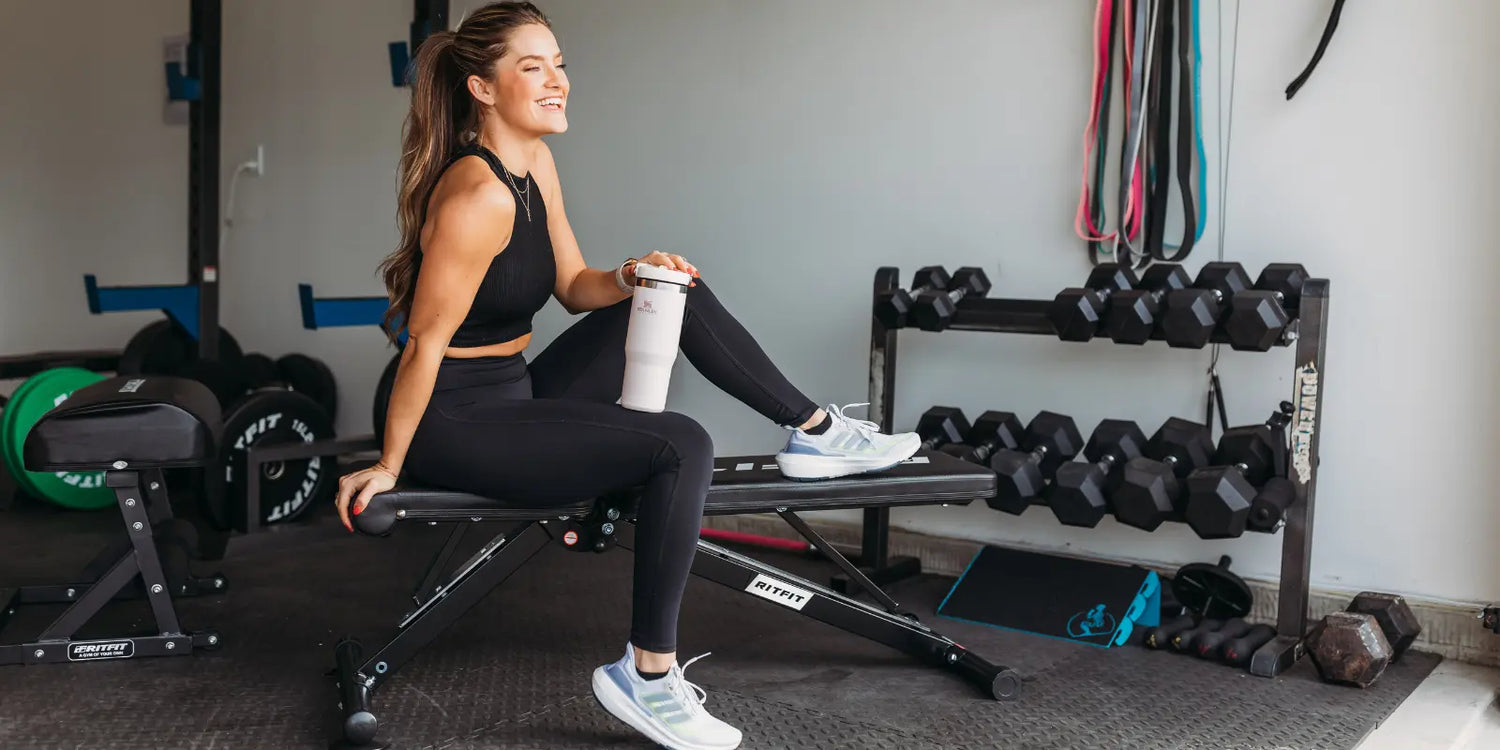
To get the most from these exercises, you need a bench that’s stable, easy to move, and adjustable through multiple angles. An adjustable bench lets you switch between flat, incline, decline, and upright positions so you can hit every major muscle group efficiently at home.
For example, the RitFit Adjustable Workout Bench is designed with home strength training in mind:
If you want a bench built for heavy, confident training, link this section to the RitFit GATOR 1600LB Adjustable Weight Bench product page.
RitFit GATOR 1600LB Adjustable Weight Bench, key specs
- Total load capacity: 1600 lb
- Back pad adjustment: 10 levels from 0 to 85 degrees
- Seat pad adjustment: 3 levels
- Headrest adjustment: 5 levels
- Decline settings: 3 levels
- Padding: 2.7 in thick foam with durable vinyl style cover
- Bench size: 57.8 in length, 25.2 in width
- Product weight: 109.1 lb
- Built in transport wheels and handle for easier moving
Final Thoughts
You don’t need a room full of machines to get strong. With one adjustable bench and a few free weights, you can train all six major muscle groups, build serious strength, and keep your workouts time-efficient.
References
- Trebs AA, Brandenburg JP, Pitney WA. An electromyography analysis of 3 muscles surrounding the shoulder joint during the performance of a chest press exercise at several angles. J Strength Cond Res. 2010;24(7):1925-1930. doi:10.1519/JSC.0b013e3181ddfae7
- Nunes JP, Jacinto JL, Ribeiro AS, et al. Placing Greater Torque at Shorter or Longer Muscle Lengths? Effects of Cable vs. Barbell Preacher Curl Training on Muscular Strength and Hypertrophy in Young Adults. Int J Environ Res Public Health. 2020;17(16):5859. Published 2020 Aug 13. doi:10.3390/ijerph17165859
- Arakawa H, Nakashima H, Li X, Tanimoto M. Rear Leg-derived Moment Contributes to Resistance Against Hip Extension in Bulgarian Split Squats. Int J Exerc Sci. 2025;18(7):881-894. Published 2025 Sep 1. doi:10.70252/NEXQ5666
Important disclaimer: This article is for general educational purposes only and is not medical advice. If you have shoulder, neck, back, elbow, or wrist pain, a recent injury or surgery, numbness or tingling, unexplained weakness, or dizziness, consult a qualified clinician before starting. Stop any exercise that causes sharp pain.