








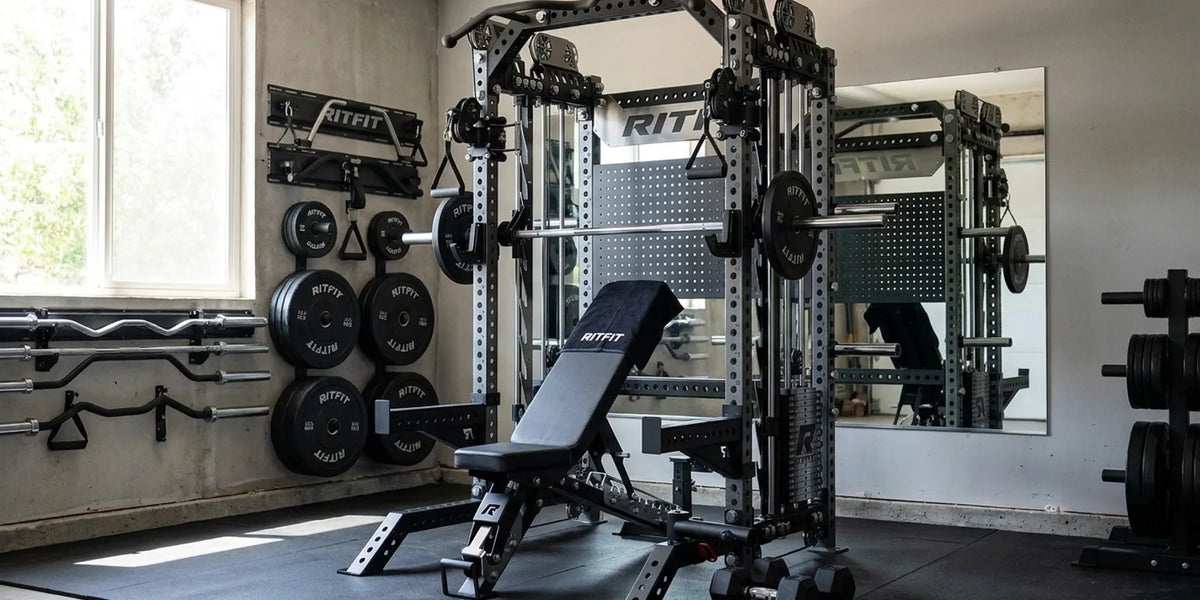
An 11 gauge steel smith machine for home gym use is the closest you can get to commercial build quality without leaving your garage, and steel thickness is the spec that decides how that machine feels and lasts. This guide explains what 11-gauge steel really means and why it predicts how a smith machine ages.
You will get the full RitFit M3 PRO Home Gym Smith Machine spec sheet translated into plain English, a decision matrix covering the whole RitFit lineup, and honest long-term ownership costs. Every capacity number comes from the official spec sheet, never rounded up.
Quick Answer: Eleven gauge steel is 0.120 inches, or 3 mm, thick, the heavy-duty benchmark used on commercial-style racks, and it gives a home gym smith machine higher capacity, less frame flex, and a longer working life. The RitFit M3 PRO is the only RitFit smith machine built with uniform 3x3 inch 11-gauge steel from front to back.
Key Takeaways
- Gauge runs backwards: Eleven gauge steel measures 0.120 inches thick, roughly 3 mm, while 14 gauge is closer to 0.075 inches, so smaller numbers mean thicker, stiffer frames.
- Gauge predicts lifespan: Thicker uprights resist flex and wobble under load, keep the bar path smooth, and support higher frame and safety-arm ratings over years of training.
- Guided training works: A 2023 systematic review found machine-based and free-weight training deliver comparable gains in maximal strength and hypertrophy.
- The M3 PRO spec lead: The RitFit M3 PRO uses uniform 3x3 inch 11-gauge steel on every post, carries a 2,500 lb frame rating, and includes 180 lb weight stacks per side.
- Lineup logic: Choose the M1 PRO for entry pricing, the M2 for modular layouts, the Buffalo for value with a lat pulldown, and the M3 PRO for maximum steel with built-in stacks.
What Does 11-Gauge Steel Actually Mean?
Eleven gauge steel is 0.120 inches thick, about 3 mm, and gauge numbers run backwards, so 11 gauge is thicker and stronger than 12 or 14 gauge. Equipment reviewers typically treat 11-gauge as the heavy-duty benchmark seen on commercial-style racks.
Gauge Numbers Run Backwards
Gauge measures tube wall thickness on an inverted scale, so a smaller number always means thicker steel. That is why an 11-gauge frame outweighs and outlasts a 14-gauge frame built to the same outer dimensions.
11 vs 12 vs 14 Gauge in Real Terms
On smith machines and power racks, 11-gauge is the commercial-style standard, 12-gauge is the budget-friendly middle tier, and 14-gauge is thinner economy construction. Commercial smith machines are typically fabricated from 11-gauge steel with a 0.120 inch wall in 3x3 or 2x4 tubing.
| Steel gauge | Wall thickness | Typical construction tier |
|---|---|---|
| 11 gauge | 0.120 in, about 3 mm | Heavy-duty benchmark on commercial-style racks |
| 12 gauge | Between 11 and 14 gauge | Budget-friendly home tier |
| 14 gauge | About 0.075 in | Thinner economy construction |
Thickness values follow the standard steel gauge table, and tier labels reflect how equipment reviewers classify rack construction.
If a brand does not publish its steel gauge, ask before you buy, because wall thickness is the one spec you cannot upgrade later.
Why Does Steel Gauge Decide How Your Smith Machine Ages?
Steel gauge decides how a smith machine ages because thicker uprights flex less under load, which protects the bar path, the welds, and the safety hardware year after year. A frame that stays rigid on your first heavy squat still feels the same years later.
- Rigidity: Thicker walls resist side-to-side sway during heavy squats and bench presses, so the guided bar travels on the path the designers intended.
- Wobble under load: Thinner frames can shift or rock when you rerack hard, which erodes confidence and accelerates bolt loosening over time.
- Component wear: Sliding parts like smith bar carriages track better on rigid uprights, so bushings and guide rods wear evenly instead of binding.
- Safety ratings: Higher capacity safety arms and J-hooks only mean something if the uprights behind them can actually carry the load.
Reviewers note typical smith machine bars weigh 15-25 lb, less than a standard 45 lb barbell, and counterbalance systems can make a bar feel as light as 1-5 lb. Those systems only work smoothly on a frame that does not flex, and gauge is what keeps the whole system honest.
Does Smith Machine Training Build Real Strength?
Smith machine training builds real strength and muscle for most lifters, and a 2023 systematic review and meta-analysis found machine-based and free-weight training produce comparable improvements in maximal strength and hypertrophy.[1] The guided bar changes the stability demand, not the growth stimulus.
Guided bars also suit controlled high-intensity work on squats and bench presses, and in one 2025 study of trained men on a Smith machine, blood flow restriction at 100% AOP with 90% 1RM loads increased squat mean propulsive velocity by 5.46% and reduced perceived exertion versus control.[2] Nobody needs that protocol to get stronger, but it shows the machine handles precise, heavy work.
A 2026 study of 28 resistance-trained men found load-velocity variables from smith-machine squats track fatigue and correlate strongly with 1RM decline, with r = 0.764 for L0 and r = 0.832 for Aline.[3] That makes velocity-based monitoring practical for lifters who train alone on a home smith machine.
For the fuller case covering safety, solo training without a spotter, and exercise variety, read our guide to the benefits of a smith machine for your home gym.
How Is the RitFit M3 PRO Actually Built?
The RitFit M3 PRO is built around uniform 3x3 inch 11-gauge steel uprights on the front, middle, and rear posts, where many multi-functional racks step down to 2x3 or 2x2 tubing on their middle and rear posts. According to the official RitFit M3 PRO spec sheet, the frame is rated for 2,500 lb.
Frame and Uprights
The frame uses Q235 steel throughout, stands 84 in tall including the pull-up bar, covers 21.5 sq ft of floor, and weighs 1,093.5 lb assembled. RitFit suggests it for users from 4 ft 9 in to 6 ft 5 in.
Smith Bar and Safety System
The smith bar is a true Olympic-length 2.2 m shaft, 86.8 in, with a 30 mm diameter, rated at 352 lb dynamic and 572 lb static, riding on 10 racking positions with stainless quick rack plates. Each safety arm is 560 mm long and rated at 650 lb static, and each J-hook carries the same 650 lb static rating.
Cable System and Weight Stacks
The cable system runs a 2:1 pulley ratio through 16 aluminum pulleys, with built-in 180 lb weight stacks per side made of 18 plates at 4.5 kg each for lat pulldowns, cable flyes, and rows. Single-hand trolleys give you 29 height positions per side.
| Component | Rated specification |
|---|---|
| Frame | 3x3 in 11-gauge, 3 mm wall, Q235 steel on front, middle, and rear posts |
| Frame capacity | 2,500 lb |
| Rack weight | 1,093.5 lb assembled |
| Footprint | 21.5 sq ft |
| Height | 84 in including pull-up bar |
| Suggested user height | 4 ft 9 in to 6 ft 5 in |
| Smith bar | 30 mm diameter, 2.2 m or 86.8 in Olympic length |
| Smith bar capacity | 352 lb dynamic, 572 lb static |
| Racking positions | 10 with stainless quick rack plates |
| Safety arms | 560 mm long, 650 lb static each |
| J-hooks | 650 lb static each |
| Pulley system | 2:1 ratio through 16 aluminum pulleys |
| Weight stacks | 180 lb per side built in, 18 plates at 4.5 kg |
| Trolley adjustment | 29 single-hand height positions per side |
All values are rated figures from the official RitFit M3 PRO product page, never rounded up.
Bar diameter is one spec home buyers rarely check, and one of the most respected voices in strength training has blunt advice on it.
"The standard bar length is a little over 7 feet, has '2-inch'/50mm diameter sleeves for loading the plates on, and weighs 20kg/44.1lbs. For home gym purposes, a 28.5 or 29mm bar will be the most durable and provide the best service over time. NEVER buy a 32mm bar. They are either junk, or a specialty squat bar that a home gym doesn't need."
Mark Rippetoe, Strength Coach and Author of Starting Strength, Starting Strength
The M3 PRO smith bar sits at 30 mm, right in the durable middle range Rippetoe describes, sized for repeated heavy use rather than specialty lifting.
Which RitFit Smith Machine Fits Your Garage?
The right model depends on your budget, your room layout, and how much built-in weight you want, and the RitFit smith machine lineup covers four clear tiers. The M3 PRO is the pick when you want uniform 11-gauge steel and built-in stacks, while the other three trade steel spec or modularity for a lower list price.
| Your situation | Recommended model | Why it fits | List price |
|---|---|---|---|
| First all-in-one on a tight budget | RitFit M1 PRO | Cable crossover plus smith station in an entry package, with an optional FUM1 11-gauge upright upgrade at $129.99 | $1,299.99 |
| Modular room layout | RitFit M2 | Four configurations including a 3D smith option, with the WSM2 286 lb stack set at $1,159.99 as an add-on | $2,199.99 |
| Maximum steel with built-in stacks | RitFit M3 PRO | Uniform 3x3 in 11-gauge frame front to back, 2,500 lb frame rating, 180 lb stacks per side included | $3,199.99 |
| Value tier with lat pulldown | RitFit Buffalo | Smith machine, lat pulldown, and cable crossover bundled for value-focused buyers | From $1,899.99 |
List prices are per the official RitFit smith machine collection page, with no promotional pricing applied.
If you are torn between the two entry options, our RitFit M1 vs M2 comparison walks through the differences frame by frame.
Want to see how a RitFit smith machine goes together before you commit? The official RitFit Sports channel walkthrough below shows the assembly process for the brand's smith machine family, using the Buffalo as the demo unit.
Is the M3 PRO Worth the Money?
The M3 PRO is worth its $3,199.99 list price if you train heavy, share the machine with family, or plan to keep it for a decade or more, because the uniform 11-gauge frame and built-in stacks are the two features you cannot retrofit later. If your training is lighter or your budget is firm, the M1 PRO or Buffalo cover the fundamentals for less.
Judge it in spec-per-dollar terms, since the M3 PRO folds a 2,500 lb rated frame, a true Olympic-length smith bar, and 180 lb weight stacks per side into one 21.5 sq ft footprint. Financing can spread that list price into monthly payments, which is how many owners fit a flagship rack into a garage build.
For a broader value framework beyond steel specs, read our guide on whether a smith machine is worth it. If your hard cap is lower, our roundup of the best smith machines under $3,000 compares the price tiers directly.
What Do Long-Term Upgrades and Expansion Cost?
Long-term M3 PRO ownership costs stay low because the 3x3 in frame with 1-inch holes accepts the widest range of attachments in the home gym market, and the built-in stacks mean no weight-stack purchase later. The main upgrade costs in the RitFit line hit M1 PRO and M2 owners, not M3 PRO owners.
- One-inch holes: The M3 PRO uprights use the 1-inch hole standard shared across the 3x3 ecosystem, so RitFit and third-party attachments fit without adapters.
- FUM1 math: M1 PRO owners can add the FUM1 11-gauge upright frame upgrade for $129.99, while M3 PRO owners get that steel spec from day one.
- WSM2 math: M2 owners adding the WSM2 286 lb weight stack set pay $1,159.99, while the M3 PRO includes 180 lb stacks per side at purchase.
- Expansion path: Start with the base machine and add attachments as your program grows, because the frame will not be the bottleneck.
Buy the frame you cannot upgrade later, and treat everything bolt-on as a future decision.
FAQs About 11-Gauge Steel Smith Machines
Is 11 gauge steel worth it for a home gym smith machine?
Yes, if you train heavy or want the machine to last decades. Eleven gauge steel is about 0.12 inches thick, the same spec used on commercial racks, so it resists flex, wobble, and wear far better than 14 gauge frames. For light recreational use, 12 or 14 gauge can still be sufficient.
What is the difference between 11 gauge and 14 gauge steel?
Gauge numbers run backwards, so 11 gauge steel is thicker and stronger than 14 gauge. Eleven gauge measures roughly 0.12 inches, or 3 mm, while 14 gauge is closer to 0.075 inches. On a smith machine, thicker steel means higher weight capacity, less frame flex under load, and better long term durability.
How much weight can the RitFit M3 PRO smith machine hold?
The M3 PRO frame is rated for 2,500 pounds overall. Its smith bar handles 352 pounds dynamic and 572 pounds static, while each J hook and each safety arm is rated at 650 pounds static. The pull up bar supports 300 pounds dynamic and 550 pounds static, according to the official spec sheet.
Will the RitFit M3 PRO fit in a low ceiling basement or garage?
Most likely yes. The M3 PRO stands 84 inches tall including the pull up bar, and its highest upright hole sits at 78 inches, so it clears typical 8 foot ceilings with room for assembly. Its footprint is 21.5 square feet, roughly the floor space of a parked SUV.
Is a smith machine as effective as free weights for building muscle?
Research suggests yes for most lifters. A 2023 systematic review and meta analysis found machine based and free weight training produced comparable gains in maximal strength and hypertrophy. A smith machine also lets you train heavy alone more safely, which helps consistency, the biggest driver of long term progress.
What size smith bar does the RitFit M3 PRO use?
The M3 PRO uses a true 2.2 meter Olympic length smith bar with a 30 mm diameter shaft and a knurled grip. It rides on a 10 position quick rack plate system with stainless hanging plates, and it takes standard 2 inch Olympic plates on its sleeves for loading.
Conclusion
The best 11 gauge steel smith machine for home gym buyers is the one whose frame you never have to think about again. The RitFit M3 PRO meets that standard with uniform 3x3 in 11-gauge posts, a 2,500 lb rated frame, a true Olympic smith bar, and built-in stacks.
Measure your space, check your ceiling against the 84 in height, and pick the lineup tier that matches your training. When you are ready, visit the RitFit sales page to see current offers and build your garage gym around steel that lasts.
Disclaimer
This article is for general informational purposes only and does not constitute medical, training, or safety advice. Consult a qualified professional before starting any new exercise program or installing heavy gym equipment at home.
References
1. Haugen ME, Vårvik FT, Larsen S, Haugen AS, van den Tillaar R, Bjørnsen T. Effect of free-weight vs. machine-based strength training on maximal strength, hypertrophy and jump performance - a systematic review and meta-analysis. BMC Sports Sci Med Rehabil. 2023;15(1):103. doi:10.1186/s13102-023-00713-4. PMCID: PMC10426227
2. Serrano-Ramón JM, García-Luna MA, Hernández-Sánchez S, Cortell-Tormo JM, García-Jaén M. Effects of Blood flow Restriction and Load on Mean Propulsive Velocity and Subjective Perceived Exertion During Squat and Bench Press Exercises. Sports Health. 2025;17(1):135-143. doi:10.1177/19417381241236808. PMCID: PMC11569684
3. Senturk D, Kumak A, Janicijevic D. Sensitivity of the load-velocity relationship variables to discriminate the level of fatigue induced by multiple sets of the smith-machine squat exercise. BMC Sports Sci Med Rehabil. 2026;18(1). doi:10.1186/s13102-026-01615-x. PMCID: PMC12980983





