The best adjustable weight bench for garage gym owners has to survive cold nights, damp air, concrete dust, and a car that still needs the floor. This guide explains how the RitFit GATOR handles those garage specific demands and how to judge footprint, ceiling clearance, storage, and long term durability before you buy.
Every specification here comes from RitFit official product data or published bench press research, and the comparisons stay inside bench categories rather than brand marketing.
Quick Answer: The RitFit GATOR is a strong choice for the best adjustable weight bench for garage gym use because its 1600 lb capacity, 50 by 70 mm steel frame, and upright storage suit a cold, dusty, shared space, though a lifter who only presses flat in a warm room can spend far less on a simple bench.
Key Takeaways
- Garage conditions beat gym fashion: cold air, humidity swings, grit, and an uneven slab wear a bench differently than a climate controlled room, so frame material and pad covering matter more than a model name.
- Footprint and storage: the GATOR is listed at 57.8 in long and 25.2 in wide and stands upright, which keeps the car bay clear between sessions.
- Adjustability: 10 backrest angles from 0 to 85 degrees, 3 seat angles, 3 decline settings, and 5 headrest positions cover flat, incline, decline, and seated work.
- Load and frame: a 1600 lb total load rating on 50 by 70 mm steel tubing gives a solo lifter a wide margin, and the headrest alone is rated to 396 lb.
- Buyer boundary: a lifter who trains flat only, or who needs the smallest possible folded footprint, may be better served by a flat or foldable bench.
What Does a Garage Gym Demand From an Adjustable Bench?
A garage gym demands a bench that tolerates cold, humidity, dust, and a shared concrete floor while still handling heavy pressing. Frame material, pad covering, and storage decide whether the bench still feels solid after a few winters.
A dedicated training room holds temperature and humidity steady, while a garage swings with the weather and shares its floor with vehicles and tools. The upside is that the room does not change the training itself, because resistance training remains one of the most dependable ways to build strength and muscle, and the ACSM 2026 position stand, an overview of 137 systematic reviews covering 30,000 participants, reports that resistance training significantly improves strength, muscle size, and physical function.[1]
Four garage specific pressures shape every buying decision:
- Ceiling height and overhead clearance: an incline press raises your shoulders, so a low beam, a garage door track, or a storage shelf limits how steep you can set the back pad.
- Unheated air and humidity swings: steel and foam react to the seasons, and damp air is what attacks bare metal once paint chips.
- Uneven concrete and grit: garage slabs are rarely level and usually dusty, which changes how a bench sits and how adjustment hardware wears.
- A shared floor plan: the bench has to clear out fast when the car comes home, so upright storage and easy movement matter as much as a stable press.
If your training room is a finished basement rather than a garage, the adjustable bench for a basement gym guide covers that layout. Whichever room you use, home gym flooring is the cheapest way to protect both the slab and the bench.
RitFit GATOR Adjustable Weight Bench at a Glance
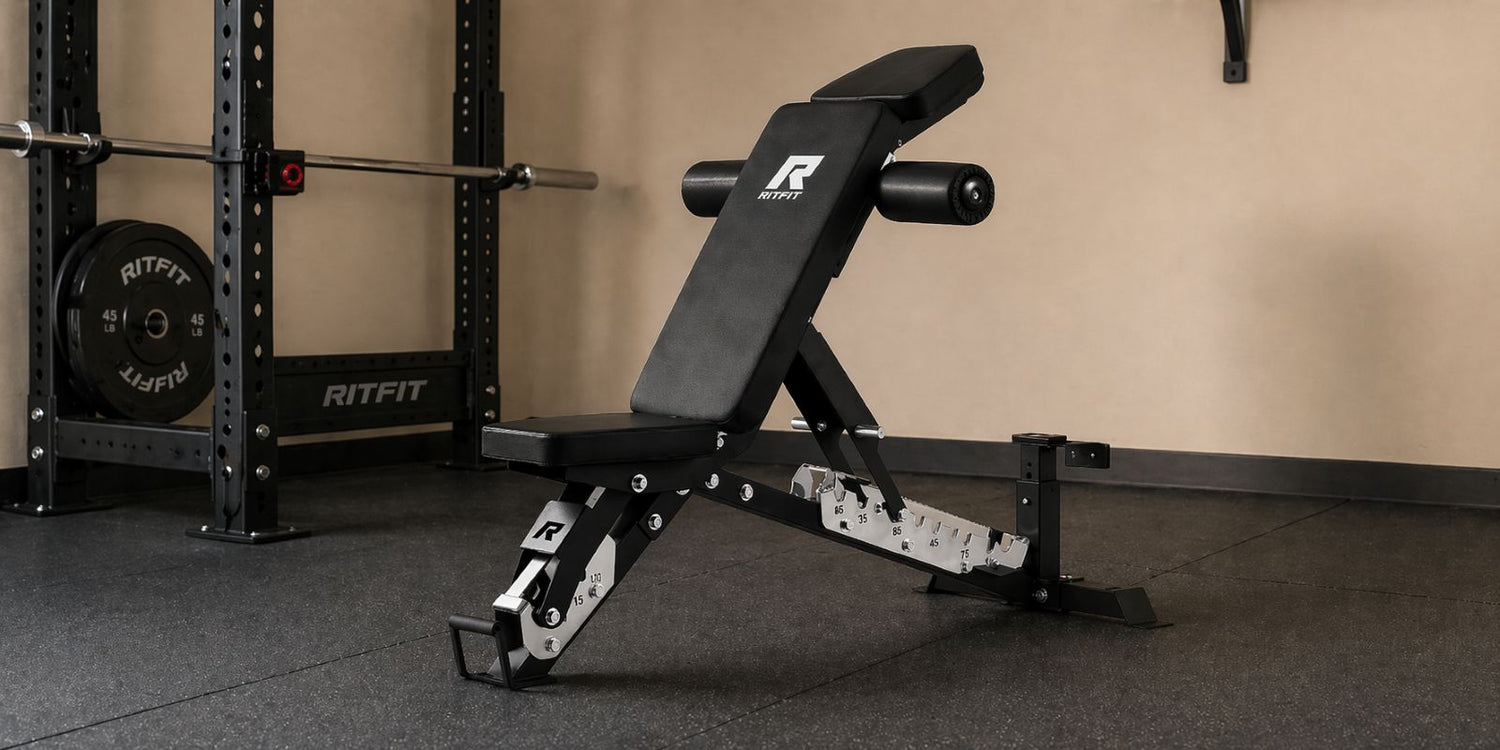
The RitFit GATOR Adjustable Weight Bench is a flat, incline, and decline bench with a 1600 lb total load rating and upright storage. The specification table below collects the numbers that decide whether it fits a small garage.
| Specification | RitFit GATOR | Why it matters in a garage |
|---|---|---|
| Total load capacity | 1600 lb | Wide safety margin for solo heavy pressing |
| Headrest rating | 396 lb | Support when the seat is set steeply for seated work |
| Frame tubing | 50 by 70 mm steel | Thicker tubing resists flex and damp air better than thin tube frames |
| Length and width | 57.8 in by 25.2 in | Decides rack fit and wall storage clearance |
| Assembled weight | 109.1 lb | Heavy enough to stay planted, movable on transport wheels |
| Backrest angle range | 0 to 85 degrees, 10 positions | Covers flat, incline, decline, and seated shoulder work |
| Pad and gap | 70 mm foam, 2 in seat back gap | Thicker foam and a known gap set expectations for flat pressing |
| Storage stance | Upright against a wall | Clears the floor when a car parks inside |
Source: RitFit official product listing for the GATOR 1600LB Adjustable Weight Bench, checked in September 2026. Confirm current figures on the RitFit weight benches pages before ordering.
Two numbers matter most for a small garage. The 25.2 in width keeps the bench narrow enough to stand against a wall, and the 2 in seat back gap is the detail flat pressing lifters notice first, which is why pad shape and seat height are worth checking before you buy.
Dumbbell pressing is also where pad gap and angle range show up most, and the dumbbell chest exercises with a bench guide covers those variations in detail.
"Great bench! Lots of settings and it's really well built and easy to use."
Alfred N. Verified Buyer, RitFit GATOR 1600LB Adjustable Weight Bench
How Does the RitFit GATOR Hold Up in an Unheated Garage?
An unheated garage tests a bench through cold, humidity, and grit. The RitFit GATOR answers that with a 50 by 70 mm steel frame and a vinyl covered 70 mm foam pad, because moisture and dust do the long term damage rather than cold air alone.
What actually ages a garage bench is simple to describe and simple to reduce:
- Steel and damp air: the frame is 50 by 70 mm steel tubing, and on any bench the weak points are unprotected spots where paint has chipped, so wipe condensation off after damp weeks and touch up chips early.
- Padding through temperature swings: the GATOR uses 70 mm recycled foam under a durable vinyl cover, and a sealed cover is what stops moisture from reaching the foam in a humid garage.
- Grit inside the hardware: fully enclosed adjustment brackets and welded footplates keep dust away from the moving parts that cheaper open designs leave exposed.
- Stability under load: in one trial measuring muscle activity, activation in the chest, front delts, triceps, and lats rose as bench press intensity moved from 70% to 100% of 1RM, which is why a frame that stays planted matters more than a decorative finish.[2]
Slab condition is the last piece. A rubber mat or tile under the bench evens out small dips, keeps grit off the frame, and gives the floor protecting stabilizers something to grip.
"Built with 14-gauge steel, the RitFit Gator Adjustable Weight Bench offers a robust weight capacity of 1,600 pounds. With 10 back pad angles, three seat pad positions, three decline settings, and a five-way adjustable head rest, you have ample options to support your strength and muscle building goals."
Stephen Sheehan, CPT, CNC, Certified Personal Trainer and Nutritionist, RitFit Gator Adjustable Weight Bench Review (2026) | Garage Gym Reviews
"The bench is awesome! Durable and easy to move. It arrived quickly also."
David J. Verified Buyer, RitFit GATOR 1600LB Adjustable Weight Bench
RitFit GATOR vs Flat and Foldable Benches for a Small Garage
A flat bench costs least, a foldable bench stores smallest, and the RitFit GATOR trades some of that convenience for a 1600 lb frame with more angles. The right answer depends on how you press and how often the car needs the bay.
| Bench category | Storage footprint | Angles and use | Load and stability |
|---|---|---|---|
| Flat bench | Fixed, cannot stand upright | Flat pressing and rows only | Stable but limited if the frame is light |
| Foldable bench | Smallest when folded | Usually flat with limited incline | Best for moderate loads and occasional use |
| RitFit GATOR | Stands upright against a wall | Flat, incline, decline, and seated work across 10 backrest positions | 1600 lb rating on 50 by 70 mm steel |
Comparison covers bench categories and RitFit framing only, with specifications from the RitFit product listing for the GATOR.
Angle range is where an adjustable bench earns its space in a garage. A study comparing bench inclinations found that around 30 degrees emphasizes the upper chest, while steeper angles shift more work to the front delts.[3]
Foldable benches win when storage is the only priority and your working loads are modest, and that trade is honest rather than wrong. If you press heavy, train alone, or want seated shoulder pressing in the same session, the heavier adjustable frame is the safer tool, and the smaller folded footprint stops mattering once the bench can stand upright. For a deeper breakdown of that trade, see adjustable vs flat vs foldable benches and the best adjustable weight bench under 500 price tier.
"Investing in a weight bench like the RitFit Gator makes a home gym space substantially more versatile. Not only can you do standard moves like bench pressing and seated shoulder pressing, but it also opens up the opportunity to do things like Bulgarian split squats and even some core exercises."
Amanda Capritto, CPT, CNC, CES, CF-L1, Editor and Certified Personal Trainer, RitFit Gator Adjustable Weight Bench Review (2026) | Garage Gym Reviews
"The wheels are small. But you can swap them out with 2.75" wheels from amazon to make this move better. Other than that this bench is great i love the folding top headrest."
Tom, Verified Buyer, RitFit GATOR 1600LB Adjustable Weight Bench
How Do You Set Up and Store a Garage Gym Bench in a Shared Garage?
Setting up a garage gym bench in a shared garage means assembling it once, then rolling it clear of the car bay and standing it upright after each session. The RitFit GATOR supports that routine with a pre assembled main frame, built in transport wheels, and a knurled pull handle.
RitFit states that most users finish setup in about 10 minutes because the main frame arrives pre assembled, which keeps the first session short.
- Upright storage: the bench stands on its end against a wall, and enclosed brackets lock the seat in place so it does not unfold while stored.
- One person movement: transport wheels plus a knurled handle let a single lifter roll the bench out of the car bay, which matters when the garage doubles as parking.
- Wall and rack clearance: at 25.2 in wide the bench stores narrow, and the same width helps it sit inside a standard home power rack without crowding your foot position.
- Cold start routine: in winter, give the pad a minute to warm under your body before a heavy set, because firm foam feels firmer when the garage is near freezing.
Storage is also where a garage gym gets its space back, so it pays to pair the bench with a wall rack or a floor rack such as weights storage rather than stacking plates beside the car. If you are still building the room, the home gym equipment under 2000 guide shows how a bench fits into a complete setup.
What Warranty and Long-Term Value Should You Expect From an Adjustable Garage Bench?
Written coverage on the frame, welding, and wearing parts matters more than a vague guarantee, and long term value comes from steel, load rating, and replaceable padding. The RitFit GATOR is listed at 399.99 USD, and RitFit publishes its own strength equipment terms rather than leaving coverage to guesswork.
According to RitFit current warranty policy, strength equipment carries 3 years on the frame, 3 years on welding, 1 year on bushings and bearings, and 6 months on parts and pads. Those terms matter more in a garage than in a spare room, because a bench that lives through damp winters is more likely to need a pad or a worn part replaced than a whole new frame.
What the warranty covers and what it does not
Frame and welding coverage runs longest because those parts decide whether the bench is safe, while pads and bushings are treated as wear items. Keep your order record, and check the current policy page before you buy, because terms can be updated between model years.
How value shows up over years
- Load headroom: a 1600 lb rating means your heaviest working set is well inside the frame limit, so the bench does not become the reason you stop adding weight.
- Replacement parts: a separate pad and hardware service route keeps a good frame out of the trash, which is where cheap benches usually end up.
- Angle coverage: one adjustable bench replaces a flat bench plus a separate incline setup, and that saved floor space is part of the real price.
Who should buy the RitFit GATOR for a garage gym
The GATOR fits a home lifter who trains alone in an unheated or shared garage, wants incline and decline pressing from one bench, and needs it to stand against a wall between sessions. It also suits anyone who is outgrowing a light foldable bench but is not ready for a commercial replacement, while a first time buyer can compare the lighter best adjustable weight bench for beginners setup.
Who should skip it
A lifter who only ever presses flat, or who needs the absolute smallest folded footprint and light weight for a single car garage, will get more value from a simpler bench. If you are still learning the movements, the bench workout routines guide is a cheaper first step than upgrading hardware.
FAQs About Best Adjustable Weight Bench for Garage Gym
What makes an adjustable weight bench better for a garage gym?
An adjustable weight bench is better for a garage gym when it replaces several single purpose setups in one footprint. The right bench lets you press flat, train on incline, add decline work, and support rows or split squats, while still storing cleanly after the session.
Can the RitFit GATOR adjustable weight bench stand vertically for storage?
Yes. The RitFit GATOR is designed for upright storage, which makes it much more practical in a garage that also holds a car, tools, or storage bins. Upright storage matters most when you need fast floor clearance after training and do not want a bench living in the center of the room.
Is a 2 inch pad gap a problem on an adjustable weight bench?
No. A 2 inch pad gap is not automatically a deal breaker, because comfort depends on your height, setup, and exercise choice. Some lifters notice pad gaps more during flat pressing, while others care more about seat shape, bench height, and how stable the bench feels under load.
How much weight capacity should a garage gym adjustable weight bench have?
You should choose a capacity that comfortably covers your body weight and the heaviest loads you plan to use, not just your current numbers. For garage gym training, a stronger frame usually also brings better stability, better confidence for solo lifting, and a longer useful life.
Will the RitFit GATOR fit inside a standard home power rack?
Yes. The RitFit GATOR should fit most standard home power racks because its footprint is compact enough for common rack setups. You should still check your rack depth, upright spacing, and bar height needs, especially if you prefer wide foot placement or use safeties at specific bench press settings.
Should you buy a foldable bench instead of an adjustable garage gym bench?
You should buy a foldable bench instead of a full adjustable model only when storage is the top priority and your loading demands are modest. If you want heavier pressing, more stable seated work, and broader exercise coverage, a heavier adjustable bench is usually the better long term choice.
Does an unheated garage damage an adjustable weight bench?
No, an unheated garage does not automatically damage an adjustable weight bench, but temperature swings, damp air, and grit do shorten the life of cheap hardware. A steel frame, a sealed pad cover, and enclosed adjustment brackets handle a cold garage far better than exposed springs or bare metal joints. Wipe the frame dry after damp weeks, and keep the bench off a wet slab.
How much ceiling height does an incline bench press need in a garage?
An incline bench press needs enough headroom for the raised back pad plus your torso height, so measure twice if your garage has a low beam, a garage door track, or a storage shelf overhead. Steep inclines raise your shoulders closer to the ceiling than a flat press. If headroom is tight, train flat or use a shallower incline angle.
How heavy is the RitFit GATOR and can one person move it?
The RitFit GATOR is listed at 109.1 lb, which is heavy enough to stay planted during a press but still manageable for one person because the frame includes built in transport wheels and a knurled pull handle. That combination lets a solo lifter roll the bench out of the car bay and stand it against a wall between sessions. Clear the path before you move it.
What should you check on a concrete garage floor before benching?
Check the slab for cracks, slopes, and standing damp before you bench on it, because a garage floor is rarely as level as an indoor room floor. Floor protecting stabilizers help the bench grip, and a rubber mat or tile can even out small dips and keep dust down. If the slab drains toward the door, store the bench on the higher side.
Conclusion
The RitFit GATOR is a practical answer to the best adjustable weight bench for garage gym question, because a 1600 lb frame, 70 mm foam padding, and upright storage match cold, dusty, space limited rooms. Measure your ceiling and car bay clearance first, then decide whether you need incline and decline range or just a flat press.
Check the RitFit discount guide before ordering, and confirm dimensions on the product page, then set the bench up so it clears the car in under a minute.
Disclaimer
This article is for general product education only and does not replace professional coaching, medical advice, or a hands on equipment inspection. Confirm current specifications, warranty terms, room measurements, and safe lifting practices on the official product page before you buy or train.
References
1. Currier BS, D'Souza AC, Singh MAF, et al. American College of Sports Medicine Position Stand. Resistance Training Prescription for Muscle Function, Hypertrophy, and Physical Performance in Healthy Adults: An Overview of Reviews. Med Sci Sports Exerc. 2026;58(4):851-872. PMCID: PMC12965823
2. Krol H, Golas A. Effect of Barbell Weight on the Structure of the Flat Bench Press. J Strength Cond Res. 2017;31(5):1321-1337. PMCID: PMC5400411
3. Rodriguez-Ridao D, Antequera-Vique JA, Martin-Fuentes I, Muyor JM. Effect of Five Bench Inclinations on the Electromyographic Activity of the Pectoralis Major, Anterior Deltoid, and Triceps Brachii during the Bench Press Exercise. Int J Environ Res Public Health. 2020;17(19):7339. PMCID: PMC7579505
4. Sheehan S. RitFit Gator Adjustable Weight Bench Review. Garage Gym Reviews. 2026. garagegymreviews.com/ritfit-gator-adjustable-weight-bench-review