








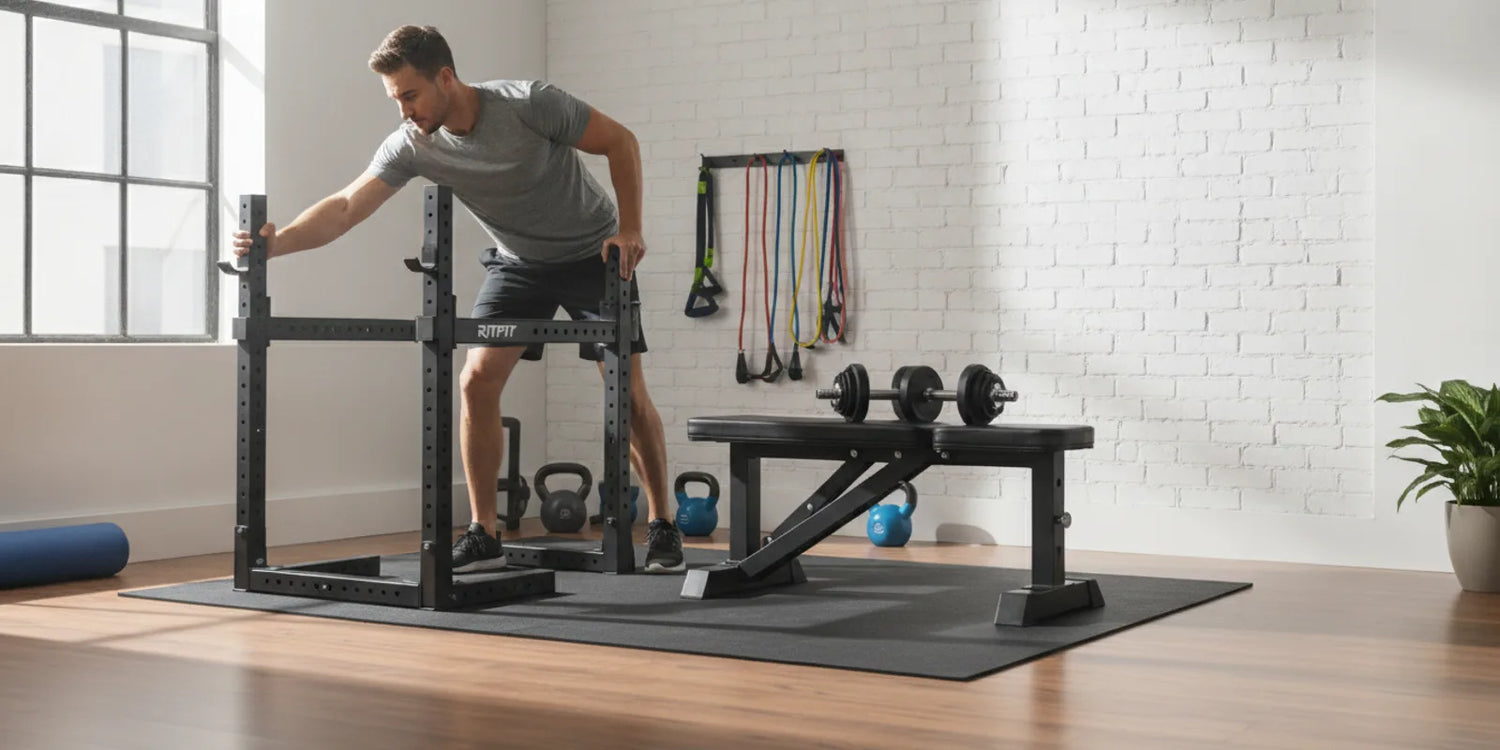
Foldable home gym equipment can be a genuine long-term investment when you pick the right pieces for your space, not just a stopgap for tight apartments. The best foldable benches, racks, and dumbbell systems hold up for years while giving back real floor space every single day.
This guide breaks down what actually makes foldable gear durable, how the cost stacks up against non-foldable equipment over time, and which RitFit foldable setup fits your apartment, budget, and training goals.
Quick Answer: Foldable home gym equipment is a genuine long-term investment when it uses steel construction, a weight capacity that exceeds your current training needs, and a wall-mount or under-bed fold design, because it holds up for years of regular use while recovering apartment floor space that fixed equipment cannot give back.
Key Takeaways
- Durability beats folding: Steel construction, a weight capacity buffer, and a one year or longer warranty determine whether foldable equipment lasts, not the fact that it folds.
- Investment is mainstream: In one survey, 49 percent of CrossFit athletes and 39 percent of weightlifting athletes bought new home gym equipment during the first COVID-19 lockdown.
- Space math works both ways: A folding rack can free nearly all of its footprint when stored, while a fixed rack occupies that space permanently, every day.
- Decision matrix depends on layout: The right RitFit foldable setup depends on ceiling height, wall length, and whether your goals include barbell training.
- Upgrade path matters: Choosing a foldable rack with attachment points from the start keeps future expansion cheaper than switching systems later.
Why Is Foldable Home Gym Equipment a Real Long-Term Investment?
Foldable home gym equipment earns long-term investment status when it is built to the same durability standard as fixed equipment, just engineered to collapse for storage. In a survey of CrossFit and weightlifting athletes, 49 percent and 39 percent respectively purchased new home gym equipment during the first COVID-19 lockdown, showing this is a mainstream buying decision, not a niche compromise.[1]
- Space recovered daily: A folded bench or wall-mounted rack gives your living room, bedroom, or entryway back every day, not just on moving day.
- Resale flexibility: One home-gym buying guide notes that equipment resale value typically retains 60 to 70 percent if your space needs change later.
- Apartment-first design: Foldable gear is engineered around shared walls, thin floors, and limited storage, so it fits the realities of renting rather than fighting them.
- An entry point that grows with you: A single foldable bench today can become a full barbell setup later without you having to start over.
For a broader breakdown of what belongs in a compact setup, see this guide to small home gym equipment essentials.
What Does Long-Term Durability Actually Require From Foldable Equipment?
Long-term durability in foldable equipment comes down to two things, a frame and hinge system that survives years of folding and unfolding, and enough load capacity to keep progressing instead of plateauing on day one. A lifestyle medicine practice guide on gym equipment selection notes that free weights and bilateral equipment tend to offer strong cost and space efficiency for resistance training.[2]
Capacity matters just as much as construction. A systematic review and meta-analysis of home-based resistance training research found that limited equipment availability may hinder the ability to reach optimal training intensity, meaning undersized foldable equipment can stall your progress even if it saves space.[3]
- Steel gauge: Thicker steel resists the wobble and metal fatigue that thin folding frames develop within months.
- Hinge and pin mechanism: A smooth, tight-locking hinge should take one motion to deploy, not a fight with a stuck pin.
- Weight capacity buffer: Buy capacity you will not outgrow in a year or two of consistent progressive overload.
- Warranty length: A warranty of one year or longer signals the manufacturer expects the frame to hold up.
- Wobble test at purchase: Unfold it, load it lightly, and check for lateral movement before you commit.
See this comparison of the best folding weight bench options for maximizing home gym space for durability specifics by model.
Which RitFit Foldable Setup Fits Your Apartment and Goals?
The right RitFit foldable setup depends on your available wall space, ceiling height, and whether your training goals include barbell work, not just your budget. A bench-only setup suits minimal space and dumbbell training, while adding a folding rack unlocks squats, bench press, and pull-ups without a permanent footprint.
| Setup | Footprint When Folded | Best For |
|---|---|---|
| RitFit Foldable Utility Bench | Folds flat against a wall or under a bed | Dumbbell-only apartment training |
| Foldable Bench plus Adjustable Dumbbells | Folds to just a few inches deep | Beginners building progressive overload in a small space |
| RitFit PWM02 Folding Squat Rack plus Bench | Wall-mounted, folds flat when not training | Apartments with wall space wanting full barbell training long-term |
Footprint descriptions are based on RitFit product specifications, not lab-measured averages.
- Choose the bench alone if: your training is dumbbell-based and your priority is minimal visible equipment.
- Choose bench plus dumbbells if: you want full-body progressive overload but still cannot dedicate wall space.
- Choose the PWM02 rack plus bench if: you have wall space and want squats, bench press, and pull-ups long-term.
Read the full wall-mounted folding squat rack guide and the RitFit PWM02 multi-functional folding squat rack guide for setup details, or compare bench styles in this adjustable vs flat vs foldable weight bench breakdown. The RitFit Adjustable Foldable Utility Bench anchors tiers one and two above.
Is Foldable Equipment Worth the Price Compared to Non-Foldable?
Foldable equipment is worth the price for most apartment dwellers because it removes the sunk cost of a permanent footprint you cannot use for anything else, even when it costs slightly more upfront than an equivalent non-foldable model. One fitness industry writer's cost estimate suggests premium adjustable dumbbells and a bench can pay for themselves within 12 to 18 months compared to ongoing commercial gym membership fees.
- Upfront cost: Expect foldable pieces to sit at or slightly above non-foldable equivalents due to the added hinge engineering.
- Membership savings: Every month you train at home instead of a commercial gym offsets that upfront difference.
- Resale value: Well-built foldable equipment holds resale value close to non-foldable gear, per the same buying guide cited above.
- Cost of buying cheap first: Replacing a wobbly, undersized folding bench within a year often costs more than buying the sturdier option once.
If budget is the main constraint, this roundup of the best home gym equipment under $500 shows where foldable pieces fit into a tight budget.
What Will It Cost to Expand a Foldable Home Gym Setup Later?
Expanding a beginner home gym in a small apartment typically means adding one focused piece at a time, such as extra plates, a pulley attachment, or a second bench, rather than replacing your whole system. Choosing a foldable rack with attachment points and a weight capacity buffer from the start keeps these additions simple and avoids paying twice for equipment you outgrow.
- First addition, dumbbells: Adjustable dumbbells extend a bench-only setup into full-body training without adding footprint.
- Second addition, a rack: A folding rack unlocks barbell work once wall space and budget allow.
- Third addition, attachments: Pulley or dip attachments layer onto an existing rack instead of requiring a new machine.
- Last addition, plates: Add plates gradually as your lifts progress rather than buying a full set upfront.
See this guide to minimum home gym equipment for the exact order most beginners should buy in.
What Mistakes Do People Make When Buying Foldable Equipment for Small Spaces?
In a small apartment, the most common mistake is buying based on folded footprint alone without checking the unfolded clearance needed during an actual set, leaving no room to safely rack a bar or drop into a squat. A close second is choosing the cheapest folding mechanism available, which tends to wobble, jam, or fail within the first year of regular use.
- Ignoring unfolded clearance: Measure the working space, not just the storage footprint.
- Skipping the weight capacity check: Buying at your current max leaves no room to progress.
- Choosing plastic locking pins: These wear out and loosen far faster than steel pin systems.
- Forgetting ceiling height: A folding rack still needs vertical clearance for pull-up or landmine attachments.
- Buying twice: Underspending on a flimsy first purchase often costs more than buying the sturdier option once.
How Do You Measure Your Apartment Before Buying Foldable Equipment?
Measure both the folded storage footprint against your apartment or condo wall and the fully unfolded working clearance you need during a lift, since only one of those numbers is usually printed prominently in a product listing. Leave at least 24 inches of clearance in front of a folding rack for squat and press movements, and check ceiling height before adding a pull-up attachment.
- Step 1, measure wall length: A wall-mounted folding rack needs a clear, load-bearing wall section at least as wide as the rack.
- Step 2, measure ceiling height: Confirm at least a few inches of clearance above your tallest planned movement.
- Step 3, measure working clearance: Stand where you would lift and measure outward in every direction you move during a set.
- Step 4, check the folded depth: Confirm the folded depth against the wall or under-bed space you plan to use.
This walkthrough shows how measuring and planning a layout before buying prevents the clearance mistakes covered above. For flooring that folds away alongside your equipment, see these folding exercise mat specifications.
"Starting small then building up is the smarter route for space, but especially for apartments, home offices, or if you have roommates. If you can't store it or easily stow it away, it's likely to become clutter, and clutter kills motivation."
Jeff Turbett, Fitness and Lifestyle Guide Writer, Man of Many
FAQs About Foldable Home Gym Equipment
Is foldable home gym equipment a good long-term investment?
Yes, when you choose steel-frame foldable equipment rated for a real weight capacity, it holds up for years of regular training while saving floor space in an apartment. The key is checking weld quality, warranty length, and load rating rather than assuming foldable automatically means lower quality or a shorter lifespan.
How much floor space do I actually save with foldable equipment?
A wall-mounted folding rack can free up to 100 percent of its footprint when stored, while foldable benches typically fold to just a few inches deep against a wall. Measure your unfolded working clearance first, since that space still needs to be available during every workout session.
Should I buy foldable or non-foldable equipment for long-term use?
Foldable equipment favors apartments and shared spaces, while non-foldable racks and machines suit dedicated rooms where stability and daily heavy use matter more than storage. Many long-term home gyms mix both, starting foldable and adding fixed equipment once space and budget allow for it.
What should I check to make sure foldable equipment lasts?
Prioritize steel construction, a stated weight capacity that comfortably exceeds your current needs, smooth non-wobbly folding mechanisms, and a manufacturer warranty of at least one year. Cheap plastic locking pins and thin-gauge steel are the most common points of early failure in folding equipment.
How do I choose between foldable setups for my apartment?
Match the setup to your ceiling height, available wall length, and training goals, a foldable bench alone suits minimal space and dumbbell work, while a foldable rack paired with a bench suits apartments with wall space for barbell training and future expansion.
What does it cost to expand a foldable home gym setup later?
Expect to add roughly one accessory purchase per major addition, such as extra plates, a pulley attachment, or a second bench, once your base rack or bench is in place. Choosing a foldable rack with attachment points from the start keeps future expansion costs and clutter lower.
Conclusion
Foldable home gym equipment earns its place as a long-term investment when you prioritize steel construction, real weight capacity, and a fold design that matches your actual apartment layout, not just the lowest price. Choose the tier that matches your goals now and leaves room to add a rack or plates later.
Start with a foldable bench if space is tight, add adjustable dumbbells for progressive overload, and browse the RitFit benches collection to compare foldable options side by side.
Disclaimer
This article is for general informational purposes about home gym equipment selection and space planning, and it does not replace professional fitness, medical, or structural advice for your specific home. Consult a qualified trainer or a building professional before installing wall-mounted equipment or beginning a new resistance training program.
Save on your next RitFit order
Tap the button to copy your code, then paste it at checkout.
References
1. Meier N, et al. Purchasing Behavior and Use of Digital Sports Offers by CrossFit and Weightlifting Athletes During the First SARS-CoV-2 Lockdown in Germany. BMC Sports Sci Med Rehabil. 2022;14:44. doi:10.1186/s13102-022-00436-y
2. Nadolsky K. Incorporating a Gym Facility in a Lifestyle Medicine Practice for Patients With Diabetes Mellitus. Am J Lifestyle Med. 2022;17(3):386-396. doi:10.1177/15598276221089898
3. Idiart-Borda Polotto V, et al. Effects of Home- and Gym-Based Resistance Training on Glycemic Control in Patients With Type 2 Diabetes Mellitus, A Systematic Review and Meta-Analysis. Diabetol Metab Syndr. 2025;17:228. doi:10.1186/s13098-025-01793-7





