








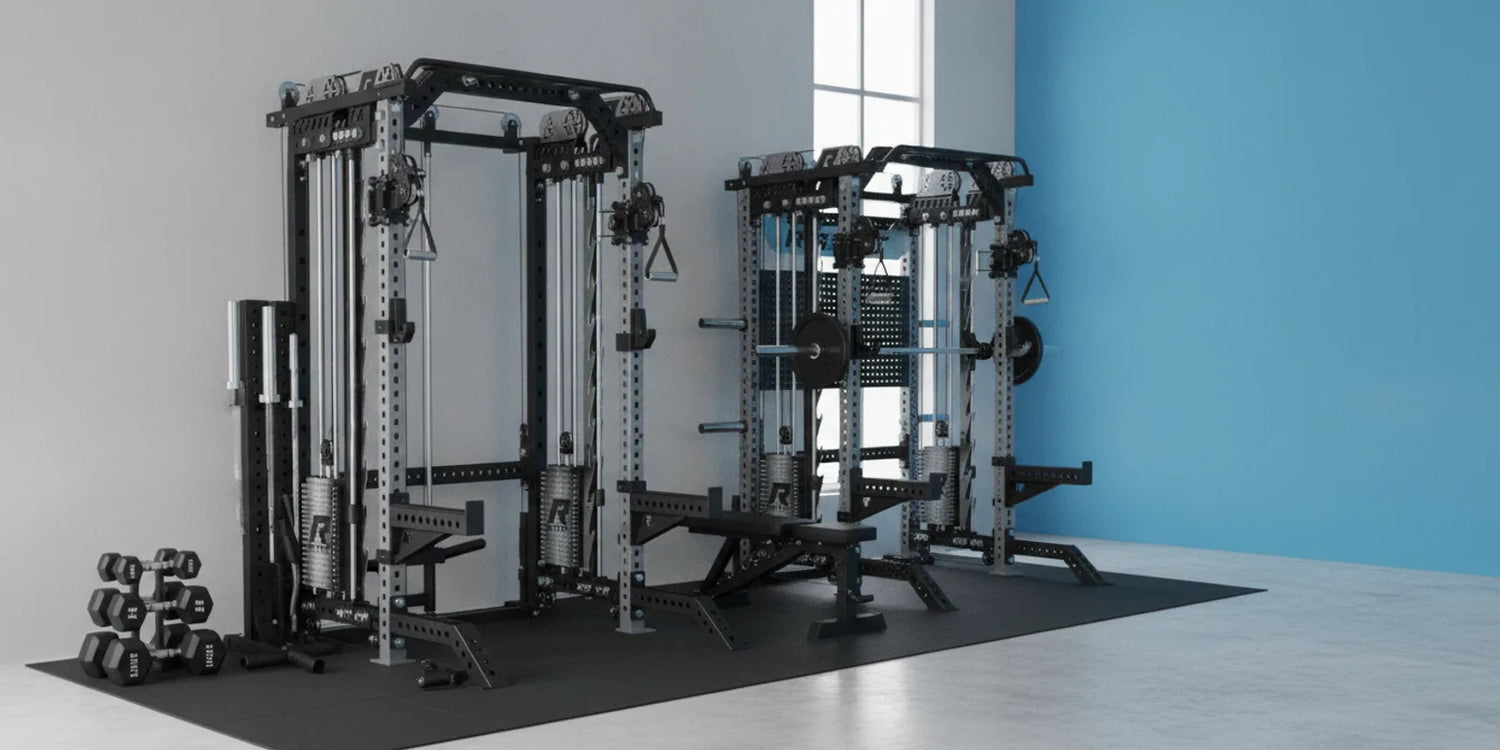
Finding the best folding power rack with cables means getting full-range resistance training in a fraction of the floor space a traditional cage demands. These wall-fold and freestanding hybrid designs combine barbell safety, a built-in pulley system, and a compact footprint, making them the top pick for garage gyms, apartments, and any space that doubles as a living area.
This guide covers every buying criterion that matters, from steel gauge and cable ratio to ceiling clearance and installation requirements, then maps each spec to the right RitFit configuration for your budget and training style.
Quick Answer: The best folding power rack with cables integrates an upright barbell cage with a built-in cable pulley system on a wall-fold or freestanding frame. Key criteria are steel gauge (11ga or better), safety bar capacity, pulley ratio (2:1 preferred), and folded depth.
Key Takeaways
- Integrated beats add-on: A rack with a factory-installed cable system delivers a more stable, calibrated pulley path than aftermarket bolt-on attachments.
- Steel gauge is the frame's report card: 11-gauge steel uprights offer meaningfully greater rigidity than 14-gauge alternatives at comparable folded depths.
- 2:1 pulley ratio matters: This ratio halves felt resistance, creating smoother motion and reducing cable wear compared to a direct 1:1 setup.
- Cable training is as effective as free weights for hypertrophy: A study found that cable-pulley and barbell training produced similar muscle thickness gains in young adults. [1]
- Space math works in your favor: Most folding racks with cables fold to within 4 to 8 inches of the wall, reclaiming nearly all floor space when the session ends.
What Is a Folding Power Rack with Cables?
A folding power rack with cables is a hybrid strength training frame that combines a collapsible barbell cage with an integrated cable pulley system, allowing compound barbell lifts and cable isolation work from a single piece of equipment. When folded, the frame hinges flush or near-flush to the wall, recovering the open floor space you need for daily living.
This category sits between a basic wall-mount squat stand (barbell only, no cables) and a full-size power rack package that stays permanently deployed. The defining feature is the built-in cable path, so one unit covers both barbell and cable training roles without a second machine.
A study found that cable-pulley and barbell training produced similar biceps brachii hypertrophy over 10 weeks of training. [1] This is the scientific case for investing in integrated cable capability: you are not sacrificing muscle-building results by using cables alongside free-weight movements.
"Many people underestimate the power of at-home workouts, believing that they lack the equipment or space to make meaningful progress."
Jeff Cavaliere, MSPT, CSCS, Physical Therapist and Strength Coach, Creator of ATHLEAN-X, Athlean-X
What Key Specs Should You Evaluate Before Buying?
The most important specs on a folding power rack with cables are steel gauge, weight capacity, pulley ratio, folded depth, and ceiling height requirement, and each has a direct impact on long-term safety and daily usability.
Folded vs. Unfolded Footprint
Most folding racks with integrated cables deploy into a footprint of 9 to 15 sq ft and fold to 4 to 8 inches from the wall surface. Measure the wall-to-clearance distance in your space before ordering, accounting for any baseboards, outlets, or trim that reduce the usable depth.
Weight Capacity and Steel Gauge
Frame weight capacity reflects the combined steel structure, weld quality, and anchor method. Look for at least 11-gauge steel uprights for serious barbell loading, as thinner gauges flex more under repeated eccentric force.
- 11-gauge steel: Greater rigidity, preferred for loaded squats and presses above 200 lb.
- 14-gauge steel: Lighter, more affordable, suitable for moderate loads and cable-focused use.
- Safety bar capacity: Distinct from the frame weight capacity. Check the free-fall rating separately before programming heavy singles.
Cable System Type: Integrated vs. Add-On, and Pulley Ratio
An integrated cable system is engineered with the frame geometry, producing consistent cable angles and a stable anchor. A 2:1 pulley ratio means the weight stack moves half the distance the cable travels, cutting felt resistance in half and creating a smooth pull while extending cable lifespan.
- High and low pulley positions: High pulley enables lat pulldowns, triceps pushdowns, and face pulls. Low pulley enables cable rows, curls, and pull-throughs.
- Attachment points: Count the number of anchor positions. More positions mean a wider exercise menu without purchasing separate equipment.
- Weight stack vs. plate-loaded: Weight stacks offer faster load changes. Plate-loaded systems are lower cost and often lighter when folded.
Ceiling Height Requirements
A folding rack with an overhead pulley for lat pulldowns requires at least 8 feet of ceiling clearance, and 9 feet is recommended if you are taller than 6 feet. Add 6 to 12 inches above the rack's listed height to allow for the pull-up bar and full overhead cable range of motion.
Wall-Mount vs. Freestanding Folding Design
Wall-mounted folding racks attach to studs or concrete anchors, shifting lateral load into the building structure. Freestanding folding racks use a counterweight base or floor-anchor system to achieve stability without wall bolts.
- Wall-mount: Flatter fold, more stable under heavy barbell work, requires stud or concrete anchoring.
- Freestanding folding: No wall drilling, more flexible placement, larger folded depth.
- Mixed designs: Some models use optional wall brackets for added stability while remaining freestanding without them.
Which RitFit Configuration Best Matches Your Space and Goals?
The right RitFit setup depends on three variables: available floor space, primary training style (barbell-first vs. cable-first vs. balanced), and budget. The matrix below maps each profile to the most suitable option within the RitFit line.
| Profile | Primary Need | Recommended Option | Key Reason |
|---|---|---|---|
| Budget-focused, minimal cable work | Barbell compound lifts in tight space | Base power rack + cable attachment | Lower entry cost, add cable capability as a modular upgrade |
| Full-feature cable + rack combo | Lat pulldown, rows, flys, and squats in one unit | Best All In One Power Rack For Home Gym configuration | Integrated cable system calibrated to the frame geometry |
| All-in-one Smith + cable | Guided bar path, cable crossover, and squat rack functions | M3 Power Rack Cable Crossover Smith Machine | Three training modalities in one footprint with cable crossover included |
Profiles based on typical buyer personas. Actual product selection should account for confirmed ceiling height and floor dimensions.
Budget-Focused: Minimal Cable Work
A base power rack paired with a compatible cable attachment module is the most cost-efficient entry point for lifters whose programming is 80% or more barbell-based. The cable attachment handles lat pulldowns and rows without the cost of a full integrated system.
- Best for: Lifters who want cable accessory work as a supplement, not a primary training mode.
- Upgrade path: Attachments from the 5 Best 2x2 Power Rack Attachments guide can expand functionality incrementally without replacing the frame.
Full-Feature Cable + Rack Combo
Lifters who want structured cable work alongside barbell training benefit most from a fully integrated rack-plus-cable system, where the pulley geometry, anchor points, and safety system are engineered as one unit. This configuration supports high and low pulley positions, a wider attachment menu, and a stable cable path during complex multi-joint movements.
- Best for: Home gym owners whose weekly programming includes lat pulldowns, cable rows, cable flys, and curls in addition to squats and presses.
- Compare options: Review the Power Rack Vs Squat Rack breakdown to confirm a full cage is right versus a simpler two-post design.
All-in-One Smith + Cable Option
The M3 Power Rack Cable Crossover Smith Machine adds a guided Smith bar path to the cable and barbell setup, giving solo lifters a machine-assisted press and squat option alongside free-bar and cable work. This is the most feature-dense configuration in the RitFit line for a single footprint.
- Best for: Lifters who train alone and want the safety of a guided bar for heavier press work, plus cable crossover capability.
- Space note: Three-in-one designs carry a larger unfolded footprint. Confirm floor dimensions and ceiling height against the product spec sheet before ordering.
- Explore the full lineup: Browse the full collection to find bundled options that add bench and barbell to the frame order.
What Cable Exercises Can You Do on a Folding Power Rack?
A folding power rack with an integrated cable system supports a full menu of compound and isolation cable movements, covering every major muscle group without additional equipment. The exercise variety depends on the number of pulley positions and the attachment kit included.
- Lat pulldown: High pulley, wide or close grip bar. Targets latissimus dorsi and biceps.
- Cable row: Low pulley, seated or standing. Targets mid-back, rear delts, and biceps.
- Cable fly: High or mid pulley, one arm or two. Targets pectoralis major with constant tension.
- Triceps pushdown: High pulley, straight bar or rope. Targets all three heads of the triceps.
- Bicep cable curl: Low pulley. Maintains tension at the shortened position unlike a barbell curl.
- Face pull: High pulley, rope attachment. Targets rear delts and external rotators.
- Cable pull-through: Low pulley. Hip hinge movement targeting glutes and hamstrings.
- Single-arm exercises: Any handle attachment allows unilateral work for balance correction and stability development.
According to a large systematic review and meta-analysis, all resistance training prescriptions increased muscle strength and size compared to no exercise, and multiple sets were the defining characteristic of the top-ranked prescriptions for hypertrophy. [2] A cable station on a folding rack allows you to program those multiple sets across a variety of movement patterns without leaving the frame.
Watch the RitFit PPC03 power cage with cable crossover in action for a real-world look at cable exercise variety on a compact rack setup.
For a deeper exercise library, the Power Rack Exercises Top Lifts guide covers both barbell and cable movements compatible with a full cage setup.
Is a Folding Power Rack with Cables Worth the Extra Cost?
A folding power rack with an integrated cable system costs more upfront than a basic folding squat stand, but it eliminates the need for a separate functional trainer, which occupies significantly more floor space and often costs more as a standalone purchase.
A systematic review and meta-analysis found no significant difference between free-weight and machine-based strength training for muscle hypertrophy. [3] From a results standpoint, you are not paying a premium for inferior gains.
Cost Comparison: Integrated vs. Separate Setup
Consider two paths to the same training capability in a small home gym.
- Integrated path: One folding rack with cables covers squats, presses, lat pulldowns, rows, and cable fly work. Single purchase, single footprint, one installation.
- Separate path: A basic folding rack plus a standalone functional trainer or cable crossover machine. Two separate purchases, two footprints, and two installation projects, with total cost typically higher and floor space consumed significantly larger.
- Long-term upgrade cost: Integrated systems within the RitFit line support incremental attachment upgrades without replacing the frame, keeping long-term expansion costs lower than buying entirely new equipment.
Who Gets the Best Return?
The value case is strongest for home gym owners whose training plan includes both barbell compound work and at least two cable exercises per week. If your programming is barbell-only, a basic folding rack is a better fit.
If cable work is a primary training mode, the Best Power Rack With Pulley System Under 1000 guide covers budget-specific options.
How Do You Plan the Space for a Folding Power Rack with Cables?
Space planning for a folding rack with cables requires measuring both the deployed footprint and the overhead clearance, then confirming that the wall or floor can bear the anchor load of the specific model you choose.
Measuring Your Space
Before ordering, measure the following and match each against the product spec sheet.
- Floor area (deployed): Clear at least the rack's listed unfolded depth plus 24 to 30 inches behind the bar for a safe step-back during squats.
- Overhead clearance: Measure floor to ceiling at the rack installation point. Folding racks with overhead pulleys require at least 8 feet, with 9 feet recommended for users over 6 feet tall. Add 6 to 12 inches above the rack's listed height for clearance above the pull-up bar.
- Folded depth: Confirm that the folded rack, at 4 to 8 inches from the wall for wall-mount models or up to 24 inches for freestanding, does not block a door, hallway, or secondary equipment.
- Wall stud spacing: For wall-mount models, locate studs before purchasing. 16-inch on-center framing is standard in North American construction. Concrete walls require appropriate masonry anchors specified by the manufacturer.
Wall-Mount Installation Checklist
Wall-mounted folding rack installation requires confirming several structural factors before drilling.
- Locate studs or solid masonry: Use a stud finder and verify with a nail probe before committing to mount positions.
- Check mount height: Installation height affects J-hook positions and the overhead cable anchor. Follow the manufacturer's recommended mount height for your height range.
- Hardware quality: Use the hardware supplied or specified by the manufacturer. Substituting lower-grade fasteners in a load-bearing application is a safety risk.
- Test before loading: After installation, apply bodyweight force to the frame before loading a barbell. The frame should feel completely rigid with zero wall movement.
- Floor anchor (if applicable): Some freestanding folding racks include optional floor anchors. Install them if you plan to use the safety bars under load. Refer to the RitFit Power Racks Exercises Posters for setup and exercise guidance specific to your model.
For the full RitFit rack lineup, the Racks Package collection lists available bundle configurations with dimensions included.
FAQs About Best Folding Power Rack with Cables
Can you actually squat safely in a folding power rack with cables?
Yes, provided the rack is properly anchored per the manufacturer's instructions, uses at least 11-gauge steel uprights, and the safety bars span enough depth for your stance. Always verify the safety bar free-fall capacity matches your working weight before loading the bar.
How much floor space does a folding power rack with cables take up when in use?
Most folding power racks with integrated cables occupy roughly 9 to 15 square feet when deployed, depending on the model. When folded against the wall, the frame typically sits 4 to 8 inches from the wall surface, freeing up nearly all your floor space between sessions.
What is a 2:1 pulley ratio and why does it matter on a folding rack?
A 2:1 pulley ratio means the cable travels twice the distance the weight stack moves, halving felt resistance for smoother motion and reduced cable wear. It is a key quality indicator when comparing integrated pulley systems on folding power racks.
Do folding power racks with cables require wall studs for mounting?
Wall-mounted folding rack models require solid stud or concrete wall anchoring to bear dynamic barbell loads safely. Freestanding folding racks do not require wall mounting but must be stabilized with floor anchors or a counterweight base when specified by the manufacturer to prevent tipping.
What ceiling height do I need for a folding power rack with an integrated lat pulldown?
Most folding racks with overhead pulley systems require at least 8 feet of ceiling clearance for safe lat pulldown work, with 9 feet recommended if you are taller than 6 feet. Always check the specific model's listed height plus add 6 to 12 inches for clearance above the pull-up bar.
Is a folding power rack with cables worth the extra cost over a basic folding rack?
If cable isolation work, including lat pulldowns, cable flys, rows, and curls, is part of your training plan, the integrated cable system eliminates the need for a separate functional trainer, which typically costs more and takes significantly more floor space. The all-in-one value case is strong for small home gyms.
Conclusion
The best folding power rack with cables matches your steel gauge, safety bar capacity, pulley ratio, and ceiling clearance to your actual training style and space. An integrated cable system removes the need for a second machine entirely.
Start by measuring your deployed footprint and overhead clearance, then match those figures to the right RitFit configuration. Browse the full Power Rack Package collection to compare bundled options with spec sheets included.
Disclaimer
The information in this article is intended for general fitness and equipment selection guidance only and does not constitute professional structural, engineering, or medical advice. Always follow the manufacturer's installation instructions and consult a qualified fitness professional before beginning any new strength training program.
Save on your next RitFit order
Tap the button to copy your code, then paste it at checkout.
References
1. Nunes JP, Jacinto JL, Ribeiro AS, Mayhew JL, Capel DMG, Santos LR, Cyrino ES, Aguiar AF. Placing Greater Torque at Shorter or Longer Muscle Lengths? Effects of Cable vs. Barbell Preacher Curl Training on Muscular Strength and Hypertrophy in Young Adults. Int J Environ Res Public Health. 2020;17(16):5859. doi:10.3390/ijerph17165859. PMCID: PMC7460162
2. Currier BS, Mcleod JC, Welton NJ, D'Souza ACD, Keogh JAJ, Lau KJ, Phillips SM. Resistance training prescription for muscle strength and hypertrophy in healthy adults: a systematic review and Bayesian network meta-analysis. Br J Sports Med. 2023;57(18):1211-1220. doi:10.1136/bjsports-2023-106807. PMCID: PMC10579494
3. Haugen ME, Vårvik FT, Larsen S, Haugen AS, van den Tillaar R, Bjørnsen T. Effect of free-weight vs. machine-based strength training on maximal strength, hypertrophy and jump performance - a systematic review and meta-analysis. BMC Sports Sci Med Rehabil. 2023;15(1):103. doi:10.1186/s13102-023-00713-4. PMCID: PMC10426227





