








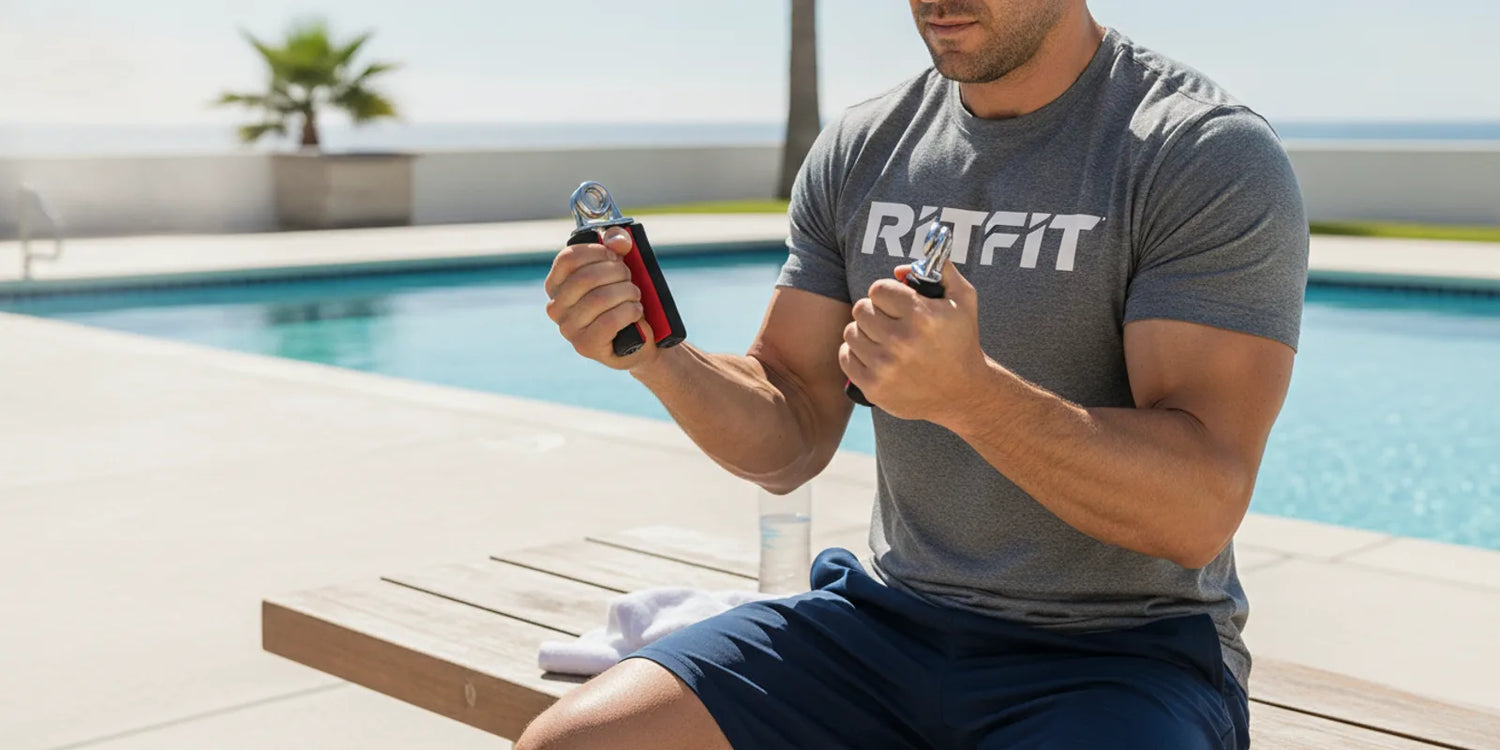
Finding the best hand exerciser in 2026 depends less on brand and more on matching the right tool type to your actual goal. A fixed-resistance gripper, an adjustable model, and a finger extension trainer each serve a different purpose, and choosing the wrong one slows your progress or causes strain.
This guide covers every major hand exerciser type, explains who each is best for, and gives you a clear decision framework, evidence-backed protocol, and the key mistakes to avoid so you can build grip that transfers to your lifts, sport, and daily life.
Quick Answer: The best hand exerciser for most people is an adjustable gripper with a wide resistance range, since it lets beginners start light and advanced trainees keep progressing without buying multiple tools. Athletes chasing benchmark strength prefer fixed-resistance grippers, while finger trainers and grip rings fill specialized roles in rehab and finger balance work.
Key Takeaways
- Type first: Fixed grippers build benchmark crushing strength; adjustable grippers offer the best all-around progression; finger trainers and grip rings serve rehab and balance work.
- Health benefit: A 2026 randomized controlled trial found that 8 weeks of home-based isometric handgrip exercise reduced systolic blood pressure by an average of 7.33 mmHg in hypertensive older adults.[1]
- Protocol matters: Training 2-3 times per week with adequate rest between sessions produces consistent grip gains without the tendon overuse risk that comes from daily high-intensity squeezing.
- Balance extension too: Pairing a closing gripper with a finger extension exerciser prevents the flexor-dominant imbalance that contributes to elbow and forearm pain over time.
- Compound lifts complete the picture: Hand exercisers are valuable supplements, but deadlifts, rows, and dead hangs remain the primary driver of performance-level grip strength.
What Types of Hand Exercisers Exist?
Hand exercisers fall into four main categories, each targeting grip strength from a different angle and suited to a different training need. Understanding the differences before you buy is the single most useful step you can take.
| Type | Resistance Style | Best Training Goal | Best For | Cost Note |
|---|---|---|---|---|
| Fixed-resistance torsion gripper | Fixed resistance levels | Milestone benchmark training | Serious lifters, grapplers, climbers | Higher per-level cost |
| Adjustable gripper | 5-100 kg range | Smooth incremental progression | Beginners, general fitness, coaches | Best value for most |
| Finger extension trainer | Light variable resistance | Corrects flexor/extensor imbalance | Desk workers, climbers, rehab users | Low cost |
| Grip ring / therapy putty | Very light, tactile | Gentle daily mobility and circulation | Seniors, arthritis, early rehab | Lowest cost |
| Multi-plane rehab device | Variable | Range of motion + strength combo | Post-surgery, OT rehab | Clinical / specialist use |
Categories reflect general market segments. Individual products vary; always verify resistance range before purchasing.
Fixed-Resistance Torsion Grippers
Fixed grippers use a spring-and-handle design with a single, unchangeable resistance rating per unit. Their primary advantage is precision: you always know exactly how hard a given close is, which makes milestone-based progression clear and motivating.
- Consistent feel: The resistance character does not change between reps or sessions, so every close is a true benchmark.
- Clear progression path: Moving from one resistance level to the next is a tangible achievement, especially valued by grapplers and competitive grip athletes.
- Durability: Quality fixed grippers made from aircraft-grade aluminum or steel last for years under heavy use.
- Limitation: Each resistance level is a separate purchase, making early-stage progression more expensive than adjustable alternatives.
Adjustable Grippers
Adjustable grippers use a dial or screw mechanism to change resistance across a continuous range, typically from around 5 kg up to 100 kg or more. A single tool covers beginner through advanced training without additional purchases.
- Cost efficiency: One adjustable gripper replaces an entire ladder of fixed-resistance units for most general fitness users.
- Smaller increments: You can progress in finer steps than fixed grippers allow, reducing the risk of stalling between levels.
- Shared use: A wide resistance range makes them practical for households or coaching settings where multiple people train at different levels.
- Trade-off: Adjustable mechanisms can feel slightly less precise than calibrated fixed grippers at maximum loads.
Finger Extension Trainers
Finger extension trainers target the extensor muscles on the back of the hand, which are almost entirely neglected by crushing-style grippers. Rock climbers, pianists, and desk workers who do significant repetitive gripping benefit most from adding extension work.
- Injury prevention: Balancing flexor and extensor strength reduces the strain on tendons that leads to lateral epicondylitis and golfer's elbow over time.
- Individual digit training: Most extension trainers let you load each finger independently, which is useful for identifying and correcting asymmetry.
- Compact and portable: They fit in a pocket and can be used at a desk or during rest periods.
Grip Rings and Therapy Putty
Grip rings and therapy putty provide very low-resistance, tactile hand exercise and are widely used in occupational therapy settings for older adults, early-stage rehabilitation, and circulation work.
- Arthritis-friendly: The gentle, malleable resistance of putty allows users to work through pain-free ranges of motion without loading tendons aggressively.
- Daily use: Low enough resistance for multiple short sessions per day without fatigue accumulation.
- Not for strength goals: Grip rings and putty do not provide enough progressive overload to build meaningful grip strength in healthy adults.
Why Does Grip Strength Matter?
Grip strength is one of the most studied proxies for overall physical health, and its benefits extend well beyond lifting heavier in the gym. A growing body of peer-reviewed evidence connects grip strength to cardiovascular health, functional independence, and daily-life performance.
- Blood pressure management: A 2026 randomized controlled trial found that 8 weeks of home-based isometric handgrip exercise significantly reduced systolic blood pressure by 7.33 mmHg and diastolic blood pressure by 3.6 mmHg in hypertensive older adults compared to controls, with no serious adverse events reported.[1]
- Lifting performance: Grip is the first link in every pulling movement. Deadlifts, rows, pull-ups, and farmer's carries all stall when hand strength fails before the target muscles do.
- Sport carryover: Grapplers, rock climbers, racket sport athletes, and baseball players all rely on sustained crushing and pinch strength. Hand exercisers provide targeted training that compound lifts alone do not fully replicate.
- Functional independence: Grip strength predicts the ability to open jars, carry groceries, and handle tools, making it a meaningful health marker across all age groups.
- Nervous system readiness: Physical therapist Jeff Cavaliere has noted that daily grip output is a practical readiness signal: a noticeable drop in squeezing force on a given morning often indicates incomplete nervous system recovery and warrants a rest day.
- Longevity signal: Multiple observational studies have linked low grip strength to higher all-cause mortality risk, positioning regular grip training as a low-cost health investment.
Using a hand exerciser alongside other functional and strength training tools lets you target these benefits at home, at the office, or while traveling, without any dedicated gym setup.
Which Hand Exerciser Is Right for Your Goal?
Choosing the right hand exerciser requires matching the tool to your primary training objective, current strength level, and how much you want to invest. The table below maps four common user profiles to the most appropriate tool type.
| User Type | Primary Goal | Recommended Type | Why |
|---|---|---|---|
| Beginner / general fitness | Build baseline grip strength, stay budget-friendly | Adjustable gripper (5-50 kg range) | Covers years of progression in one purchase; fine increments reduce injury risk |
| Serious lifter / grappler / climber | Maximize crushing force, track milestones | Fixed-resistance torsion gripper | Calibrated resistance gives clear benchmarks; best for sport-specific strength |
| Desk worker / musician / rehab user | Balance flexor/extensor ratio, prevent elbow issues | Finger extension trainer + adjustable gripper | Extension training corrects the imbalance that closing-only grippers create |
| Older adult / arthritis / early rehab | Maintain hand function, manage blood pressure | Grip ring or therapy putty + low-resistance adjustable gripper | Evidence supports safe daily use at low loads; clinical trial validates home-based isometric protocol[2] |
Recommendations reflect general-purpose training guidance. Consult a healthcare provider before starting any grip program if you have an existing medical condition.
Is a Mid-Range Adjustable Gripper Worth the Price?
An adjustable gripper in the mid-range price tier delivers the best value for most users because one tool eliminates the need for multiple fixed-resistance levels during early and intermediate training.
Budget options tend to lack the resistance range needed for long-term progression, while premium calibrated grippers are designed for competitive grip athletes. For most home gym users, pairing a quality adjustable gripper with the strength training equipment they already own covers the full spectrum of grip development.
How Do You Plan Long-Term Resistance Progression?
Long-term progression with a hand exerciser follows the same principle as any strength training tool: add resistance only when you can complete all sets with controlled, full-range movement.
For adjustable grippers, increase resistance by the smallest available increment when the top of your working set feels consistently easy across two consecutive sessions. Pairing grip training with foundational strength training principles ensures your progression stays sustainable.
How Do You Use a Hand Exerciser Effectively?
Effective hand exerciser training comes down to three variables: protocol design, progressive overload, and avoiding the overuse errors that sideline most beginners within the first month.
What Is the Right Sets, Reps, and Frequency?
A practical starting protocol for most adults is 3 sets of 10-15 full closes per hand, with 60 seconds of rest between sets, performed 2-3 times per week. Grip muscles recover faster than large compound muscle groups, but daily high-intensity training accumulates tendon stress quickly.
- Dynamic reps (beginners to intermediate): 3 sets of 10-15 full closes per hand, rest 60 seconds, 2-3 days per week.
- Isometric holds (intermediate to advanced): Hold each close for 5-10 seconds per rep, 3-4 sets per hand, same frequency.
- Endurance focus: 2-3 sets of 20-30 reps at lower resistance, useful for sport endurance and rehab carryover.
- Research-informed protocol: One validated handgrip study design used 32 sets of 5-second maximal squeezes with 5 seconds rest between sets, achieving 97% participant compliance across postmenopausal women.[3] This structure demonstrates how short work intervals with equal rest produce strong adherence for home-based grip training.
What Are the Most Common Mistakes to Avoid?
Most beginners make one or more of the following errors that either stall progress or cause preventable injury. Avoiding them from the start saves weeks of wasted training time.
- Training every day at high intensity: Grip tendons adapt more slowly than muscles. Skipping rest days leads to forearm and elbow pain within 2-3 weeks, especially for beginners.
- Skipping extension work: Using only a closing gripper without any finger extension training progressively tightens the flexor-extensor balance and increases golfer's elbow risk. Add an extension trainer or rubber-band extension exercise to every grip session.
- Starting too heavy: Beginning with a resistance that only allows 3-5 closes per hand trains pure max strength but limits volume, which is what beginners need most for tendon adaptation. Start lighter and build volume first.
- Partial closes only: Only using the gripper through part of its range limits the development of the smaller intrinsic hand muscles. Always aim for a complete, controlled close to full range.
- Neglecting the non-dominant hand: Most people are significantly stronger in their dominant hand. Training the weaker hand with equal volume reduces injury risk and improves overall functional strength.
- Progressing resistance too quickly: Increase resistance only when all sets feel controlled and repeatable across two consecutive sessions. Rushing ahead creates a technique and tendon gap that surfaces as pain.
For a complete home training setup that supports grip development alongside your other lifts, explore the strength machines collection and the CrossFit and functional training equipment range.
Should You Pair a Hand Exerciser with Compound Lifts?
A hand exerciser builds targeted crushing and pinch strength, but compound pulling movements remain the highest-volume grip stimulus available and should anchor any serious grip training program. The relationship between isolated grip tools and compound lifts is complementary, not substitutional.
Physical therapist Jeff Cavaliere, MSPT, CSCS, has noted that grip output is a useful daily readiness indicator:
"When people start to see a drop off of 10% or so of their grip output, you really should skip the gym that day."
Jeff Cavaliere, MSPT, CSCS, Physical Therapist and Strength Coach, Athlean-X
Which Compound Exercises Best Complement a Hand Exerciser?
The following compound and accessory movements provide the highest grip training stimulus as part of a complete strength program, and each of them transfers directly to improved gripper performance over time.
- Deadlifts and Romanian deadlifts: The highest-load grip stimulus available. Use a double-overhand grip as long as possible before adding straps to maximize grip development.
- Farmer's carries: Sustained grip under load across distance builds the endurance component of grip that dynamic close-and-open training misses.
- Dead hangs: Hanging from a pull-up bar for 30-90 second holds builds support grip and forearm endurance with no spinal loading. Ideal if back fatigue limits heavy deadlift frequency.
- Plate pinch holds: Pinching two weight plates together and holding them at arm's length for 20-30 seconds trains the pinch grip muscles that grippers and bar work leave underdeveloped.
- Rows and pull-ups: High-rep pulling movements accumulate meaningful grip volume across a full training week even without adding dedicated grip sessions.
The RitFit AuraSpin grip plates are particularly well suited to plate pinch holds and other loaded grip work. For grappling athletes and BJJ practitioners who need grip-intensive home training, see the home gym strength training for BJJ guide.
The video above demonstrates three practical grip exercises you can add to your lifting sessions, including plate pinch holds, cylindrical grip squeezes, and dead hangs, all of which pair directly with regular hand exerciser work.
For a broader look at progressive strength training that incorporates grip work alongside major lifts, the 5-3-1 strength training program for beginner lifters and the best strength training for women at home guide both address programming grip alongside compound movements. You can also explore tips for building strength and muscle size for additional progressive overload strategies.
FAQs About Hand Exercisers
How often should I use a hand exerciser to see results?
Most physical therapists and trainers recommend using a hand exerciser 2 to 3 times per week, allowing at least one rest day between sessions. Grip muscles recover faster than large muscle groups, but daily high-intensity training causes tendon strain over time. Consistent sessions over 6 to 8 weeks typically produce noticeable improvements in grip strength and endurance.
What is the best hand exerciser for beginners?
An adjustable gripper with a resistance range of roughly 5 to 50 kg is the best starting point for most beginners, allowing progression from light loads to challenging resistance in a single tool. Adding a finger extension exerciser gives a more balanced experience and reduces strain risk by training both the closing and extension sides of the hand.
Can a hand exerciser really improve your deadlift or pull-up performance?
A hand exerciser builds the crushing and pinch strength that supports deadlifts, rows, and pull-ups, but compound lifts themselves are the primary driver of performance-level grip. Using a gripper 2 to 3 times per week as a supplemental tool, paired with loaded carries and dead hangs, produces the best carry-over to heavier barbell and bodyweight movements.
How many reps and sets should I do with a hand gripper?
A common starting protocol is 3 sets of 10 to 15 full closes per hand, with 60 seconds of rest between sets, performed 2 to 3 times per week. Advanced trainees may use isometric holds of 5 to 10 seconds per close or endurance sets of 20 to 30 reps. Increase resistance only when all sets feel controlled across two consecutive sessions.
Is there a difference between a hand exerciser and a grip strengthener?
The terms are often used interchangeably, but hand exerciser is the broader category, covering extension trainers, therapy putty, grip rings, and closing devices. Grip strengthener typically refers to a spring-loaded closing gripper only. A complete program includes both closing and extension work to prevent the muscle imbalance that closing-only training creates.
Are hand exercisers safe for older adults or people with arthritis?
Low-resistance hand exercisers and therapy putty are widely used in occupational therapy for older adults and mild arthritis cases. A 2026 randomized controlled trial found home-based isometric handgrip exercise reduced blood pressure significantly with no serious adverse events. Individuals with acute joint inflammation or recent hand surgery should consult a healthcare provider first.
Conclusion
The best hand exerciser in 2026 is whichever type matches your goal. Adjustable grippers offer the best value for most people; fixed-resistance grippers suit athletes chasing benchmarks; finger extension trainers fill the balance role that closing-only tools leave open.
Train 2-3 times per week and pair your grip work with compound pulling movements. Browse the RitFit functional training equipment range to find tools that complement your setup, and use code RFBLOG at checkout.
Disclaimer
The information in this article is intended for general educational purposes and does not constitute medical advice, diagnosis, or a substitute for professional healthcare guidance. Individuals with existing medical conditions, injuries, or concerns about grip training should consult a qualified healthcare provider before beginning any new exercise program.
Save on your next RitFit order
Tap the button to copy your code, then paste it at checkout.
References
1. Champaiboon J, Jitkaew T, Rangkla S, Petchlorlian A. Effect of home-based isometric handgrip exercise with a commercially available device on blood pressure in older adults with hypertension: A randomized controlled trial. PLoS One. 2026;21(3):e0342563. doi:10.1371/journal.pone.0342563
2. Kong S. The effect of two different hand exercises on grip strength, forearm circumference, and vascular maturation in patients who underwent arteriovenous fistula surgery. Ann Rehabil Med. 2014;38(5):648-657. doi:10.5535/arm.2014.38.5.648
3. Bentley DC, Thomas SG. Maximal intermittent handgrip strategy: design and evaluation of an exercise protocol and a grip tool. Clin Interv Aging. 2016;11:589-601. doi:10.2147/CIA.S103046





