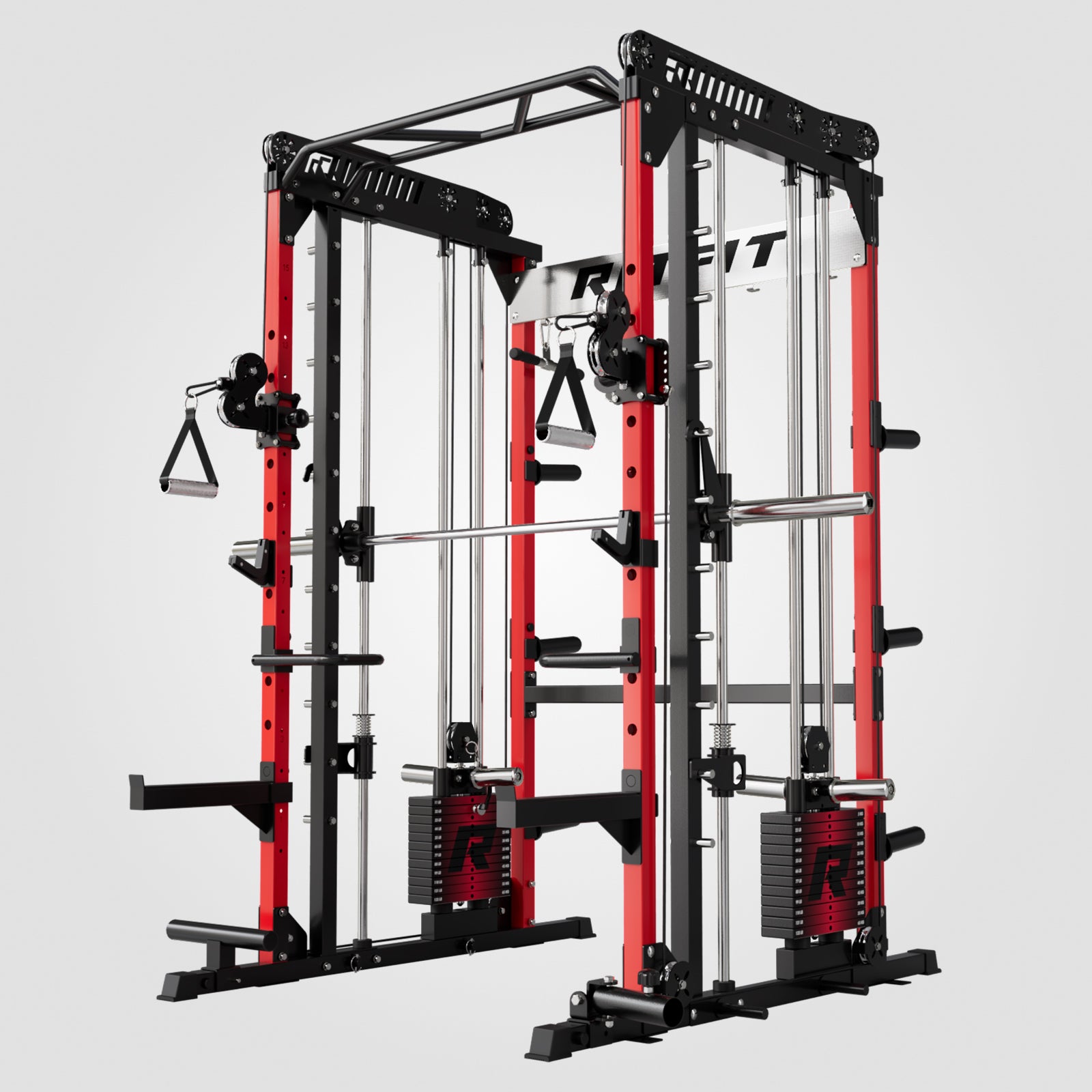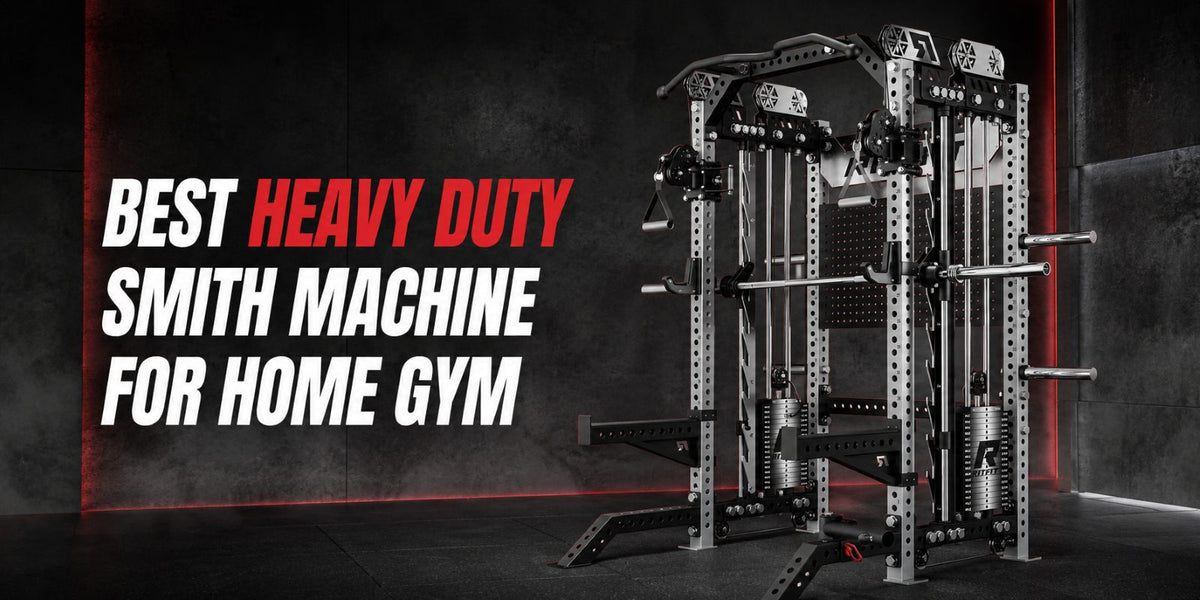
A heavy duty smith machine is only as heavy duty as the steel holding it together, and the RitFit M3 PRO is the strongest-built machine in RitFit's Smith line. This guide walks through the M3 PRO's load-bearing specs, its 2,500 pound frame rating, and how it compares to the M1 PRO and M2, so you can decide if it is the right heavy duty smith machine for your home gym.
You will get the exact construction, safety, and footprint numbers, plus honest pricing and upgrade notes, before you commit to a permanent station that weighs over 1,000 pounds.
Quick Answer: The RitFit M3 PRO is the strongest-built heavy duty smith machine in RitFit's Smith line, with a uniform 3x3 inch 11-gauge steel frame rated for 2,500 pounds, a 572-pound static Smith capacity, and 650-pound safety arms, all in a 21.5 square foot footprint that also houses a power rack and cable crossover.
Key Takeaways
- Frame: The M3 PRO uses a uniform 3x3 inch 11-gauge Q235 steel frame rated for 2,500 pounds, with 1,093.5 pounds of steel keeping it planted under heavy loads.
- Smith capacity: The Smith module holds 572 pounds static and 352 pounds dynamic, with 650-pound static safety arms for solo lifting.
- Three in one: A power rack, cable crossover, and Smith machine fit in a 21.5 square foot, 84 inch tall footprint.
- Comparison: The M3 PRO carries a heavier frame rating than the M1 PRO at 1,600 pounds and the M2 at 2,000 pounds, with built-in 180-pound stacks instead of plate-loaded cables.
- Price: The M3 PRO lists at $3,199.99 with a current promo at $2,815.99, a fair premium for a permanent three-station setup.
What Does Heavy Duty Really Mean for a Home Smith Machine?
A heavy duty smith machine for home use earns that label through frame construction, load capacity, and safety components rather than through marketing language, and the RitFit M3 PRO meets all three with a uniform 3x3 inch 11-gauge steel frame rated for 2,500 pounds.
A Smith machine guides the bar along a fixed vertical path, so the frame takes the brunt of every loaded rep. When uprights are thin or unevenly gauged, the bar can flex and wander under heavy weight, which is the last thing you want mid-squat.
- Steel gauge and upright size: 3x3 inch 11-gauge Q235 posts resist flex better than thinner 2x2 or 14-gauge tubes under max loads.
- Capacity ratings: A 2,500 pound frame rating plus separate static and dynamic Smith limits tell you what the machine can actually hold.
- Safety components: 650-pound static safety arms and J-hooks let you train heavy without a spotter.
- Planted mass: 1,093.5 pounds of steel keeps the rack from shifting when you rack a heavy squat.
Capacity alone does not make a machine safe, though. A 2025 review of resistance-training injuries identifies improper technique and excessive loading as key contributing factors and recommends progressive overload management.[1]
For a broader look at how a guided bar fits a home program, see Smith Machine Benefits for Your Home Gym.
How Much Weight Can the RitFit M3 PRO Frame Support?
The RitFit M3 PRO frame is rated for 2,500 pounds and built from uniform 3x3 inch 11-gauge Q235 steel, with 1,093.5 pounds of total steel mass that keeps the rack rigid under heavy presses, squats, and deadlifts.
Every upright on the M3 PRO measures 75x75x3 millimeters, which translates to a 3x3 inch 11-gauge profile. Unlike multi-station racks that step down to thinner rear posts, the M3 PRO keeps the same gauge front to back, so the frame does not flex when you load a near-maximal Smith squat.
- Frame capacity: 2,500 pounds of headroom means the frame is not the limiting factor in a heavy 1RM squat or deadlift.
- Smith bar capacity: 572 pounds static and 352 pounds dynamic, where the static rating covers a loaded hold and the dynamic rating covers a moving loaded bar.
- Safety arms and J-hooks: 650 pounds static each with 560-millimeter safety arms, so you can fail a solo heavy bench press safely.
- Height: 84 inches including the pull-up bar, which fits most garage and basement ceilings when you leave clearance for the bar path.
See the full spec sheet and current pricing on the RitFit M3 PRO Smith Machine page.
Smith Machine vs Free Weights for Heavy Lifting
A Smith machine fixes the bar path, so it removes the balance requirement and lets you push heavier loads or train to failure without a spotter, while free weights demand more stabilization and transfer better to unsupported movements.
A study found training on a Smith machine improved performance specifically on the Smith machine, while free-weight training showed better transfer to other strength tasks, and muscle thickness improved similarly in both groups.[2]
A study found prime-mover activation in the chest, triceps, and front delts was not significantly different between the Smith-machine and free-weight bench press in untrained men.[3]
- Push past plateaus: The fixed path and safety stops let you load more and grind out reps without a spotter.
- Keep transfer: Barbell and dumbbell work builds the stabilization that carries to sport and daily strength.
- Combine both: Alternating Smith and free-weight sessions captures hypertrophy from both without sacrificing either.
If you want to dial in the movement, read How to Do the Smith Machine Bench Press.
"The smith machine is great because it's going to take a lot of the pressure out of your shoulders because it's supporting itself and you can do a little bit more weight on here. So it can help you break some barriers too, and also if you don't have a spotter you can utilize the tabs, put that right here so if you drop it it'll just bounce and then you won't hurt yourself."
Jeff Cavaliere, MSPT, CSCS, Physical Therapist and Strength Coach, former Head Physical Therapist for the NY Mets, Athlean-X
Three Strength Stations in 21.5 Square Feet
The RitFit M3 PRO fits a power rack, cable crossover, and Smith machine into a single 21.5 square foot footprint, so you get three training stations without dedicating three separate zones of your garage or basement.
RitFit's founder describes the M3 PRO as the most complete home gym the brand has built, combining a power rack, cable crossover, and Smith machine in that footprint.
- Power rack: Squat, bench, and pull-up on the open rack side, with J-hooks and safety arms for free-bar work.
- Smith machine: A guided bar path for heavy presses and squats with a 572-pound static capacity.
- Cable crossover: 180-pound stacks per side at a 2:1 ratio for cable flys, lat pulldowns, and rows.
Browse the full RitFit Smith Machine collection to see every model in this footprint class.
RitFit M3 PRO vs M1 PRO vs M2: Which Fits You?
The RitFit M3 PRO is the premium permanent station in the line, the M1 PRO is the value pick with a plate-loaded cable, and the M2 is the modular choice with a 3D Smith option, so your pick depends on budget, space, and training frequency.
| Model | Steel Frame | Frame Capacity | Footprint | Height | Cable System | Price |
|---|---|---|---|---|---|---|
| RitFit M1 PRO | 2x2 14-gauge | 1,600 lb | 20.9 sqft | 85.3 in | Plate-loaded cable | $1,299.99 |
| RitFit M2 | 2.36x2.36 14-gauge | 2,000 lb | 22.8 sqft | 86.14 in | 3D Smith, optional horizontal | Config-dependent |
| RitFit M3 PRO | 3x3 11-gauge Q235 | 2,500 lb | 21.5 sqft | 84 in | 180 lb stacks per side | $3,199.99 ($2,815.99 promo) |
Specs reflect RitFit's published product pages as of 2026. Pricing is list MSRP; the M3 PRO promo price applies at the time of writing.
- Choose the RitFit M1 PRO if you want a lower price and are fine loading plates onto a cable system.
- Choose the M2 if you value modular flexibility and the 3D Smith horizontal movement option.
- Choose the M3 PRO if you lift heavy most days and want a permanent uniform 3x3 11-gauge frame with built-in stacks.
RitFit also offers plate-loaded and package alternatives such as the RitFit PSR05, RitFit Buffalo Smith Machine, and RitFit BPC06. For a deeper breakdown, read RitFit M3 PRO vs M2 vs M1 PRO.
Is the RitFit M3 PRO Worth the Price?
The RitFit M3 PRO is worth its $3,199.99 list price for frequent lifters who want a single permanent station, because you get a power rack, cable crossover, and Smith machine with built-in 180-pound stacks instead of buying three separate pieces.
At $3,199.99 list with a current promo at $2,815.99, the M3 PRO costs more than the M1 PRO, but the built-in stacks and heavier frame account for the difference. You skip buying a separate weight stack, a cable crossover, and a second rack.
- Built-in stacks: 180 pounds per side are included, so you are not adding plates to a cable system or buying a selectorized stack separately.
- One footprint: Three stations in 21.5 square feet replace three machines that would each need their own floor space.
- Permanent install: Over 1,000 pounds assembled means freight delivery, door clearance, and at least two people for assembly, so plan the location before it ships.
If you train three to five days a week and want one machine that does it all, the M3 PRO is the buy. Occasional lifters who only need guided bar work may be better served by a lower-priced plate-loaded model.
FAQs About the RitFit M3 PRO Heavy Duty Smith Machine
Is the RitFit M3 PRO strong enough for heavy lifting at home?
The M3 PRO is built for heavy loads.
Its uniform 3x3 inch 11-gauge steel frame carries a 2,500 pound rating and the assembled rack weighs over 1,000 pounds to stay planted.
The Smith module holds 572 pounds static, and each safety arm supports 650 pounds static, so solo lifters can push near-maximal loads safely.
What does the M3 PRO's 3x3 11-gauge frame actually mean?
That spec describes the uprights.
All three posts, front, middle, and rear, use 3 inch by 3 inch 11-gauge steel instead of stepping down to thinner tubing like many multi-station racks.
This uniform thickness keeps the frame rigid under load, so it does not flex or shift during heavy presses, squats, and deadlifts.
How much weight can the RitFit M3 PRO Smith machine hold?
The frame is rated for 2,500 pounds.
The Smith bar holds 572 pounds static and 352 pounds dynamic, the safety arms hold 650 pounds static each, and the J-hooks are rated 650 pounds static.
The built-in cable stacks provide 180 pounds per side at a 2:1 ratio.
Is the RitFit M3 PRO worth the price for a home gym?
For frequent lifters, yes.
5 square foot station with built-in 180-pound stacks per side, so you skip buying three separate pieces.
The 3x3 inch 11-gauge frame is rated for 2,500 pounds, which supports heavy solo lifting.
If you only need guided bar training, a lower-priced plate-loaded model may fit better.
How hard is the RitFit M3 PRO to assemble and move?
The M3 PRO arrives in one wooden crate and weighs over 1,000 pounds assembled, so plan for freight delivery, door clearance, and at least two people to help. RitFit provides detailed install guidance, but this is the heaviest rack in its line, so choose a permanent ground-level location before delivery.
Conclusion
The RitFit M3 PRO is the heavy duty smith machine for a serious home lifter: a uniform 3x3 inch 11-gauge frame rated for 2,500 pounds, a 572-pound static Smith, and 650-pound safety arms, all in a 21.5 square foot station. It is the premium pick in RitFit's Smith line, built for frequent heavy lifting rather than occasional guided-bar work.
Measure your ceiling and door clearance before ordering, and plan for freight and two-person assembly. Check current pricing and financing on the RitFit sales page.
Disclaimer
This article is for informational purposes only and does not replace professional medical or training advice. Consult a qualified coach or healthcare provider before starting a new heavy lifting program, especially if you have a prior injury or medical condition.
References
1. Kawa O, Zywiec W, Czyzewski B, et al. Most Common Injuries in Resistance Training: Mechanisms, Therapeutic Interventions, and Preventive Strategies. Cureus. 2025;17(10):e94035. PMCID: PMC12591260
2. Saeterbakken AH, Olsen A, Behm DG, Bardstu HB, Andersen V. The short- and long-term effects of resistance training with different stability requirements. PLoS One. 2019;14(4):e0214302. PMCID: PMC6443166
3. Wang L, Qiao X, Tao Y, et al. A comparison of muscle activation and concomitant intermuscular coupling of antagonist muscles among bench presses with different instability degrees in untrained men. Front Physiol. 2022;13:940719. PMCID: PMC9486837