Choosing the best home workout program for beginners to build muscle fast comes down to a simple rule: pick a repeatable full-body routine you can actually stick to. This guide gives you the exact program, sets and reps, starting-weight rules, and weekly progression you need to build noticeable muscle at home.
The plan below works with bodyweight alone and scales up to adjustable dumbbells and a bench, so you can start today no matter what gear you own. It also covers how to progress, common mistakes, and when to stop, so you train hard without guessing.
Quick Answer: The best home workout program for beginners to build muscle fast is a three to four day full-body routine built around squats, hinges, pushes and pulls, performed for three sets of eight to twelve reps. Add reps each week, then add weight, and you build muscle steadily at home with just adjustable dumbbells and a bench.
Key Takeaways
- Full-body wins for beginners: Full-body routines build muscle for untrained lifters as effectively as splits when weekly volume matches, and they are simpler to run at home.
- Train three to four days: Spread your weekly volume across three or four sessions so each muscle group gets frequent stimulus with recovery in between.
- Use three sets of eight to twelve reps: Keep sixty to ninety seconds of rest between sets for the right balance of effort and recovery.
- Progress with small steps: Add a rep or two each week, then raise the weight once you complete all sets with good form.
- Keep equipment simple: Adjustable dumbbells and a bench cover nearly every exercise a beginner program needs and let you keep progressing.
Why Is a Full-Body Routine Best for Beginner Muscle Growth?
A full-body routine trains every major muscle group multiple times a week, which gives a beginner the frequency and volume that drive early strength and muscle gains. A study of untrained adults found similar gains in strength and muscle thickness between split and full-body routines after eight weeks when weekly set volume was equal, so the simpler structure is the smart default at home. [1]
- Frequency without complexity: Training the same movements two or three times a week gives each muscle repeated stimulus while staying easy to plan.
- Recovery is built in: Four sessions with a rest day between most workouts lets your body rebuild while you still train often.
- Progression stays obvious: When the same lifts repeat all week, it is easy to see when a weight gets easier and time to add load.
New to structured training? Pair this plan with the beginner workout plan for females guide to match the structure to your goals.
What Equipment Do You Need to Build Muscle at Home?
You need adjustable dumbbells, a bench, and enough floor space to cover nearly every exercise in a beginner muscle-building program. A pair of adjustable dumbbells replaces a full rack of fixed weights and lets you add load in small steps as you get stronger.
- Adjustable dumbbells: One pair spans light to heavy loads, so you can progress without buying new weights each month.
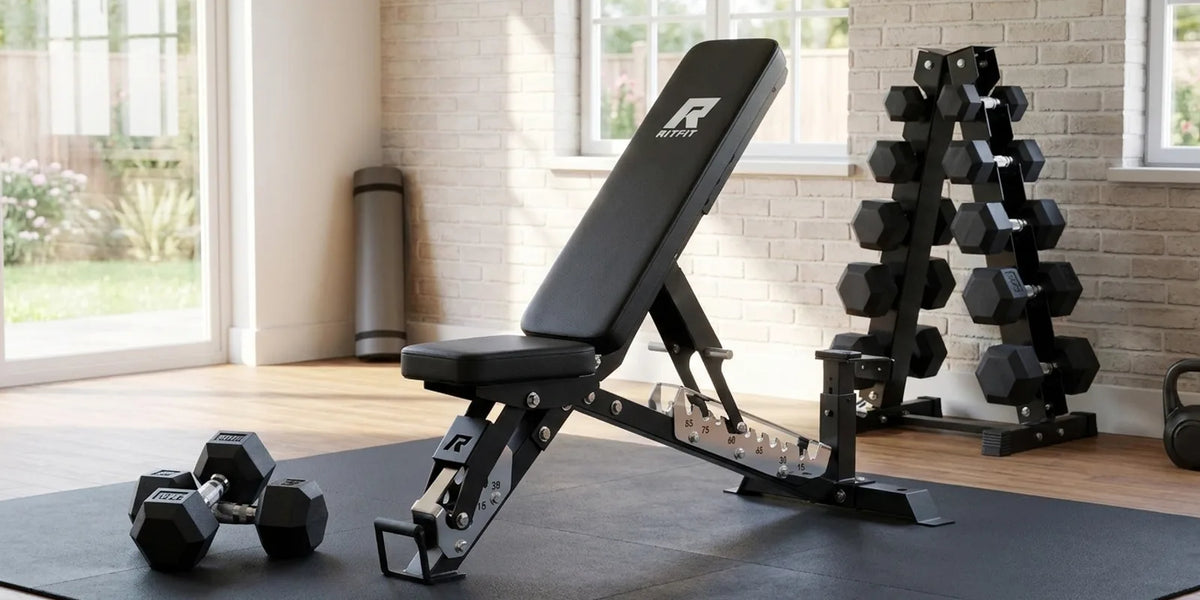
- Adjustable weight bench: A weight bench turns floor presses into full pressing work and supports rows, and incline settings reach the upper chest.
- Floor space and a mat: A clear area about the size of a yoga mat is enough for lunges, planks, and deadlifts.
For beginner lifters, the best dumbbells for beginners to build muscle guide walks through weight ranges and pair types, so you can choose dumbbells that fit this program.
What Is the Best 4-Day Home Workout Program for Beginners?
The best 4-day home workout program for beginners is a full-body split that alternates two workouts across four days, so every major muscle group is trained twice a week. Monday and Thursday run Workout A, while Tuesday and Friday run Workout B.
- Workout A: Lower-body, back, and chest focus with squats, rows, and pushes.
- Workout B: Legs, shoulders, and arms focus with lunges, presses, and curls.
- Rest days: Wednesday, Saturday, and Sunday are off or light, which keeps recovery in balance.
This structure gives you four training sessions per week with a rest day between almost every session, which is the sweet spot for a beginner building muscle at home.
"If your space is limited, a good set of adjustable dumbbells might be your better option. They will allow you to progress to heavier weight as you get stronger."
Jeff Cavaliere, MSPT, CSCS, Athlean-X
The 4-Day Program at a Glance
Each session takes about 30 to 40 minutes and follows one template: a short warm-up, five core lifts, and a core finisher. The table below shows how the two workouts fit across the week.
| Workout | Days | Sample exercises |
|---|---|---|
| Full-Body A | Monday and Thursday | Goblet squat, dumbbell row, push-up, shoulder press, glute bridge |
| Full-Body B | Tuesday and Friday | Reverse lunge, dumbbell deadlift, floor press, lat row, biceps curl |
Both workouts run twice a week, so each muscle group gets two sessions with at least one rest day between them.
Warm up with five minutes of light cardio and dynamic stretches before each session, and finish with a brief cool-down walk.
Day 1 and Day 3: Full-Body Workout A
Workout A starts with the biggest lower-body and back movements, then finishes the upper body with pushing and pulling. Complete each exercise for three sets of eight to twelve reps with controlled form.
- Goblet squat: Hold one dumbbell at your chest and squat to at least parallel, keeping your heels down.
- Dumbbell Romanian deadlift: Hinge at the hips with a soft knee until you feel a hamstring stretch.
- Dumbbell row: Brace on the bench and row the dumbbell to your hip with a straight back.
- Push-up: Drop to your knees if needed, and keep your body in a straight line.
- Dumbbell shoulder press: Press from shoulder height to full lockout without arching your back.
- Plank: Hold with your hips level and your core braced.
For more pulling and pressing ideas, the best back workouts at home guide adds variety to Workout A.
Day 2 and Day 4: Full-Body Workout B
Workout B emphasizes the legs, shoulders, and arms so the week stays balanced across all major muscle groups. Use the same three sets of eight to twelve reps template.
- Reverse lunge: Step back into a lunge and drive through the front heel to return.
- Dumbbell deadlift: Deadlift from the floor with a flat back and the weight path close to your legs.
- Floor press or bench press: Lie on the bench and press the dumbbells above your chest with control.
- Lat row: Row with a long spine and squeeze your shoulder blades together.
- Biceps curl: Curl with a full range of motion and no swinging.
- Side plank: Hold on each side with your hips stacked.
The hamstring workouts with a home bench guide adds targeted leg work you can swap into Workout B.
How Many Sets and Reps Should a Beginner Do?
A beginner-friendly target is three sets of eight to twelve repetitions per exercise, with sixty to ninety seconds of rest between sets. That rep range is exactly what a study of untrained adults used when it produced clear gains in strength and muscle thickness over eight weeks. [1]
- Sets: Three working sets per exercise balances enough volume with a manageable session length.
- Reps: Stay in the eight to twelve rep range; if you cannot reach eight, lighten the load.
- Rest: Sixty to ninety seconds between sets keeps intensity high without dragging the workout out.
How Do You Choose Your Starting Weight?
Pick a weight you can lift with clean form for at least eight reps but that makes the last two reps of a set genuinely challenging. If you finish every set easily, move up; if your form breaks before eight reps, move down.
- Start light: Your first session is a test, so err on the lighter side and learn the movement.
- Last two reps hard: The weight is right when the final two reps of each set are difficult but clean.
- Adjust by exercise: Squats and presses need different loads, so choose a weight for each one separately.
How Do You Progress and When Do You Add Weight?
Add a rep or two to your sets each week, and raise the weight only once you complete every set and rep with controlled form. A study of untrained trainees found that spreading the same weekly volume across three sessions built more strength than one session with less fatigue, which is why this program trains full body three to four days a week. [2]
- Add reps first: Increase to ten, eleven, then twelve reps before you think about adding weight.
- Then add weight: Move up by the smallest step available, often five pounds or less.
- Two-week rule: If you complete all sets and reps with good form twice in a row, it is time to progress.
What If You Have No Bench or Heavy Dumbbells?
Swap any exercise for a bodyweight or dumbbell variation and keep the same set and rep structure, then progress by adding reps. A published case report shows a simple full-body routine can be progressed by adding a few repetitions each week, which works when your equipment options are limited. [3]
- No bench: Do floor presses and push-ups instead of bench presses, and use floor glute bridges for hip work.
- No heavy dumbbells: Add reps, slow the tempo, or use single-leg variations to make bodyweight harder.
- Resistance band: A band adds load to rows and presses when weight is limited.
If you prefer other tools, the beginner kettlebell workout guide and the home CrossFit workouts guide show alternate programming styles for the same goal.
What Mistakes Stop Beginners From Building Muscle at Home?
The biggest mistakes are lifting too heavy too soon, skipping rest days, and changing exercises every week so no progression baseline forms. Avoid them and the program above works as designed.
- Too heavy too soon: Heavy loads with poor form lead to pain and stalls before muscle builds.
- Skipping rest: Muscle is built between sessions, so honor your rest days.
- Constant variation: Keep the core lifts stable and progress them instead of chasing novelty.
When Should You Stop or Modify an Exercise?
Muscle soreness the day after training is normal, but sharp or joint pain during an exercise is a sign to stop and modify the movement. Train hard, keep every rep controlled, and take a rest day when soreness limits your range of motion.
- Soreness: Mild soreness is expected and fine to train through at a lighter load.
- Sharp pain: Stop immediately, reduce the range or the load, and pick a substitute.
- Form first: If your last rep looks nothing like your first, the set is over.
Add a conditioning day with the best HIIT workouts for beginners guide if you want to mix cardio into the program.
Which Equipment Setup Fits Your Program and Budget?
Match your setup to your space and budget: adjustable dumbbells alone support a full three-day routine, adding a bench unlocks pressing and rowing variations, and a complete home gym lets you run barbell compound lifts.
| Setup | Typical program | Best for |
|---|---|---|
| Adjustable dumbbells only | 3 full-body sessions a week with bodyweight and dumbbell lifts | Smallest footprint and lowest cost |
| Adjustable dumbbells plus adjustable bench | 3 to 4 full-body sessions a week with all major lifts | Mid cost and medium footprint, fits most beginners |
| Full home gym with power cage and barbell | 4 sessions a week with barbell compound lifts | Highest cost and largest footprint, supports long-term progression |
All three setups run the same full-body program; the difference is how much load you can add over time.
For a setup that removes the upgrade path entirely, the RitFit Home Gym Package M1 Smith Machine and the RitFit Home Gym Package PSR05 Smith Machine bundle a rack, bar, and bench into one package. If you already own a bench, grab a pair from the dumbbells collection and run the three-day version today.
FAQs About Building Muscle at Home
How many days a week should a beginner train to build muscle at home?
Three to four full-body sessions a week is a strong starting point.
A study of untrained adults found that spreading the same weekly volume across more sessions produced gains as good as fewer, harder sessions.
Three or four days also leaves a rest day between most workouts, and recovery is when muscle gets built.
How fast can a beginner build muscle at home?
Most beginners notice measurable strength gains within six to eight weeks of consistent training.
A study of untrained adults found clear increases in strength and muscle thickness after eight weeks of structured resistance training.
The fastest progress usually happens in the early weeks, so stay consistent and the results show up quickly.
Do I need heavy equipment to build muscle at home?
No.
A pair of adjustable dumbbells, a bench, and floor space cover most of a beginner muscle-building program.
Adjustable dumbbells are especially useful because they let you progress from light to heavy weight as you get stronger without buying a rack of fixed dumbbells.
A barbell and squat stand unlock even more exercises later.
What is progressive overload for beginners?
Progressive overload means gradually making training harder so your muscles keep adapting.
The simplest beginner version is to add a rep or two each week, then increase the weight once you complete all sets and reps with good form.
Small steady increases beat jumping to heavier weight too quickly, which risks poor technique and injury.
Should beginners train full body or a split?
Full-body workouts are the best place for beginners to start.
Training the same major movements three or four times a week gives each muscle frequent stimulus with enough recovery between.
A study of untrained adults found full-body and split routines produced similar gains when weekly volume matched, so pick the structure that fits your schedule.
How many sets and reps should a beginner do per exercise?
A beginner-friendly range is three sets of eight to twelve repetitions per exercise, matching the rep range used in studies of untrained adults that produced clear strength and muscle gains.
Keep sixty to ninety seconds of rest between sets.
If you cannot finish the planned reps with good form, the weight is too heavy.
When should I increase the weight on an exercise?
Increase weight when you complete all your sets and reps with controlled form on two consecutive workouts.
Add the smallest step available, often five pounds or less with adjustable dumbbells.
If form breaks down before the final rep, stay at the current weight for another week.
Progression should feel challenging but never sloppy.
Can beginners build muscle using only bodyweight exercises?
Yes, for the first few weeks bodyweight movements such as push-ups, squats, and rows build a solid foundation.
The challenge is that bodyweight alone makes it hard to keep progressing.
Adding adjustable dumbbells or a bench lets you load beyond bodyweight, which is how muscle size continues to grow after the beginner phase.
Conclusion
The best home workout program for beginners to build muscle fast is simple: train full body three or four days a week, do three sets of eight to twelve reps, and add a rep or weight each week. Adjustable dumbbells and a bench give you everything you need to keep progressing for months.
If you want to scale this program further, browse the RitFit sales page for complete home gym packages that let you train heavier with barbells and a power cage. Pick a starting weight, schedule your four sessions, and begin this week.
Disclaimer
This article provides general fitness information and does not replace professional medical advice. Consult a qualified healthcare provider before starting any new exercise program, especially if you have an injury, a medical condition, or have been inactive for a long time.
References
1. Evangelista AL, Braz TV, La Scala Teixeira CV, et al. Split or full-body workout routine: which is best to increase muscle strength and hypertrophy?. Einstein (Sao Paulo). 2021;19:eAO5781. doi:10.31744/einstein_journal/2021AO5781. PMCID: PMC8372753
2. Ochi E, Maruo M, Tsuchiya Y, Ishii N, Miura K, Sasaki K. Higher Training Frequency Is Important for Gaining Muscular Strength Under Volume-Matched Training. Front Physiol. 2018;9:744. doi:10.3389/fphys.2018.00744. PMCID: PMC6036131
3. Ravara B, Giuriati W, Maccarone MC, Kern H, Masiero S, Carraro U. Optimized progression of Full-Body In-Bed Gym workout: an educational case report. Eur J Transl Myol. 2023;33(2). doi:10.4081/ejtm.2023.11525. PMCID: PMC10388607