








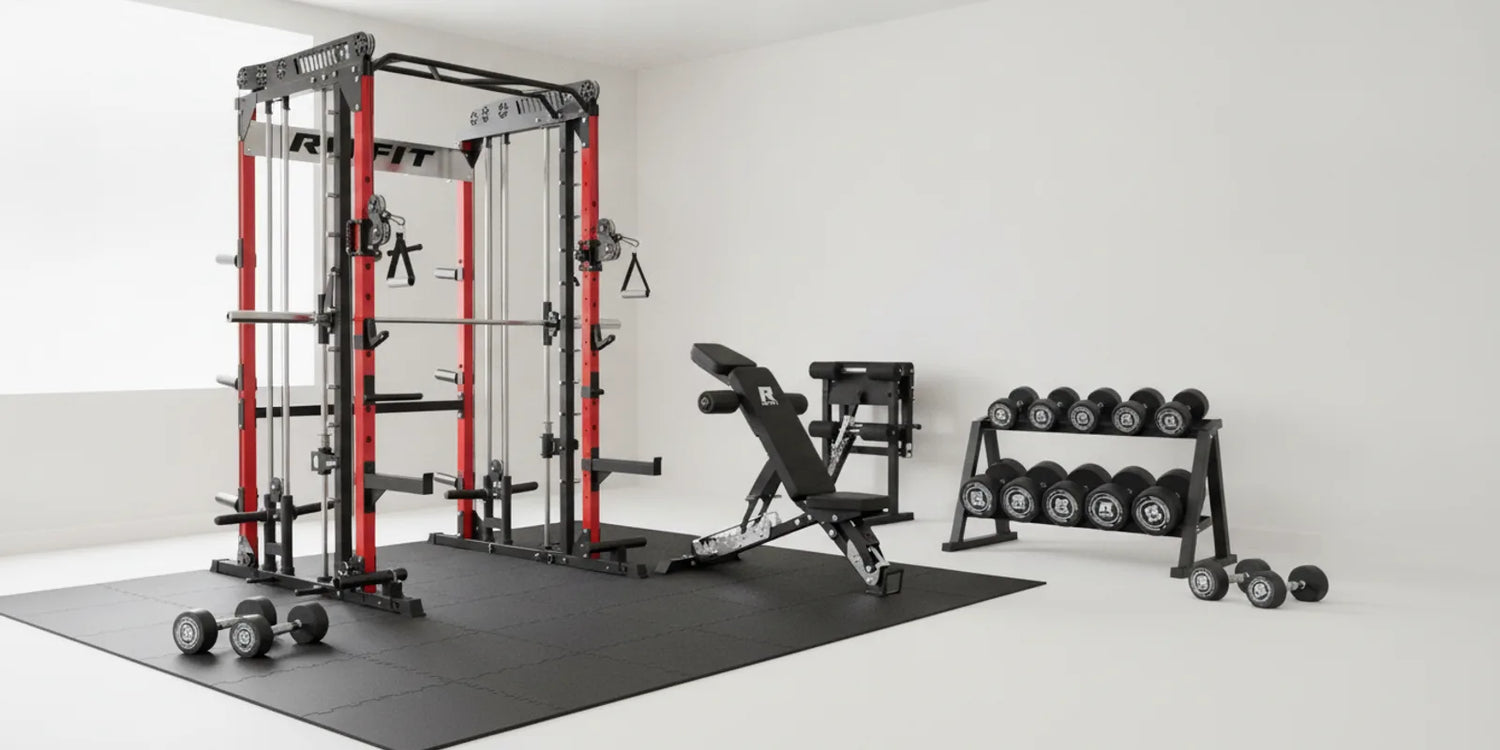
Building the best house gym in 2026 means getting the right equipment in the right order, so every dollar you spend actually gets used. This guide matches RitFit equipment options to your budget, space, and fitness goals so you can train hard without ever driving to a commercial gym again.
Whether you have a single-car garage, a spare bedroom, or a low-ceiling basement, you'll find a practical setup path here, along with the most common mistakes to skip and the safety habits that matter most when you're training alone.
Quick Answer: The best house gym starts with a power rack or Smith machine, a barbell with plates, and an adjustable bench in a minimum 8x8 foot space with 8-foot ceilings. RitFit's product line scales from compact starter racks to all-in-one Smith machine systems that cover every major compound lift at any budget.
Key Takeaways
- Minimum Space: You need at least 8x8 feet (64 sq ft) and 8-foot ceilings to fit a power rack and barbell with room to load plates safely.
- Starter Cost: A functional house gym covering all major compound lifts starts around $500 to $1,000 for rack, barbell, bench, and flooring.
- Equipment Priority: Buy rack first, then barbell and plates, then bench, then flooring. Everything else comes after this foundation is in place.
- Research Support: A scoping review found that having exercise equipment at home is positively associated with increased moderate-to-vigorous daily physical activity.[3]
- RitFit Options: RitFit's line scales from compact starter racks under $1,000 to all-in-one Smith machine systems with integrated cables for serious home athletes.
Why a House Gym Is Worth the Investment in 2026
A house gym pays for itself in under two years compared to a commercial gym membership, and the convenience of training on your own schedule removes the single biggest barrier to consistency. Beyond the financial math, having equipment at home creates an environment that directly supports daily physical activity habits.[3]
The fitness case is equally strong. A systematic review and meta-analysis found that home-based HIIT was as effective as lab-based protocols in improving cardiorespiratory fitness, showing that the training quality of a properly equipped house gym matches what you'd get in a facility.[1]
- No commute: Eliminating a 20-30 minute round-trip drive removes the most common reason people skip workouts.
- No wait times: Every piece of equipment is always available, which means you run your program as written instead of improvising around busy squat racks.
- Privacy and focus: Training alone or with a partner removes social distractions and lets you train at the intensity your program requires.
- Long-term savings: After the break-even point, your only ongoing costs are maintenance and occasional equipment upgrades.
- Flexible programming: A rapid review found that home-based multi-component programs combining aerobic, resistance, and flexibility training showed consistent positive effects on weight management,[2] confirming that a house gym can handle full-spectrum training when equipped correctly.
The investment calculus is straightforward: a $1,000 setup against a $50-per-month membership means you break even in under two years, then train free for the life of the equipment.
How Much Space Do You Need for a House Gym?
The minimum functional space for a house gym is 8x8 feet (64 sq ft), which fits a standard power rack and a 7-foot barbell with enough room to load plates on both sleeves. Ceiling height needs to be at least 8 feet for any rack with an integrated pull-up bar.
Minimum Setup: 50 to 80 Square Feet
A 50 to 80 sq ft space fits adjustable dumbbells, a foldable bench, and a doorway pull-up bar for a bodyweight-plus setup. For barbell training with a compact rack, 64 sq ft (8x8 feet) is the practical floor, with a full 7-foot barbell requiring at least 8 feet of length to load plates without hitting a wall.
Full Build: 100 to 200 Square Feet
A 100 to 200 sq ft space allows a full power rack or Smith machine with attachments, an adjustable bench, dumbbells, and a dedicated deadlift platform with room to move between stations. A single-car garage bay (roughly 10x20 feet) is the most common full-build footprint in American homes.
Ceiling Height Requirements
Standard power cages run 80 to 84 inches tall, meaning you need at least 8 feet of overhead clearance. Basements with 7-foot ceilings are best served by a compact half rack, a wall-mounted fold-flat rack, or a Smith machine system.
- Garage gyms: Check for sloped ceilings near garage doors before positioning a full-height rack.
- Basement gyms: Measure at multiple points, as HVAC ducts and beams often reduce usable headroom in the training zone.
- Apartment gyms: Focus on adjustable dumbbells, a foldable bench, and resistance bands. Barbell drops and jumping exercises create noise and impact issues for floors below.
Before buying any rack, measure your ceiling at the exact spot where the unit will sit, then check the product's assembled height with the pull-up bar included. RitFit's space planning resources can help you confirm clearances before placing an order.
What Equipment Should You Buy First?
The right purchase order for a house gym is power rack or Smith machine first, then barbell and weight plates, then an adjustable bench, then rubber flooring, then accessories. Buying in this sequence means every purchase unlocks the next tier of exercises rather than creating equipment that can't be used without what you're still missing.
Foundation: Power Rack or Smith Machine
A power rack or Smith machine is the centerpiece of any serious house gym because it makes barbell training safe to do alone. Safety bars or spotter arms catch a failed squat or bench press without needing a training partner, which is the defining difference between a setup you'll actually push hard on and one you'll sandbag for safety.
- Four-post power rack: Maximum exercise variety, open footprint, works with any standard barbell. Best for experienced lifters with 8x8 feet or more.
- Smith machine system: Guided barbell path adds an extra layer of safety for solo training, and modern all-in-one units integrate cable columns, pull-up bars, and landmine attachments into a single footprint. Ideal for lifters who want a full-system solution without multiple separate pieces.
- Half rack or wall-mounted fold-flat rack: Best choice for spaces under 80 sq ft or ceilings under 8 feet. Footprint folds away when not in use.
Barbell and Weight Plates
A standard 7-foot Olympic barbell with 300 lb of cast iron plates covers every major compound lift for most home athletes. Cast iron is the most cost-effective plate material for house gyms where dropping weights is not a regular part of the programming.
- Plate type: Cast iron for powerlifting and standard strength training. Bumper plates if you Olympic lift or regularly drop from overhead.
- Starting weight: 300 lb of plates is enough for years of squats, deadlifts, bench press, and overhead press for intermediate lifters.
- Barbell diameter: A 28.5 mm to 29 mm diameter bar is the most durable and versatile choice for a house gym; avoid 32 mm bars.
Adjustable Bench
An adjustable bench unlocks flat bench press, incline press, seated overhead press, and dumbbell work, making it the third most important purchase in a house gym. Look for a bench rated to at least 600 lb (body weight plus the loaded bar) with multiple incline settings including flat, 30-degree, 45-degree, and upright for seated presses.
Rubber Flooring
Rubber flooring protects your subfloor from dropped plates, deadens impact noise for rooms below, and prevents equipment from sliding during heavy sets. Install flooring before your first training session, not after the first scuff mark appears.
- Best option for concrete floors: 3/4-inch thick rubber horse stall mats are the most cost-effective solution, available at farm supply stores for roughly $50 per 4x6 foot section.
- Under a rack or Smith machine: Lay at minimum one 4x6 mat under each upright, plus one mat in front for the lifting zone.
- Wood subfloors: Build a plywood lifting platform (two layers of 3/4-inch plywood topped with a rubber mat) to distribute deadlift impact and protect the structure.
Browse RitFit Home Gym Ideas for layout photos showing how different flooring configurations work in real garage and basement setups.
RitFit House Gym Decision Matrix by Budget and Goal
The right RitFit setup depends on three variables: how much you want to spend, how much space you have, and whether your priority is raw strength, functional variety, or a full-system approach that eliminates the need for multiple standalone pieces.
| RitFit Option | Budget Tier | Best For | Key Feature |
|---|---|---|---|
| Starter Power Rack | Under $1,000 | Beginners, barbell-first builds | Safety bars, pull-up bar, compact footprint |
| RitFit M1 Smith Machine | ~$1,500 | Solo trainers wanting guided bar + cable | Linear bearings, integrated cable, 1,000 lb capacity |
| RitFit M2 Smith Machine | ~$1,800 | Intermediate lifters, multi-angle pressing | Enhanced footprint, multi-angle press, 1,200 lb capacity |
| RitFit M3 Smith Machine | ~$2,200 | Serious home athletes, commercial-feel build | Full cable column, 1,500 lb capacity, premium build |
| RitFit M1 PRO | ~$2,500 | Advanced lifters, all-in-one system | Expanded cable range, heavy-duty construction |
| RitFit BUFFALO | Mid-range | Space-conscious setups, quick install | Multi-functional, compact, install in minutes |
Budget tiers are approximate. Visit each product page for current pricing and package options.
Starter Build Under $1,000, RitFit Power Racks
A RitFit starter power rack pairs with a barbell and plate set to build the foundation of a house gym that covers squats, bench press, deadlifts, overhead press, and pull-ups for under $1,000. This is the right call for anyone new to strength training or converting a small space for the first time.
- Who it is for: Beginners, college athletes setting up a first home gym, or anyone testing whether house gym training fits their routine before investing more.
- What to add first: Barbell and plates, then an adjustable bench. Rubber flooring before anything else loads the floor.
- Upgrade path: A starter rack is a permanent fixture. When you outgrow the weight capacity, you upgrade the barbell and plates rather than the rack itself, keeping your initial investment intact.
Explore the Truemed Eligible Gym Rack collection if you plan to use HSA/FSA funds. Many RitFit racks qualify for tax-advantaged health account spending under the 2023 HSA/FSA fitness equipment expansion.
Mid-Range Build $1,000 to $2,500, RitFit Smith Machines (M1 / M2 / M3)
The RitFit M1, M2, and M3 Smith machines step up from a basic rack by integrating a guided barbell path, cable columns, and multi-function attachments into a single footprint, which matters when you're training solo and want both safety and exercise variety without buying separate cable machines.
- RitFit M1: Entry point into the Smith machine line. Linear bearings deliver smooth bar travel. Integrated cable column handles rows, pulldowns, and cable flys. Capacity: 1,000 lb. Fits most 10x10 ft house gym spaces.
- RitFit M2: Wider footprint and multi-angle press positioning for incline, flat, and decline variations within the Smith frame. Capacity: 1,200 lb. Best for intermediate lifters who want pressing versatility.
- RitFit M3: Full cable column with independent weight stack, 1,500 lb Smith capacity, and commercial-grade build quality. This is the professional-level house gym anchor for serious athletes who want a commercial gym experience at home.
See how real athletes configure their setups in Chase DeMoor's Gym and Kendra Herber's Gym for practical layout inspiration.
Full Build $2,500 and Up, RitFit All-in-One Systems (BUFFALO / M1 PRO)
The RitFit BUFFALO and M1 PRO are the top-tier house gym anchors for lifters who want everything in one unit, from heavy Smith bar training to full-range cable work to specialty attachment compatibility, all without dedicating separate floor space to a standalone functional trainer.
- RitFit BUFFALO: Multi-functional Smith machine that installs in minutes and fits compact house gym footprints. The quick-setup design makes it the right call for renters or anyone who may need to move the unit. Read Jarell Carter's Gym to see the BUFFALO in a real athlete setup.
- RitFit M1 PRO: All-in-one system with expanded cable range and heavy-duty construction for advanced lifters running high-volume programming that demands both barbell and cable work in every session.
Browse Jake Miller's Gym and Jamaal Lewis's Gym for additional full-build examples built around top-tier RitFit systems.
Watch RitFit's own team walk through a real house gym build:
For women-focused house gym layouts, Cathy Ding's Gym and Kiaya Jackson's Gym show how RitFit Smith machines and racks anchor performance-first home setups for female athletes.
What Are the Long-Term Upgrade and Expansion Costs of a House Gym?
A well-built house gym has low ongoing costs once the core equipment is in place, because the foundation pieces, rack, barbell, and bench, are durable enough to last decades with basic maintenance. The upgrade path is additive rather than replacement-driven: you add to what you have rather than replace it.
- Additional plates ($100 to $300): Most intermediate lifters add a second plate set within 12 to 18 months as their lifts progress past the capacity of the starter set.
- Adjustable dumbbells ($150 to $500): The single highest-value accessory add-on for any house gym. A full adjustable set replaces multiple pairs of fixed dumbbells and takes up minimal floor space.
- Cable machine or functional trainer ($300 to $800): If your rack or Smith machine does not include an integrated cable column, a wall-mounted or freestanding cable station is the next functional upgrade. For RitFit Smith machine owners, cable work is already built in.
- Cardio equipment ($250 to $1,000): Add a rower, air bike, or treadmill only after your strength foundation is fully established. Cardio equipment first is the most common sequencing mistake in house gym builds.
- Specialty bars ($150 to $300): A safety squat bar or EZ curl bar adds exercise variety after the core programming is dialed in. Not a priority purchase for most house gym owners.
- Maintenance (minimal annual cost): Barbell lubricant, occasional collar replacement, and mat cleaning. Cast iron plates and steel frames require almost no maintenance with basic care.
The total five-year cost of a $1,000 house gym, including a typical upgrade path to adjustable dumbbells and additional plates, runs $1,500 to $2,000, which is less than three years of a $50-per-month gym membership.
Is a House Gym Worth It vs. a Gym Membership?
A house gym is worth it for anyone who trains consistently three or more times per week and plans to stay in the same location for at least two years. At that frequency and time horizon, the financial break-even happens before the end of year two, and every session after that point is effectively free.
- Break-even calculation: A $1,000 house gym vs. $50 per month gym membership = break-even at 20 months. A $2,000 house gym = break-even at 40 months.
- Time value: Eliminating a 30-minute round-trip commute to the gym saves 26 hours per year for someone training 4 days per week, or roughly one full training day per month recovered as productive time.
- Consistency advantage: No weather excuses, no hours-of-operation limits, no crowded equipment during peak hours. You train when your schedule says to train, not when the gym is available.
- When a gym membership still makes sense: If you train infrequently (fewer than 2 times per week), need specialized equipment you can't replicate at home (Olympic platforms, full-rack specialty bars), or enjoy the social environment of a commercial gym, a membership may be the better fit.
The break-even math clearly favors house gym ownership for regular lifters. The non-financial benefits, consistency, privacy, convenience, reinforce that conclusion for anyone committed to a long-term training practice.
What Are the 5 Most Common House Gym Setup Mistakes?
The five most common house gym mistakes all share the same root cause: buying in the wrong order, or optimizing for appearance over function before the training foundation is in place.
- Buying cardio equipment first: Treadmills and ellipticals are the default first purchase for many beginners, but strength equipment is the foundation. A barbell, rack, and bench deliver more fitness return per dollar than any cardio machine, and cardio can be substituted with running, jumping rope, or an air bike added later.
- Skipping flooring: Training on bare concrete without rubber mats damages both the floor and the equipment. A single dropped plate can crack concrete, split cast iron, or dent a steel frame. Rubber mats are a $50 to $150 insurance policy on a $1,000 to $2,500 equipment investment.
- Underestimating space and ceiling height: Measure before you order. Many first-time buyers discover their 7-foot basement ceiling can't accommodate the rack they ordered, or that their 8x8 space doesn't leave room to deadlift after the bench is in position.
- Buying the cheapest barbell: Entry-level no-brand barbells bend permanently under moderate loads and have rough knurling that shreds your hands. Spend slightly more for a 28.5-29 mm bar with a verified weight rating. The barbell is the most-used piece of equipment in any house gym.
- Buying everything at once: Spreading purchases over time lets you evaluate what you actually use before committing to the next tier. Start with the core four (rack, barbell, bench, flooring), train consistently for 90 days, and then upgrade based on what your programming actually requires.
Check the Lexie Brown's Gym collection for an example of a clean, practical house gym build that prioritizes function and avoids common setup errors.
What Safety Habits Are Non-Negotiable for a House Gym?
Solo house gym training is safe when you use equipment correctly and set up your safety systems before your first heavy session. The risk is not the equipment itself but lifting without those systems in place.
- Set safety bars or spotter arms before every session: Position them just below your lowest squat depth for squats, and at chest height for bench press. Every session, every time. Practice failing safely with an empty bar before you load anything heavy.
- Never skip the warm-up: Cold muscles and connective tissue in a home environment (especially garages in winter) are more vulnerable to strains. Three to five minutes of movement prep before every session is not optional.
- Secure the equipment to the wall or floor if required: Tall racks can tip under lateral load if not anchored. Check your rack's installation manual for anchoring requirements before use.
- Ventilate your space: Unventilated garages become dangerously hot in summer. A box fan or portable standing fan is the minimum. Overheating impairs performance and increases injury risk during high-effort sets.
- Keep a phone within reach: If you train alone and fail a lift in a way the safeties don't fully catch, you need to be able to call for help. This is especially true during max-effort single rep attempts.
Keep your chalk, belt, and straps organized and within reach during every session. The RitFit Waterproof Gym Bag is a practical way to keep accessories ready without cluttering your training floor.
FAQs About Best House Gym
What is the minimum space needed for a house gym?
You need at least 8x8 feet, or 64 square feet, to fit a power rack and a 7-foot barbell with room to load plates. Ceiling height should be at least 8 feet for standard cages with a pull-up bar. A single-car garage bay, basement corner, or spare bedroom can all work within these dimensions.
How much does a good house gym cost to build?
A functional starter house gym costs around $500 to $1,000 for a power rack, barbell, plates, bench, and rubber flooring. A mid-range build with a Smith machine or multi-functional trainer runs $1,500 to $2,500. A full build with cable attachments, adjustable dumbbells, and cardio equipment reaches $3,000 or more.
Is a house gym cheaper than a gym membership long-term?
Yes. A $1,000 house gym setup pays for itself in under two years compared to a $50 per month commercial gym membership. After the break-even point, your only ongoing costs are maintenance and occasional equipment upgrades, making a house gym significantly cheaper over five to ten years.
What equipment should I buy first for a house gym?
Start with a power rack or Smith machine, a barbell with weight plates, and an adjustable bench. These three pieces cover every major compound lift, including squats, bench press, deadlifts, and overhead press. Add rubber flooring before anything else to protect your subfloor and reduce noise during training.
Can I build a house gym with low ceilings?
Yes. If your ceiling is under 8 feet, choose a half rack or compact Smith machine instead of a full power cage with a pull-up bar. RitFit offers Smith machine options that fit lower-ceiling basements and garages without sacrificing weight capacity or safety features, making them a practical choice for tighter spaces.
Do I need a spotter for a house gym?
No, not if you use a power rack or Smith machine with properly set safety bars. Set the safeties just below your lowest point for squats and at chest height for bench press. Practicing how to safely fail a rep with an empty bar before loading heavy is the most important safety habit in any solo house gym.
What flooring is best for a house gym?
Rubber horse stall mats, typically 3/4 inch thick and available at farm supply stores, are the most cost-effective option for house gyms on concrete floors. They protect your subfloor, reduce noise, and prevent equipment from sliding. Foam puzzle mats work for lighter setups but compress under heavy equipment over time.
Conclusion
The best house gym is the one matched to your actual space, budget, and training goals. Start with a rack, a barbell, a bench, and rubber flooring, and you have everything needed for years of serious strength training at home.
When you're ready to scale up, explore the RitFit Home Gym Guide to plan your space, and check the Truemed Eligible Gym Rack collection for HSA/FSA eligible options.
Disclaimer
This article is for informational purposes only and does not constitute professional fitness, medical, or structural engineering advice. Consult a qualified professional before beginning any new strength training program, installing heavy equipment on an elevated floor, or making purchasing decisions based on your specific health or space requirements.
Save on your next RitFit order
Tap the button to copy your code, then paste it at checkout.
References
1. Sudo M, Costigan S, Ando S, Tsuchiya Y, Miyamoto N, Okura T. Home-based high-intensity interval training improves cardiorespiratory fitness: a systematic review and meta-analysis. Front Physiol. 2023;14:1257609. doi:10.3389/fphys.2023.1257609. PMCID: PMC10696712
2. Cowan J, Livingstone K, McCloat A, Walsh MC, McKinley MC. Home-based exercise for adults with overweight or obesity: A rapid review. Front Sports Act Living. 2023;4:1082677. doi:10.3389/fspor.2022.1082677. PMCID: PMC9817080
3. Fattahi A, Mohammadi F, Ghasemi F, Sadeghi-Bahmani D, Brand S. Home-based physical activity strategies for healthy adults: A scoping review. J Phys Act Health. 2025. PMCID: PMC12662578





