








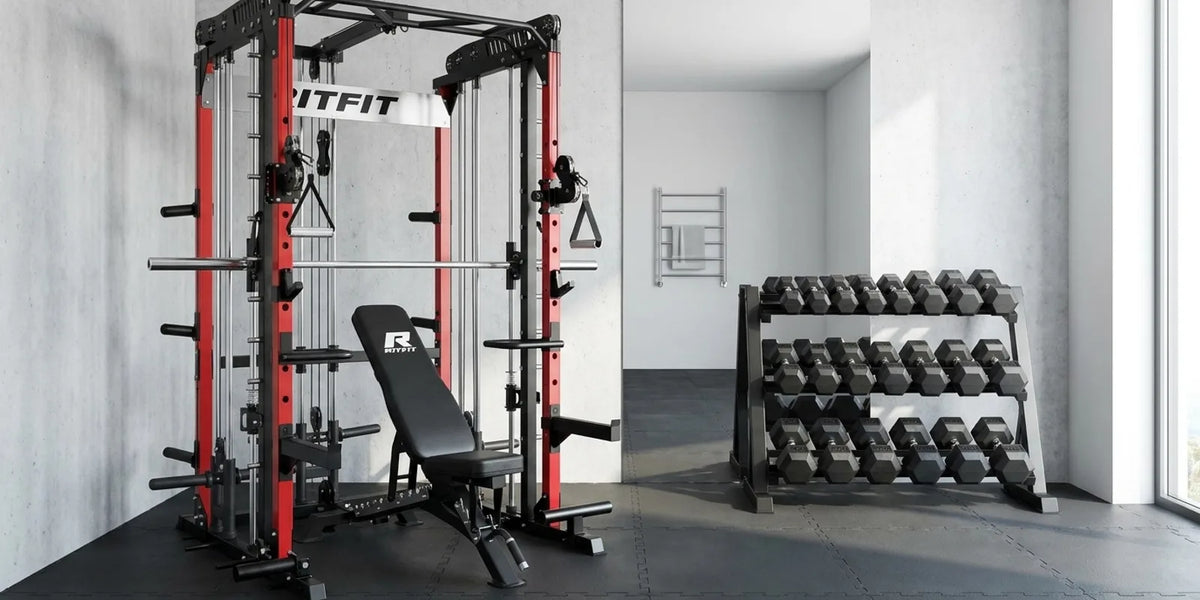
Choosing the best fitness equipment for a personal training studio comes down to how much training each piece delivers per square foot of floor you pay for. A studio runs the same rack through six clients a day, so capacity, adjustment range and footprint matter more than brand polish.
This guide compares RitFit all-in-one platforms, benches, dumbbells and leg machines using published capacity, footprint and warranty figures, then maps each one to the studio layout and client mix it fits. Prices and policies are current published values, so confirm them at checkout.
Quick Answer: The best fitness equipment for a personal training studio is one all-in-one Smith machine with a cable crossover and built-in stacks, an adjustable bench rated at least 1,500 lb, and a rubber hex dumbbell set. Together they cover nearly every client session inside about 40 square feet.
Key Takeaways
- Buy the platform, not the machine: One all-in-one covers Smith, cable and pull-up work in 21.5 to 22.8 square feet, which is less floor than three separate stations.
- Capacity sets the ceiling: Published frame ratings run from 1,600 lb on the M1 Pro to 2,500 lb on the M3 Pro, and every one of them sits far above normal client loads.
- Two clients, two columns: A dual-sided design like the BUFFALO supports two clients training at once, which changes how you schedule small group sessions.
- Free weights still earn their space: A 2023 meta-analysis of 13 studies found no significant strength or hypertrophy difference between machine-based and free-weight training.
- Plan the second station now: Entry packages start near $1,300, so map the upgrade path before the first machine arrives.
What Equipment Does a Personal Training Studio Actually Need?
A studio needs equipment that survives repeated client use and adjusts quickly between clients.
Four qualities decide whether a piece earns its floor space: frame capacity, adjustment range, footprint, and how fast one client hands the machine to the next.
- Frame capacity: the published rating should sit well above what any single client lifts, because that frame runs every session of the day.
- Adjustment range: a platform that fits both a 4 ft 9 in client and a 6 ft 5 in client removes the need to buy two machines.
- Footprint per station: divide the floor a machine occupies by the number of exercises you can coach on it.
- Handoff speed: pin-loaded stacks and quick-change J-hooks cut the dead time between booked sessions.
- Upkeep: cables, pads and hardware wear first, so check what the warranty covers and for how long.
Machines and free weights both build strength, so the choice belongs to your client mix rather than the equipment category. A 2023 meta-analysis of 13 studies with 1,016 participants found no significant differences between machine-based and free-weight training in the direct comparison of strength, jump performance and muscle hypertrophy, and concluded that strength changes follow the modality you train.[1]
Start with the RitFit Smith machine collection if you want one frame to anchor the room. The rest of this guide prices and measures what sits around it.
This showroom walkthrough shows how the pieces sit next to each other on a real floor, which helps when you are sketching your own layout.
Which Smith Machine Fits a Personal Training Studio Floor?
An all-in-one Smith machine fits a studio best when its frame capacity and footprint match the client mix you coach.
RitFit publishes both numbers for every model, which turns the decision into arithmetic instead of opinion.
| RitFit platform | Price | Uprights | Frame capacity | Footprint | Cable positions |
|---|---|---|---|---|---|
| M1 Pro, rack only | $1,299.99 | 2 x 2 in, 14-gauge | 1,600 lb | 20.9 sqft | 15 |
| M2 3D | $2,199.99 | 2.36 x 2.36 in, 13-gauge | 2,000 lb | 22.8 sqft | 16 |
| M3 Pro | $3,099.99 | 3 x 3 in, 11-gauge | 2,500 lb | 21.5 sqft | 29 |
| BUFFALO | $1,899.99 | 2 x 3 in, 13-gauge | 1,800 lb max | 38.1 sqft | 14 |
Specifications and list prices taken from RitFit product pages in 2026; confirm current pricing and availability at checkout.
The RitFit M3 Pro home gym Smith machine is the widest-ranging option on that table because it puts a power rack, a cable crossover and a Smith machine on one 21.5 sqft platform.
- Capacity headroom: the frame is rated 2,500 lb, and each J-hook and safety arm holds 650 lb static, so a strong client never eats into the machine's margin.
- Adjustment spread: 35 upright holes, 29 cable trolley positions and 10 Smith bar positions cover users from 4 ft 9 in to 6 ft 5 in.
- Resistance without plate loading: the cable system runs 16 pulleys at a 2:1 pulley ratio, and 180 lb of built-in stacks per side let a client move from a squat to cable work without stripping the bar.
- Ceiling check: the frame stands 84 inches including the pull-up bar, and the highest upright hole sits at 78 inches.
The RitFit BUFFALO Smith machine takes a different route, using a dual-sided frame that supports two clients at once on separate cable columns, with safety arms rated 1,300 lb static and J-hooks rated 1,700 lb static. That layout costs floor space, with a published soft footprint of 38.1 sqft against 21.5 for the M3 Pro.
The M1 platform in daily use on the RitFit channel, filmed by a long-term owner.
Which RitFit Model Should You Choose for Your Studio?
The right RitFit model is the one whose footprint and capacity already match the sessions you sell today.
Work down this table from your studio type rather than from the price tag.
| Studio type | RitFit platform | Why it fits |
|---|---|---|
| One-on-one coaching in a tight room | M1 Pro, rack only, $1,299.99 | 20.9 sqft footprint, 1,600 lb frame, 15 cable positions |
| Coach who wants cable work without loading plates | M1 Pro with 264 lb stack, $2,199.99 | Built-in stack removes plate changes between clients |
| Programming that mixes free and guided paths | M2 3D, $2,199.99 | 3D Smith path and a 2,000 lb frame in 22.8 sqft |
| Small group sessions with two clients at once | BUFFALO, $1,899.99 | Dual-sided design, 1,800 lb max, 1,300 lb static safety arms |
| Heaviest client loads and the widest height range | M3 Pro, $3,099.99 | 3 x 3 in 11-gauge steel, 2,500 lb frame, 29 cable positions |
RitFit list prices and published specifications, 2026; the matrix covers RitFit models only.
If your book is mostly one-on-one sessions, the entry M1 Pro rack leaves the most cash for dumbbells and a bench. RitFit strength machines then fill the gaps as your schedule fills.
"For $1,800, this machine delivers a combination of build quality, stability, and versatility that is rare at this price. The BUFFALO is not a machine that excels at one thing. It is a platform that lets you program an entire training week without ever stepping off the frame."
BJ Nelson, Head of Field Testing, The Iron Clinic, RitFit Buffalo Smith Machine Review
Do Studio Clients Need to Buy a Weight Bench and Dumbbells?
Yes, a weight bench and dumbbells are the usual second purchase because they cover clients an all-in-one cannot.
Bench pressing, incline work, rows and loaded carries all need a stable platform plus a free implement, and that pairing is cheap next to a second machine.
The RitFit GATOR adjustable weight bench is rated to a 1,600 lb total load capacity on a 14-gauge reinforced steel frame, with 10 back pad levels and 21 total adjustment positions across a footprint of about 3.5 sqft. The RitFit weight bench range also includes the 1300LB Adjustable Weight Bench BWB01 at $269.99 for a lighter duty second bench.
- Bench for heavy pressing: the GATOR's 1,600 lb rating and 21 positions let you move a client from flat press to a steep incline without changing stations.
- Dumbbells for unilateral work: RitFit rubber hex dumbbells start at $49.99 per pair, and full RitFit dumbbell sets cover the working range most clients use.
- Floor covers the difference: a dumbbell set plus a three-tier rack needs roughly 10 square feet, so free weights stay the cheapest station you can add.
The research backs owning both formats rather than picking one. A 2020 randomized trial put 36 novice men through a 10-week program on machines, on free weights, or on a switch between the two, and reported similar improvements in muscle size, strength and functional ability across all three groups.[2]
"Wow! This is not my first weight bench, but I am confident it will be my last. The ease of use and ability to move around the cable machine from one exercise to the next is awesome. Regardless of the exercise I am performing I feel secure and stable. It is an awesome product."
Richard R. Verified Buyer, RitFit GATOR 1600LB Adjustable Weight Bench
Is the BLP01 the Best Leg Machine for a Small Studio?
The RitFit BLP01 leg press and hack squat machine is the strongest single-machine leg answer for a small studio floor.
It is rated 1,200 lb and folds leg press, hack squat and calf raise onto one 20.3 sqft frame.
- Capacity: the 1,200 lb rating rides on a linear bearing slide with three lockout position settings, so a solo client can pause safely under load.
- Adjustability: five lower footplate positions and three upper positions shape the pressing angle, with a 33.43 in range of motion.
- Height window: the machine suits users roughly 5 ft 4 in to 6 ft 4 in, so measure your tallest client before ordering.
- Mode changes: switching between leg press and hack squat is tool-free and takes under a minute, which keeps a session moving.
The case for owning both a squat path and a leg press is not about preference. An 8-week study of 120 men found that barbell squat and 45 degree leg press training both raised 1-repetition-maximum, yet only the squat group improved jump performance, which makes the two movements complements rather than substitutes.[3]
The RitFit leg machine range extends that logic, with the GAZELLE PRO carrying a 2,000 lb weight capacity and fitting users from 4.9 ft to 6.8 ft, while the standard GAZELLE is rated 1,500 lb.
"What can i say hack squat and leg press in one stop shop. Makes leg day fun, easy to switch from one to the other and looks good in my gym"
William, Verified Buyer, RitFit BLP01 3-in-1 Leg Press and Hack Squat Machine
Is RitFit Equipment Worth Buying for a Commercial Studio?
RitFit equipment is worth buying for a private studio or a light commercial floor.
RitFit describes the M3 Pro as built for advanced home gym users, heavier training needs, and light commercial or private studio use, and the published numbers support that brief.
- Structural warranty: the M3 Pro carries a 5-year warranty on steel parts and a 2-year warranty on wearing parts, while the GATOR bench carries a 3-year frame warranty with 1-year coverage on moving parts.
- Logistics: RitFit lists free shipping within the continental United States and 35-day returns, and the M3 Pro arrives in a single crate rather than several parcels.
- Capacity per dollar: 2,500 lb of frame rating on the M3 Pro and 1,800 lb on the BUFFALO both sit well above the loads a personal training client produces, which leaves room for progressive overload as clients get stronger.
- Where it stops: these are home-gym-class frames, so a high-traffic commercial floor with dozens of daily users should confirm duty rating and warranty terms with RitFit before ordering.
Value in a studio is capacity and footprint per dollar rather than the lowest sticker price. A 2,500 lb frame on 21.5 sqft hosts a squat, a press, cable work and pull-ups without a second purchase.
To compare the full spec sheets side by side before ordering, the RitFit equipment technical specs guide collects the frame, capacity and dimension figures in one place.
What Does It Cost to Add a Second Station Later?
A second station usually costs less than the first because the flooring, free weights and layout are already paid for.
The two variables are the platform you add and whether it needs its own weight stack.
- Cheapest expansion: a second adjustable bench plus another dumbbell tier adds a full client station for a few hundred dollars.
- Lowest entry platform: the M1 Pro rack at $1,299.99 adds a second Smith and rack station at the lowest published price in the line.
- Stack upgrade: moving from the rack-only M1 Pro at $1,299.99 to the 264 lb stack package at $2,199.99 buys handoff speed rather than more capacity.
- Leg day expansion: adding a BLP01 at a 1,200 lb rating and 20.3 sqft keeps the lower-body station compact.
- Hidden costs: budget for flooring under any new platform and check ceiling clearance before the crate arrives.
The order that keeps a studio cash-positive is platform first, bench and dumbbells second, leg machine third. Each step adds a station you can book rather than a piece that sits idle.
FAQs About Fitness Equipment for a Personal Training Studio
What equipment does a personal training studio need first?
Start with one all-in-one machine that covers Smith squats, cable work and pull-ups, plus an adjustable bench and a dumbbell set. Those three items let you coach most clients. Add a leg press and specialty machines once your weekly session count justifies the floor space they occupy.
How much floor space does a personal training studio need for strength equipment?
A compact all-in-one needs about 21 square feet and an adjustable bench about 3.5 square feet. A dumbbell set with a three-tier rack adds roughly 10 square feet. A private studio can run a full strength floor in 300 to 500 square feet with room for two clients training at once.
Is RitFit equipment strong enough for commercial studio use?
RitFit rates the M3 Pro frame at 2,500 lb and the BUFFALO safety arms at 1,300 lb static, which is well beyond most client loads. RitFit describes the M3 Pro as suitable for light commercial or private studio use. High-traffic commercial floors should confirm duty rating with RitFit first.
How many clients can use one Smith machine at a time?
A single-frame Smith machine serves one client at a time. A dual-sided design like the BUFFALO lets two clients train at once on separate cable columns. For one-on-one coaching a single station works, while small group sessions usually need the dual-sided layout or a second platform.
Are machines or free weights better for personal training clients?
A 2023 meta-analysis of 13 studies found no significant differences between free-weight and machine training for strength or hypertrophy. A 2020 trial in 36 novice men reported similar gains in both formats. Most studios therefore buy both and match the tool to each client.
What warranty do RitFit studio machines include?
RitFit lists a 5-year warranty on steel parts and a 2-year warranty on wearing parts for the M3 Pro. The GATOR bench carries a 3-year frame warranty and 1-year coverage on moving parts. Buyers should confirm how each policy applies to commercial use.
How much does it cost to equip a personal training studio?
A single-platform studio starts near $1,300 for an M1 Pro rack and about $2,399 for the M1 Pro weight stack package. Budget roughly $5,000 to $8,000 for a one-machine studio with bench, dumbbells and flooring, then add stations as revenue grows.
How much floor space does each RitFit studio machine take up?
The M1 Pro covers 20.9 square feet, the M3 Pro 21.5, the M2 3D 22.8 and the BUFFALO 38.1 on its soft footprint. Benches need about 3.5 square feet and a dumbbell set with a rack roughly 10. Measure your ceiling too, because the M3 Pro stands 84 inches tall.
How do you cover leg training without buying five machines?
One 45 degree machine like the BLP01 handles leg press, hack squat and calf raise on a 20.3 square foot frame rated 1,200 lb. Pair it with a barbell squat path, since an 8-week study of 120 men found only the squat group improved jump performance. Two stations cover most lower-body sessions.
Conclusion
Studio equipment pays for itself when one frame covers many clients, and the RitFit line lets you match capacity and footprint to your room instead of guessing. Start with the all-in-one platform that fits your tallest client and your ceiling, add a rated bench and dumbbells, then bring in a leg machine when your book fills.
Before you order, check the current RitFit discount guide so the expansion budget you planned still holds.
Disclaimer
This article is general information about studio equipment selection and is not medical, safety or professional fitness advice. Confirm current specifications, prices, warranty terms and commercial duty ratings with RitFit before you buy, and consult a qualified professional about your facility and your clients.
References
1. Haugen ME, Vårvik FT, Larsen S, Haugen AS, van den Tillaar R, Bjørnsen T. Effect of free-weight vs. machine-based strength training on maximal strength, hypertrophy and jump performance - a systematic review and meta-analysis. BMC Sports Sci Med Rehabil. 2023;15(1):103. doi:10.1186/s13102-023-00713-4. PMCID: PMC10426227
2. Aerenhouts D, D'Hondt E. Using Machines or Free Weights for Resistance Training in Novice Males? A Randomized Parallel Trial. Int J Environ Res Public Health. 2020;17(21). doi:10.3390/ijerph17217848. PMCID: PMC7662789
3. Wirth K, Keiner M, Hartmann H, Sander A, Mickel C. Effect of 8 weeks of free-weight and machine-based strength training on strength and power performance. J Hum Kinet. 2016;53:201-210. doi:10.1515/hukin-2016-0023. PMCID: PMC5260589





