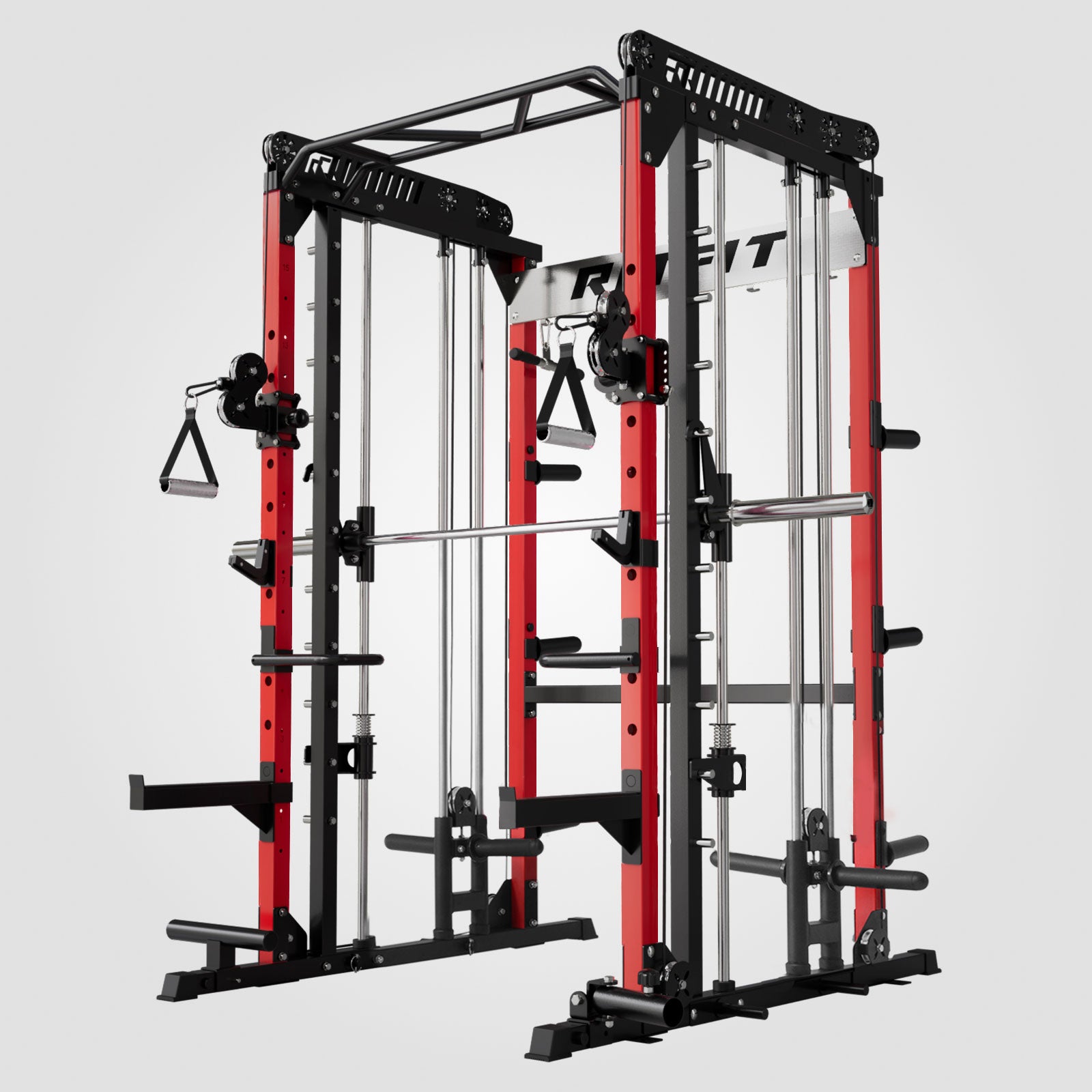
The best power rack with a pulley system is the one that lets you train heavy, train safely, and add cable work without overrunning your room. For 2026 home gym buyers who want real rack function, plate loaded cable versatility, and a compact footprint, the RitFit P3 power cage is one of the strongest value picks in the category.
Key Takeaways
- The P3 works best for compact home gyms. Its 81 inch height and 17.53 sq ft footprint make it easier to place than many taller all in one stations.
- The rack is more than a barbell frame. The built in dual pulley system gives you lat pulldowns, rows, pushdowns, curls, and other accessory work in the same station.
- The value case is strongest for plate owners. If you already own Olympic plates, the P3 lets you stretch that investment across both rack work and cable work.
- The main tradeoff is convenience. Plate loaded cable training costs less upfront than a weight stack, but it is slower to change between sets.
- The buyer decision is mostly about room and workflow. If you need one compact station for squats, presses, pull ups, and cable accessories, the P3 makes more sense than a bare rack for many home users.
What to Look for in a Power Rack With Pulley System
Core Buying Criteria
A good power rack with a pulley system needs to solve three problems at once, it must feel stable under a barbell, move smoothly on cable work, and fit the actual room you train in. Buyers should judge the category by frame capacity, pulley feel, safety hardware, footprint, height, and how much weekly training the station can realistically replace.
- Frame strength: A rack only earns its place if it feels trustworthy during squats, benching, pulls, and re racking.
- Pulley usability: A cable add on matters most when it is smooth enough to make rows, pulldowns, pushdowns, and raises worth using every week.
- Safety setup: Adjustable J hooks and spotter arms are not optional if you train alone.
- Room fit: Ceiling height, side clearance, and bench clearance matter just as much as the printed footprint.
- Ownership flow: The right machine should reduce the need for separate stations, not just add another piece of steel to the room.
Why Height and Footprint Matter
Most home gym mistakes happen before the first workout, because buyers focus on capacity and forget working clearance. If your room is a garage, basement, or spare room, a compact rack height can matter more than one extra feature you may rarely use.
Why the RitFit P3 Is a Smart 2026 Pick
Who It Fits Best
The P3 fits buyers who want one practical station for heavy basics plus cable accessories without stepping into the size and price range of a larger integrated Smith machine. It is especially attractive for first serious home gym setups, budget minded households, and garage or basement users who want more than a bare rack.
- Best for solo home training: The rack format plus spotter arms makes heavy basics more realistic at home.
- Best for mixed goals: It supports strength work, hypertrophy accessories, and general fitness inside one footprint.
- Best for space sensitive rooms: The lower overall height makes the P3 easier to place than many taller multifunction units.
- Less ideal for convenience obsessed users: If you want instant pin changes for every cable movement, a weight stack machine still feels easier.
What Makes the Value Case Strong
The P3 makes sense because it covers the training jobs that home users most often need every week, squats, presses, pull ups, rows, pulldowns, arm work, and core work. The value is not that it replaces every machine on earth, it is that it combines enough rack utility and cable utility to remove the need for several separate purchases.
- Verified rack size: 67.2 inches long, 59.1 inches wide, and 81 inches high.
- Verified frame capacity: 1200 lb upright capacity with a 600 lb pulley capacity.
- Verified construction: 2x2 inch 14 gauge steel, aluminum pulleys, and stainless steel cable rails.
- Verified cable ratio: 2:1, which helps the pulley system feel smoother and more manageable for many accessory lifts.
RitFit P3 Specifications and Build Quality
Verified Specs at a Glance
The P3 is compact by home gym standards, but it still gives you true rack function plus a full dual pulley layout. That combination is why it sits in a sweet spot between a basic cage and a much larger all in one machine.
- Rack length: 67.2 inches
- Rack width: 59.1 inches
- Rack height: 81 inches
- Rack weight: 200 lb
- Footprint: 17.53 sq ft
- Upright capacity: 1200 lb
- Pulley capacity: 600 lb
- Pull up bar capacity: 308 lb
- Safety spotter arm capacity: 440 lb
- J hook capacity: 440 lb
- Plate compatibility: suitable for both 2 inch and 1 inch hole plates
What Those Specs Mean in Real Home Gyms
The 81 inch height is the headline spec because it opens the door for more basements and lower garage ceilings. The rest of the numbers matter because they show the P3 is not just compact, it is also built to carry serious rack work and meaningful cable loading for home use.
- Low ceiling friendly: Many buyers can fit it where taller 90 inch plus frames fail.
- Compact but still usable: The footprint is modest, but you should still plan extra room for a bench, bar sleeves, and loading movement.
- Plate loaded flexibility: Buyers with existing plates get more value because the rack and cable system can share the same ecosystem.
- Material choice: Aluminum pulleys and stainless cable rails matter because smoothness is what decides whether the pulley system becomes a daily tool or dead weight.
The Pulley System and Exercise Range
How the Pulley Setup Changes the Rack
The best reason to buy a power rack with a pulley system is not novelty, it is training density. Once cable work lives on the same frame as your main lifts, you can move from heavy compounds to higher rep accessories without walking across the room or buying another machine.
- High and low cable access: You can cover pulldown, row, pushdown, curl, raise, and pull through patterns in one place.
- Plate loaded logic: The system costs less upfront than a selectorized stack and works best when you already own enough plates.
- 2:1 pulley feel: The ratio generally makes many cable movements feel smoother and more controllable for accessories.
- Real ownership tradeoff: You save on machine price, but you spend more time changing resistance than you would on a weight stack.
What You Can Actually Train
A rack with pulleys earns its keep when it expands your weekly exercise menu in useful ways, not when it adds random features you rarely touch. The P3 is strongest when it handles your main barbell work first, then lets you finish the session with simpler, lower fatigue cable movements.
- Main rack lifts: back squat, front squat, bench press, overhead press, rack pull, and pull ups
- Cable back work: lat pulldowns, low rows, face pulls, and straight arm pulldowns
- Cable arm work: triceps pushdowns, cable curls, and rope style finishing work
- Lower body and core: pull throughs, glute kickbacks, cable crunches, and standing anti rotation work
Training Value Beyond a Basic Rack
Why One Station Can Cover More of Your Week
Resistance training is one of the most dependable ways to improve strength and muscle size when the program gives you enough productive work over time.[4] That matters here because a rack plus pulleys gives you a simple way to pair heavy basics with easier accessory volume in the same session.
- Strength base: Use the rack for squats, presses, and pulls that need safeties and a stable setup.
- Accessory volume: Use the pulleys after the main lifts to add work for lats, delts, triceps, biceps, and core with less setup friction.
- Time efficiency: One station makes supersets and short transitions easier in small home gyms.
Where a Dedicated Functional Trainer Still Wins
Hypertrophy programming still responds to variables such as exercise selection, total work, and progression quality, which means better convenience can matter if it helps you do more useful work consistently.[3] A dedicated weight stack trainer still wins when you care most about instant changes, wider cable travel, or a cleaner shared household workflow.
- Faster weight changes: Weight stacks are still easier for drop sets, circuits, and shared use.
- Less plate handling: Plate loaded systems ask more of your setup time and your storage plan.
- Better for convenience first buyers: If speed matters more than upfront savings, a stack based machine may suit you better.
Setup, Assembly, and Daily Use
What to Expect Before You Order
The P3 is compact, but compact does not mean effortless to place. Buyers should measure not only the rack footprint, but also bench position, bar sleeve clearance, plate loading space, and the route used to carry heavy boxes into the room.
- Measure the room: check ceiling height, side clearance, and front to back bench position before ordering.
- Plan your floor: rubber flooring helps stability, noise control, and surface protection.
- Match the bench: a quality adjustable bench unlocks far more value from the station than a flat only bench.
- Think through storage: plate loaded cable work is easiest when your plates and collars are already organized.
Day to Day Convenience
The P3 becomes more useful when your weekly plan treats it like a full station rather than a squat cage with a bonus cable. That means keeping your bench, plates, handles, and usual cable attachments close enough that transition time stays short.
- Fast session flow: move from squats to rows or from benching to pushdowns without changing stations.
- Better ownership value: the more often you use both the rack side and cable side, the more justified the purchase becomes.
- Better beginner confidence: a single familiar station often makes home training feel less fragmented and easier to repeat.
Pros and Cons of the RitFit P3
Main Advantages
The P3 is easy to recommend when the buyer wants one practical centerpiece instead of a growing row of separate machines. Its strongest advantages are compact size, verified capacity, and a cable system that expands the weekly exercise menu in meaningful ways.
- Compact 81 inch height: easier to place in many basements and garages
- 1200 lb upright capacity: enough headroom for serious home strength work
- Dual pulley system: adds real accessory utility instead of one token attachment
- Plate compatibility: works well for buyers who already own Olympic plates
- All in one training flow: squats, presses, rows, pulldowns, curls, and pushdowns can live in one station
Main Tradeoffs
The main limitations are not hidden, they are the same tradeoffs most plate loaded hybrid stations carry. The P3 asks you to accept slower resistance changes and a little more ownership friction in exchange for a lower machine cost and a smaller footprint than many larger integrated systems.
- Slower than a weight stack: plate changes take more time during cable work
- Still needs clearance: a compact rack can still feel cramped if the room plan is poor
- Not the best choice for every advanced user: lifters who want commercial style convenience or a freer cable crossover feel may want a different category
RitFit P3 Versus Other Home Gym Paths
P3 vs a Basic Power Rack
A basic rack is still the cleaner answer for lifters who only care about free barbell specificity and the simplest hardware. The P3 is the better answer for buyers who want real rack function plus a built in accessory lane without adding a second station, and you can read the broader decision logic in this Smith machine vs power rack guide.
- Choose a basic rack if: you want the purest barbell workflow and do not care much about cables.
- Choose the P3 if: you want one station to cover heavy basics and a lot of weekly accessory work.
P3 vs a Weight Stack Machine
A weight stack machine wins on convenience, but plate loaded systems are often the smarter value for plate owners who can tolerate slower changes. If that is your main debate, start with this guide on plate loaded vs weight stack systems before you decide.
- Choose a weight stack if: you want pin based changes, faster circuits, and easier shared household use.
- Choose the P3 if: you want lower machine cost, flexible plate use, and strong rack first value.
Sample Workouts on the P3
Full Body Strength and Hypertrophy Day
Strength is usually best served by keeping your main lifts heavy, repeatable, and easy to progress, even though muscle growth can happen across a wider loading range.[2] That is why the best P3 sessions usually start with rack work and end with simpler cable volume.
- Barbell back squat: 3 to 5 hard sets
- Barbell bench press: 3 to 5 hard sets
- Lat pulldown: 3 sets of 8 to 15
- Low row: 3 sets of 8 to 15
- Triceps pushdown and cable crunch: 2 to 4 finishing sets each
Upper Body Cable and Press Session
Muscle growth tends to respond well when a program gives you enough quality volume and enough useful exercise variety across the week.[1] A rack with pulleys helps because it lets you press heavy first, then add lower fatigue back, arm, and delt work without changing stations.
- Overhead press: 3 to 5 sets
- Pull ups: 3 to 4 sets
- Lat pulldown or straight arm pulldown: 3 sets
- Face pulls: 3 sets
- Cable curls and pushdowns: 2 to 4 finishing sets each
Buying Tips Before You Commit
Best Supporting Gear
The P3 performs best when the surrounding gear is chosen to match the same home gym logic, compact, versatile, and easy to use often. That usually means pairing it with an adjustable bench, enough plates for both barbell work and cable work, and a few cable handles you will actually use.
- Bench: Pair it with the RitFit Gator adjustable weight bench for pressing, rows, split squats, and incline work.
- Plates: Build around the barbells and weight plates collection if you need a full plate ecosystem.
- Research support: Use this Smith machine with cable system workout guide if you want more movement ideas for weekly programming.
- Room planning: Read the best Smith machine for low ceilings guide if your ceiling height is the first constraint you need to solve.
Best Buyer Match
The P3 is the right match when your room is limited, your budget is still real, and you want more training options than a bare rack can give you. It is the wrong match when you want the easiest cable workflow on the market or when your training plan barely uses cables at all.
- Buy the P3 if: you want a rack first home gym with meaningful cable versatility in one compact frame.
- Skip the P3 if: you want selectorized speed, a larger functional trainer feel, or a pure free barbell only setup.
FAQs About Power Racks With Pulley Systems
Is a power rack with a pulley system worth it for a home gym?
Yes. It is worth it when you want one station for barbell lifts, cable work, pull ups, and accessory training. The value is strongest for home gym buyers who need versatility, train alone, and want to save floor space instead of buying several separate machines.
How much space do you need for the RitFit P3 power rack with pulley system?
Most buyers should plan for more than the rack footprint alone. The P3 itself is compact, but you still need working room for a bench, plate loading, bar movement, and comfortable entry and exit, especially if you train in a garage or basement.
Can a plate loaded pulley system replace a weight stack machine at home?
No. It does not fully replace the speed and convenience of a selectorized machine, but it can cover most home cable needs very well. Plate loaded systems cost less upfront and work best for buyers who already own enough Olympic plates and accept slower changes.
Should beginners buy a power rack with a pulley system or a Smith machine?
Beginners should buy the option that matches their confidence, budget, and training goals. A rack with pulleys gives broader exercise variety and long term value, while a Smith machine usually feels simpler at first because the guided bar path reduces balance demands.
What exercises can you do on a power rack with a pulley system?
You can do far more than squats and bench presses on it. A good power rack with pulleys can handle lat pulldowns, low rows, triceps work, curls, face pulls, pull throughs, core work, and many superset combinations around your main strength lifts.
Will an 81 inch power rack fit a low ceiling basement gym?
Yes. An 81 inch rack can work well in many low ceiling rooms, but you must measure carefully before ordering. You need extra clearance for the pull up bar area, assembly, flooring, and your own movement, and some users may still prefer seated overhead pressing.
Conclusion
The best power rack with a pulley system is not the one with the longest feature list, it is the one you will use well in your actual room. If you want a compact, plate loaded all in one station for barbell basics, cable accessories, and solo training in a garage or basement, the RitFit P3 is an excellent 2026 value pick.
Disclaimer: This guide is for general educational and product comparison purposes only. It does not replace medical advice, injury diagnosis, or individualized coaching. Always measure your space, follow the official assembly instructions, use safeties correctly, and progress load based on your current training level and tolerance.
References
- Krzysztofik M, Wilk M, Wojdala G, Golas A. Maximizing muscle hypertrophy: a systematic review of advanced resistance training techniques and methods. Int J Environ Res Public Health. 2019;16(24):4897.
- Schoenfeld BJ, Grgic J, Van Every DW, Plotkin DL. Loading recommendations for muscle strength, hypertrophy, and local endurance: a re examination of the repetition continuum. Sports. 2021;9:32.
- Bernárdez-Vázquez R, Raya-González J, Castillo D, Beato M. Resistance training variables for optimization of muscle hypertrophy: an umbrella review. Front Sports Act Living. 2022;4:949021.
- Currier BS, Mcleod JC, Banfield L, Beyene J, Welton NJ, D'Souza AC, et al. Resistance training prescription for muscle strength and hypertrophy in healthy adults: a systematic review and Bayesian network meta analysis. Br J Sports Med. 2023;57(18):1211-1220.