








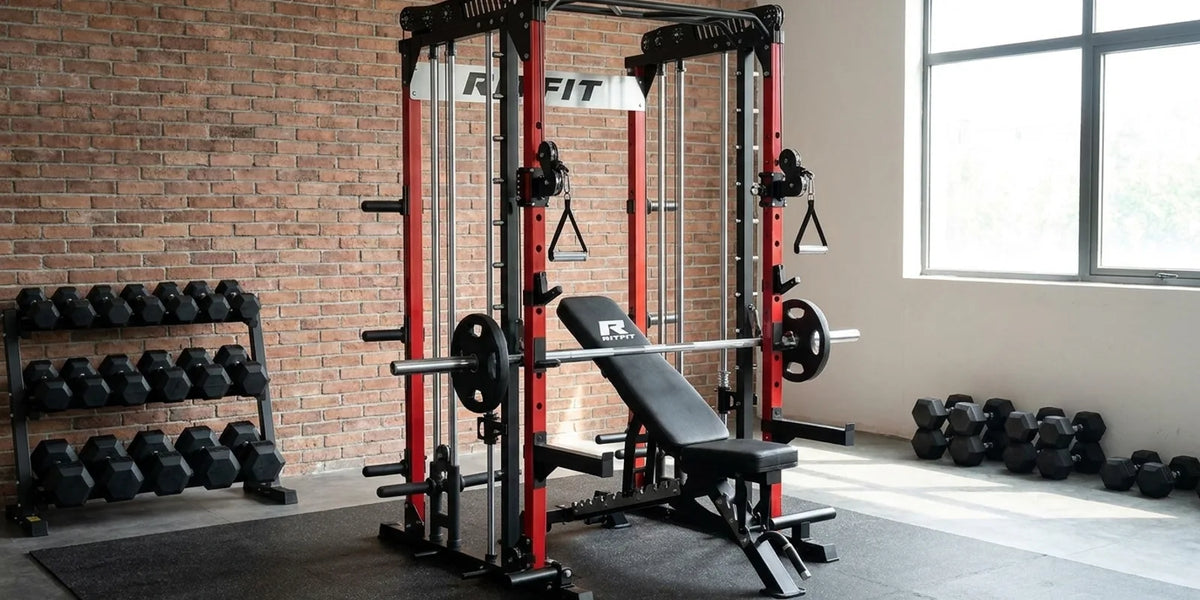
Smith machine calf exercises put a loaded bar on a fixed path over the calves, so balance and spotting never decide how hard a set gets. This guide covers five setups and the variables that shift work between the gastrocnemius heads and the soleus.
Every move here runs alone in a home gym with a block or a weight plate. Use the muscle notes to pick the right tool, and the programming section to set load, frequency, and stop rules.
Quick Answer: The best smith machine calf exercises are the standing raise, deficit raise, single-leg raise, seated raise, and donkey raise, together covering the medial and lateral gastrocnemius and the soleus. Pick straight-knee work for calf shape and bent-knee work for the soleus, and train through a full stretch.
Key Takeaways
- Muscle first: Straight-knee raises build the gastrocnemius while bent-knee raises shift the work to the soleus, so a complete calf plan needs both kinds of work.
- Five setups: Standing, deficit, single-leg, seated, and donkey raises cover the trainable variables without padding the list with toe angle tweaks.
- Toe angle is a small dial: Toes in or out nudges emphasis between the inner and outer calf head but barely changes the rep, so rotate it instead of counting it as a new move.
- Smith advantages: The guided bar removes balance work and the safety hooks make drop sets and last-set failure realistic without a spotter.
- Progression rule: Add load only when every set ends with a full stretch and a clean squeeze, and stop calf work that causes sharp heel or Achilles pain.
Why Train Calves on a Smith Machine?
A Smith machine loads the calves heavy without asking for balance, so the set ends when the calves fail, not when the feet wobble. The guided bar keeps the load over the midfoot, and the numbered safety hooks let anyone rack the bar mid-set without a spotter. Small muscles like the triceps surae respond best to that kind of hard, controlled work.
- Isolation without balance: The fixed bar path takes the stabilizers out of the rep, so the calves finish the set first instead of the arches and ankles.
- Intensity made safe: Drop the hooks one notch for drop sets, hold the stretched position for pauses, or finish with half reps, and a failed set simply rests on the hooks.
- Direct loading: Plates go straight onto the bar beside the uprights, so a small plate between sets takes seconds and keeps rest periods honest.
- Five variables, five moves: Stance width, toe direction, forefoot elevation, single versus double legs, and knee angle are the dials the list below turns.
Every setup here fits the machines in the RitFit Smith machine collection, and one station covers the rest of leg day too.
"Next, I do Smith machine squats for the quads and glutes. Here I get as deep as I can and explode out of the hole. Doing these on the Smith allows me to push my last set to failure without worrying about dumping the bar."
Jeff Nippard, Science-Based Natural Bodybuilder and Powerlifter, JeffNippard.com, Jeff Nippard's Science-Backed Leg Workout for Massive Quads (Men's Health UK)
5 Best Smith Machine Calf Exercises
The five best smith machine calf exercises are the standing, deficit, single-leg, seated, and donkey raises. Each one changes a trainable variable like knee angle or range of motion. Full setup notes for the standing version live in our standing calf raise form guide.
1. Smith Machine Standing Calf Raise
The standing calf raise is the default straight-knee builder for both gastrocnemius heads, and most lifters should load it first. One 12-week study in untrained adults found standing raises grew the lateral gastrocnemius 12.4% and the medial head 9.2%, versus 1.7% and 0.6% from seated raises, with soleus gains similar at 2.1% and 2.9% [1].
- Neutral toes, hip width: The default version, with steady work across both heads and the simplest loading.
- Toes slightly in or out: A small emphasis shift toward the outer or inner calf head inside the same movement, not a separate exercise.
- Close or wide stance: Changes hip comfort more than calf recruitment, so pick the stance that keeps the bar stacked over the midfoot.
2. Smith Machine Deficit Calf Raise
The deficit raise runs the same standing pattern through a longer range of motion, with the heels dropping below the level of the toes at the bottom. Treat it as its own move because the added stretch changes the whole rep, and the calf works hardest at the point where floor raises stop.
- Setup: A low step or two weight plates under the forefoot gives about 2 to 3 inches of heel travel.
- Target: Both gastrocnemius heads trained at long length, the stretched position emphasized in the study above.
- Boundary: Skip the deficit version when the Achilles tendon complains at the bottom, and build range gradually.
3. Smith Machine Single-Leg Calf Raise
The single-leg raise fixes left-right strength gaps, and the guided bar makes it possible to load one heavy leg without wobbling off the block. Run it flat or with a small deficit, and match clean reps between legs before adding more weight.
- Target: Each calf separately, which exposes and then trains down the weaker side.
- Use it when: One calf is visibly smaller or the weaker leg fails first on standing sets.
- Regress to: The bodyweight version in our bodyweight single-leg calf raise guide when traveling.
4. Smith Machine Seated Calf Raise
The seated raise keeps the knee bent and makes the soleus the main worker, which rounds out the calf work that standing moves start. With the knee bent, one lab study measured 31% lower plantarflexion torque and 35% lower medial gastrocnemius activation than with the knee straight, along with 15% to 28% higher soleus activity in the first half of slower reps [2].
- Setup: A bench inside the frame, the padded bar across the lower thighs, and the forefeet on a low block.
- Target: The soleus, the deep muscle under the gastrocnemius that gives the calf its thickness from the side.
- Boundary: Keep the tempo slow and place this move second in the session, after straight-knee work.
5. Smith Machine Donkey Calf Raise
The donkey raise hinges at the hips so the padded bar sits across the pelvis, putting both gastrocnemius heads under a long stretch with the knee nearly straight. It is the stretch-position specialist for lifters who want more from the bottom of the rep.
- Setup: Hips high, torso close to parallel with the floor, and the bar on a thick pad across the hips.
- Target: Both gastrocnemius heads at long length, the same stretched position the deficit raise emphasizes.
- Boundary: Skip it when deep hip flexion bothers the low back, and keep the range controlled.
Are These Calf Exercises Safe to Run Solo on the RitFit M1 PRO Workout System?
Yes, the guided bar and adjustable hooks make the RitFit M1 PRO safe to train solo: set the hooks a notch below the top of the raise and a failed set racks itself without a spotter. The open floor space also fits a block, a bench, and single-leg work.
"This thing is amazing for the price. Solid build quality. Shipped super fast, packing was done very well. Lifts have improved from my previous routine and now are much safer due to the smith machine benefits."
Walter S. Verified Buyer, RitFit M1 PRO Multi-Functional Smith Machine with Cable Crossover System and Squat Rack for Home Gym
How Should You Program and Progress These Calf Exercises?
A simple smith machine calf program runs two weekly sessions of two to three hard sets per move. Add load only when every rep ends with a full stretch and a clean squeeze, and keep progressive overload on the standing raise first.
- Choose the weight: Start with the empty bar plus one light plate per side, and pick a load that fails between 8 and 12 clean reps.
- Progress: Add the smallest plate when all sets finish at full range of motion, and use the hooks for drop sets, paused eccentrics, and one-and-a-half reps before adding sets.
- Frequency: Two sessions a week works for most lifters, and the calf training volume guide covers when to add a third.
- Rotate the dials: Change toe angle or stance width across the week as light variation. A biomechanics analysis of heel raises found no significant differences in ankle range of motion or mechanical energy across toes-in, neutral, and toes-out positions [3].
- Substitute anywhere: Away from the Smith machine, run the leg press calf raise setup or keep the calves going with calf work without machines.
- Stop rules: Sharp heel or Achilles pain ends the set, and soreness that changes the way the foot lands means a lighter week before returning to deficit work.
What Setup Do These Calf Exercises Need?
The full setup needs a stable block for the forefoot, safety hooks set below the top of the raise, and a bar pad for the seated and donkey versions. Flat-floor raises skip the block, while deficit and donkey work need it for the stretch.
- Block height: Two to three inches gives full heel travel without straining the ankle at the bottom.
- Hook height: Set the hooks one notch below the top of the raise so a failed rep lands softly and the bar never travels past the rack point.
- Bar pad: Required for the donkey and seated versions, optional everywhere else.
- Foot placement: Keep the load stacked over the midfoot and the toes pointing where the block is widest.
The multifunctional Smith machine covers the same work, and lifters who want a power rack plus Smith in one footprint can compare the M3 power rack with Smith and cable.
FAQs About Smith Machine Calf Exercises
Are Smith machine calf raises effective for building bigger calves?
Yes. Smith machine calf raises load the calves through full plantarflexion while the guided bar removes balance work, so the calves take the whole set. Keep straight-knee raises for the gastrocnemius and bent-knee raises for the soleus, train close to failure, and progress load before you add extra exercises.
How often should you train calves on a Smith machine?
Train calves two to three times a week with at least one rest day between sessions. The muscles recover quickly but tendons adapt slower, so start with two weekly sessions and add a third only when your ankles and Achilles tendons feel fully fresh before every session.
Should your knees stay straight or bent during Smith machine calf raises?
Straight knees train the gastrocnemius and bent knees shift most of the work to the soleus. Keep the knees straight but never locked for standing and deficit raises, and pick the seated bent-knee raise when the soleus is the target of the training block.
How much weight should you start with on Smith machine calf raises?
Start with the empty Smith bar plus one light plate per side and stop each set one or two reps before form breaks. Add a small plate only when you finish every set with a full stretch at the bottom and a hard squeeze at the top of each repetition.
Do you need a block for Smith machine calf raises?
No. A block is optional but useful, since a low step or weight plate lets the heels drop below the toes and adds the stretched bottom range that floor raises never reach. Keep the surface stable and wide enough for both feet.
What is the best foot position for Smith machine calf raises?
Neutral toes with a hip width stance is the best default foot position. Toes in or toes out slightly shift emphasis between the inner and outer calf heads, but the change is small, so keep most sets neutral and use angled toes only as a light rotation within the week.
How do knee angle and range of motion change which calf muscle works?
Knee angle picks the muscle and range of motion makes the rep harder. Straight knees put the gastrocnemius in charge, bent knees hand most of the work to the soleus, and a deficit lengthens the stroke so both heads work from a deeper stretch at the bottom.
How far do stance width and toe direction shift calf emphasis?
Only a little. Stance width mostly changes hip comfort, and toes in or toes out nudges emphasis between the inner and outer calf heads without changing the rep much. Keep the stance you control best, rotate toe angle across the week, and save the big changes for knee angle and range of motion.
When should you stop or regress a calf exercise because of pain?
Stop the set right away when the heel or Achilles tendon hurts sharply, and switch to a flat floor raise without a deficit. Wait until walking feels normal again before adding load, and see a qualified professional if the pain returns during two sessions in a row.
Conclusion
The best smith machine calf exercises come from changing the right variables: knee angle, range of motion, and single versus double leg work. Run standing and deficit raises for the gastrocnemius, seated raises for the soleus, and progress the load before adding more moves.
Beginners can start with the standing raise twice a week and add the seated raise a month later. Check the RitFit discount guide before shopping, and build the rest of leg day around Smith machine glute exercises.
Disclaimer
This article is general training information, not medical advice, and it does not replace a diagnosis from a qualified professional. Stop any calf exercise that causes sharp heel or Achilles pain, and consult a physician or physical therapist before training through an injury.
References
1. Kinoshita M, Maeo S, Kobayashi Y, et al. Triceps surae muscle hypertrophy is greater after standing versus seated calf-raise training. Front Physiol. 2023;14:1272106. doi:10.3389/fphys.2023.1272106. PMCID: PMC10753835
2. Kovács B, Csala D, Yang S, Tihanyi J, Gu Y, Hortobágyi T. Knee position affects medial gastrocnemius and soleus activation during dynamic plantarflexion: no evidence for an inter-muscle compensation in healthy young adults. Biol Open. 2024;13(12). doi:10.1242/bio.061810. PMCID: PMC11708772
3. Arnsdorff K, Limbaugh K, Riemann BL. Analysis of Heel Raise Exercise with Three Foot Positions. Int J Exerc Sci. 2011;4(1):13-21. doi:10.70252/YPIC8188. PMCID: PMC4738962





