








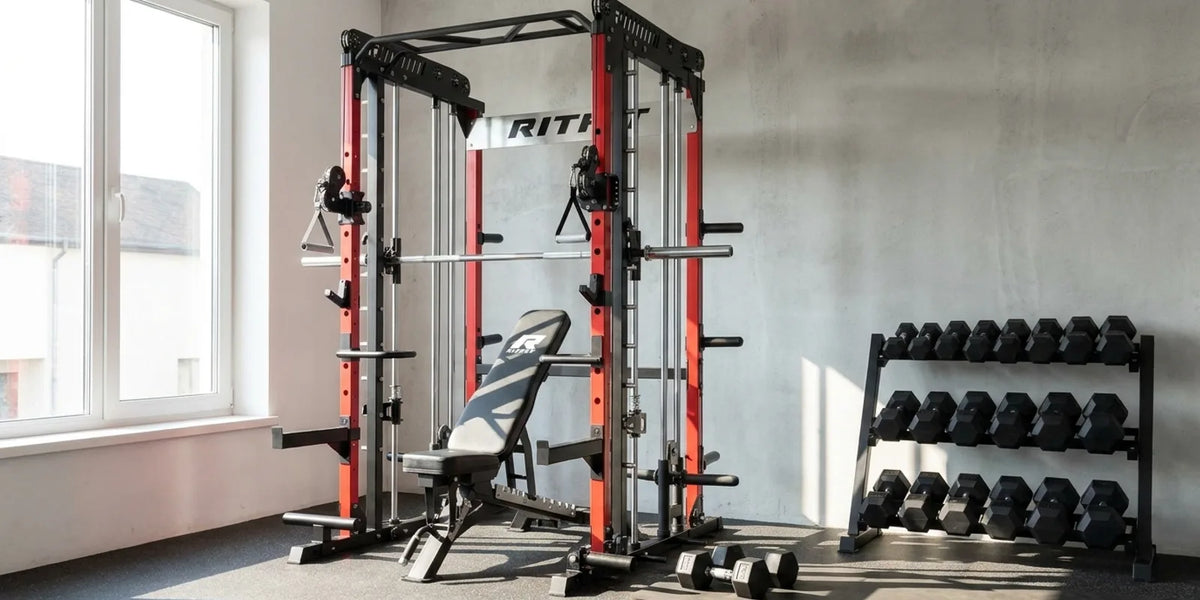
Smith machine core exercises give your trunk something a floor routine rarely provides: load you must resist instead of motion you create. The fixed bar path, low parking positions, top bar, and cable stack open eight real movements for anti-extension, anti-rotation, and hip flexion work.
This guide lists exactly those eight, with setup, load, and stop rules for each one. It also marks the limits of the machine: no true loaded spinal flexion crunch lives on it, and ab isolation is not the same as a braced core.
Quick Answer: The eight best smith machine core exercises are the dead bug press, overhead hold march, ab rollout, body saw, pike-up, hanging leg raise, Pallof press, and cable woodchop. Each one uses the fixed rail, low bar positions, top bar, or cable stack to load anti-extension, anti-rotation, or hip flexion.
Key Takeaways
- Resist, do not crunch: The fixed rail turns holds into loaded anti-movement work, so the trunk resists flexion, side bending, and rotation under real load.
- Three setups cover all: A parked low bar, the top bar, and a cable stack unlock all eight movements between them.
- Evidence backs the style: 6 weeks of anti-movement training raised trunk muscle activation and neuromuscular efficiency in trained lifters.
- Start with control: The body saw and the dead bug press teach bracing first, and the rollout and the hanging leg raise come later.
- Stop on signal: Sharp spine pain, sagging hips, or a flaring lower back ends the set immediately.
Why the Smith Machine Trains Your Core Differently
A Smith machine trains the core by making you resist motion instead of creating it. The guided bar holds a load steady while your trunk works to stop flexion, side bending, and rotation, which is how core strength transfers to squats, presses, and everyday lifting.
- Loaded anti-movement: The fixed rail keeps the load on one track, so holds like the overhead hold march and the dead bug press add resistance to anti-extension and anti-lateral flexion without a spotter in a home gym.
- Low parked bar: The hooks and safety stops park the bar near the floor, which unlocks rollout and body saw positions where your body moves around a fixed pivot.
- Top bar and cable stack: The top bar supports hanging leg raises, while the pulleys feed Pallof presses and woodchops that train rotation control against a steady line of pull.
That anti-movement focus has direct backing. In a 2025 randomized controlled trial, 36 trained men ran 6 weeks of twice-weekly core training, and the group holding 30-second isometric holds gained more external and internal oblique activation than controls.[1]
The same trial also tracked how hard the trunk worked during endurance tests. The anti-movement group showed reductions in muscle activation of 22.17% to 53%, greater than the dynamic group, and the researchers read that as improved neuromuscular efficiency.
What the machine does not do matters as much. There is no true loaded spinal flexion crunch on this apparatus, and pumping out bodyweight crunches under the bar is isolation work rather than the bracing practice that prepares a core for heavy squats and presses.
Every movement below runs on any solid machine in our Smith machine collection, and the setup notes call out what each one needs.
8 Best Smith Machine Core Exercises
The eight movements below cover every core task the machine can genuinely train: anti-extension, anti-rotation, anti-lateral flexion, and hip flexion. Each entry gives setup, execution, load, and a swap option so you can start at the level your control and attachments allow.
1. Smith Machine Dead Bug Press
The dead bug press teaches anti-extension with the bar locked on rails overhead, so the load cannot drift toward your face. You hold full lockout while the legs extend, and the trunk stops the lower back from arching.
- Setup: Lie under the bar with the hooks just above lockout reach, then press the bar out and turn the hooks clear.
- Do this: Brace hard, extend one leg toward the floor, return it, and repeat on the other side while the arms stay locked.
- Load: Start with the unloaded bar and add the smallest plates you own once the lower back stays flat for every rep.
- Swap: Hold a plate at lockout instead of the bar if the empty bar still feels heavy overhead.
2. Smith Machine Overhead Hold March
The overhead hold march trains anti-extension and anti-lateral flexion under a load that stays perfectly vertical. Unhook the bar at lockout and march in place while the ribs stay down and the spine stays long.
- Setup: Set the bar at full reach, press to lockout, and turn the hooks clear with a small wrist turn.
- Do this: March one knee at a time to hip height, slow and quiet, for 20 to 30 seconds per set.
- Load: The empty bar is honest work on its own, and small plates follow only when the torso never leans.
- Swap: The dead bug press keeps the overhead lockout while the floor supports your back.
3. Smith Machine Ab Rollout
The ab rollout is the hardest anti-extension move on this list, and the machine makes it friendlier than a free ab wheel. On a straight-track machine the bar acts as a fixed pivot that your body falls around, while a machine with horizontal travel lets the bar roll out ahead of you.
- Setup: Park the bar at knee height or lower and pad the center before you grip it.
- Do this: Hinge from the knees and extend the torso only as far as the hips can hold, then pull back.
- Load: Body weight is plenty, so extend the range before you add anything since a longer lever already raises the demand.
- Swap: Cut the range in half or drop to the body saw when the lower back starts to sag.
4. Smith Machine Body Saw
The body saw turns a plank into a moving anti-extension drill with your feet hooked on the parked bar. The sawing angle changes the lever arm, so the abs work harder without any spinal motion.
- Setup: Park the bar a few inches off the floor and hook your toes over it with forearms down.
- Do this: Saw forward and back from the shoulders while the hips and ribs stay glued in line.
- Load: Reach farther instead of adding plates, since a longer body line is the real progression.
- Swap: Hold a static plank with your feet on the bar until the saw stays controlled.
5. Smith Machine Pike-Up
The pike-up trains the trunk to fold the hips over a fixed bar while the arms stay locked. It bridges floor work and hanging raises because the hands carry part of your body weight through a stable grip.
- Setup: Set the bar around waist height and grip it with straight arms and active shoulders.
- Do this: Drive the hips up and back over the shoulders, then lower with control instead of dropping.
- Load: Raise the bar to shorten the lever or lower it to lengthen the lever before you touch plates.
- Swap: Tuck the knees to the chest instead of piking with straight legs.
6. Smith Machine Hanging Leg Raise
The hanging leg raise loads hip flexion against a stable bar, and the rectus abdominis works hard to control the legs on the way down. Hang from the top bar and keep the swing at zero so the abs finish the set instead of the lats.
- Setup: Hang from the top bar with straight arms and active shoulders before the first rep.
- Do this: Raise straight legs toward the bar and lower them slowly, stopping the moment the swing starts.
- Load: Body weight with slow lowers beats added weight with swinging, so earn the range first.
- Swap: Bend the knees into a hanging knee raise to shorten the lever.
7. Smith Machine Pallof Press
The Pallof press is pure anti-rotation: the cable pulls sideways while your trunk refuses to turn. The pulley keeps the line of pull constant, so the obliques stay loaded from the press to the hold.
- Setup: Set the pulley at chest height, stand sideways to it, and hold the handle at the sternum.
- Do this: Press straight out, hold for a quiet count, and return without letting the handle drift.
- Load: Step the difficulty up with ten-second holds before you add stack weight.
- Swap: Hold the arms extended isometrically instead of pressing when the set breaks down.
Moves seven and eight need pulleys, so a Smith machine with an adjustable dual cable system keeps both sides trained evenly.
8. Smith Machine Cable Woodchop
The woodchop trains the trunk to own rotation, from a fast turn to a hard brake at end range. Pull diagonally from the high pulley to the opposite hip with quiet feet and braced ribs.
- Setup: Set the pulley high, take a side-on stance, and start with the handle near your head.
- Do this: Pull across the body in one piece, then return slowly so the obliques control the way back.
- Load: Light and smooth first, because speed with control is the point of the chop.
- Swap: Slow the lowering phase to a five-second count when the handle starts pulling you around.
An all-in-one Smith machine with weight stacks keeps tension steady through the whole diagonal.
"Probably the most shocking result of this entire experiment was the level of rectus abdominis activity elicited by a bodyweight chin-up! It beat out any other abdominal exercise, weighted exercises and all, in mean and peak rectus abdominis activity."
Bret Contreras, PhD, Sports Scientist at Contreras Strength Institute. Inside the Muscles: Best Ab Exercises (T-Nation)
"This thing is great! I have a home gym and having the capability to get so many exercises in one machine is great. The smith and cables are very smooth. Love it!"
Nikolas S. Verified Buyer, RitFit M1 PRO Multi-Functional Smith Machine with Cable Crossover System and Squat Rack for Home Gym
How to Program Smith Machine Core Training
Two short sessions per week is enough core work for lifters who already squat and press. Pick two or three movements from the list, run them early in the session, and progress them like any other strength exercise.
Choosing the First Load
Start every movement with the unloaded bar or pure body weight because these drills punish form breakdown fast. Add load only after every rep of the set looks identical to the first.
- Holds and anti-movement drills: Add the smallest plates you own once 30-second isometric holds stay repeatable.
- Dynamic moves: Rollouts and hanging raises progress by range and speed first, and load second.
Sets, Reps, and Frequency
Holds and anti-movement drills work in 2 to 3 sets of 20 to 30 seconds, while dynamic moves run 2 to 3 sets of 8 to 12 controlled reps. Train the core twice per week and leave at least a day between hard anti-extension sessions.
- Placement: Core work goes early in the session, before grip and abs fatigue on heavy pulls.
- Frequency ceiling: Three sessions per week is the top end, because more volume adds soreness rather than control.
Short, consistent blocks pay off beyond the rack as well. In one study, a 6-week core stability program improved total Functional Movement Screen scores more than routine exercise in untrained college students.[2]
When to Add Load and When to Swap Exercises
Add load when every rep of the last set matches the first in speed and position. Swap the exercise instead when the movement changes shape, such as the lower back arching during a rollout or the legs swinging on the hang.
- Progress: The dead bug press and the overhead hold march take small plates, while rollouts and body saws take longer levers.
- Regress: Move from the hanging leg raise to the hanging knee raise, or from the rollout to a shorter fallout.
- Rotate: Keep one anti-extension move and one anti-rotation move per block so no pattern is left behind.
- Pair up: Full-body days on a multifunctional Smith machine leave room for a short core block between pushes and pulls.
For pairing ideas outside core day, see our Smith machine biceps exercises and Smith machine glute exercises guides.
Common Mistakes and When to Stop
Four mistakes account for most failed sets: crunching instead of bracing, skipping the safety stops, rushing the setup, and chasing range over control. The stop rules below tell you when to end a set and when to swap the movement entirely.
- Crunching instead of bracing: The machine loads anti-movement work, so folding the spine under the bar misses the point.
- Skipping the safety stops: Every low position depends on hooks and stops catching the bar if grip or core gives out.
- Rushing the setup: A careful setup beats a fast one, especially with the bar overhead or parked near the floor.
- Chasing range: A short rollout with a flat spine beats a long one with a sagging lower back.
A 2026 review frames anti-core work like planks, dead bugs, and the Pallof press as low-risk and practical in routines of 5 to 10 minutes, which fits home gym and garage gym schedules.[3]
Stop any set that produces sharp pain in the spine, and end the session if the lower back keeps flaring or the grip fails before the abs do. Substitute the knee raise or the body saw for a week and rebuild control before returning to the long-lever version.
What Setup Do These Core Exercises Require?
Three machine parts cover all eight movements: the bar with its hooks and safety stops, the top bar for hanging, and a pulley system for the anti-rotation pair. A bar-only machine still delivers six of the eight, so you can start before adding cables.
Does the RitFit M1 PRO Fit These Core Exercises?
The RitFit M1 PRO covers all eight movements because its product page pairs the fixed-path bar with a cable system and a top bar, and its hooks and safety stops park the bar at the low positions these moves need. Hanging leg raises run off the top bar, the Pallof press and the woodchop run off the pulleys, and rollouts and body saws sit on the same low hooks that catch squats.
- Versatility: One station runs pushing, pulling, and core work in a single footprint, so a core block slots between sets instead of onto a second machine.
- Performance: Verified buyers report lifts feeling safer than their previous routines and the machine working smoothly in daily use.
- Value: For a garage gym that already owns the machine, all eight movements cost no extra floor space and scale from first session to advanced holds.
If you are still choosing hardware, a power rack with cable crossover and Smith machine or the RitFit home gym package around the M1 Smith machine covers the same eight movements.
"Extremely happy with my M1 pro smith machine, the weight stacks is a must! So much to do especially for someone who is barely starting a fitness journey."
FRANCISCO, Verified Buyer, RitFit M1 PRO Smith Machine Weight Stack Home Gym Package
FAQs About Smith Machine Core Training
Are smith machine core exercises effective for building a stronger core?
Yes, when the list leans on anti-extension, anti-rotation, and hanging work instead of endless crunches. The fixed bar path lets you load bracing drills safely, and a randomized controlled trial found anti-movement core training improved trunk muscle activation and neuromuscular efficiency over 6 weeks.
How often should you do smith machine core exercises?
Two focused sessions per week is enough for most lifters, which matches the training frequency used in controlled studies of core work. Keep each session short, four to six sets total, and leave at least a day between hard anti-extension work such as rollouts.
What is the best smith machine core exercise for beginners?
Start with the body saw or the dead bug press, since both teach bracing with the bar doing the balancing for you. Shorten the range of motion, hold each rep for a slow count, and add the ab rollout only after you can hold a solid plank position.
Do you need a cable system for smith machine core exercises?
Not for every move, but the cable stack is what unlocks the Pallof press and the woodchop, which are the two anti-rotation staples on this list. The other six exercises need only the bar, its hooks and safety stops, and clearance to hang from the top bar.
Can smith machine core exercises cause lower back pain?
They can if your hips sag during rollouts or your lower back arches under the overhead hold, so stop any set that produces sharp pain in the spine. Reduce the range, lower the load, and substitute a shorter lever movement such as the knee raise until control improves.
How is core training on a smith machine different from an ab machine?
An ab machine trains one pattern, usually spinal flexion against a pad, while the smith machine trains your trunk to resist motion under load. The bar, the low parking positions, and the cable stack cover anti-extension, anti-rotation, and hanging leg raises that a crunch machine cannot deliver.
What load should you start with on smith machine core exercises?
Start with the unloaded bar or body weight alone, because these movements punish form breakdown faster than they punish light loads. Add the smallest plates you own once you complete every rep with a braced spine, and keep the working sets in the eight to fifteen rep range.
Conclusion
Smith machine core training works when it stays honest: anti-movement holds, low-bar levers, hanging raises, and cable chops, with no crunch filler. Start with the body saw and the dead bug press, run them twice a week, and let rep quality decide when the load goes up.
When you are ready for attachments or a machine of your own, check the RitFit discount guide before you buy.
Disclaimer
This article is general training information, not medical advice, and it assumes healthy joints and a properly assembled machine. Stop any exercise that causes sharp pain, and consult a qualified physician or physical therapist before starting a new core program if you have a current back injury.
References
1. Cinarli FS, Kafkas ME. Neuromuscular activation following anti-movement and dynamic core training: a randomized controlled comparative study. Eur J Appl Physiol. 2025;125(9):2449-2459. doi:10.1007/s00421-025-05768-4. PMCID: PMC12423174
2. Šćepanović T, Protić-Gava B, Sporiš G, et al. Short-Term Core Strengthening Program Improves Functional Movement Score in Untrained College Students. Int J Environ Res Public Health. 2020;17(22). doi:10.3390/ijerph17228669. PMCID: PMC7700566
3. Odemıs M, Cobanoglu HO, Cobanoglu HB. The role of anti-core exercises in public health: a preventive approach to spinal health. Rev Assoc Med Bras (1992). 2026;72(2):e20250667. doi:10.1590/1806-9282.20250667. PMCID: PMC13143152





