








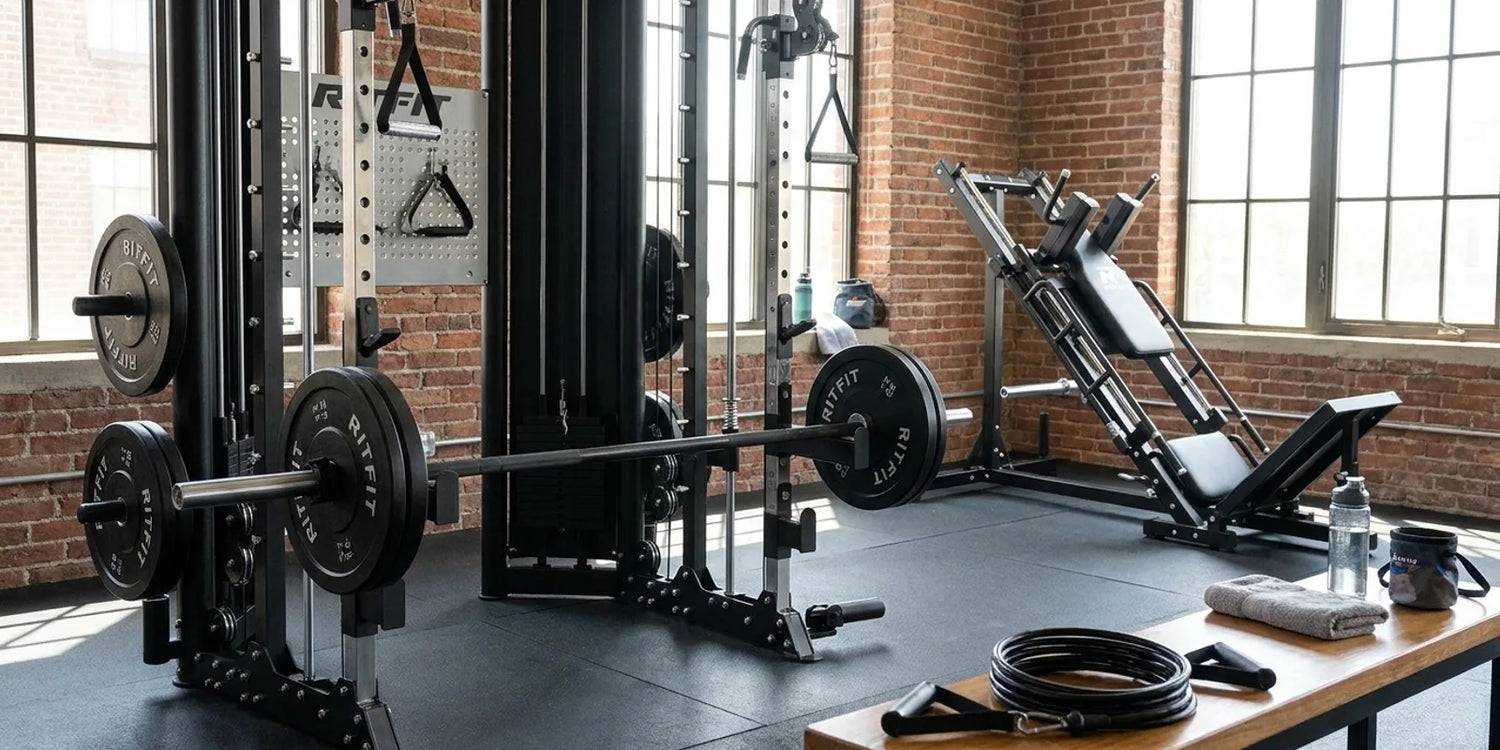
The best Smith machine biceps exercises are the Smith machine bicep curl, drag curls, reverse drag curls, underhand inverted rows, bodyweight biceps curls, low cable curls, Bayesian curls, rope hammer curls, and high cable curls. Together, these nine movements train the biceps, brachialis, and brachioradialis through several useful grip and shoulder positions.
The first five exercises use the guided Smith bar, while the final four need an integrated cable system. Use controlled resistance, secure the bar and safety stops, and stop any movement that causes sharp wrist, elbow, or shoulder pain.
Quick Answer: Yes, a Smith machine can build bigger biceps. The best options are the standard Smith machine bicep curl, the Smith machine drag curl, an underhand inverted row, and a rope hammer curl, performed for two to four movements per session with controlled repetitions before added resistance.
Key Takeaways
- Best guided bar option: The Smith machine drag curl matches the vertical bar path better than a conventional forward curling motion.
- Best complete station: A Smith machine with an integrated cable system supports guided bar curls, independent handle curls, hammer curls, and compound pulling exercises.
- Best exercise mix: Combine one palms up curl, one neutral or palms down variation, and one compound pulling movement.
- Best progression method: Add controlled repetitions before increasing resistance, then restart near the lower end of the repetition range.
- Most important safety rule: Never force a fixed grip or guided path through wrist, elbow, or shoulder pain.
Can a Smith Machine Build Bigger Biceps?
Yes, a Smith machine can help build bigger biceps when the chosen movement creates enough muscular tension and becomes progressively more challenging. The machine is not automatically better than dumbbells, barbells, or cables, but it can provide repeatable setup and stable loading.
The guided bar travels along a fixed path, so it suits drag style curls better than a conventional curl that normally follows a curved path around the elbow. An integrated cable system adds more freedom for grip width, hand rotation, unilateral work, and shoulder position.
- Guided bar benefit: The same bar path and starting position can make technique and progress easier to compare across workouts.
- Cable benefit: Independent handles allow the wrists and forearms to find a more comfortable position.
- Bodyweight benefit: A securely locked Smith bar can support inverted rows and bodyweight biceps curls.
- Main limitation: A fixed bar path may not feel natural for every body structure or curl variation.
A ten week study comparing cable and barbell preacher curls reported similar improvements in biceps muscle thickness and strength between the two exercise conditions.[1] The practical conclusion is that equipment choice can be based on comfort, access, setup quality, and the ability to progress consistently.
How These Exercises Were Selected
The nine exercises below were selected for their mechanical fit with a Smith machine, usefulness for home training, progression potential, and ability to cover different elbow flexor functions. No exercise was included solely because it contains the Smith machine keyword.
- Equipment fit: Guided bar exercises must work with a vertical or near vertical bar path.
- Target muscle role: Each movement must meaningfully involve elbow flexion or compound pulling.
- Grip variety: The final list includes palms up, palms down, and neutral hand positions.
- Shoulder position: Exercises place the upper arm beside, behind, or in front of the torso.
- Home gym practicality: The setup should be realistic on an all in one Smith machine without excessive equipment changes.
- Joint adjustability: Cable options are included for users who find a fixed straight bar uncomfortable.
- Progress tracking: Resistance, repetitions, body angle, or range of motion can be increased gradually.
This selection does not rank exercises by temporary muscle sensation alone. A strong pump can be useful feedback, but long term results depend more on productive volume, appropriate effort, recovery, and gradual progression.
Biceps Muscles and Functions
A complete biceps workout trains the biceps brachii together with the brachialis and brachioradialis. These muscles contribute differently depending on grip, shoulder position, and the type of pulling movement.
| Muscle | Main Function | Useful Exercise Types |
|---|---|---|
| Biceps brachii | Elbow flexion and forearm supination | Drag curls, bicep curls, low cable curls, Bayesian curls, high cable curls |
| Brachialis | Elbow flexion in several forearm positions | Hammer curls, reverse curls, bodyweight curls |
| Brachioradialis | Elbow flexion and forearm stabilization | Reverse curls, rope hammer curls, underhand rows |
The long and short heads of the biceps work together during curls, and no grip completely isolates one head. Readers interested in arm shape differences can review the long versus short biceps genetics and training guide.
"Exercises such as preacher curls and concentration curls (where the upper arm is positioned in front of the torso) work more in the short head, as do exercises such as cross cable curls on a high pulley apparatus."
Brad Schoenfeld, PhD, Exercise Science Researcher specializing in Muscle Hypertrophy, CUNY Lehman College, The Science of Biceps Training
9 Best Smith Machine Biceps Exercises
The best exercise depends on whether your machine has only a guided bar or also includes an adjustable cable system. Choose two to four movements per workout rather than performing the entire list in one session.
| Exercise | Required Equipment | Primary Emphasis | Suggested Repetitions |
|---|---|---|---|
| Smith machine drag curl | Guided bar | Biceps brachii | 8 to 12 |
| Reverse drag curl | Guided bar | Brachialis and forearms | 10 to 15 |
| Underhand inverted row | Locked guided bar | Back and biceps | 6 to 15 |
| Bodyweight biceps curl | Locked guided bar | Biceps and brachialis | 6 to 15 |
| Smith machine bicep curl | Guided bar | Biceps brachii and brachialis | 8 to 12 |
| Standing low cable curl | Low pulley | General biceps development | 8 to 15 |
| Bayesian cable curl | Single low pulley | Biceps with the arm behind the torso | 10 to 15 |
| Rope hammer curl | Low pulley and rope | Brachialis and brachioradialis | 10 to 15 |
| High cable curl | Two adjustable pulleys | Biceps in a shortened position | 12 to 20 |
Use the largest comfortable range you can control instead of shortening every repetition to lift more weight. In one preacher curl study, training the initial portion of elbow flexion produced greater distal biceps growth than training only the final portion in untrained young women.[2]
1. Smith Machine Drag Curl
The Smith machine drag curl is the most practical guided bar biceps exercise because its upward path closely matches the fixed movement of the machine.
- Set the bar around mid thigh height.
- Load both sides evenly with a conservative resistance.
- Stand close to the bar with a shoulder width palms up grip.
- Unlock the bar and extend the arms without aggressively locking the elbows.
- Drag the bar upward along the thighs and torso.
- Move the elbows slightly behind the body as the bar rises.
- Stop before the shoulders shrug or roll forward.
- Lower the bar slowly along the same path.
- Coach cue: Pull the elbows backward instead of swinging the bar away from the body.
- Common mistake: Leaning backward to move a load that is too heavy.
- Starting prescription: Three sets of 8 to 12 repetitions.
For the full setup and common faults, review the dedicated drag curls on a Smith machine guide.
2. Smith Machine Reverse Drag Curl
The reverse drag curl uses a palms down grip to increase the contribution of the brachialis, brachioradialis, and forearm muscles.
- Set the bar at mid thigh height.
- Use a shoulder width or slightly narrower palms down grip.
- Keep the wrists aligned with the forearms.
- Drag the bar upward while moving the elbows slightly backward.
- Stop before the wrists bend or the shoulders rise.
- Lower the bar under control.
- Coach cue: Keep the knuckles and forearms in one straight line.
- Common mistake: Allowing the wrists to fold backward under the load.
- Starting prescription: Two or three sets of 10 to 15 repetitions.
The same reversed grip carries over to other reverse curls on a Smith machine, and the forearm side is covered in the best Smith machine forearm exercises.
3. Smith Machine Underhand Inverted Row
The underhand inverted row is a compound pulling exercise that trains the biceps together with the lats, rear shoulders, and upper back.
- Lock the Smith bar securely between waist and chest height.
- Set the safety stops directly beneath the bar.
- Hold the bar with the palms facing toward you.
- Walk the feet forward and keep the body in a straight line.
- Pull the lower chest toward the bar.
- Drive the elbows behind the torso.
- Lower the body until the arms are extended.
- Coach cue: Move the chest toward the bar instead of reaching with the chin.
- Regression: Raise the bar or bend the knees.
- Progression: Lower the bar or elevate the feet.
- Starting prescription: Three sets of 6 to 15 repetitions.
Because this movement also loads the back, pair it with the 8 best Smith machine back workouts when you program a full pulling session.
4. Smith Machine Bodyweight Biceps Curl
The bodyweight biceps curl keeps the upper arms relatively high and bends the elbows to bring the forehead toward the bar, creating more direct elbow flexor work than a standard inverted row.
- Lock the bar securely around chest or shoulder height.
- Set the safety stops immediately beneath it.
- Hold the bar with a palms up grip.
- Walk the feet forward and brace the torso.
- Keep the upper arms pointed toward the bar.
- Bend the elbows and bring the forehead toward the hands.
- Extend the elbows slowly without losing body position.
- Coach cue: Think about curling your body toward the bar.
- Common mistake: Pulling the chest toward the bar and turning the exercise into a row.
- Starting prescription: Two or three sets of 6 to 15 repetitions.
5. Smith Machine Bicep Curl
The standard Smith machine bicep curl is the most widely searched version of this exercise, and it uses an underhand grip to train the biceps brachii and brachialis through elbow flexion.
- Set the bar near mid thigh height.
- Load both sides evenly and take a shoulder width palms up grip.
- Stand with the bar close to the thighs and the elbows near the sides.
- Unlock the bar and curl it upward without swinging the torso.
- Stop when the elbows are fully bent or the wrists begin to roll.
- Lower the bar slowly along the same path.
- Coach cue: Keep the upper arms still and let only the forearms move.
- Common mistake: Leaning backward or drifting the elbows forward to lift heavier resistance.
- Starting prescription: Three sets of 8 to 12 repetitions.
Because the machine guides the bar along a fixed vertical path, a standard curl can feel less natural at the top than a drag curl, which keeps the bar close to the body. Treat the standard curl as a baseline for comparing your wrist position, comfort, and top range of motion against the drag curl variation.
6. Standing Low Cable Curl
The standing low cable curl provides a simple direct biceps exercise and allows straight bars, angled bars, or independent handles to be used.
- Rack the Smith bar safely out of the cable path.
- Attach a suitable handle to the low pulley.
- Stand tall with the ribs stacked over the pelvis.
- Begin with the elbows close to the sides.
- Curl the handle without leaning backward.
- Pause briefly near the top.
- Lower the resistance to a comfortable extended position.
- Coach cue: Keep the upper arms quiet while the forearms move.
- Common mistake: Using the hips and lower back to start each repetition.
- Starting prescription: Three sets of 8 to 15 repetitions.
For a dedicated setup guide, review how to do cable biceps curls on a Smith machine.
7. Single Arm Bayesian Cable Curl
The Bayesian cable curl positions the working arm behind the torso and trains the biceps from a lengthened shoulder position with an independent handle.
- Attach one handle to the lowest cable position.
- Face away from the pulley.
- Step forward until the working arm rests slightly behind the torso.
- Keep the shoulder stable and the wrist neutral.
- Curl the handle toward the front of the shoulder.
- Lower slowly until the elbow is comfortably extended.
- Coach cue: Keep the upper arm behind the torso without forcing the shoulder backward.
- Common mistake: Rotating the torso toward the working arm.
- Starting prescription: Three sets of 10 to 15 repetitions per arm.
A controlled trial found similar regional biceps and brachialis growth from Bayesian cable curls and cable preacher curls when resistance profiles were matched.[3] Exercise choice can therefore be guided by comfort, setup access, and which position you can progress consistently.
8. Rope Hammer Curl
The rope hammer curl uses a neutral grip that emphasizes the brachialis and brachioradialis while still training the biceps.
- Attach a rope to the low pulley.
- Hold the rope with the palms facing each other.
- Stand tall and keep the elbows near the sides.
- Curl the rope without rotating the wrists.
- Separate the rope ends slightly at the top if comfortable.
- Lower the rope until the elbows are extended.
- Coach cue: Lead with the thumbs and maintain a neutral wrist.
- Common mistake: Moving the elbows forward to shorten the exercise.
- Starting prescription: Two or three sets of 10 to 15 repetitions.
9. High Cable Biceps Curl
The high cable curl places the upper arms near shoulder height and works well as a controlled finishing movement after heavier curls or rows.
- Set two handles around shoulder height or slightly higher.
- Stand centrally between the pulleys.
- Raise the upper arms until they are approximately level with the shoulders.
- Curl the hands toward the sides of the head.
- Pause without allowing the elbows to drop.
- Extend the arms slowly while maintaining shoulder position.
- Coach cue: Hold the upper arms steady as if posing the biceps.
- Common mistake: Arching the lower back and flaring the ribs.
- Starting prescription: Two or three sets of 12 to 20 repetitions.
Smith Machine Biceps Workout Plans
A productive workout normally needs one compound pulling exercise and two direct curl variations. Place curls after major back exercises when biceps growth is secondary, or place them earlier when arm development is the session priority.
Beginner Smith Machine Biceps Workout
This beginner plan uses simple movements, moderate volume, and repetition ranges that make technique easier to practice.
| Exercise | Sets | Repetitions | Rest |
|---|---|---|---|
| Underhand inverted row | 3 | 8 to 12 | 90 seconds |
| Smith machine drag curl | 3 | 8 to 12 | 75 seconds |
| Rope hammer curl | 2 | 12 to 15 | 60 to 75 seconds |
Complete this workout once per week initially. Add a second shorter session only when elbow comfort, soreness, and performance show that you are recovering well.
Intermediate Biceps Growth Workout
This plan combines a heavier guided bar movement with cable exercises that use different grips and shoulder positions.
| Exercise | Sets | Repetitions | Rest |
|---|---|---|---|
| Smith machine drag curl | 3 | 6 to 10 | 90 seconds |
| Single arm Bayesian cable curl | 3 | 10 to 15 per arm | 60 to 75 seconds |
| Rope hammer curl | 3 | 10 to 15 | 60 to 75 seconds |
| High cable curl | 2 | 15 to 20 | 60 seconds |
Count the biceps work already performed during rows, pulldowns, and chin ups before adding more direct sets. More exercises are not automatically better when they repeat the same function and reduce recovery.
Smith Bar Only Biceps Workout
This version works for a basic Smith machine that does not include a low pulley or functional trainer.
- Underhand inverted row: Three sets of 8 to 15 repetitions.
- Smith machine drag curl: Three sets of 8 to 12 repetitions.
- Reverse drag curl: Two sets of 10 to 15 repetitions.
- Bodyweight biceps curl: Two sets of 6 to 15 controlled repetitions.
Readers who are unsure about loading can use the curl weight selection guide to choose a more realistic starting resistance. For the opposing muscle group, review the best Smith machine triceps exercises, and for the heavy row pattern behind a guided bar, see how to do the Smith machine bent over row.
Progression, Mistakes, and Safety
The best progression method is to improve repetitions within a planned range before adding resistance. This keeps the exercise measurable without sacrificing wrist position, elbow control, or range of motion.
How to Use Double Progression
Double progression increases repetitions first and resistance second, making it practical for both plate loaded bars and cable stacks.
- Select a repetition range such as 8 to 12.
- Choose a load you can control near the lower end of that range.
- Add one or more repetitions across later workouts.
- Keep the same movement path and lowering control.
- Increase resistance after reaching the top of the range on every planned set.
- Return to the lower end of the range and repeat the process.
Common Smith Machine Biceps Mistakes
Most problems come from forcing the fixed path, using too much weight, or adding unnecessary exercises that repeat the same stimulus.
- Forcing a conventional curl: Use a drag style movement when curling the guided Smith bar.
- Loading too aggressively: Reduce resistance when the hips, shoulders, or lower back initiate the repetition.
- Bending the wrists: Keep the hands aligned with the forearms throughout the movement.
- Dropping the resistance: Control the lowering phase instead of allowing the bar or cable to fall.
- Chasing an excessive top position: Stop before the shoulders roll forward or shrug upward.
- Using redundant curls: Select movements with different grips or shoulder positions instead of repeating nearly identical exercises.
- Ignoring pulling volume: Rows and pulldowns already contribute to weekly elbow flexor work.
- Training through pain: Muscular effort is expected, but sharp or increasing joint pain is not.
Smith Machine Safety Checklist
Check the bar, stops, cables, attachments, and surrounding floor space before beginning any loaded or bodyweight biceps exercise.
- Confirm that the machine is level and assembled according to its manual.
- Load matching plates on both sides of the Smith bar.
- Set the safety stops before loaded curls.
- Confirm that the bar is fully locked before inverted rows or bodyweight curls.
- Test the locked bar with partial body weight before moving underneath it.
- Inspect cables, pulleys, carabiners, and handles for visible wear.
- Keep fingers clear of hooks, guide rails, plates, and pulley wheels.
- Rack the Smith bar away from the cable path before cable curls.
- Do not exceed the stated capacity of the machine or attachment.
- Stop immediately if the bar or cable moves unpredictably.
Remember that the empty bar resistance varies between Smith machine designs. Review how much a Smith machine bar weighs before estimating your starting load.
Choosing a RitFit Smith Machine Setup
A Smith machine with an integrated cable crossover offers the broadest biceps exercise selection because it combines guided bar work, adjustable handles, compound pulling, and isolation curls. A simpler guided bar model can still support drag curls, reverse curls, inverted rows, and bodyweight curls.
- Choose a basic Smith machine: Best for lifters who mainly want guided compound exercises and bar based accessory work.
- Choose an integrated cable model: Best for users who want low cable curls, rope hammer curls, unilateral curls, rows, and pulldowns.
- Choose independent handles: Best when a fixed straight grip causes wrist or elbow discomfort.
- Check working space: Leave room for cable extension, plate loading, bodyweight rows, and safe movement around the frame.
- Check included attachments: Confirm whether the package includes a straight bar, rope, single handles, or compatible carabiners.
Does the RitFit M1 PRO Support Cable Biceps Curls?
Yes, the RitFit M1 PRO Multi Functional Smith Machine combines a guided Smith bar with a cable crossover system, so a single frame supports drag curls on the bar plus low, Bayesian, and high cable curls on the pulleys. Additional configurations are available in the RitFit Smith machine collection.
For a broader explanation of pulley exercises, read the Smith machine with cable system workout guide. You can also compare resistance tools in cable biceps curls versus dumbbell curls, or plan a wider program with the best Smith machine exercises for muscle building.
"Packages arrived within 4 days of ordering, very well packaged and boxes to protect during shipping. Instructions were very clear and well laid out. Putting the set together was very easy and quality control was very good as haven't had any defects."
Stephen R. Verified Buyer, RitFit Pro Strength System
FAQs About Smith Machine Biceps Exercises
Can Smith machine biceps exercises build bigger arms?
Yes. Smith machine biceps exercises can build muscle when they provide enough resistance, controlled repetitions, and gradual progression. Use guided bar curls for repeatable loading, use cable curls for adjustable hand positions, and include rows or bodyweight curls when you also want compound pulling work.
Which Smith machine biceps exercise is best for beginners?
The Smith machine drag curl is usually the most practical guided bar option for beginners. Start with a light balanced load, keep the bar close to the thighs and torso, move the elbows slightly backward, and stop the set before the shoulders shrug or the lower back begins to swing.
Can I train biceps on a Smith machine without cables?
Yes. You can use Smith machine drag curls, reverse drag curls, underhand inverted rows, and bodyweight biceps curls without a cable system. Lock the bar securely before bodyweight movements, set the safety stops directly below it, and test the setup with partial body weight before starting the set.
How much weight should I use for Smith machine curls?
Use a load that allows every repetition without leaning backward, bending the wrists, or rushing the lowering phase. Begin lighter than your normal free weight curl because the guided path changes the movement, then add repetitions before increasing resistance when all planned sets remain controlled.
Are cable curls better than Smith machine drag curls?
No. Cable curls are not automatically better, but they allow more freedom in grip and shoulder position. Smith machine drag curls provide a repeatable guided path, so both can be useful, choose the option that feels comfortable, matches your equipment, and lets you progress without joint pain.
How often should I perform a Smith machine biceps workout?
Train the biceps one or two times each week, depending on your back training volume and recovery. Begin with about six to ten direct working sets across the week, then increase volume only when performance improves, soreness resolves before the next session, and the elbows remain comfortable.
Should Smith machine biceps exercises cause wrist or elbow pain?
No. Smith machine biceps exercises should create muscular effort, not sharp or increasing joint pain. Reduce the load, adjust grip width, or switch to independent cable handles when a fixed straight grip feels uncomfortable, and seek qualified medical guidance when pain persists or affects normal movement.
What is the best Smith machine biceps workout for growth?
A practical growth workout combines underhand inverted rows, Smith machine drag curls, and rope hammer curls. Perform three controlled sets of each movement, use moderate repetition ranges, rest long enough to preserve technique, and increase repetitions or resistance gradually instead of adding more exercises every session.
Conclusion
The best Smith machine biceps workout combines a guided bar curl, a compound pulling exercise, and one cable variation with a different grip. Start with drag curls, underhand inverted rows, and rope hammer curls before adding more specialized movements.
Prioritize comfortable joint positions, controlled repetitions, and gradual progression. A small group of well chosen exercises performed consistently will usually be more productive than changing the workout every session.
Disclaimer
This article provides general fitness education and does not replace medical diagnosis, rehabilitation, or individualized coaching. Consult a qualified health professional before training if you have an injury, persistent pain, a medical condition, or uncertainty about whether these exercises are appropriate for you.
References
1. Nunes JP, Jacinto JL, Ribeiro AS, et al. Placing greater torque at shorter or longer muscle lengths? Effects of cable vs barbell preacher curl training on muscular strength and hypertrophy in young adults. Int J Environ Res Public Health. 2020;17(16):5859. doi:10.3390/ijerph17165859. PMCID: PMC7460162
2. Pedrosa GF, Simoes MG, Figueiredo MOC, et al. Training in the initial range of motion promotes greater muscle adaptations than at final in the arm curl. Sports (Basel). 2023;11(2):39. doi:10.3390/sports11020039. PMCID: PMC9960616
3. Attarieh P, Nunes JP, Khani S, et al. Comparison between shoulder flexed and extended positions in elbow flexion resistance training on regional hypertrophy and maximum strength: preacher versus Bayesian cable curls. Eur J Sport Sci. 2025;25(4):e12279. doi:10.1002/ejsc.12279. PMCID: PMC11906226





