








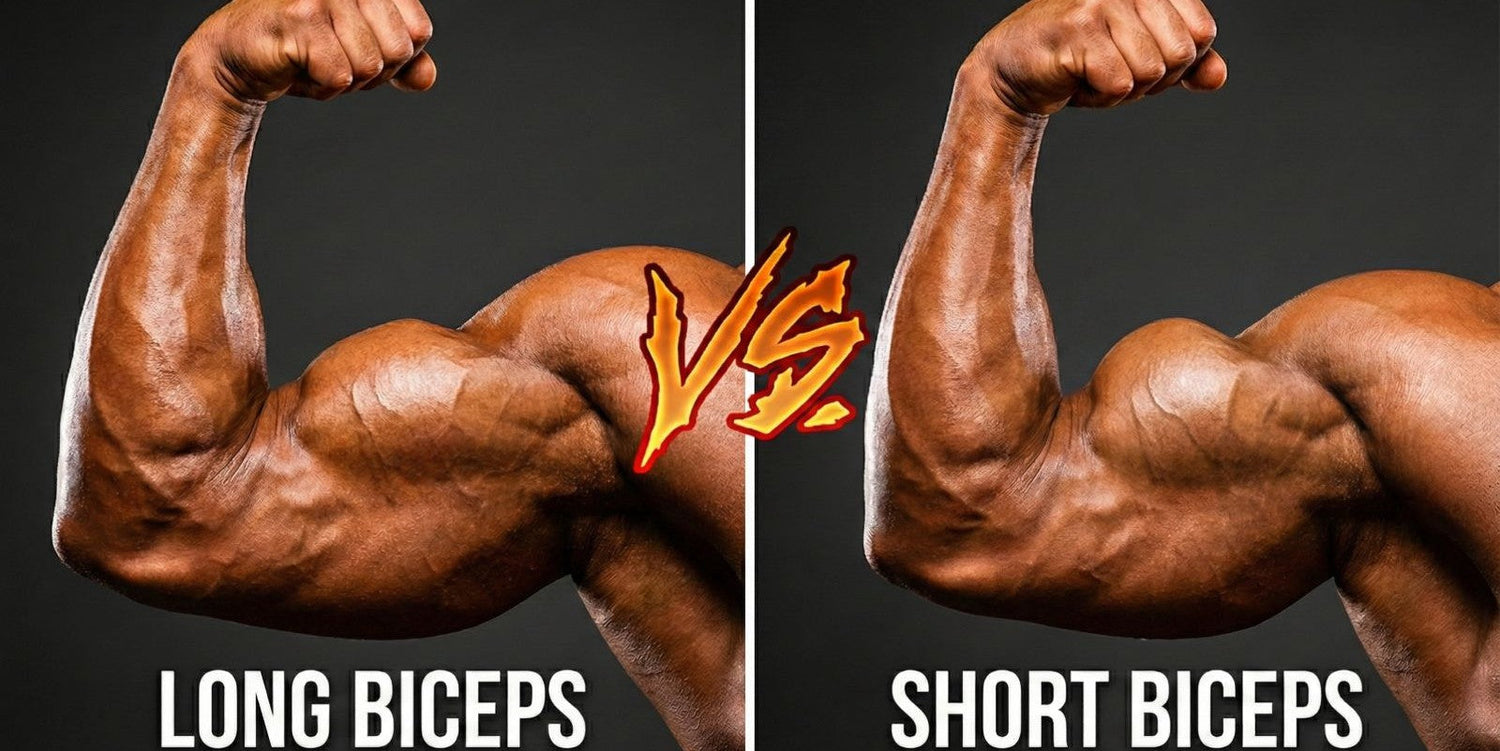
Long biceps usually look fuller near the elbow, while short biceps create a more visible gap and a higher peak. You cannot change your tendon insertion, but you can train your biceps, brachialis, brachioradialis, and forearms to make either arm shape look bigger and more defined.
This guide explains how to identify your biceps type, how to train for your genetics, and how to avoid common mistakes that waste time or irritate your elbows.
Quick Answer: Long biceps extend closer to the elbow with zero to one finger gap, while short biceps show two or more fingers of space between the muscle belly and elbow crease. You cannot change your insertion, but short biceps benefit from brachialis and forearm thickness work, while long biceps respond best to stretched curls and peak-focused training.
Key Takeaways
- Genetics: You cannot turn short biceps into long biceps, because insertion points are largely genetic.
- Finger test: The finger test is a simple visual check, not a medical diagnosis.
- Peak vs fullness: Short biceps often create a higher peak, while long biceps often look fuller when relaxed.
- Gap reduction: To reduce the visual gap near the elbow, build the brachialis and brachioradialis.
- Progressive overload: The best results come from strict form, progressive overload, enough weekly volume, and pain free execution.
What Are Long and Short Biceps?
Long and short biceps describe how far the muscle belly appears to extend toward the elbow, determined by the relationship between the visible muscle belly and the tendon rather than the length of your arm.

The Muscle Belly and the Tendon

The muscle belly is the part that contracts and grows, while the tendon connects that muscle to bone. A longer visible muscle belly usually means less visible gap near the elbow, while a shorter visible muscle belly usually means a larger tendon gap.
- Muscle belly: This is the fleshy part of the biceps that gets pumped during curls and grows from resistance training.
- Tendon: This is the tough connective tissue that anchors the biceps to bone and does not grow like muscle tissue.
- Insertion point: This is the attachment area that influences how long or short your biceps look when flexed.
Short Biceps
Short biceps usually have a higher muscle belly and a larger visible gap between the biceps and the elbow crease. This arm shape can create a dramatic peak when flexed, but it may look less filled out near the lower upper arm.
- Visual cue: Two or more fingers may fit between the flexed biceps and the elbow crease.
- Main advantage: The arm can show a strong peak during front or side flexing poses.
- Main challenge: The lower arm area may look thinner when the arm is relaxed.
Long Biceps
Long biceps usually extend closer to the elbow and leave little visible gap when flexed. This arm shape often looks thick in a shirt, but it may show less of a sharp peak.
- Visual cue: Zero or very few fingers fit between the flexed biceps and the elbow crease.
- Main advantage: The arm often looks fuller when relaxed because more of the upper arm is covered by muscle.
- Main challenge: Peak development may require more focused long head training and stricter squeezing.
The Two Heads of the Biceps
The biceps brachii has a long head and a short head, and each contributes to arm shape. You cannot move the tendon, but you can bias tension through arm position, grip, and exercise selection.
- Long head: This sits more toward the outside of the upper arm and contributes strongly to peak appearance.
- Short head: This sits more toward the inside of the upper arm and contributes to width and front facing thickness.
- Supporting muscles: The brachialis and brachioradialis help create a thicker lower arm line and stronger curl mechanics.
How Do You Test Your Biceps Length?
The finger test helps you estimate whether your biceps look short, average, or long. It is useful for training decisions, but it should not be treated as a clinical anatomy test.
How to Do the Finger Test
Flex one arm hard at about 90 degrees, then measure the gap between your biceps muscle belly and the elbow crease with the fingers of your other hand. Keep your wrist slightly supinated so the biceps fully contracts.
- Step 1: Bend your elbow to about 90 degrees and keep your upper arm still.
- Step 2: Flex your biceps as hard as possible and turn your pinky slightly toward your face.
- Step 3: Find the space between the end of the biceps muscle belly and the elbow crease.
- Step 4: Place your fingers flat in the gap and count how many fit comfortably.
How to Read Your Result
Your result gives a practical estimate of your visual biceps type. Check both arms because mild left to right asymmetry is common.
- Zero fingers: You likely have long biceps with a muscle belly that reaches close to the elbow.
- One finger: You likely have average biceps with a balance of fullness and peak potential.
- Two or more fingers: You likely have short biceps with more visible tendon gap and stronger peak potential.
- Higher body fat note: If you cannot see the edge clearly, feel for the hard muscle belly instead of relying only on appearance.
How Should You Train Short Biceps?
Short biceps are not bad genetics, they are a different visual structure. They often peak well when flexed, but the lower arm line needs support from brachialis and forearm development to look balanced and complete.
The Main Look
Short biceps usually create a rounder and taller peak because the muscle belly has less vertical space to spread out. The tradeoff is a more visible gap near the elbow when the arm is straight or relaxed.
- Best visual strength: Flexed photos and front double biceps poses often look impressive.
- Biggest concern: The arm may look less full near the elbow without brachialis and forearm work.
- Training goal: Build arm thickness around the gap instead of trying to lengthen the biceps.
The Best Training Focus
Short biceps benefit from training that builds the brachialis, brachioradialis, and total arm thickness. Hammer curls and neutral grip work are especially useful because different handgrips can change elbow flexor synergy and brachioradialis involvement.[1]
- Build the brachialis: Use hammer curls, cross body curls, and neutral grip cable curls.
- Build the brachioradialis: Use reverse curls and controlled neutral grip curls to thicken the top of the forearm.
- Keep curls strict: Avoid swinging because momentum reduces tension on the target muscles.
"Exercises such as preacher curls and concentration curls (where the upper arm is positioned in front of the torso) work more in the short head, as do exercises such as cross cable curls on a high pulley apparatus."
Brad Schoenfeld, PhD, Exercise Science Researcher, CUNY Lehman College
How Should You Train Long Biceps?
Long biceps are excellent for a full arm look, especially when relaxed. They may need more long head bias and top end control to create sharper separation and a more noticeable peak.
The Main Look
Long biceps usually fill more of the upper arm and create less visible empty space near the elbow. The tradeoff is that the biceps may look more like a smooth curve than a sharp mountain peak.
- Best visual strength: The arm can look thick in sleeves even without flexing hard.
- Biggest concern: Peak height may look less dramatic unless the long head is well developed.
- Training goal: Create shape through stretched curls, supination, and hard peak contraction.
The Best Training Focus
Long biceps benefit from curl variations that place the upper arm slightly behind the torso and increase long head stretch. Research on shoulder position during dumbbell curls suggests that arm position can influence biceps brachii long head EMG activity.[2]
- Prioritize incline curls: Let your arms hang behind the torso and curl without letting the elbows drift forward.
- Use strict supination: Rotate the pinky upward near the top to maximize the squeeze.
- Control the lowering phase: Use a slow eccentric to maintain tension and reduce sloppy reps.
"The Incline Dumbbell Curl and the Dumbbell Biceps Curl resulted in a considerable neuromuscular effort throughout the whole elbow range of motion, and thus, may be preferable for the improvement of biceps brachii force in training programs."
Oliveira LF, Matta TT, Alves DS, et al. J Sports Sci Med. 2009
What Is the Smart Biceps Training Guide?
The best biceps program trains the biceps directly while also building the supporting elbow flexors. Use enough volume to progress, but not so much that your elbows become irritated.
Rule 1: Use Progressive Overload
Progressive overload means you must gradually make training more challenging over time. Add reps, load, control, range of motion, or better technique instead of chasing random exercise variety.
- Add reps first: Move from 8 reps to 12 reps before increasing weight.
- Add load carefully: Increase weight only when form stays clean.
- Add control: Slow the eccentric and pause at the top to remove momentum.
Rule 2: Choose Exercises by Function
A complete biceps plan includes one supinated curl, one stretched curl, and one neutral or reverse grip curl. This covers the biceps brachii, brachialis, and brachioradialis without making the workout unnecessarily long.
- Supinated curl: Use dumbbell curls or cable curls to train the main biceps function.
- Stretched curl: Use incline curls or cable curls with the arm slightly behind the body.
- Neutral grip curl: Use hammer curls to build the lower arm line and elbow flexor thickness.
Rule 3: Train With Recoverable Weekly Volume
Most lifters should start with moderate weekly arm volume and increase only when recovery is good. A systematic review found that training volume is a key variable for hypertrophy, but more is not automatically better when effort and recovery are poor.[4]
- Beginner range: Start with 6 to 10 hard biceps sets per week.
- Intermediate range: Use 10 to 16 hard sets per week if elbows feel good.
- Recovery warning: Reduce volume if elbow pain, forearm tightness, or performance drops for more than one week.
Rule 4: Build a Home Setup That Supports Progress
A small home gym can train biceps well if it includes adjustable resistance, stable support, and safe loading options. For arm focused work, start with RitFit dumbbells, a stable weight bench, and cable options when available.
For a complete training setup, browse the RitFit home gym packages to combine multiple pieces in one purchase to save on shipping.
- Dumbbells: They support unilateral curls and help manage left to right strength differences.
- Bench: It allows incline curls, concentration curls, and chest supported spider curls.
- Cables: A cable station or cable machine attachments can keep tension smoother through the curl.
"10+ sets per muscle per week elicited greater hypertrophy than 10 sets or fewer. Thus, this would be a good starting point for your biceps training volume."
Brad Schoenfeld, PhD, Exercise Science Researcher, CUNY Lehman College
What Are the Best Exercises for Short Biceps?
Short biceps usually respond best to exercises that thicken the lower arm line and support the peak. The goal is to make the gap less visually obvious by building the muscles around it.
Exercise 1: Hammer Curl
The hammer curl is the most useful gap filler for short biceps because it trains the brachialis and brachioradialis. It also keeps the wrist neutral, which can feel more elbow friendly for many lifters.
- How to do it: Hold dumbbells with palms facing each other and curl without turning the wrist.
- Form cue: Keep elbows close to your ribs and avoid letting the shoulders roll forward.
- Best equipment: Use hex rubber dumbbells for stable grip and simple loading.
Exercise 2: Preacher Curl
The preacher curl places the upper arm in front of the body and makes swinging harder. Research comparing cable and barbell preacher curl variations suggests that different resistance profiles can produce strength and hypertrophy adaptations while emphasizing different points in the range of motion.[3]
- How to do it: Set your upper arms on the pad and curl without lifting your elbows.
- Form cue: Lower with control and avoid bouncing out of the bottom position.
- Best use: Use this after heavier curls to add focused tension without full body momentum.
Exercise 3: Spider Curl
The spider curl keeps the upper arms hanging in front of the body and makes the top squeeze very direct. It is especially useful when you want a strict curl that highlights peak contraction.
- How to do it: Lie chest down on an incline bench and let the arms hang straight down.
- Form cue: Curl upward without pulling the elbows behind you.
- Best use: Use lighter weight and a hard squeeze at the top.
"If you wanna build thicker arms you gotta make sure you're hitting the brachialis. Hammer curls do a great job targeting this muscle and are gonna help add width to your biceps."
Jay Cutler, 4x Mr. Olympia, Fitness Volt
What Are the Best Exercises for Long Biceps?
Long biceps usually need more peak focused work and better contraction quality. The best choices stretch the long head and teach you to squeeze hard without using momentum.
Exercise 1: Incline Dumbbell Curl
The incline dumbbell curl is a top choice for long biceps because the arm starts behind the torso. This stretched position helps target the long head and can make the biceps look more separated over time.
- How to do it: Set a bench to 45 to 60 degrees and let your arms hang slightly behind your torso.
- Form cue: Keep the elbows back and avoid turning it into a front shoulder movement.
- Best equipment: Pair adjustable resistance with a secure RitFit GATOR adjustable weight bench.
Exercise 2: Concentration Curl
The concentration curl removes most body momentum and makes the top contraction easy to feel. It is useful for long biceps because it teaches hard supination and peak control.
- How to do it: Sit on a bench and brace your upper arm against your inner thigh.
- Form cue: Rotate your pinky upward near the top and squeeze for one second.
- Best use: Put it late in the workout when lighter loads can still create strong tension.
Exercise 3: Drag Curl
The drag curl keeps the bar close to the torso and moves the elbows slightly behind the body. This can help lifters feel the outer biceps more clearly than a loose swinging curl.
- How to do it: Hold a barbell and pull it upward along your torso instead of curling it far in front.
- Form cue: Keep the chest tall and do not shrug the shoulders.
- Best equipment: Use a straight bar such as a 7ft Olympic barbell when your wrists tolerate it well.
"One of the best bicep curl movements for hitting the long head is the drag curl. The positioning of the elbows back behind the body allows us to hit the long head preferentially in this bicep curl exercise."
Jeff Cavaliere, MSPT, CSCS, Physical Therapist and Strength Coach, ATHLEAN-X
What Are Common Biceps Myths?
Most biceps myths come from confusing genetics with training potential. You cannot rewrite your insertion points, but you can still build bigger and better looking arms with the right approach.
Myth 1: You Can Fill the Gap by Lengthening the Biceps
You cannot lengthen the biceps muscle belly through curls. You can only make the gap look less obvious by adding size to the brachialis, brachioradialis, and forearms.
- Better goal: Build surrounding arm thickness instead of chasing a different insertion point.
- Best tools: Use hammer curls, reverse curls, cable curls, and progressive loading.
Myth 2: Short Biceps Are Bad Genetics
Short biceps are not automatically bad genetics. They often produce a strong peak and can look excellent when the supporting arm muscles are developed.
- Reality: Short biceps usually need more lower arm thickness to balance the gap.
- Training fix: Prioritize neutral grip and reverse grip work in addition to regular curls.
Myth 3: Long Biceps Are Always Stronger
Long biceps may look fuller, but strength still depends mostly on training quality, joint structure, skill, and consistency. A trained lifter with short biceps can easily outcurl an untrained lifter with long biceps.
- Reality: Muscle size, tendon health, technique, and progressive loading all matter.
- Training fix: Track performance instead of assuming genetics decide everything.
Myth 4: You Need Ten Biceps Exercises
You do not need endless curl variations to grow your arms. Most people need a few well selected exercises performed with high effort and good recovery.
- Simple plan: Use one standard curl, one stretched curl, and one hammer or reverse curl.
- Better progression: Keep the same core exercises long enough to improve them.
Myth 5: A Painful Pop Means a Huge Pump
A sudden painful pop near the elbow during heavy lifting is a red flag, not a pump. Distal biceps tendon rupture can involve a pop, visible contour change, and loss of strength, so it should be medically evaluated quickly.[5]
- Stop immediately: Do not keep curling if pain, bruising, swelling, or sudden deformity appears.
- Get evaluated: A clinician can check tendon integrity and decide whether imaging or urgent care is needed.
How Do You Pose for Your Biceps Type?
The right pose can highlight your best biceps features without pretending anatomy has changed. Use angles that match your natural arm shape to get the most impressive results.
How to Pose Short Biceps
Short biceps look best when the elbow is bent enough to stack the muscle belly upward. A tight flex and slight arm pressure against the torso can make the peak look fuller.
- Use a 90 degree flex: This position shows the peak better than a relaxed straight arm.
- Press lightly into the torso: This can make the upper arm look wider in photos.
- Shoot slightly above: A higher angle can emphasize roundness and peak shape.
How to Pose Long Biceps
Long biceps look best when the photo shows overall sleeve filling thickness. Slightly side facing angles and strong wrist supination help reveal more shape.
- Use side angles: They show fullness from shoulder to elbow.
- Supinate hard: Turn the pinky upward to bring out the peak as much as possible.
- Use semi flexed poses: Long biceps can look big even without a full bodybuilding pose.
Quick Summary: Short vs Long Biceps at a Glance
The table below summarizes the key differences between short and long biceps, including visual appearance, training priorities, and best exercises for each type.
| Feature | Short Biceps | Long Biceps |
|---|---|---|
| Finger Test | Two or more fingers fit in the gap. | Zero fingers or very little gap. |
| Visual Look | Higher peak with more visible elbow gap. | Fuller upper arm with less visible gap. |
| Main Advantage | Strong flexed peak. | Full relaxed arm shape. |
| Main Challenge | Lower arm gap can look thinner. | Peak may be less sharp. |
| Best Focus | Brachialis and brachioradialis thickness. | Long head stretch and top end squeeze. |
| Best Exercises | Hammer curls, preacher curls, spider curls. | Incline curls, concentration curls, drag curls. |
FAQs About Long vs Short Biceps
How do I know if I have long biceps or short biceps?
Use the finger test while flexing your arm at about 90 degrees.
If two or more fingers fit between the biceps and elbow crease, your biceps likely look short.
If almost no gap appears, your biceps likely look long.
Check both arms, since mild asymmetry is common.
Can short biceps become long biceps with training?
No. Training cannot move your tendon insertion or make the biceps muscle belly attach lower. You can still improve the look by growing the biceps, brachialis, brachioradialis, and forearms, which makes the entire arm look thicker and more balanced overall.
What exercises are best for short biceps?
Hammer curls, preacher curls, spider curls, and reverse curls are strong choices for short biceps. These movements help build the brachialis and brachioradialis, which can reduce the visual gap near the elbow and make the peak look more supported and impressive.
What exercises are best for long biceps?
Incline dumbbell curls, drag curls, and concentration curls are strong choices for long biceps. These exercises help bias the long head, improve the top squeeze, and create more visible separation in an arm that already has good natural fullness from elbow to shoulder.
Is the biceps finger test accurate?
It is useful as a practical visual check, but it is not a medical measurement. Body fat, flexing effort, arm position, and natural asymmetry can all affect the result, so use it as a training guide rather than a clinical diagnosis.
Do long biceps take longer to grow?
No. Long biceps do not grow slower by default. They may look slower to peak because the muscle belly covers more area, so size changes can appear less dramatic than the high bunching effect often seen with short biceps during flexed poses.
Should I train biceps if curls hurt my elbow?
No.
Do not push through sharp or worsening elbow pain.
Reduce load, switch to neutral grip curls, slow the lowering phase, and lower weekly volume for one to two weeks.
If pain continues or a pop occurs, get professional evaluation immediately.
Which biceps type looks bigger in a shirt?
Long biceps often look bigger in a shirt because the muscle belly fills more of the upper arm when relaxed. Short biceps can still look very impressive, especially when the brachialis, triceps, shoulders, and forearms are well developed to balance the overall arm shape.
Conclusion
Long biceps and short biceps can both look strong, athletic, and impressive. The winning strategy is to stop chasing a different insertion point and start building the muscles that improve your natural shape.
Short biceps should emphasize brachialis and forearm thickness, while long biceps should emphasize stretched curls, supination, and peak contraction. Train consistently, progress gradually, and let your structure guide your exercise choices.
For the equipment you need to support your arm training, browse our RitFit sales page for current deals on dumbbells, benches, and strength equipment.
Disclaimer
This article is for general fitness education only and is not medical advice. Stop training and consult a qualified professional if you feel sharp pain, sudden weakness, bruising, swelling, or a painful pop near the elbow or shoulder.
References
1. Coratella G, Tornatore G, Longo S, et al. Biceps brachii and brachioradialis excitation in biceps curl exercise: different handgrips, different synergy. Sports (Basel). 2023;11(3):64. doi:10.3390/sports11030064
2. Oliveira LF, Matta TT, Alves DS, Garcia MA, Vieira TM. Effect of the shoulder position on the biceps brachii EMG in different dumbbell curls. J Sports Sci Med. 2009;8(1):24-29.
3. Nunes JP, Jacinto JL, Ribeiro AS, et al. Placing greater torque at shorter or longer muscle lengths? Effects of cable vs barbell preacher curl training on muscular strength and hypertrophy in young adults. Int J Environ Res Public Health. 2020;17(16):5859. doi:10.3390/ijerph17165859
4. Baz-Valle E, Balsalobre-Fernandez C, Alix-Fages C, Santos-Concejero J. A systematic review of the effects of different resistance training volumes on muscle hypertrophy. J Hum Kinet. 2022;81:199-210. doi:10.2478/hukin-2022-0017
5. Guo S, Herrera-Soto JA. Delayed surgical treatment of distal biceps tendon rupture. J Orthop Case Rep. 2012;2(4):6-8.





