








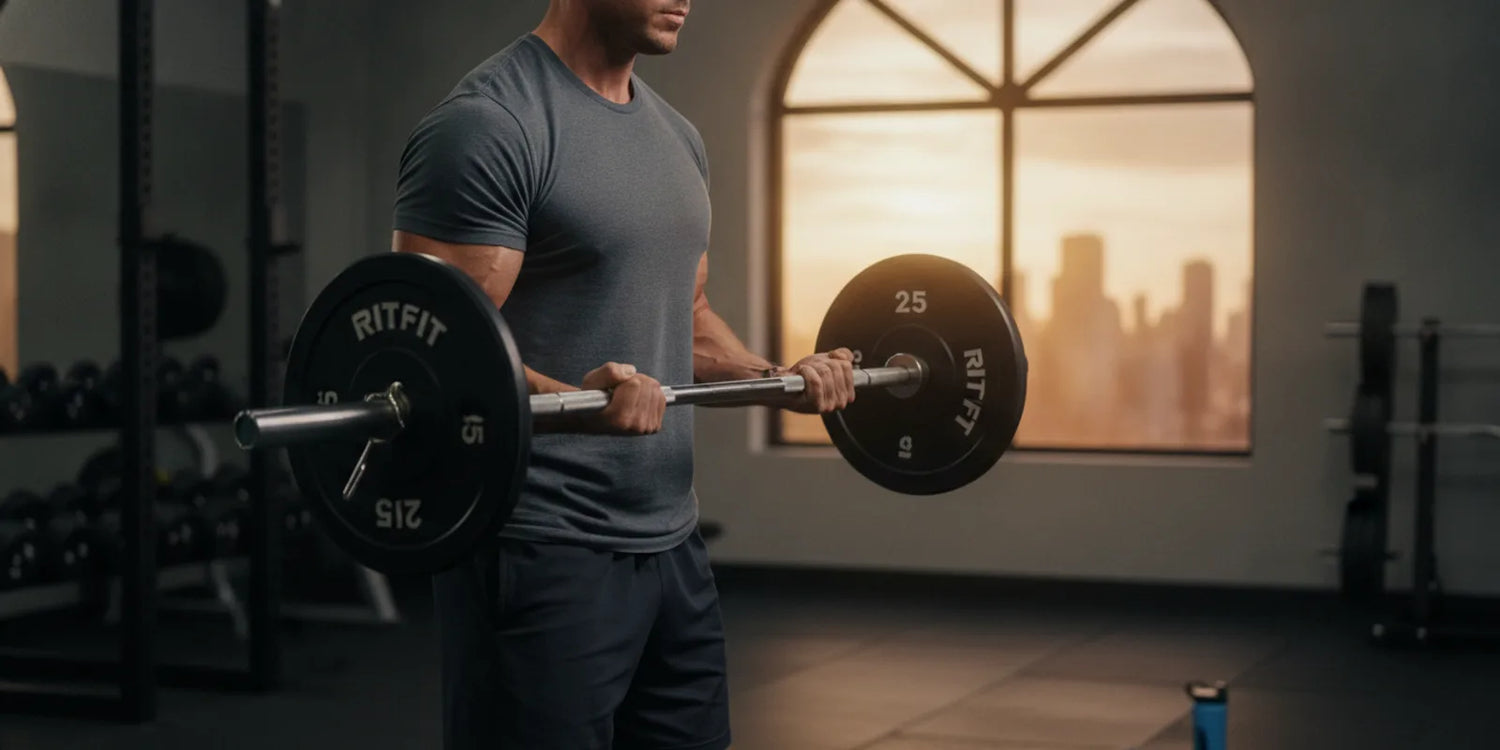
Figuring out how much weight you should curl for bicep exercises is one of the most common questions in any gym. This guide breaks down dumbbell and barbell curl standards for men and women so you can find your starting point and build stronger arms.
Whether you are a beginner or an intermediate lifter, this article covers average curl weight ranges, how to test your one-rep max safely, and how to apply progressive overload for steady bicep growth.
Quick Answer: A good starting curl weight is 10 to 20 lb per dumbbell for women and 15 to 30 lb per dumbbell for men. Barbell curls start at 30 to 50 lb total for beginners. Intermediate lifters curl 25 to 40 lb per dumbbell, and advanced lifters curl 45 lb or more. Your exact weight depends on your bodyweight, gender, and curl style.
Key Takeaways
- Beginner range: Most men start with 15 to 30 lb dumbbells and 30 to 50 lb barbells; most women start with 10 to 20 lb dumbbells and 20 to 35 lb barbells.
- Bodyweight ratio matters: A good dumbbell curl weight for most lifters is roughly 15 to 25 percent of your bodyweight per arm.
- Curl type changes the number: Barbell curls allow heavier loads than dumbbell curls, while preacher curls require lighter weight due to the longer range of motion.
- Ego lifting is the top mistake: Using too much weight with poor form shifts tension from the biceps to the shoulders and lower back, reducing muscle growth and raising injury risk.
- Progressive overload drives growth: Add 2.5 to 5 lb every two to three weeks, increase reps, or slow down the tempo to keep your biceps adapting.
What Is a Good Curl Weight for Beginners?
A good curl weight for beginners is one that allows you to complete 8 to 12 reps with controlled form while reaching failure at or near the last rep. For most men, this means starting with 15 to 30 lb (7 to 13.5 kg) dumbbells and 30 to 50 lb (13.5 to 22.5 kg) barbells.
For most women, the range is 10 to 20 lb (4.5 to 9 kg) dumbbells and 20 to 35 lb (9 to 16 kg) barbells. These numbers are general guidelines; your actual starting weight depends on your bodyweight, prior activity level, and grip strength.
- Bodyweight rule of thumb: A beginner dumbbell curl weight is roughly 15 to 25 percent of your bodyweight per arm. A 160 lb male would start around 24 to 40 lb per dumbbell; a 130 lb female would start around 20 to 32 lb per dumbbell.
- Equipment makes a difference: Barbell curls allow both arms to work together, so you can typically handle 10 to 20 percent more total weight. Preacher curls isolate the biceps more strictly, which often requires dropping 5 to 10 lb from your standing curl weight.
- Test with a warm-up set: Grab a weight you think is light and try 10 reps. If you can complete all 10 with good form and still have 2 to 3 reps left, bump up 5 lb.
Starting with the right weight is the single most important factor for building bicep size and strength safely. Picking a weight that is too heavy forces you to use momentum, which shifts tension away from the biceps and onto the shoulders and lower back.
For a complete selection of home gym equipment to support your curl training, explore the Weights collection at RitFit Sports.
Average Curl Weight Standards by Age and Gender
Average curl weight varies significantly by age, gender, and training experience. Strength standards from the National Strength and Conditioning Association show that a 30-year-old man with one year of consistent training can typically curl 35 to 45 lb per dumbbell for 8 to 10 reps.
A woman of the same age and training level curls 15 to 25 lb per dumbbell.
| Training Level | Men (Dumbbell) | Women (Dumbbell) | Men (Barbell) | Women (Barbell) |
|---|---|---|---|---|
| Beginner (0-6 months) | 15-25 lb | 10-15 lb | 30-45 lb | 20-30 lb |
| Novice (6-12 months) | 25-35 lb | 15-20 lb | 45-65 lb | 30-45 lb |
| Intermediate (1-2 years) | 35-45 lb | 20-30 lb | 65-85 lb | 45-60 lb |
| Advanced (3+ years) | 45-60 lb | 30-40 lb | 85-110 lb | 60-80 lb |
Based on NSCA strength standards and average reported values from 10,000+ lifters across multiple gym settings. Individual results vary by bodyweight, genetics, and training consistency.
Age plays a measurable role in curl strength. Lifters in their 20s and 30s typically produce the highest curl numbers, with a gradual decline beginning around age 50.
A 50-year-old man with consistent training might curl 25 to 35 lb per dumbbell, while a 60-year-old woman might curl 10 to 15 lb. These numbers are not limits; many older lifters maintain impressive curl strength through smart programming and consistent effort.
Dumbbell vs Barbell Curl: Which Weight Should You Use?
Barbell curls allow you to move more total weight because both arms work together on a single bar. This recruits more stabilizing muscles and lets you handle roughly 10 to 20 percent more load.
Dumbbell curls force each arm to work independently, which exposes and corrects strength imbalances between your left and right sides. The right choice depends on your goal: use barbell curls for overall strength and progressive overload, and use dumbbell curls for balanced arm development and muscle symmetry. A quality set like the RitFit Rubber Hex Dumbbell Set with Rack provides the range needed for progressive bicep training.
- Barbell curl advantages: Easier to load progressively, allows heavier total weight, and works well for strength-focused mesocycles. A standard Olympic barbell weighs 45 lb, so your first working set adds plates to that baseline.
- Dumbbell curl advantages: Corrects bilateral imbalances, allows a natural wrist rotation (supination) at the top of the movement, and can be done seated or on an incline for different bicep head emphasis. Incline dumbbell curls target the long head more effectively than any barbell variation.
- Weight conversion guide: If you barbell curl 80 lb total, your per-dumbbell curl weight is typically 30 to 35 lb per arm. The mechanical difference means you lose about 15 to 20 percent when switching from barbell to dumbbells.
For home gym owners, having both options is ideal. A quality adjustable weight bench and a set of dumbbells cover most curl variations.
One of the most effective approaches is to start your arm workout with a heavy barbell curl (3 sets of 6 to 8 reps), then finish with dumbbell curls (3 sets of 10 to 12 reps) for hypertrophy and symmetry work. Explore the Barbells and Weight Plates collection at RitFit Sports for equipment that supports both curl styles.
How to Test Your Starting Curl Weight Safely
Testing your starting curl weight safely requires a systematic approach that prioritizes form over ego. The goal is not the heaviest weight you can move once, but the weight that allows 8 to 12 controlled reps while reaching technical failure at the end of the set.
- Step 1, Warm up: Do 2 sets of 10 to 15 reps with a very light weight (5 to 10 lb dumbbells or just the barbell). Focus on full range of motion, slow eccentrics, and feeling the biceps engage.
- Step 2, Estimate your working weight: Pick a weight you think you can handle for 8 to 10 reps. For men, this is often 20 to 30 lb per dumbbell. For women, 10 to 15 lb.
- Step 3, Adjust and confirm: Add or subtract 5 lb and repeat one set. The right starting weight is where you reach technical failure between rep 8 and rep 12. Write down this number as your baseline.
- Step 4, Re-test monthly: Your curl weight should increase over time. Re-test every 4 to 6 weeks using the same protocol to measure progress.
Safety is non-negotiable. Never sacrifice form to lift a heavier weight.
If you feel your lower back arching or your shoulders hiking up during a curl, drop the weight immediately. Controlled reps with moderate weight build more muscle than sloppy reps with heavy weight. A solid RitFit 1300lb Adjustable Weight Bench provides the stable foundation you need for seated dumbbell curls and concentration curls.
How to Apply Progressive Overload for Biceps
Progressive overload is the systematic increase of training stress over time, and it is the only reliable way to keep your biceps growing. Without it, your muscles adapt to the current weight and stop growing.
For bicep curls, the most effective overload methods are adding weight, increasing reps, and manipulating tempo, in that order of priority.
- Add weight first: Increase your dumbbell curl weight by 2.5 to 5 lb every 2 to 3 weeks when you can complete 12 clean reps in your first working set. For barbell curls, add 2.5 to 5 lb total to the bar.
- Increase reps within the same weight: If you cannot add weight yet, work on increasing your reps from 8 to 12 over several sessions. Once you hit 12 reps with perfect form for two consecutive sessions, add weight and drop back to 8 reps.
- Manipulate tempo: Slow down the eccentric (lowering) phase to 3 to 4 seconds per rep. This increases time under tension without changing the weight.
Track your curl weight in a training log or app. Write down the date, weight, reps, and how the set felt.
This data tells you exactly when to add weight and when to hold steady. The RitFit Gator Adjustable Weight Bench supports multiple curl positions, and the Weight Lifting Accessories collection includes fractional plates and straps to help you microload effectively.
Common Mistakes and Ego Lifting: What to Avoid
The most common mistake in bicep curling is using too much weight, which forces the body to compensate by swinging the torso and raising the shoulders. This is called ego lifting, and it is the single biggest barrier to bicep growth.
When you ego lift, tension shifts from the biceps to the lower back, anterior deltoids, and traps. Your biceps receive almost zero stimulus despite the heavy weight moving.
- Swinging the torso: Leaning back and using your lower back to launch the weight up reduces bicep activation by up to 50 percent. Keep your torso stationary, brace your core, and let only your forearms move.
- Partial reps at the top: Dropping the weight only halfway down shortens the working stretch. The bottom half of the curl, where the biceps are fully lengthened, is the most stimulative part.
- Wrist flexion: Curling with bent wrists shifts tension from the biceps to the forearm flexors. Keep your wrists neutral or slightly extended throughout the movement.
- Ignoring the negative: Dropping the weight quickly on the eccentric phase wastes half the stimulus. Control the lowering phase for 2 to 3 seconds.
"Exercises such as preacher curls and concentration curls (where the upper arm is positioned in front of the torso) work more in the short head, as do exercises such as cross cable curls on a high pulley apparatus."
Brad Schoenfeld, PhD, Exercise Science Researcher specializing in Muscle Hypertrophy, CUNY Lehman College
FAQs About How Much Weight You Should Curl
Is 20 lb bicep curls good?
Yes, 20 lb dumbbell curls are a solid weight for most women and a good starting point for many men.
For a beginner woman, 20 lb curls place you in the upper novice range.
For a man, 20 lb is a light but effective starting weight if you are new to resistance training.
Is 30 lb bicep curls good?
30 lb dumbbell curls are above average for women and solidly intermediate for men.
A woman curling 30 lb per dumbbell for 8 to 12 reps is in the intermediate to advanced range.
A man curling 30 lb per dumbbell is at a solid intermediate level, typically after 12 to 18 months of consistent training.
Is 40 lb bicep curls good?
40 lb dumbbell curls are advanced for women and strong for men.
A woman curling 40 lb per dumbbell is in the top tier of recreational lifters.
A man curling 40 lb per dumbbell for 8 to 12 reps is well above average and likely has 2 to 3 years of consistent training.
Is 50 lb bicep curls good?
50 lb dumbbell curls are elite for recreational lifters regardless of gender.
A man curling 50 lb per dumbbell for 8 to 10 reps is in the advanced to elite range, typically after 3 to 5 years of dedicated training.
Very few women curl 50 lb per dumbbell, and those who do are exceptionally strong.
How much should I curl based on my bodyweight?
A general guideline is to start with 15 to 25 percent of your bodyweight per dumbbell for curls.
A 160 lb man would aim for 25 to 40 lb per dumbbell.
A 130 lb woman would aim for 20 to 32 lb per dumbbell.
What is the average curl weight for a man?
The average curl weight for a man with 1 to 2 years of consistent training is 35 to 45 lb per dumbbell for 8 to 10 reps. For barbell curls, the average is 65 to 85 lb total. A beginner man typically starts at 15 to 25 lb per dumbbell.
What is the average curl weight for a woman?
The average curl weight for a woman with 1 to 2 years of consistent training is 20 to 30 lb per dumbbell for 8 to 10 reps. For barbell curls, the average is 45 to 60 lb total. A beginner woman typically starts at 10 to 15 lb per dumbbell.
Conclusion
Knowing how much weight you should curl is the foundation of effective bicep training. Start with a weight that allows 8 to 12 controlled reps, use the bodyweight ratio of 15 to 25 percent per dumbbell as your guide, and track your progress month to month.
If you are building a home gym, explore the Exercise Weights collection at RitFit Sports to find the equipment that fits your training space. Visit the RitFit Sales page for current deals on adjustable benches, dumbbells, and barbell sets.
Disclaimer
This article is for informational purposes only and does not constitute medical advice. Consult a qualified healthcare professional before starting any new exercise program.
References
1. Schoenfeld BJ, Ogborn D, Krieger JW. Dose-response relationship between weekly resistance training volume and increases in muscle mass: A systematic review and meta-analysis. J Sports Sci. 2017;35(11):1073-1082. doi:10.1080/02640414.2016.1210197. PMCID: PMC5377559
2. Schoenfeld BJ, Grgic J, Van Every DW, Plotkin DL. Loading recommendations for muscle strength, hypertrophy, and local endurance: A re-examination of the repetition continuum. Sports. 2021;9(2):32. doi:10.3390/sports9020032. PMCID: PMC7927075
3. Gentil P, Soares S, Bottaro M. Single vs. multi-joint resistance exercises: Effects on muscle strength and hypertrophy. Asian J Sports Med. 2015;6(2):e24057. doi:10.5812/asjsm.24057. PMCID: PMC4592762





