








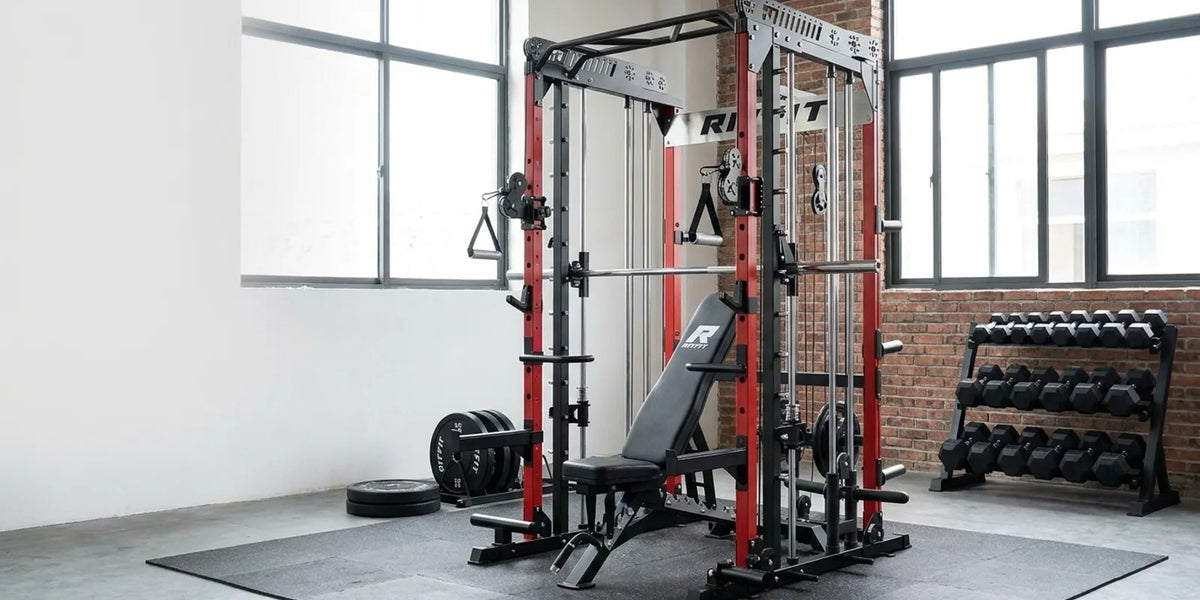
Smith machine quad exercises let you build the front of your thighs with a fixed bar path and no spotter. This guide covers eight quad-dominant movements, the setup variables that shift load toward the knees, and how to load each one.
Use it to build a quad-focused leg day in a home gym, swap movements when your knees object, and match every lift to the right bar and foot position.
Quick Answer: The best smith machine quad exercises are the heels-elevated quad squat, front squat, sissy squat, narrow-stance squat, reverse lunge, rear-foot-elevated split squat, assisted pistol squat, and belt squat, chosen and set up so foot placement, bar position, and depth keep the load on your quads.
Key Takeaways
- Load shift rule: feet forward, bar forward, toes square, and controlled depth move work from the hips to the quads.
- Eight movements: heels-elevated squat, front squat, sissy squat, narrow-stance squat, reverse lunge, rear-foot-elevated split squat, assisted pistol squat, and belt squat.
- Evidence: one 2025 study measured 43.0 kJ of total work across five heavy sets of Smith machine back squats, with quad fatigue similar to a leg press.
- Loading: baseline each movement on its own, add the smallest jump when every rep is crisp, and swap any variation that causes sharp knee pain.
How Load Shifts to Your Quads on a Smith Machine
Five trainable setup variables decide how much of a Smith machine lift your quadriceps absorb. Feet forward of the bar line, a front-racked bar, toes square to the bar, controlled depth into deep knee flexion, and deliberate knee-forward travel all move work from the hips toward the knees.
- Foot placement: feet further forward and heels raised increase knee flexion and cut hip flexion demand, so the quads own more of every rep.
- Bar position: a front-racked bar pulls the load line ahead of the spine and keeps the torso upright through the full range of motion.
- Toe angle: toes square to the bar let the knees travel forward more freely than a flared, toes-out stance.
- Squat depth: deeper controlled knee flexion lengthens the quads under load, where mechanical tension does its best work.
- Knee-forward travel: letting the knees pass the toes under control raises the knee flexion moment and lowers the hip's share of the lift.
In one 2025 study, five sets of ten-repetition-max Smith machine back squats produced 43.0 kJ of total work versus 29.1 kJ on the horizontal leg press[1]. The authors noted the leg press fatigued the quadriceps in a similar manner, which puts the Smith squat squarely in quad-builder territory.
These variables work on any guided unit, from the multifunctional Smith machine to the full setups in the Smith machine collection. Pick the movement and the variable first, then load it with the eight exercises below.
"You're going to have more joint torque at the knee and less joint torque at the hip. The further forward you shift your feet, in general, the more quads you're going to get."
Joe Bennett, Hypertrophy Coach, Independent. Hypertrophy Coach Breaks Down Jay Cutler's Quad Training (Fitness Volt)
8 Best Smith Machine Quad Exercises
Eight Smith machine movements load the quads hard when you bias setup toward the front chain. A 2024 modeling study measured rectus femoris forces above 25 N/kg in loaded back squats and above 15 N/kg in the back leg of split squats[2]. Run one to three of these movements per leg day and tune each with its variable notes.
1. Heels-Elevated Quad Squat
Rest your heels on a small plate or wedge, keep feet hip-width with toes square, and sit straight down while the knees travel forward. The raised heels supply the ankle range of motion that deep knee flexion demands while the torso stays tall.
- Quad bias variable: heel raise plus knee-forward travel, with the hips dropping straight down instead of sitting back.
- Load tip: the guided bar lets you chase deep reps near failure without worrying about dumping the bar.
2. Smith Machine Front Squat
Turn the hooks, hold the bar across the front of your shoulders, and squat with a tall torso. The front-racked bar position pulls the load line forward, so the quads work harder than in a back-racked squat at the same weight.
- Quad bias variable: anterior bar position limits how far you can hinge and keeps the knee flexion demand high.
- Load tip: the fixed path makes the front rack easier to learn than a free bar, since you never chase balance.
"Solid all in one rack. The pulleys and smith machine are so smooth. Ample room to store attachments and barbells. Time consuming assembly but easy"
Khristian P. Verified Buyer, RitFit M1 PRO Multi-Functional Smith Machine with Cable Crossover System and Squat Rack for Home Gym
3. Smith Machine Sissy Squat
Set the bar at hip height behind you for balance, rise onto the balls of your feet, and drive the knees forward while the hips stay extended. The position loads the quads in their lengthened position with almost no hip flexion.
- Quad bias variable: maximal knee flexion with the hip locked in extension, plus a long controlled eccentric.
- Load tip: bodyweight first, then hold a plate once deep reps feel smooth.
4. Smith Machine Narrow-Stance Squat
Stand with feet together or hip-width, toes pointing straight ahead at the bar, and squat to full depth. The narrow, square stance pushes the knees forward over the toes, which raises knee flexion while the glutes take a smaller share.
- Quad bias variable: narrow stance plus square toes, with depth judged by knee flexion rather than hip crease.
- Load tip: expect a lighter working weight than a wide-stance back squat at the same effort.
5. Smith Machine Reverse Lunge
Unrack the bar, take a short step back, and drop the back knee toward the floor while the front knee travels forward. A shorter stride keeps the torso stacked over the hips and leaves the front quad doing the braking and the driving.
- Quad bias variable: short stride and upright torso keep the knee flexion demand on the lead leg.
- Load tip: alternate legs each rep, and keep the rear foot light enough that the front quad fails first.
6. Smith Machine Rear-Foot-Elevated Split Squat
Rest the top of your rear foot on a bench behind you and raise the front heel for the most quad-biased version. The split stance pushes the front leg through deep knee flexion while the rear leg only balances.
- Quad bias variable: front-foot heel raise with knee-forward travel loads the lead quad through a long range.
- Load tip: the guided bar keeps the wobble out, so a weight bench under the rear foot is the only extra setup.
7. Smith Machine Assisted Pistol Squat
Face the bar, hold it at waist height for balance, and squat on one leg through a full range. The guided bar removes the balance problem so you can chase full knee flexion on a single leg.
- Quad bias variable: deep single-leg knee flexion with the hands helping only enough to stay upright.
- Load tip: progress by using the hands less before you add any external load.
8. Smith Machine Belt Squat
Stand on two stable platforms with the bar hanging between them, clip a squat belt to the bar, and squat with the heels raised. The belt loads the legs through the hips with no bar on your back, so the quads can be taken deep without spinal fatigue.
- Quad bias variable: belt line loading with heel elevation keeps the torso vertical and the knees traveling forward.
- Load tip: the only entry needing extra gear, a squat belt plus two solid platforms of equal height.
Should You Choose the RitFit M1 PRO for These Quad Exercises?
The RitFit M1 PRO Smith machine runs all eight movements, with hook positions that cover front-rack and back-rack setups and enough bar travel for deep heels-elevated work. Only the belt squat adds equipment, a squat belt plus two stable platforms.
- Bundle route: the M1 Smith machine home gym package arrives with the basics for quad-focused leg days.
- Cable accessory work: the M1 Smith machine with a cable crossover system adds low-pulley leg work between Smith sets.
- Full-rack route: the M3 power rack with cable crossover Smith machine pairs the Smith bar with a full power rack frame.
- Stack-loaded alternatives: the Buffalo Smith machine home gym package and the BPC06 all-in-one Smith machine with weight stacks trade plate loading for selectorized stacks.
"Next, I do Smith machine squats for the quads and glutes. Here I get as deep as I can and explode out of the hole. Doing these on the Smith allows me to push my last set to failure without worrying about dumping the bar."
Jeff Nippard, Science-Based Natural Bodybuilder and Powerlifter, JeffNippard.com. Jeff Nippard's Science-Backed Leg Workout for Massive Quads (Men's Health UK)
"M1 Pro is extremely well built. Easy to install. The weight stacks are a must and enhance the performance. Very satisfied. Should have purchased much sooner."
Anthony G. Verified Buyer, RitFit M1 PRO Smith Machine Weight Stack Home Gym Package
How to Load and Progress These Quad Movements
Every movement on this list carries its own loading baseline, because Smith machine loads do not transfer one to one between exercises. The variables in each entry change how much work the quads absorb at the same weight.
Choosing Your Starting Weight
Start with the empty bar or a load you can move for 12 clean reps, and treat every new setup as its own baseline. In worked examples from one 2018 study, matching the same perceived effort from a 100 kg Smith machine squat to the leg press required 172 kg, while matching activation measured at the vastus lateralis and vastus medialis required 210 kg[3].
When to Add Weight
Add the smallest available jump once every set hits the top of its rep range with clean technique and two good reps left in reserve. Deep, knee-forward variations earn weight slower than the front squat or belt squat, so judge progress rep by rep.
Swap Options When a Movement Bothers Your Knees
Swap a movement before you skip the day, because the belt squat and assisted pistol squat keep load honest when deep knee flexion irritates the front of the knee. Reducing range of motion is the first dial to turn before abandoning a pattern.
- Reduce range first: stop an inch or two shy of the pinch point and rebuild depth over several sessions.
- Trade the exercise: our Smith machine glute exercises guide covers posterior-chain swaps that still fill a lower-body day.
How Often to Run These Movements
Twice a week per muscle group suits most home gym lifters running three to five training days. Pick two or three movements per session for 3 to 4 sets of 6 to 12 reps, and keep at least 48 hours between quad-focused days.
When Knee Pain Means Stop
Quad fatigue is the goal, but sharp or pinching pain at the front of the knee is a stop signal. Slow the eccentric, cut range, or swap the movement entirely, and see a qualified clinician if pain lingers past a few sessions.
"If maximum quad growth is the goal, do squats and also do exercises such as front squats, leg press, lunges, and leg extensions."
Bret Contreras, PhD, PhD in Sports Science, known as The Glute Guy, Contreras Strength Institute. Do More than 'Just Squat' (Bret Contreras Blog)
FAQs About Smith Machine Quad Exercises
Can you build big quads with only smith machine quad exercises?
Yes. Smith machine squats and split squats load the quadriceps hard enough to grow them, and you can run the eight movements here as your main quad work. Train quads twice a week, add load or reps over time, and stop any variation that causes sharp knee pain.
What foot position shifts the load to your quads on a Smith machine?
Move your feet forward and raise your heels. Forward foot placement increases knee flexion and reduces hip flexion demand, so the quadriceps do more of the work. A small weight plate or wedge under the heels lets your knees travel forward while your torso stays upright through the full range.
Are Smith machine quad exercises easy on the knees?
They can be, when you control depth and load. The fixed bar path removes balance demands, so you can keep a smooth tempo and stop shy of any pinch point. If a movement causes sharp pain rather than quad fatigue, swap it for a supported single-leg option and reduce range.
How often should you train quads with these movements?
Twice a week works well for most home gym lifters. Pick two or three movements per session, run each for 3 to 4 sets of 6 to 12 reps, and leave at least 48 hours between quad-focused sessions so the muscles recover fully before the next one.
What weight should you start with on a Smith machine quad exercise?
Start with the empty bar or a light load you can move for 12 clean reps. Loads do not transfer one to one between movements, so treat each exercise as its own baseline, add the smallest jump available once all reps are crisp, and keep two reps in reserve early on.
Does the RitFit M1 PRO work for all of these quad movements?
Yes. The RitFit M1 PRO runs a guided Smith bar that suits every movement on this list, its hook positions cover both front-rack and back-rack setups, and there is enough depth for heels-elevated squats. Only the belt squat needs an extra belt attachment and two stable platforms.
Conclusion
The best smith machine quad exercises win by setup as much as by name, because feet forward, bar forward, toes square, and controlled depth turn eight simple movements into serious quad work. Pick two or three, load each from its own baseline, and progress patiently.
Start with the heels-elevated squat on your next leg day, and check the RitFit discount guide before you add a bench, belt, or machine to finish the list. On upper-body days, run the Smith machine biceps exercises list for the same machine.
Disclaimer
This article provides general training information and is not medical advice or a substitute for a program written around your injury history. Consult a qualified physician or physical therapist before starting a new training program, especially if you have knee, hip, or back problems.
References
1. Kotikangas J, Walker S, Häkkinen K, Peltonen H. Acute neuromuscular fatigue, hormonal responses, and recovery in males during high-volume resistance exercises: Smith machine back squat vs horizontal leg press. Eur J Appl Physiol. 2025;125(10):2921-2938. doi:10.1007/s00421-025-05793-3. PMCID: PMC12479625
2. Jaeggi JS, Achermann B, Lorenzetti SR. Female Lower Body Muscle Forces: A Musculoskeletal Modeling Comparison of Back Squats, Split Squats and Good Mornings. J Funct Morphol Kinesiol. 2024;9(2). doi:10.3390/jfmk9020068. PMCID: PMC11036218
3. Migliaccio GM, Dello Iacono A, Ardigò LP, et al. Leg Press vs. Smith Machine: Quadriceps Activation and Overall Perceived Effort Profiles. Front Physiol. 2018;9:1481. doi:10.3389/fphys.2018.01481. PMCID: PMC6206431





