








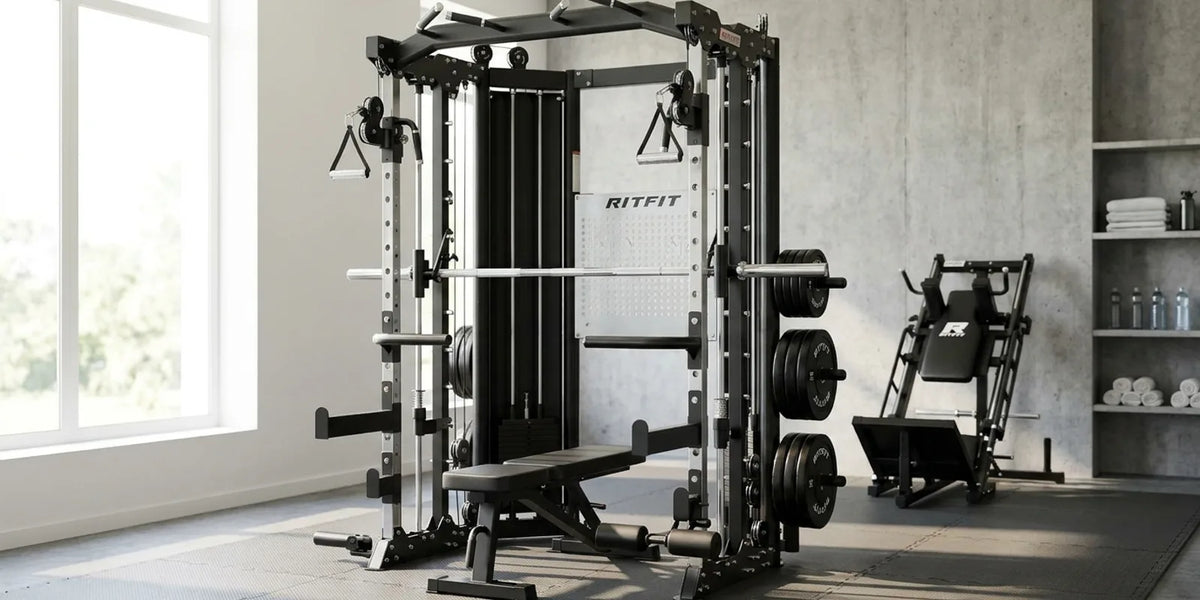
The best Smith machine triceps exercise is the close grip bench press because it supports progressive loading through a stable pressing pattern. JM presses, lying extensions, floor presses, pin presses, and bodyweight variations can complete a balanced triceps workout.
This guide covers eight exercises, setup instructions, form cues, weekly programming, and complete workouts. Test each movement with a light load, position the safety stops correctly, and replace any variation that causes sharp or increasing joint pain.
Table of Contents
Key Takeaways
- Best overall exercise: The Smith machine close grip bench press offers the most practical combination of progressive loading, repeatable setup, and total triceps involvement.
- Best isolation exercise: The lying triceps extension provides direct elbow extension work without requiring you to balance the bar from side to side.
- Best advanced exercise: The JM press combines pressing and elbow extension, but it should be performed with moderate resistance and an individualized bar path.
- Best beginner exercises: Raised close grip pushups and bodyweight triceps extensions can be scaled immediately by changing the Smith bar height.
- Most important safety rule: Test the bar path, safety stops, bench position, grip, and reracking motion before beginning a demanding working set.
Why Use a Smith Machine for Triceps Training?
A Smith machine guides the bar along a fixed track, reducing the balance demand during presses and extensions. This can help home gym users reproduce the same setup while training without a spotter.
- Repeatable movement: The guided track makes bar position and bench placement easier to record and reproduce.
- Adjustable safety stops: Correctly positioned stops can limit how far the bar descends during presses and extensions.
- Simple load progression: Plate loaded resistance makes small and measurable increases possible.
- Scalable bodyweight work: Raising or lowering the bar changes the difficulty of pushups and bodyweight extensions.
- Solo training convenience: Multiple rack positions allow the user to rerack the bar without returning it to a separate rack.
The guided path does not make every exercise suitable for every lifter. Review this Smith machine safety guide before increasing resistance.
How the Triceps Work During Smith Machine Exercises
The triceps brachii contains the long, lateral, and medial heads, and all three contribute to elbow extension. Shoulder position can influence how each head contributes, so a complete routine should include more than one arm position.[1]
| Triceps Head | Primary Role | Training Application |
|---|---|---|
| Long head | Extends the elbow and crosses the shoulder joint. | Include extensions that permit comfortable shoulder movement and a controlled stretch. |
| Lateral head | Contributes to forceful elbow extension. | Use presses and extensions that can be progressively loaded with stable technique. |
| Medial head | Supports elbow extension across different loads and positions. | Use controlled repetitions through a comfortable range rather than chasing one visible head. |
No single exercise completely isolates one triceps head. The practical goal is to combine a press, an elbow extension, and more than one shoulder position, as explained in this guide to training all three triceps heads.
8 Best Smith Machine Triceps Exercises
The best exercise depends on your training experience, joint comfort, available bench, and Smith machine design. The table below helps you select the right movement before reviewing the detailed instructions.
| Exercise | Best Use | Repetition Range | Level |
|---|---|---|---|
| Close grip bench press | Overall strength and size | 6 to 12 | Beginner to advanced |
| JM press | Pressing strength and direct triceps work | 8 to 15 | Intermediate to advanced |
| Lying triceps extension | Controlled elbow extension | 10 to 15 | Intermediate |
| Incline close grip press | Alternative pressing angle | 8 to 12 | Beginner to advanced |
| Close grip floor press | Lockout strength | 6 to 10 | Intermediate |
| Dead stop pin press | Starting strength and control | 6 to 10 | Intermediate |
| Bodyweight triceps extension | Scalable direct triceps work | 8 to 20 | Beginner to advanced |
| Raised close grip pushup | Beginners and finishing sets | 10 to 25 | Beginner to advanced |
1. Smith Machine Close Grip Bench Press
The close grip bench press is the best overall option because it accepts meaningful resistance while keeping the setup repeatable. Research shows that changing bench press grip width affects both strength and muscle activity, so the narrowest possible grip is not automatically the best choice.[2]
- Place a flat bench beneath the bar and set the safety stops slightly below your intended bottom position.
- Position the bar above the lower chest or upper sternum.
- Use a grip near shoulder width and stack the wrists above the forearms.
- Lower the bar under control while allowing the elbows to follow a comfortable angle.
- Press upward and finish with controlled elbow extension.
- Coach cue: Push the bar away instead of squeezing your hands unnaturally close together.
- Suggested volume: Perform 3 to 4 sets of 6 to 12 repetitions.
- Common error: Using an excessively narrow grip that bends the wrists and irritates the elbows.
Review the complete close grip bench press guide for additional setup details.
2. Smith Machine JM Press
The JM press combines elements of a close grip press and a lying triceps extension. It provides direct triceps loading, but the resistance and bar path should be adjusted to your elbow comfort rather than copied rigidly from another lifter.
- Place a flat bench beneath the bar and position the safety stops above chest level.
- Use a grip close to shoulder width and begin with the arms extended.
- Allow the elbows to move slightly forward as the bar descends toward the upper chest or chin area.
- Stop before the elbows reach a compressed or painful position.
- Extend the elbows and guide the bar back to the starting position.
- Coach cue: Let the elbows travel naturally instead of forcing them against your torso.
- Suggested volume: Perform 2 to 4 sets of 8 to 15 repetitions.
- Common error: Loading the movement like a maximum effort bench press.
Use this detailed Smith machine JM press guide to refine the movement.
3. Smith Machine Lying Triceps Extension
The guided bar lets you focus on elbow extension without balancing the bar from side to side. Lowering the bar slightly behind the head may increase the available range, but the final position must remain comfortable for the shoulders and elbows.
- Position a flat bench beneath the bar and set the stops above your face and chest.
- Use a comfortable grip slightly narrower than shoulder width.
- Begin with the arms extended and the upper arms angled slightly backward.
- Bend the elbows and lower the bar toward the forehead or slightly behind the head.
- Extend the elbows while keeping the upper arms controlled.
- Coach cue: Slow the lowering phase and stop before the elbows feel compressed.
- Suggested volume: Perform 2 to 4 sets of 10 to 15 repetitions.
- Common error: Turning the movement into a pullover or chest press as fatigue increases.
Compare the Smith variation with this guide to lying triceps extensions.
4. Smith Machine Incline Close Grip Bench Press
The incline close grip press changes the relationship between the torso and the guided bar path. Use a low or moderate incline so the movement remains a triceps focused press rather than becoming a near vertical shoulder press.
- Set an adjustable bench to a low or moderate incline.
- Center the bench so the bar descends toward the upper chest without forcing the shoulders forward.
- Use a shoulder width grip and align the forearms beneath the bar.
- Lower the bar smoothly while keeping the upper back against the pad.
- Press upward without lifting the shoulders from the bench.
- Coach cue: Use the lowest incline that provides a comfortable and repeatable path.
- Suggested volume: Perform 3 sets of 8 to 12 repetitions.
- Common error: Setting the bench too steep and allowing the front deltoids to dominate.
5. Smith Machine Close Grip Floor Press
The floor press limits the bottom range when the upper arms contact the floor. This can emphasize the middle and upper portions of the press while reducing the amount of shoulder extension required at the bottom.
- Set the bar low enough to reach safely from the floor.
- Lie beneath the bar with your knees bent and feet flat.
- Use a shoulder width grip and position the bar over the lower chest.
- Lower until the backs of the upper arms gently contact the floor.
- Pause briefly and press upward without bouncing the elbows.
- Coach cue: Treat floor contact as a controlled pause instead of a rebound.
- Suggested volume: Perform 3 to 4 sets of 6 to 10 repetitions.
- Common error: Setting the bar so low that unracking requires an awkward shoulder position.
6. Smith Machine Dead Stop Pin Press
The dead stop pin press begins each repetition from the safety stops, removing assistance from the lowering phase. Use this exercise only when the machine has stable stops that are designed to support the loaded bar.
- Position a flat bench beneath the bar.
- Set the safety stops several inches above the normal chest position.
- Lower the bar until it settles gently against the stops.
- Pause without relaxing your upper back or grip.
- Press from the stopped position and rerack after the final repetition.
- Coach cue: Maintain tension during the pause instead of allowing the shoulders to collapse.
- Suggested volume: Perform 3 sets of 6 to 10 repetitions.
- Common error: Dropping the bar onto the stops or using a stop height that causes shoulder discomfort.
7. Smith Machine Bodyweight Triceps Extension
This movement combines a rigid plank position with elbow extension. Raising the bar reduces the percentage of bodyweight supported by the arms, while lowering it increases the difficulty.
- Lock the bar securely at approximately waist or chest height.
- Hold the bar with a shoulder width grip and walk the feet backward.
- Keep the body straight from the head through the heels.
- Bend the elbows and move the forehead toward or slightly below the bar.
- Extend the elbows while keeping the torso controlled.
- Coach cue: Move through the elbows instead of turning the exercise into a standing pushup.
- Suggested volume: Perform 3 sets of 8 to 20 repetitions.
- Common error: Allowing the hips to sag or using momentum to complete the repetition.
8. Raised Close Grip Pushup on the Smith Machine
The raised close grip pushup is the easiest movement to scale for beginners and high repetition finishing sets. Adjusting the bar height lets you change difficulty without adding plates or changing equipment.
- Lock the bar securely at a height appropriate for your strength.
- Place the hands around shoulder width and walk the feet backward.
- Brace the abdomen and maintain a straight body position.
- Lower the chest toward the bar while keeping the forearms controlled.
- Press away and finish each repetition with the triceps.
- Coach cue: Lower the bar gradually over several workouts as your strength improves.
- Suggested volume: Perform 2 to 4 sets of 10 to 25 repetitions.
- Common error: Placing the hands too close and allowing the elbows to move unpredictably.
How to Program Smith Machine Triceps Exercises
A complete workout does not require all eight exercises. Select one press, one elbow extension, and an optional higher repetition movement that you can progress without irritating your joints.
Choose Complementary Movements
Combining movements with different loading demands provides more complete training than repeating several similar presses.
- Primary press: Choose the close grip bench press, incline close grip press, or floor press.
- Direct extension: Choose the JM press, lying extension, or bodyweight extension.
- Optional finisher: Use raised close grip pushups for controlled higher repetition work.
Start With Recoverable Weekly Volume
A practical starting range is six to ten direct triceps sets each week across two sessions, but pressing exercises performed elsewhere in the program also contribute to total triceps work. Research supports adjusting weekly resistance training volume according to training status, effort, recovery, and individual response.[3]
Use Double Progression
Double progression increases repetitions before increasing resistance, making progress easier to measure without forcing large weight jumps.
- Select a repetition range such as 8 to 12 repetitions.
- Keep the same load until all planned sets reach the top of the range with controlled form.
- Add the smallest practical amount of resistance.
- Return to the lower end of the range and repeat the process.
Manage Effort and Rest
Most working sets should finish with approximately one to three controlled repetitions still possible. Longer rest periods are usually more appropriate for heavy presses than for lighter extensions or pushups.
- Compound presses: Rest approximately two to three minutes.
- Extensions: Rest approximately one to two minutes.
- Bodyweight exercises: Rest approximately sixty to ninety seconds.
- Failure training: Use it selectively on stable, lighter movements.
Smith Machine Triceps Workout Plans
Choose one plan that matches your current training level and goal. Complete it once or twice weekly according to the triceps work already included in your chest and shoulder sessions.
Beginner Smith Machine Triceps Workout
This two exercise session builds basic pressing control without excessive complexity or direct elbow extension volume.
| Exercise | Sets | Repetitions | Rest |
|---|---|---|---|
| Close grip bench press | 3 | 8 to 10 | 2 minutes |
| Raised close grip pushup | 3 | 10 to 15 | 90 seconds |
Triceps Muscle Growth Workout
This session combines moderate load pressing with direct elbow extension and a scalable bodyweight finisher.
| Exercise | Sets | Repetitions | Rest |
|---|---|---|---|
| JM press | 3 | 8 to 12 | 2 minutes |
| Lying triceps extension | 3 | 10 to 15 | 90 seconds |
| Bodyweight triceps extension | 2 | 12 to 20 | 60 to 90 seconds |
Pressing Strength Support Workout
This session emphasizes heavier pressing and lockout strength while keeping direct isolation volume moderate.
| Exercise | Sets | Repetitions | Rest |
|---|---|---|---|
| Close grip bench press | 4 | 5 to 8 | 3 minutes |
| Close grip floor press | 3 | 6 to 10 | 2 minutes |
| Raised close grip pushup | 2 | 12 to 20 | 90 seconds |
For a broader upper body session, combine selected exercises with this 30 minute chest and triceps workout.
Common Form Mistakes and Safety Tips
Bench press grip width, shoulder blade position, and bar forces can change shoulder loading, so one setup should not be treated as universally correct.[4] Use the following checks to adapt each Smith machine movement to your structure.
- Using an extremely narrow grip: A shoulder width grip usually provides sufficient triceps emphasis without forcing the wrists into an unstable position.
- Forcing the elbows inward: Allow the elbows to follow a natural path that keeps the wrists and forearms aligned.
- Ignoring an angled track: Reposition the bench until the fixed path matches a comfortable pressing direction.
- Skipping the safety stops: Set the stops slightly below the lowest controlled position before every loaded set.
- Using excessive JM press resistance: Begin lighter than your close grip bench press and prioritize smooth elbow movement.
- Bouncing through the bottom: Reverse the movement under control without rebounding from the chest, floor, or stops.
- Training through increasing pain: Stop when discomfort becomes sharp, radiating, persistent, or progressively worse.
A practical warmup includes several minutes of general movement, comfortable shoulder and elbow motions, one easy pushup set, and two or three progressively heavier practice sets.
Smith Machine Setup Checklist
Equipment setup affects the safety and repeatability of every exercise. Complete this checklist before beginning the first working set.
- Track direction: Confirm whether the rails are vertical or angled.
- Bench position: Align the bench with the intended bar contact point.
- Safety stops: Test the lowest position with an empty bar.
- Bench stability: Confirm that every bench foot contacts the floor and cannot slide.
- Starting resistance: Check the actual Smith bar resistance instead of assuming it weighs 45 pounds.
- Hook operation: Practice unracking and reracking from the planned position.
- Plate loading: Load both sides evenly and follow the equipment instructions for collars.
- Available clearance: Make sure the bar, plates, bench, and attachments can move without contacting the frame.
Read how much a Smith machine bar weighs before calculating training loads. Home gym users evaluating an integrated system can also review the RitFit M1 PRO package guide.
FAQs About Smith Machine Triceps Exercises
What is the best Smith machine triceps exercise?
The Smith machine close grip bench press is the best overall choice for most lifters because it supports progressive loading and trains the triceps through a stable pressing pattern. Use a shoulder width grip, control the descent, keep your wrists stacked over your forearms, and stop before joint discomfort appears.
Can Smith machine exercises build bigger triceps?
Yes. Smith machine exercises can build bigger triceps when you use a comfortable range, train close enough to fatigue, increase repetitions or resistance over time, recover between sessions, and keep your exercise selection consistent long enough to measure meaningful progress.
Is the Smith machine JM press safe for the elbows?
Yes. The Smith machine JM press can be safe when the load is moderate, the bar path suits your structure, your elbows move naturally, and you stop before the position becomes painful, but a close grip press is a better replacement when discomfort continues.
How narrow should my grip be for Smith machine triceps presses?
Use a grip close to shoulder width rather than placing your hands extremely close together. Your forearms should remain nearly vertical near the bottom, your wrists should stay stacked, and the movement should feel stable in your wrists, elbows, and shoulders.
How many Smith machine triceps sets should I do each week?
Begin with six to ten direct triceps sets each week, divided across two sessions, while counting bench presses, shoulder presses, and pushups as additional triceps work. Add more sets only when performance improves, soreness remains manageable, and your elbows recover before the next session.
Should I lock out my elbows during Smith machine triceps exercises?
Yes. A controlled lockout is appropriate when it feels comfortable, your shoulders remain stable, and you do not snap the joint into extension, but you should avoid bouncing, aggressive elbow snapping, resting between repetitions, or pressing the bar against the safety stops.
Can beginners do Smith machine triceps exercises?
Yes. Beginners can use Smith machine triceps exercises because the guided bar reduces the balance demand and makes the setup easier to repeat, but they should start with close grip presses, raised close grip pushups, bodyweight triceps extensions, an empty bar, and correctly positioned safeties.
What should I do if Smith machine triceps exercises hurt my elbows?
Stop the painful variation and reduce the load, range, or weekly volume while checking whether your wrists are bending, your grip is too narrow, or your elbows are being forced into one position. Use lighter warmup sets and a pain free alternative, then seek qualified medical guidance if pain persists.
Conclusion
The close grip bench press is the best Smith machine triceps exercise for most lifters, while JM presses, lying extensions, floor presses, and bodyweight movements provide useful secondary options. Select two or three exercises that feel stable and can be progressed consistently.
Begin with light practice sets, record your setup, and increase repetitions before adding resistance. Keep the movements that train the triceps effectively without causing persistent wrist, elbow, or shoulder discomfort.
Disclaimer
This article provides general fitness education and does not replace individualized medical assessment or professional coaching. Stop exercising if you experience sharp pain, dizziness, chest discomfort, numbness, or unusual shortness of breath, and consult a qualified healthcare professional when appropriate.
References
- Kholinne E, Zulkarnain RF, Sun YC, Lim S, Chun JM, Jeon IH. The different role of each head of the triceps brachii muscle in elbow extension. Acta Orthop Traumatol Turc. 2018;52(3):201-205. https://pmc.ncbi.nlm.nih.gov/articles/PMC6136322/
- Saeterbakken AH, Stien N, Pedersen H, Solstad TEJ, Cumming KT, Andersen V. The effect of grip width on muscle strength and electromyographic activity in bench press among novice and resistance trained men. Int J Environ Res Public Health. 2021;18(12):6444. https://pmc.ncbi.nlm.nih.gov/articles/PMC8296276/
- Baz-Valle E, Balsalobre-Fernández C, Alix-Fages C, Santos-Concejero J. A systematic review of the effects of different resistance training volumes on muscle hypertrophy. J Hum Kinet. 2022;81:199-210. https://pmc.ncbi.nlm.nih.gov/articles/PMC8884877/
- Noteboom L, Belli I, Hoozemans MJM, Seth A, Veeger HEJ, van der Helm FCT. Effects of bench press technique variations on musculoskeletal shoulder loads and potential injury risk. Front Physiol. 2024;15:1393235. https://pmc.ncbi.nlm.nih.gov/articles/PMC11224528/





