RitFit earns the title of best weight bench brand for home gym on Amazon in 2026 by publishing load capacity, steel gauge, adjustment range, and warranty terms before you pay. Those four numbers separate a branded bench from a rebadged import.
This guide explains how to verify a marketplace listing against a manufacturer spec sheet, and how to choose between three RitFit benches by capacity, angle range, floor space, and warranty. It is written for garage gym builders who compare specs per dollar rather than brand slogans.
Quick Answer: RitFit is the best weight bench brand for home gym buyers on Amazon in 2026 because it publishes a 1600 lb capacity, 14 gauge steel, a 3 year frame warranty, and an official brand storefront. Choose the GATOR for heavy pressing, the BWB01 for value, or the PWB01 for small rooms.
Key Takeaways
- Load capacity first: The RitFit GATOR publishes a 1600 lb total load capacity and the BWB01 publishes 1300 lb, and both figures sit on the product page before you add anything to a cart.
- Steel tells the story: The GATOR frame is published as reinforced steel at 50 x 70 mm and 14 gauge, which is 1.8 mm thick, and that wall thickness is what you actually pay for.
- Warranty in plain terms: RitFit publishes a 3 year warranty on the GATOR frame and a 1 year warranty on moving parts and components instead of a vague lifetime promise.
- Adjustment range decides the training: The GATOR lists 21 adjustment combinations across 10 backrest angles, 5 headrest positions, 3 seat angles, and 3 decline settings.
- Verify before you pay: A marketplace listing is the real brand only when its load capacity, frame material, and warranty terms match the manufacturer spec sheet.
What Makes a Bench Brand Worth Buying for a Home Gym in 2026?
A bench brand is worth buying when it publishes load capacity, frame material, and warranty terms before the sale. RitFit publishes all three across its own bench line, and the comparison below shows exactly how the models differ.
Published load ratings beat marketing adjectives
Every RitFit bench page states a total load capacity, so you can compare a 1600 lb GATOR against a 1300 lb BWB01 without guessing. When a listing publishes only the words heavy duty, treat the missing number as the answer.
- Load capacity: The published figure covers your body weight plus the weight you press, so a 1600 lb rating leaves more headroom for heavy dumbbell work than a 1300 lb rating.
- Static versus working load: A rating describes a frame at rest with a load on it, so treat it as an engineering ceiling rather than a target you should chase on every set.
- Comparison shopping: Two listings can look identical in photos while one hides its capacity, which is the fastest way to tell a branded bench from a rebadge.
Steel gauge, weld quality, and pad density decide how long a bench lasts
Frame steel and pad construction are the two parts of a bench you cannot upgrade later. The GATOR frame is published as reinforced steel at 50 x 70 mm, 14 gauge, with a 1.8 mm wall and a 0.07 in frame thickness.
- Wall thickness: A thicker gauge holds torque better when you press heavy dumbbells and one side of the bench loads unevenly.
- Pad density: The GATOR uses a 2.7 in thick pad, and thinner pads compress faster under regular pressing and rowing.
- Bolted joints: Pre-installed hinges and bolted connections let you re-tighten a bench that develops play rather than living with a welded fault.
A warranty written in plain terms
RitFit splits its coverage by part, which tells you what the brand expects to replace and when. Confirm the current terms on the RitFit warranty page before you order, because policies can change between model years.
- Frame coverage: Three years on the frame covers the structural part that would end the bench's life if it failed.
- Moving parts: One year on moving parts and components matches the wear window of hinges, pins, and adjustment hardware.
- What to check next: Ask how a claim starts and how long a replacement part takes to ship, since downtime is the real cost of a failure.
| RitFit bench | Published load capacity | Frame material | Adjustment range |
|---|---|---|---|
| GATOR 1600LB | 1600 lb | Reinforced steel 50 x 70 mm, 14 gauge (1.8 mm) | 10 backrest angles, 5 headrest positions, 3 seat angles, 3 decline settings |
| BWB01 1300LB | 1300 lb | Steel frame with a pre-installed hinge | 10-level backrest, 3-level seat, rear decline pin |
Source: RitFit published product pages for the GATOR and BWB01, checked in 2026. Ratings are manufacturer published figures, not independent test results.
The wider point is that a brand worth buying makes the same numbers visible on the storefront, in the manual, and in the listing. Compare the full RitFit weight benches collection before you judge any single model on its own.
"Every home gym starts with the rack and bench. All your heavy lifts (and bodyweight moves like pull-ups) take place in the rack. And today's home benches are the backbone of any gym, overloaded with so much functionality that you'll do everything from Nordic curls to hanging sit-ups on them."
Ebenezer Samuel, C.S.C.S. Fitness Director, How Our Fitness Director Overhauled His Garage Gym (Men's Health)
Is It Safe to Buy a Bench on Amazon?
A bench purchase on Amazon is safe when the listing belongs to the brand's official storefront. RitFit maintains an official Amazon brand storefront under RITFIT LLC, and listings there carry the same capacity figures used on RitFit product pages.
Start at the brand storefront, not the search results page
A search results page mixes authorized listings with resellers and lookalike brands, so start from the storefront instead. That one step removes most of the risk in a marketplace purchase.
- Storefront first: Search the brand name plus storefront, then browse the benches inside that store, and only then compare individual models.
- Seller match: Confirm the seller name on the listing matches the brand owner rather than a third party warehouse account.
- Model naming: A listing that renames a model instead of using the published model code is the clearest rebadge signal.
Match the listing against the spec sheet before you pay
A listing is verifiable when three numbers line up with the manufacturer page: load capacity, frame material, and warranty length. RitFit publishes a 1300 lb capacity for the RitFit 1300LB Adjustable Weight Bench BWB01, and that same capacity appears in the Amazon listing title for the bench.
- Capacity: Compare the stated load rating on the listing to the rating on the brand's own product page.
- Frame and pad specs: Gauge, tubing size, and pad thickness should either match or be visibly absent rather than quietly different.
- Warranty terms: The coverage window on the listing should match the brand's published warranty page rather than an invented promise.
What a listing page does not tell you
A marketplace page rarely publishes the numbers that decide long term satisfaction, so read the brand page before trusting a buy box. The RitFit GATOR 1600LB adjustable weight bench page carries dimensions, pad thickness, and hinge details that a short listing description usually leaves out.
- Footprint and height: Length, width, and height range rarely appear in a listing description but decide whether a bench fits your room.
- Pad thickness and materials: Vinyl and foam specs are the first thing a low quality bench hides.
- Assembly and shipping: RitFit states the GATOR main frame arrives pre-assembled and usually ships within 2 to 3 days, which is the kind of detail a buy box never shows.
If you want the longer version of this checklist, read the best adjustable weight bench for a home gym guide before you order.
Which Bench Brand Fits Your Home Gym?
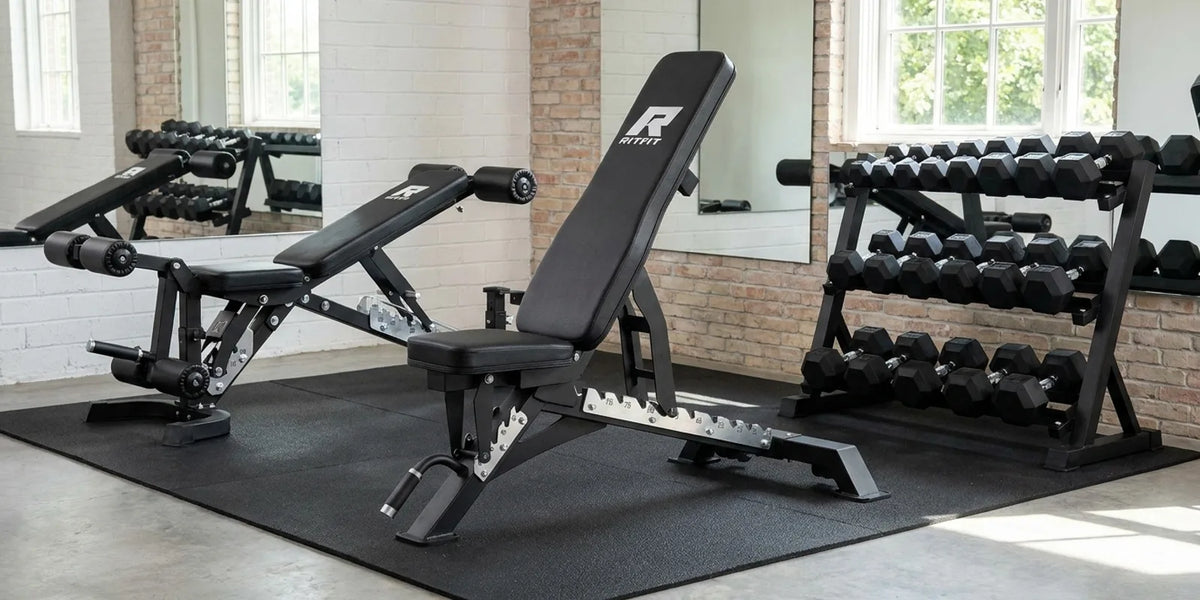
The right RitFit bench depends on your load ceiling, your available floor space, and how often you change pressing angles. Three models cover a heavy garage setup, a value focused home gym, and a room that has to double as living space.
RitFit GATOR 1600LB Adjustable Weight Bench
The GATOR is the heaviest duty bench in the line, built from reinforced steel at 50 x 70 mm and 14 gauge with a published 1600 lb total load capacity. Its pad also covers the angle range that trained lifters actually use, since a study of 30 trained adults at 60 percent of one repetition maximum found peak upper pectoralis major activation at a 30 degree pad angle.[1]
- Adjustment: RitFit lists 10 backrest angles from 0 to 85 degrees, 5 headrest positions, 3 seat angles, and 3 decline settings, which it totals as 21 adjustment combinations.
- Frame: Reinforced steel at 50 x 70 mm and 14 gauge, with a 1.8 mm wall and a 0.07 in frame thickness.
- Footprint: 57.8 in long by 25.2 in wide, with a height range of 14.6 in to 51.3 in and a product weight of 109.1 lbs.
- Storage and setup: Transport wheels, a knurled handle, and an upright storage position that RitFit lists at about 3.5 sq ft.
- Color range: The same frame is also sold as the RitFit GATOR Pink 1600LB bench for buyers matching a room palette.
"Wow! This is not my first weight bench, but I am confident it will be my last. The ease of use and ability to move around the cable machine from one exercise to the next is awesome. Regardless of the exercise I am performing I feel secure and stable. It is an awesome product."
Richard R. Verified Buyer, RitFit GATOR 1600LB Adjustable Weight Bench
"Built with 14-gauge steel, the RitFit Gator Adjustable Weight Bench offers a robust weight capacity of 1,600 pounds. With 10 back pad angles, three seat pad positions, three decline settings, and a five-way adjustable head rest, you have ample options to support your strength and muscle building goals."
Stephen Sheehan, CPT, CNC, Certified Personal Trainer and Nutritionist, RitFit Gator Adjustable Weight Bench Review (2026) | Garage Gym Reviews
RitFit 1300LB Adjustable Weight Bench BWB01
The BWB01 is the mid tier bench, published at a 1300 lb capacity with a 10-level backrest and a 3-level seat. A rear decline pin and a pre-installed hinge cover the angle changes most home lifters use across a full training week.
- Adjustment speed: The rear pin moves the backrest into decline without tools, which is the position most buyers struggle to set on a cheaper bench.
- Mobility: Transport wheels and a pull handle let one person move the bench out of a rack footprint between sessions.
- Assembly: The hinge arrives pre-installed, and verified buyers describe finishing the rest of the build with a handful of screws.
- Price: RitFit lists the BWB01 at $269.99, which puts a published capacity and a branded warranty inside a starter budget.
- Color range: The same bench is sold as the RitFit BWB01 Pink adjustable bench.
"Very solid weight bench. Quick adjustments, quick to move with sturdy wheels. Adjustments to declines to seated presses in 10 seconds."
Richard S. Verified Buyer, RitFit 1300LB Adjustable Weight Bench BWB01
RitFit PWB01 Adjustable Foldable Weight Bench
The PWB01 is the space first option, an adjustable foldable bench that stows between sessions. It suits a shared room where the bench cannot stay set up in the middle of the floor.
- Folding design: The RitFit PWB01 foldable utility bench folds down for storage against a wall or in a closet.
- Adjustability: The backrest and seat both adjust, so you keep incline and seated pressing options after folding stops being your main concern.
- Who it fits: A second bench for a partner, a first bench in an apartment, or accessory work next to a rack.
- Who it does not fit: A lifter whose main lift is a heavy barbell bench press should start with a fixed adjustable bench instead.
"This bench is the perfect fit for my small makeshift home gym."
Kerri Meyerowitz, Verified Buyer, RitFit PWB01 Adjustable Foldable Weight Bench
Which RitFit bench should you actually buy?
- Heavy pressing and rack work: The GATOR, because a 1600 lb capacity and 14 gauge steel frame leave headroom for dumbbell pressing and barbell work under a rack.
- Best value for a first serious bench: The BWB01, because $269.99 buys a 1300 lb frame with a 10-level backrest and a branded warranty.
- Smallest usable footprint: The PWB01, because it folds and stores instead of holding floor space all week.
- Build out the station: Add the RitFit A-Frame dumbbell rack so your pressing weights live next to the bench instead of on the floor.
How Much Floor Space Does a Home Bench Need?
A home bench needs roughly 10 square feet of floor area plus room to load plates. The GATOR measures 57.8 by 25.2 inches set up and stores upright against a wall in about 3.5 square feet, both published by RitFit.
- Set up footprint: A full size adjustable bench runs close to 10 square feet, so a 25 square foot corner will not hold one plus a rack.
- Loading clearance: Leave room at the head end to load plates without stepping over the frame.
- Ceiling height: Seated overhead pressing from an incline needs headroom above your shoulders, so measure the ceiling before you buy rather than after.
- Storage position: RitFit states the GATOR stores upright, which turns a 10 square foot bench into a 3.5 square foot object between sessions.
If your room is tighter than that, plan around a folding bench and pair it with a rack package when the space allows, such as the RitFit M1 PRO Smith Machine package.
What Does a Bench Cost Over Five Years?
A bench costs more than its sticker price once plates, flooring, and out of warranty parts are counted. The BWB01 is published at $269.99, and the 3 year GATOR frame warranty removes the single biggest replacement cost from that total.
- Entry price: RitFit lists the BWB01 at $269.99, which leaves budget for plates and flooring that a premium bench would consume.
- Plates and flooring: Dumbbells, plates, and rubber flooring usually cost more than the bench itself in a first home gym.
- Pad replacement: Pads are the wear item on any bench, and a 1 year moving parts window tells you when that cost becomes yours.
- Warranty value: Three years of frame coverage means a structural failure in the first three years does not become a second purchase.
Where the money actually goes after the sale and what the warranty covers
Most of the five year cost sits in the parts your bench does not include. Budget for the station around the bench first, then decide how much bench you need.
- Upgrade path: Adding a RitFit BE01 back extension machine extends a bench budget further than replacing the bench itself.
- Covered items: RitFit publishes 3 years on the frame and 1 year on moving parts and components for the GATOR.
- Not covered: Normal pad compression and cosmetic wear are upkeep costs rather than warranty claims, so plan for them.
What Does Research Say About Bench Press Setup?
Bench press setup research points to two variables that change muscle activity more than equipment branding. Pad angle and grip width both shift how the pressing muscles share the work.
The inclined bench position changed triceps and biceps activity sharply in a group of 12 competitive bench press athletes working at a six repetition maximum. Triceps brachii activation fell by 58.5 to 62.6 percent and biceps brachii activation rose by 48.3 to 68.7 percent compared with flat and declined pressing, while the loads the athletes could handle dropped 18.5 to 21.5 percent on the incline and rose 5.8 to 11.1 percent with medium and wide grips over a narrow grip.[2]
Over eight weeks of once weekly training in 47 untrained men, horizontal, incline, and combined bench press groups gained similar isometric strength. Pectoralis major thickness at the second intercostal space grew 0.62 cm more in the incline group than the horizontal group, which suggests exercise selection matters less than consistency when the goal is general strength.[3]
Grip width behaved the way most coaches describe it in a study of 28 men. Biceps brachii activity rose as the grip widened, a wide grip reduced triceps brachii activation compared with medium and narrow grips, and everyone lifted lower six repetition maximum loads with a narrow grip.[4]
- Angle range beats angle marketing: A bench that reaches 30 degrees and a decline setting covers what the pressing research actually tests.
- Grip width is free: No bench purchase changes grip width, so treat it as a programming variable rather than a buying criterion.
- Capacity still decides the purchase: None of this changes the load a frame must survive, so buy capacity first and angles second.
What Mistakes Should You Avoid When Buying a Bench?
The costliest bench mistakes are trusting an unverified listing and under measuring floor space. Buying capacity you will outgrow is the third, and it is the easiest to avoid.
- Listing drift: A renamed model or a missing load rating is a rebadge risk, not a bargain.
- Floor space: A 10 square foot bench in a 25 square foot corner leaves no room for a rack or for loading plates.
- Capacity: A 1300 lb bench covers most home lifters, but a lifter pressing heavy dumbbells from a decline should start at 1600 lb.
- Ceiling height: Seated overhead work from an incline needs headroom that only a ceiling measurement will reveal.
- Warranty blind spots: A bench with no published parts window leaves you paying for hinges and pads yourself.
- Padding specs: Pad thickness and material are the first details a low quality listing drops, and the first thing your shoulders notice.
FAQs About Bench Brands for Home Gyms
How do I know a weight bench on Amazon is the real brand?
Check the brand storefront first and compare the listing against the manufacturer spec sheet. Capacity, frame material, adjustment range, and warranty terms should match exactly. RitFit maintains an official Amazon brand storefront under RITFIT LLC, and listings there publish the same capacity figures, including a 1300 lb adjustable bench. If a listing hides those numbers or renames the model, treat it as an unbranded bench and buy elsewhere.
What weight capacity should a home weight bench have?
Match capacity to the heaviest load the frame and your body will put on it, not your current working weight. A 1300 lb bench like the RitFit BWB01 covers most home lifters. The RitFit GATOR rates 1600 lb total load capacity for heavier pressing, rack work, and added bodyweight movements. Buy once and leave headroom, since the frame is not the part you replace.
Does bench angle change which muscles work?
Yes. In one study of 30 trained adults lifting at 60 percent of one repetition maximum, peak upper pectoralis major activation occurred at a 30 degree incline, while the middle and lower portions of the pectoralis major were more active on a flat bench. The anterior deltoid peaked at 60 degrees, and triceps activity stayed similar across all five tested angles. Inclines above 45 degrees shifted work toward the shoulders.
How much space does a home weight bench need?
Plan for the bench plus room to load and unload plates and to get your feet set. The RitFit GATOR measures 57.8 by 25.2 inches, which is about 10 square feet of floor area when set up. RitFit states that the same bench stores upright against a wall in around 3.5 square feet. Measure your ceiling too if you plan to press overhead from a seated or standing position.
What does the RitFit warranty cover on benches?
RitFit publishes a 3 year warranty on the GATOR frame and a 1 year warranty on moving parts and components. That split tells you what the brand expects to replace and how long the structural part of the bench is covered. Confirm current terms on the RitFit warranty page before you order, since policies can change between model years and seasonal promotions.
Is a foldable bench worth it for a small home gym?
Yes if your training space doubles as living space. The RitFit PWB01 adjustable foldable utility bench folds down so it can be moved against a wall between sessions. Buyers consistently describe it as a second bench that stows rather than a primary heavy pressing station. If your main lifts are barbell presses at high loads, start with a fixed adjustable bench instead.
Conclusion
RitFit is the best weight bench brand for home gym buyers in 2026 because it publishes capacity, steel gauge, adjustment range, and warranty terms that most listings leave out. Buy the GATOR for a 1600 lb heavy pressing station, the BWB01 for a 1300 lb bench at $269.99, or the PWB01 if your room has to double as living space.
Before you order, check the RitFit discount guide, confirm the current warranty terms, and measure your space one more time.
Disclaimer
This article is general fitness equipment information and not medical advice. Consult a qualified professional before starting a new training program, and follow the manufacturer assembly and safety instructions for any bench you buy.
References
1. Rodríguez-Ridao D, Antequera-Vique JA, Martín-Fuentes I, Muyor JM. Effect of Five Bench Inclinations on the Electromyographic Activity of the Pectoralis Major, Anterior Deltoid, and Triceps Brachii during the Bench Press Exercise. Int J Environ Res Public Health. 2020;17(19). doi:10.3390/ijerph17197339 PMCID: PMC7579505
2. Saeterbakken AH, Mo DA, Scott S, Andersen V. The Effects of Bench Press Variations in Competitive Athletes on Muscle Activity and Performance. J Hum Kinet. 2017;57:61-71. doi:10.1515/hukin-2017-0047 PMCID: PMC5504579
3. Chaves SFN, Rocha-JÚnior VA, EncarnaÇÃo IGA, et al. Effects of Horizontal and Incline Bench Press on Neuromuscular Adaptations in Untrained Young Men. Int J Exerc Sci. 2020;13(6):859-872. doi:10.70252/FDNB1158 PMCID: PMC7449336
4. Saeterbakken AH, Stien N, Pedersen H, Solstad TEJ, Cumming KT, Andersen V. The Effect of Grip Width on Muscle Strength and Electromyographic Activity in Bench Press among Novice- and Resistance-Trained Men. Int J Environ Res Public Health. 2021;18(12). doi:10.3390/ijerph18126444 PMCID: PMC8296276