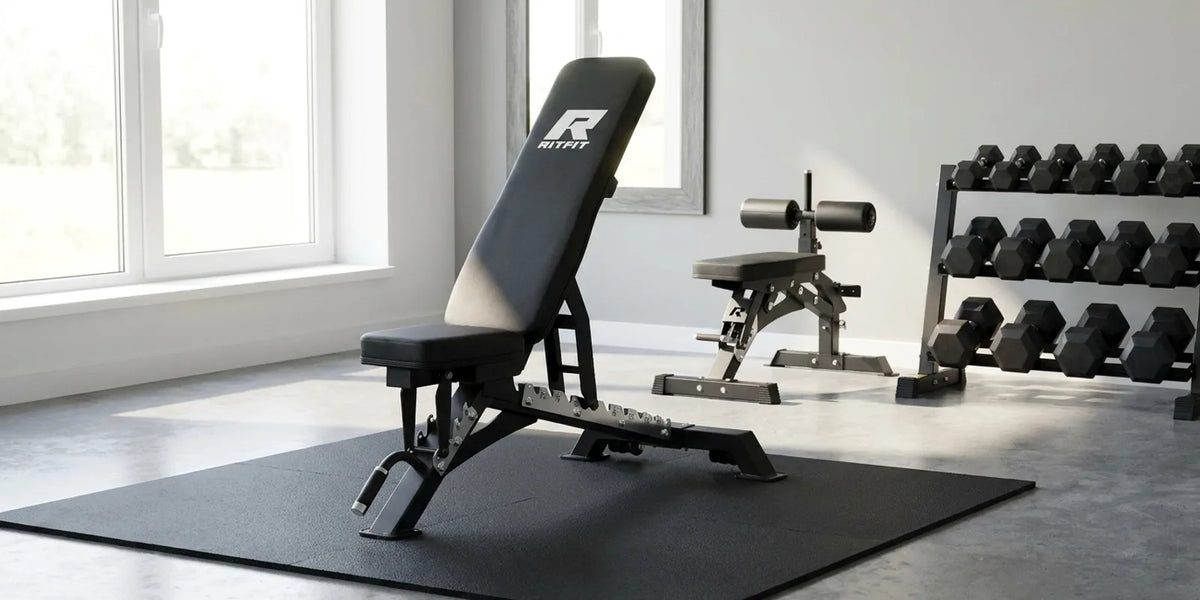
The best weight bench for bodybuilding is the one that stays planted under a near-maximal press and lets you change angles without losing your setup. The RitFit Gator 1600LB Adjustable Weight Bench pairs a 1,600-pound rating with 10 back pad angles, a 2.7-inch pad, and a five-position headrest.
This guide covers the pad geometry that matters for hypertrophy, how each back angle maps to chest, shoulder, and arm work, how the frame behaves when you press heavy alone, and where a dedicated flat bench is still the smarter buy.
Quick Answer: The RitFit Gator is the best weight bench for bodybuilding in a home gym when you press heavy and train several angles. Its 1,600-pound rated 14-gauge frame, 2.7-inch pads, and 10 back pad angles cover flat, incline, and shallow decline work without the bench becoming the weak link.
Key Takeaways
- Geometry beats features for hypertrophy: The Gator's 11.8-inch pad width, 2.7-inch foam, and 2-inch seat-to-back gap support the upper back through heavy pressing sets.
- Angle resolution drives regional growth: Ten back pad positions from 0 to 85 degrees let you separate upper chest, mid chest, and front delt work instead of guessing one incline fits all.
- Stability is the real heavy-lifting asset: A 1,600-pound rating on a 14-gauge frame removes the bench as the weak link when you press near your maximum.
- Know the decline limit: Three rear decline settings at roughly minus 2.5 to minus 7 degrees are shallow, so steep decline work needs a different bench.
- It is not a flat-bench replacement for every lifter: Purists chasing competition-standard flat pressing should still consider a dedicated flat bench.
Why Bodybuilding Pressing Punishes a Generic Adjustable Bench
A generic adjustable bench fails a bodybuilding block in three specific places: pad geometry, angle resolution, and stability under near-maximal loads. A bench built mainly for bodyweight and light dumbbell work is engineered to a different standard than one that anchors a heavy barbell press.
- Pad geometry: Narrow, thinly padded benches let your shoulder blades roll and your torso sink, which changes your pressing line and shortens your range of motion.
- Angle resolution: Wide jumps between incline settings skip the positions that separate upper chest from front delt emphasis.
- Stability: Flex and wobble force you to slow the eccentric and fight the bench for position, which quietly costs you reps at the loads that build mass.
Bodybuilders also need a bench that does more than press, because rows, split squats, and arm work fill the rest of the week. A bench that only handles flat pressing pushes that work onto other equipment, which is where a full adjustable weight bench buying guide helps you compare priorities before you commit.
RitFit Gator Bench Geometry for Hypertrophy
The Gator's pad geometry centers on a 25.9-inch back pad that runs 11.8 inches wide with 2.7 inches of foam. A 12.6-inch seat at the same width keeps the torso supported from warm-up sets through near-maximal singles. Those dimensions keep the shoulder blades supported and the torso level from the first warm-up set to a near-maximal single.
- Back pad: 25.9 inches long by 11.8 inches wide gives scapular support across the published fit range of 4 feet 8 inches to 6 feet 6 inches.
- Pad density: 2.7 inches of foam holds its shape through repeated heavy sets instead of compressing into the frame.
- Seat pad: A 12.6-inch seat at 11.8 inches wide keeps your hips positioned on incline work where a short seat lets you slide.
Pad Width and Density for Upper-Back Support Under Load
Upper-back support is what lets you hold scapular retraction and a stable pressing base, and pad width is the spec that decides whether you get it. An 11.8-inch wide back pad covers the shoulder blades of most adult lifters, while 2.7 inches of foam keeps the pad firm enough that your torso does not sink between the rails.
The 2-Inch Seat-to-Back Gap and Your Pressing Setup
RitFit lists a 2-inch gap between the seat pad and the back pad, which sits below the shoulder blades for most lifters during a bench press. Lifters who feel pressure there can shift their torso position slightly, and the gap matters far more on a steep incline than it does on flat work.
"Great bench! Lots of settings and it's really well built and easy to use."
A. N. Verified Buyer, RitFit GATOR 1600LB Adjustable Weight Bench
Match the Back Angle to the Muscle on the RitFit Gator
Ten back pad positions from 0 to 85 degrees give fine enough resolution to treat chest regions and front delts as separate training targets. Bench inclination changes which region of the pectoralis major does the work, so the angle you pick is a programming decision rather than a comfort setting. In its hands-on review, Garage Gym Reviews also notes that the Gator's pull-motion adjuster never stuck when changing angles and the headrest twist-pin adjuster moved smoothly through its range.[4]
A 2020 trial that trained 47 young men once a week for eight weeks found horizontal and incline pressing produced similar strength gains, but incline pressing produced a larger thickness change in the upper region of the pectoralis major.[1] A separate study of 30 trained adults pressing at 60 percent of their one-rep max found the upper portion of the pectoralis major peaked at a 30-degree incline, while the middle and lower portions were most active on the flat setting.[2]
Flat for Mid and Lower Chest, Around 30 Degrees for the Upper Chest
Use the flat position when you want the sternocostal head of the pectoralis major to carry the load, and move to roughly 30 degrees when the clavicular head and upper chest are the goal. The Gator has dedicated stops at 0, 30, and 37.5 degrees, so you can rotate between those two stimulus profiles without hunting for an angle.
When Steeper Inclines Hand the Work to the Front Delts
Inclines above 45 degrees shift a larger share of the work to the anterior deltoid and reduce how much the pectoralis major contributes, according to the same five-inclination study.[2] The Gator's 52.5, 60, 67.5, 75, and 85-degree stops are therefore shoulder pressing positions, not chest positions, which makes them useful on a delt-focused day rather than a chest day.
"Great quality and heavy duty! Super easy to set up and get rolling. Has so many different adjustments its perfect"
D. S. Verified Buyer, RitFit GATOR 1600LB Adjustable Weight Bench
Stability and Bar Path Under Near-Maximal Loads
The Gator's 1,600-pound rating and 14-gauge steel frame remove the bench as the limiting factor in a heavy press, which is the entire point of a high capacity rating. A platform that does not move lets you repeat the same bar path rep after rep instead of correcting for bench flex mid-set. In its hands-on review, Garage Gym Reviews notes that its product tester noticed no shaking, wobbling, or noise from the Gator during workouts.[4]
A systematic review of 14 surface electromyography studies on the bench press concluded that exercise intensity is the dominant factor shaping muscle activity, more than small variations in setup.[3] That margin matters because progressive overload depends on adding load over time, and a rigid platform lets you apply mechanical tension at intensities a flexing bench cannot support.
- Bar path: A rigid platform keeps the bar groove consistent, which matters most on the last two reps of a heavy set.
- Training alone: Less flex means less chance the bar drifts when you cannot rely on a spotter.
- Confidence: Knowing the bench is rated well above your working load lets you commit to a rep instead of bracing for movement.
What the 1,600-Pound Rating Actually Buys You
The 1,600-pound figure covers the combined load of your body, the bar, and the plates, so a 220-pound lifter pressing 405 pounds uses well under half the rated capacity. That headroom is a safety margin, not a target, and it is the number to compare when you look at lighter benches in the same RitFit weight bench collection.
Welded Footplates, Enclosed Brackets, and Locking Pins
RitFit builds the Gator with a 50 by 70 mm reinforced steel frame at 14-gauge, welded footplates that stay flat under load, fully enclosed adjustment brackets that prevent pinching, and a magnetic locking pin for the headrest. Those details are what stop the click and shift that shows up on cheaper adjustable benches once the loads get serious.
Built with 14-gauge steel, the RitFit Gator Adjustable Weight Bench offers a robust weight capacity of 1,600 pounds. With 10 back pad angles, three seat pad positions, three decline settings, and a five-way adjustable head rest, you have ample options to support your strength and muscle building goals.
Stephen Sheehan, CPT, CNC, Certified Personal Trainer and Nutritionist, Garage Gym Reviews, RitFit Gator Adjustable Weight Bench Review
"The gator bench is SOLID! Very sturdy and heavy. You will feel very safe on this bench with any heavy workouts. The wheels make it easy to scoot around the gym when needed. This is money well spent and much better than the basic ritfit bench. Good quality product for the price!"
Christopher O. Verified Buyer, RitFit GATOR 1600LB Adjustable Weight Bench
Headrest, Arm Rollers, and Decline Work
The Gator's five-position headrest and removable arm rollers turn a pressing bench into an accessory station, and the main frame arrives pre-assembled for roughly 10-minute setup. Each headrest step moves 22.5 degrees, and the rollers screw onto the frame to create a fixed preacher curl pad.
- Chest-supported rows: Raising the headrest gives your chest a pad to brace against, which takes the lower back out of the movement.
- Preacher curls: The arm rollers hold your upper arms in place so the biceps work through a full range without swinging.
- Overhead work: Folding the headrest flat clears the bar path for seated presses and triceps extensions.
- Capacity: RitFit rates the foam rollers to 176 pounds with an 8.7-inch roller length and the headrest section to 396 pounds.
Decline is the one place the Gator sets a clear limit. Its three rear settings run about minus 2.5, minus 4.5, and minus 7 degrees, which is shallow next to a dedicated decline bench, so treat it as slight decline pressing rather than a steep decline platform.
If you want accessory variety inside one hypertrophy block, this is the part of the bench that earns its keep, and a weight bench workout plan shows how to slot that work into a week.
Leg Drive, Pin Presses, and Setup Discipline
Leg drive transfers force from your feet through a rigid torso into the bar, which only works when the bench plants instead of absorbing that force. Pin presses and heavy partial work make the same demand, because a fixed platform keeps the bar path honest while you grind through a sticking point.
- Foot placement: The Gator's 14.6-inch minimum height and welded footplates give you a flat base without the bench tipping.
- Lock everything first: Confirm the back pad, seat, and decline settings are fully seated before your first heavy set.
- Pin press setup: Keep the bench square to the rack uprights so the bar travels straight down to the safeties.
- Head position: Leave the headrest flat for barbell pressing so your neck is not pushed into a raised pad.
The movement pattern still decides your results, which is why a bench press form guide belongs next to any bench purchase. Adjustable benches reward discipline: the more positions you have, the more often a half-locked setting can cost you a rep.
Who the RitFit Gator Is For and When a Flat Bench Wins
The RitFit Gator suits lifters who press heavy, train more than one angle, and want accessory work on the same bench. It is the wrong buy if you want a single-purpose flat pressing platform, or if steep decline work sits at the center of your program.
Choose the RitFit Gator If
Pick the Gator if you run a hypertrophy block that mixes flat pressing, roughly 30-degree incline work, dumbbell rows, split squats, and curls, and you want to train without a spotter. Its 109.1-pound build stores upright, rolls on transport wheels, and takes accessories the lighter RitFit benches do not, so one purchase covers the pressing and accessory slots in your week.
Choose a Dedicated Flat Bench Instead If
Choose a flat bench if your program is built entirely around competition-style flat pressing and you never change angles, because an adjustable bench always trades some rigidity for range. Choose one as well if steep decline pressing is a priority, since the Gator's shallow rear settings will not get you there.
| RitFit Bench | Total Load Capacity | Adjustment Range | Best For |
|---|---|---|---|
| RitFit Gator 1600LB | 1,600 lb | 10 back pad angles, 3 seat positions, 3 decline settings, 5 headrest levels | Heavy pressing plus full-range hypertrophy work |
| RitFit 1300LB BWB01 | 1,300 lb | Flat and incline pressing positions | Lower-budget flat and incline pressing |
Capacity and adjustment figures are the published RitFit product specifications for each bench, checked in 2026.
What the Gator Costs and What the Warranty Covers
The Gator lists at $399.99, ships free in the US, and carries a 3-year frame warranty with 1-year coverage on moving parts and components, plus a 35-day return window. If that budget is tight, the RitFit 1300LB Adjustable Weight Bench BWB01 covers flat and incline pressing at a lower rating, and the foldable utility bench PWB01 is the pick for tight spaces and light accessory work.
"Super easy to put together, very sturdy when lifting, and fits me perfectly! I look forward to hitting my fitness goals using this bench!"
J. F. Verified Buyer, RitFit GATOR 1600LB Adjustable Weight Bench
FAQs About the RitFit Gator for Bodybuilding
Is the RitFit Gator bench good for bodybuilding?
Yes. Its 1,600-pound rating, 14-gauge steel frame, and 10 back pad angles cover heavy flat pressing plus the incline and decline positions hypertrophy training relies on. The 2.7-inch pads and 11.8-inch width support your upper back through near-maximal sets without flex.
What incline is best for upper chest on the Gator?
Around 30 degrees. A study of five bench inclinations found the upper portion of the pectoralis major peaked at 30 degrees, while middle and lower fibers were most active on the flat setting. Inclines above 45 degrees shifted more work to the front delts.
How much weight can the RitFit Gator bench hold?
The Gator is rated to 1,600 pounds total load, which covers your body weight plus the bar and plates you press. The headrest section alone supports up to 396 pounds. That safety margin matters when you train heavy alone without a spotter in a home gym.
Does the Gator work for decline bench press?
It offers three rear decline settings at roughly minus 2.5, 4.5, and 7 degrees. That is a shallow decline rather than a steep one, so it suits flat-to-slight decline pressing, but lifters who want a pronounced decline angle should look at a dedicated decline bench.
Is a 2-inch pad gap a problem for pressing?
Not usually. The 2-inch gap between the seat and back pad sits below the shoulder blades for most lifters, so it rarely interferes with a pressing setup. Taller or shorter lifters who feel pressure can shift their torso position slightly.
What warranty does the RitFit Gator bench include?
RitFit covers the frame for three years and moving parts and components for one year. The bench also ships free in the US and comes with a 35-day return window, so you can assemble it and test the geometry in your own space.
Conclusion
The RitFit Gator 1600LB Adjustable Weight Bench is the strongest single-bench answer for bodybuilding and heavy strength training in a home gym. Its geometry supports the upper back, its angle range covers regional chest work, and its 1,600-pound rating keeps the frame out of your way on heavy days.
If you want one bench for pressing and accessory work, compare it against the lighter options in the lineup and check the RitFit discount guide before you order.
Disclaimer
The information in this article is for general educational purposes only and is not a substitute for professional medical or training advice. Consult a qualified coach or healthcare provider before starting a new strength program or lifting near your maximum capacity.
References
1. Chaves SFN, Rocha-JÚnior VA, EncarnaÇÃo IGA, et al. Effects of Horizontal and Incline Bench Press on Neuromuscular Adaptations in Untrained Young Men. Int J Exerc Sci. 2020;13(6):859-872. doi:10.70252/FDNB1158. PMCID: PMC7449336
2. Rodríguez-Ridao D, Antequera-Vique JA, Martín-Fuentes I, Muyor JM. Effect of Five Bench Inclinations on the Electromyographic Activity of the Pectoralis Major, Anterior Deltoid, and Triceps Brachii during the Bench Press Exercise. Int J Environ Res Public Health. 2020;17(19). doi:10.3390/ijerph17197339. PMCID: PMC7579505
3. Stastny P, Gołaś A, Blazek D, et al. A systematic review of surface electromyography analyses of the bench press movement task. PLoS One. 2017;12(2):e0171632. doi:10.1371/journal.pone.0171632. PMCID: PMC5295722
4. Sheehan S. RitFit Gator Adjustable Weight Bench Review. Garage Gym Reviews. 2026. garagegymreviews.com/ritfit-gator-adjustable-weight-bench-review