








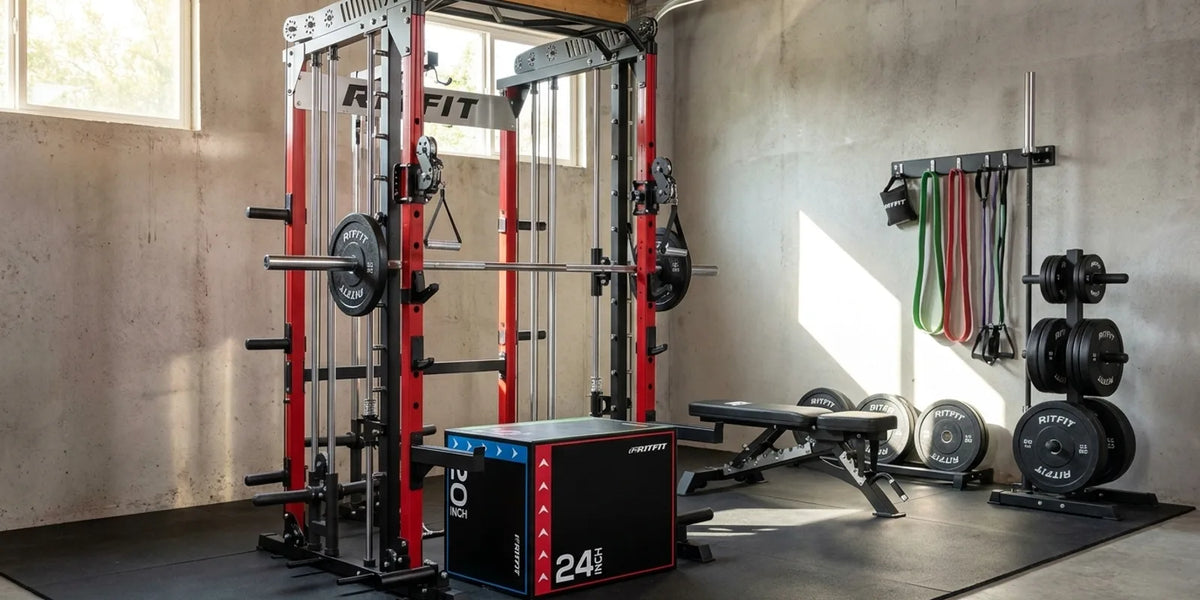
The smith machine box squat is a back squat performed to a box on a fixed vertical bar path, giving you a repeatable depth target and a practical way to load the squat pattern without a spotter. This guide covers box height, foot position, hook setup, the pause and drive, and how to progress the lift.
You will learn how to set the box at or slightly below knee height, sit back with vertical shins, and rack the bar safely, plus when the power rack box squat alternative fits better. Stop any set that causes sharp pain.
Quick Answer: A smith machine box squat works by setting a sturdy box at or slightly below knee height, stepping your feet about 8 to 12 inches in front of the bar, and sitting back until your glutes touch the box. Pause briefly under tension, drive up along the fixed bar path, and set the safety catches just below your lowest depth before each set.
Key Takeaways
- Box height decides depth: Start the box at or slightly below knee height so your thighs reach at least parallel with a braced lower back.
- Feet sit in front of the bar: Place your feet about 8 to 12 inches ahead of the bar so your shins stay near vertical and your hips can travel back.
- Pause, do not rest: Touch the box with your glutes, hold tension through a brief pause on the box, then drive up.
- Set the catches first: Position the safety catches just below your lowest working depth so a failed rep has a clear exit.
- Progress patiently: Build the smith machine box squat with the empty bar first, then add small loads when every rep looks the same.
Set the Box Height for Your Smith Machine Box Squat
The right box height for box squats sits at or slightly below knee height so your thighs reach at least parallel with a braced lower back. Everything else in the lift, from your stance to your rack height, follows from this first measurement.
Find Your Working Depth First
A 2024 biomechanical review defines medium depth as 90 to 110 degrees of knee flexion with the thigh parallel to the floor, and both knee and hip flexion moments rise as the squat gets deeper[1]. A strength and conditioning commentary adds that a box at the appropriate depth works as a physical target and that descent strategies should bring the thighs at least parallel to the ground[2].
| Depth Band | Knee Flexion | What the Box Should Do |
|---|---|---|
| Partial | 0 to 90 degrees | Set the box higher and rebuild control before chasing depth |
| Medium | 90 to 110 degrees | Thighs parallel to the floor, the standard target for box height for box squats |
| Deep | 110 to 135 degrees | Lower the box only while the lower back stays braced |
Depth bands follow the knee flexion definitions cited in reference 1.
Common Mistakes With Box Height and Depth
If the box is too low, your chest drops and your heels lift before contact, and if it is too high, the range shortens without warning. Treat either pattern as a signal to move the box one step before adding any load.
- Stability first: Pick a solid box for box squats that does not slide or compress under load.
- Repeatable height: A fixed-height box beats an improvised seat because the same height gives the same box squat depth every set.
- One step changes: Adjust the height one step at a time so you can feel the difference before committing to a working weight.
"Easy to set up smooth cable operation well worth the price smith very smooth as well. I have seen some machines the aluminum pulley upgrade alone cast what this machine cost and free fast shipping had it in 3 days from order."
Davy M. Verified Buyer, RitFit M1 PRO Multi-Functional Smith Machine with Cable Crossover System and Squat Rack for Home Gym
Position Your Feet in Front of the Bar
Your feet sit about 8 to 12 inches in front of the bar so your shins stay near vertical while you sit back to the box. The fixed vertical bar path cannot travel with you, so feet under the bar push the knees forward and lift the heels at the bottom.
Choose a Stance Width and Toe Angle
Medium or wide stance work has been reported to raise gluteus maximus activity by 13 to 61 percent compared with narrow stance, with no measured change in quadriceps or hamstring activity. Turning the feet out about 30 degrees cuts the knee valgus moment by 50 percent and the knee external rotation moment by 20 percent without changing leg muscle activation.
Keep Your Shins Near Vertical
Shins that stay near vertical let the hips travel back and load the glutes and hamstrings on the way down. If the knees shoot forward as you descend, push the hips back harder at the start of the rep or step the feet a little farther ahead.
"You're going to have more joint torque at the knee and less joint torque at the hip. The further forward you shift your feet, in general, the more quads you're going to get."
Joe Bennett, Hypertrophy Coach, Independent. Source: Hypertrophy Coach Breaks Down Jay Cutler's Quad Training (Fitness Volt), fitnessvolt.com
Set the Safety Hooks Before You Unrack
The safety catches sit just below your lowest working depth, and the bar rotates fully onto the hooks before you let go. This arrangement turns the machine into a self-spotting station so a failed rep has a clear exit without a training partner.
Place the Catches Just Below Your Lowest Depth
One exercise guide recommends setting the catches a notch below the lowest point of your working depth before any plates go on. The catches act as insurance rather than part of the lift, so the bar never touches them during a clean set.
- Step 1: Set the box behind the bar, then adjust the safety catches to sit just below your lowest depth.
- Step 2: Rest the bar across your upper back and traps, grip slightly wider than shoulder width, and rotate it off the hooks.
- Step 3: After the set, step back under the bar and rotate it fully onto the hooks before releasing your grip.
The unrack and rack moment is the most awkward part of the lift, so rehearse it with an empty bar and compare the rhythm with the plain movement in our guide on how to do a Smith machine squat.
Sit Back, Pause on the Box, and Drive Up
A proper rep touches the box with your glutes under full tension, pauses briefly, and drives up through the mid foot. Think of the pause as loading a spring rather than taking a seat, because fully relaxing rounds the lower back and turns the next rep into a bounce.
Control Every Inch of the Descent
Dropping onto the box transfers impact to your spine instead of your legs, so control the last few inches of every descent. A heavy thud on each rep is the clearest sign that the final portion of the descent was dropped.
Own the Pause and the Drive
Hold tension in your trunk and legs during the pause on the box, then drive through the mid foot and squeeze the glutes to stand. Exhale as you rise and re-brace before the next descent so every rep starts from the same tight position.
"Next, I do Smith machine squats for the quads and glutes. Here I get as deep as I can and explode out of the hole. Doing these on the Smith allows me to push my last set to failure without worrying about dumping the bar."
Jeff Nippard, Science-Based Natural Bodybuilder and Powerlifter, JeffNippard.com. Source: Jeff Nippard's Science-Backed Leg Workout for Massive Quads (Men's Health UK), menshealth.com
Choose Your Starting Weight
The right starting load for the smith machine box squat is the empty bar or a light weight while the setup is new. Dial in box height, foot placement, and the pause first, then let the load follow clean reps.
- Empty bar first: Spend the first sessions confirming that the box, feet, and catches give the same result rep after rep.
- Add small: Move up one small plate per side only when every rep looks the same and your heels stay planted through the drive.
- Read the bar speed: If the bar slows sharply or your form breaks on a rep, treat that as the top of the range for the day.
The fixed path of a multifunctional Smith machine takes balance out of the equation, so the load you choose goes straight to your legs.
Program Sets, Reps, and Progression
The smith machine box squat fits most programs at 2 to 3 sets of 6 to 10 controlled reps, twice a week. Rest about 2 to 3 minutes between sets so each rep stays crisp.
When to Add Weight
Add weight when every rep looks identical and the pause stays controlled, not when the bar speed collapses. Bar velocity is a practical guide here, though the exact numbers differ by person, and in one 2024 load-velocity study of the box squat in 19 women breast cancer survivors, mean concentric velocity tracked relative load with an R squared fit of 0.903 and averaged 0.22 m/s at a one-rep max[3].
Stop Signals: When to End the Set
End the set if sharp pain appears in the knees, hips, or lower back, if the lower back rounds on the box, or if the heels lift at the bottom. These are setup problems first, so drop the load and adjust the box or stance before the next session.
Run the Power Rack Box Squat Alternative
The power rack box squat alternative swaps the fixed bar path for a free barbell inside a rack with safety pins. It trains the same pattern with more balance demand, and it suits lifters who want to rotate between fixed-path and free-weight work.
- Same box, different bar: Set the box inside the rack and the safety pins just below your lowest depth, then squat with a free bar over the mid foot.
- More balance work: The free bar adds horizontal hip travel and trunk demand that the machine removes.
- Rotate setups: Use a power rack for box squats on free-bar days and the machine on days you want to push effort without a spotter.
If you want both paths in one footprint, the M3 Power Rack Cable Crossover Smith Machine combines rack and machine work. Machine leg movements like the 3-in-1 leg press and hack squat machine or the Gazelle Pro leg press and hack squat machine give your quads variety on days the box stays in the corner.
"Very Solid 3x3 setup. Cables are smooth. Love that it came in pink. Great all in one piece. Hope you add more accessories and attachments for the m3 ! I use it daily!!!!"
Katharine B. Verified Buyer, M3 Power Rack Cable Crossover Smith Machine
Choose a Smith Machine Setup for Box Squats
The best Smith machine for box squats offers lockout positions and safety catches that bracket your working box depth. Match the bar start and finish heights to your box height so unracking and racking stay comfortable every set.
Look for closely spaced lockout holes, a stable frame that does not flex under heavy sets, and catches that adjust to your depth. These details decide whether the machine fades into the background or fights you on every rep.
Choose the RitFit M1 PRO If You Squat Solo at Home
RitFit's M1 Multi-Functional Home Gym Smith Machine matches solo box squat work with closely spaced lockout positions, adjustable safety catches, and a frame built for heavy sets without a spotter. Pick the box height that keeps your thighs parallel, then set the catches one notch below so every set has a clear exit.
- Full leg days: The M1 PRO Smith machine package with leg press adds machine leg work for accessory days after your main squat sets.
- Stack-loaded option: The BPC06 all-in-one Smith machine home gym package keeps loading simple in a gym shared by the whole family.
"I bought the bundle with the M1 Pro and the leg press machine. I am so glad to have a home gym in my basement where I can go and workout and not have to worry about going all the way to a gym"
Russell M. Verified Buyer, RitFit Pro Strength System
FAQs About Smith Machine Box Squats
What is a Smith machine box squat?
A Smith machine box squat is a back squat performed on a Smith machine with a sturdy box behind you as a depth target. You sit back until you touch the box, pause briefly under tension, then drive up along the fixed vertical bar path.
How high should the box be for box squats on a Smith machine?
Choosing the right box height for box squats starts with a box at or slightly below knee height so your thighs reach at least parallel depth without your lower back rounding. If you lean far forward or your heels lift to reach the box, raise it one step and rebuild depth from there.
How deep should a Smith machine box squat be?
Your box squat depth is the point where your glutes touch the box with your lower back braced, which for most lifters puts the knees near 90 to 110 degrees of flexion with the thighs parallel to the floor. Deeper is not automatically better if your form breaks down.
Should you pause on the box during a box squat?
Yes. Pause on the box for a brief, controlled moment while staying tight through your trunk and legs, then drive up. Touch and load the box rather than collapsing onto it, because fully relaxing rounds your lower back and turns the next rep into a bounce.
Where should your feet be on a Smith machine box squat?
Place your feet roughly 8 to 12 inches in front of the bar at hip to shoulder width with the toes turned slightly out. The fixed bar path pushes your knees forward if your feet sit directly under the bar, so step forward until your shins stay near vertical.
Can you do a box squat in a power rack instead?
Yes. The power rack box squat alternative uses a free barbell with the box set inside the rack and the safety pins just below your lowest depth. It trains the same pattern with more balance demand, and it works well when you want to rotate between the two setups.
Is a Smith machine box squat good for beginners?
Yes. The fixed bar path removes most of the balance problem and the box defines depth on every rep, so beginners can learn to sit back with a repeatable bottom position. Start with body weight or a light load and dial in box height and foot placement first.
What weight should you start with on a box squat with a Smith machine?
Start with the empty bar or a light load for the first few sessions while you set box height, foot placement, and the pause. Add a small plate per side only after every rep looks the same and your heels stay planted through the drive.
How often should you train a Smith machine box squat?
Train the smith machine box squat twice a week for 3 sets of 6 to 10 controlled reps, resting about 2 to 3 minutes between sets. Progress by adding a small plate per side only after every rep looks the same and the pause stays controlled.
Conclusion
The smith machine box squat gives you a repeatable depth target and a fixed path, so the only variables left are your box height, foot position, and the pause. Set the box first, own the rhythm, and let the load follow clean reps.
New to home gym training? Browse the Smith machine collection for a setup that matches your space, and check the RitFit discount guide before you buy.
Disclaimer
This article provides general training information and is not medical advice. Stop any exercise that causes sharp pain and consult a qualified professional before starting a new strength program.
References
1. Straub RK, Powers CM. A Biomechanical Review of the Squat Exercise: Implications for Clinical Practice. Int J Sports Phys Ther. 2024;19(4):490-501. doi:10.26603/001c.94600. PMCID: PMC10987311
2. Kushner AM, Brent JL, Schoenfeld BJ, et al. The Back Squat Part 2: Targeted Training Techniques to Correct Functional Deficits and Technical Factors that Limit Performance. Strength Cond J. 2015;37(2):13-60. doi:10.1519/SSC.0000000000000130. PMCID: PMC4725067
3. Díez-Fernández DM, Esteban-Simón A, Baena-Raya A, et al. Optimizing exercise prescription during breast cancer rehabilitation in women: Analysis of the load-velocity relationship in the box squat exercise. Eur J Sport Sci. 2024;24(7):1021-1031. doi:10.1002/ejsc.12130. PMCID: PMC11235820





