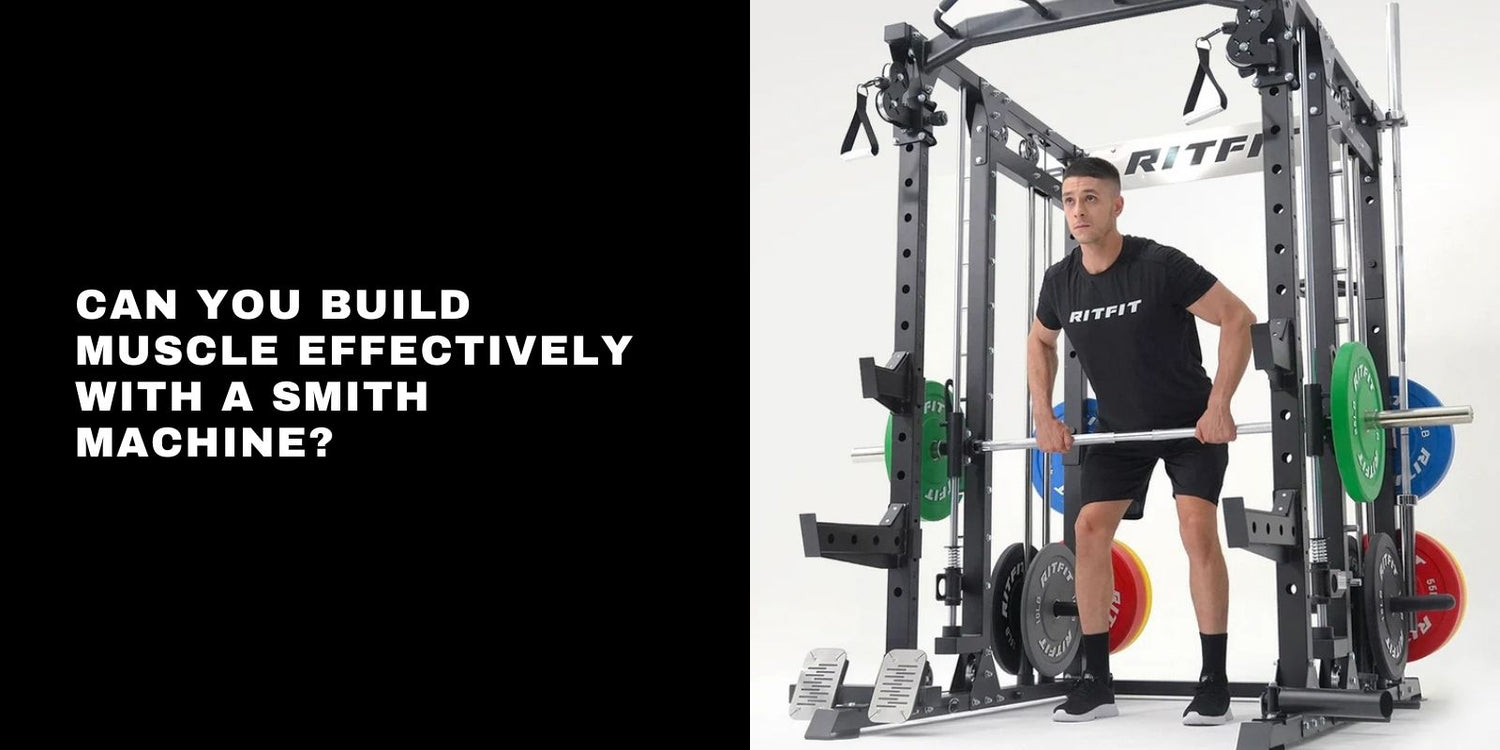
Yes, you can build muscle effectively with a Smith machine if your training creates enough tension, volume, and progression. The fixed bar path changes stabilization demands, but it can still be a highly productive hypertrophy tool for home gym lifters, beginners, and solo trainees.
Table of Contents
- How Muscle Growth Works in Simple Terms
- What Is a Smith Machine and How Does It Work?
- Can You Build Muscle Effectively With a Smith Machine?
- Smith Machine vs Free Weights for Muscle Building
- Best Exercises to Build Muscle With a Smith Machine
- How to Program a Smith Machine for Muscle Growth
- Example Smith Machine Focused Workout Routines
- Technique and Safety Tips Specific to the Smith Machine
- Common Mistakes That Limit Muscle Growth on a Smith Machine
- Who Benefits Most From Using the Smith Machine?
Key Takeaways
- Yes, a Smith machine can build muscle well: Hypertrophy depends on tension, effort, volume, and progression, not on free weights alone.
- It often works especially well for solo training: The guided bar path and frequent rack points can make hard sets feel more manageable when no spotter is present.
- It is best used with intent: The Smith machine shines when you want stable reps, targeted loading, and repeatable setup for quads, glutes, chest, shoulders, and upper back.
- It is not a perfect replacement for every goal: Free weights still have an advantage when your main priority is coordination, barbell skill, or broader stabilization demands.
- Programming still decides your results: Good exercise selection, enough weekly sets, and smart effort levels matter more than the machine itself.
How Muscle Growth Works in Simple Terms
Muscle growth happens when training exposes a muscle to enough mechanical tension and repeatable effort over time. The specific tool matters less than whether the target muscle is challenged hard enough and progressed consistently.[1]
A broad loading range can build muscle when sets are performed with control and meaningful effort, so there is no single magic hypertrophy rep zone. That is why a Smith machine can work across moderate and higher rep ranges when your technique and programming are sound.[2]
What Is a Smith Machine and How Does It Work?
A Smith machine uses a bar fixed to rails, which means the bar travels on a guided path instead of floating freely through space. That guided path reduces lateral balance demands and gives you more predictable setup from rep to rep.
Most home gym shoppers compare vertical and slightly angled designs, along with plate loaded and weight stack systems. If you are still comparing options, the RitFit Smith machine collection and the plate loaded vs weight stack Smith machine guide can help you narrow the right setup for your space.
Can You Build Muscle Effectively With a Smith Machine?
Yes, you can build muscle effectively with a Smith machine because the machine still lets you train hard enough to create muscular tension and progressive overload. In practice, the added stability often helps you push the target muscle with more consistency on hypertrophy focused sets.
This matters most for lifters who train alone, want cleaner setup, or care more about muscle size than barbell skill transfer. It also helps explain why many people use the Smith machine for squats, presses, split squats, rows, calf raises, and hip thrusts in a home gym.
The Smith machine becomes even more useful when paired with a bench, cable work, and a few free weight accessories. For broader planning, the functional trainer with Smith machine guide and the all in one Smith machine replacement guide are strong next reads.
Smith Machine vs Free Weights for Muscle Building
The Smith machine is often better when your goal is stable, repeatable hypertrophy work on a specific muscle. Free weights are often better when your goal is coordinated whole body lifting skill, freer movement paths, and greater stabilization demand.
That difference does not mean one tool is universally superior, it means each tool solves a different training problem. If you want the broader equipment tradeoff explained in more detail, see Smith machine vs power rack and Smith machine vs free weights.
| Goal | Smith Machine | Free Weights |
|---|---|---|
| Train close to failure alone | Usually a strong fit | More dependent on setup and spotting |
| Target a muscle with more stability | Usually a strong fit | More balance demand |
| Improve barbell skill transfer | More limited | Usually better |
| Home gym confidence and convenience | Usually high | Depends on rack, safeties, and skill |
Best Exercises to Build Muscle With a Smith Machine
Lower Body
Lower body work is where many lifters get the most obvious hypertrophy value from the Smith machine because stable loading makes it easier to push quads, glutes, hamstrings, and calves hard.
- Smith Squat: This is a strong option for quad focused training when foot position and torso angle are adjusted to the machine. Many lifters place the feet slightly forward to match the fixed path more comfortably.
- Smith Romanian Deadlift: This is one of the most reliable Smith machine patterns for hamstrings and glutes because the guided bar path helps keep the load close and repeatable. If you want a full form breakdown, see the Smith machine Romanian deadlift guide.
- Smith Split Squat and Bulgarian Split Squat: These are excellent when balance usually limits your single leg work before the target muscles are truly challenged. The machine lets you stay locked into the pattern and focus on depth, stretch, and load.
- Smith Calf Raise: This is a practical way to load the calves heavily without wrestling a free bar into place. The stable line of force also makes slower pauses and longer eccentrics easier to repeat.
- Smith Hip Thrust: This is one of the most practical Smith machine glute builders because setup is stable and loading is easy to progress. If glute development is a priority, the Smith machine hip thrust guide and Smith machine hip thrust glute workout are highly relevant.
Chest and Back
Chest and back exercises also work well on a Smith machine because the fixed path can help you focus on pressing and rowing output instead of bar control.
- Smith Bench Press: This is a solid chest builder when the bench and bar path are aligned so the bar reaches the lower chest area comfortably. The movement is often easier to push hard when you train alone.
- Smith Incline Press: This is especially useful for upper chest hypertrophy because the setup is stable and easy to repeat. For angle and bench placement tips, see how to do incline Smith machine press.
- Smith Bent Over Row: This can be productive for upper back and lats when your hinge position is strong and the path feels natural for your body. It usually works best when you control the eccentric and do not turn the set into a shrug.
- Inverted Row: This is one of the most underrated Smith machine back builders because you can adjust bar height and body angle easily. It is also a strong option for lifters who need a scalable pulling pattern at home.
Shoulders and Arms
Shoulder and arm work on the Smith machine tends to work best when you want stable tension and easy progression without needing very high skill.
- Smith Overhead Press: This can build the delts well if the bench angle and torso position let the bar track without joint irritation. Many lifters do better with a modest incline than with a fully upright bench.
- Smith Upright Row: This can be useful for traps and side delts if grip width and range of motion feel comfortable. It should feel smooth, not forced.
- Smith Drag Curl: This is a niche but effective arm variation when you want a different biceps stimulus from standard cable or dumbbell work. It usually works best with strict tempo and modest loading.
If you want more movement ideas for programming variety, the must do Smith machine exercises for full body gains article is a strong companion resource.
How to Program a Smith Machine for Muscle Growth
Your Smith machine plan should still follow the same hypertrophy rules as any other good resistance training plan. The machine does not replace programming, it only changes how you deliver the stimulus.
Weekly set volume is still one of the clearest drivers of muscle growth, so each major muscle group needs enough quality work across the week instead of random hard sets done without structure.[3]
- Rep Ranges: Most compound Smith machine lifts work well in the 6 to 15 rep range, while many accessory and leg focused movements also work well in the 10 to 20 rep range.
- Effort: Most hypertrophy sets should finish close to failure, but not every set needs all out grinding. That usually means leaving about zero to three reps in reserve depending on the movement and your skill level.[4]
- Failure Use: Absolute failure is a tool, not a requirement. Trained lifters can still gain size with non failure training when total effort, technique quality, and progression are well managed.[5]
- Progressive Overload: Add load, reps, cleaner execution, or total weekly sets over time. A logbook matters just as much on a machine as it does with a free barbell.
- Exercise Pairing: The Smith machine works even better when paired with cables, dumbbells, and bodyweight pulling so your program stays well rounded.
Example Smith Machine Focused Workout Routines
Full Body Plan
A full body Smith machine plan works well for lifters who want simplicity, repeatable setup, and enough weekly exposure to the basic movement patterns.
- Smith Squat: 3 sets of 6 to 10 reps.
- Smith Bench Press: 3 sets of 8 to 12 reps.
- Smith Bent Over Row: 3 sets of 8 to 12 reps.
- Smith Romanian Deadlift: 3 sets of 8 to 12 reps.
- Smith Overhead Press: 2 to 3 sets of 8 to 12 reps.
- Smith Calf Raise: 3 sets of 12 to 20 reps.
Push Pull Legs Split
A push pull legs split is often the best choice if your goal is more weekly hypertrophy volume and better exercise variety without overly long sessions.
- Push Day: Smith incline press, Smith flat press, Smith overhead press, cable or dumbbell triceps work.
- Pull Day: Smith row, inverted row, pulldown variation, biceps work, rear delt work.
- Leg Day: Smith squat, Smith split squat, Smith Romanian deadlift, Smith hip thrust, Smith calf raise.
Minimal Equipment Home Gym Plan
A minimal equipment Smith machine plan is effective when you only have a machine, a bench, and a modest amount of extra equipment, because the stable setup lets you get a lot of work done in a small space.
- Use slower eccentrics: A three second lowering phase can make moderate loads more challenging without forcing sloppy reps.
- Use pauses: Pausing in the stretched position improves control and keeps tension on the target muscle.
- Rotate emphasis: Run one block with more quad and chest emphasis, then another with more glute, hamstring, and upper back emphasis.
Technique and Safety Tips Specific to the Smith Machine
The Smith machine is safest and most effective when you adapt your body position to the machine instead of forcing a barbell pattern onto a guided path. Good setup is what turns stability into a benefit instead of a limitation.
- Match your stance to the rail path: Slight foot adjustments often solve discomfort in squats and split squats. The correct setup should feel smooth, not jammed.
- Align the bench before you load the bar: A small bench shift can change shoulder feel dramatically on presses. Take the extra minute and set the bench first.
- Use the safeties: Set bottom stops just below your working range when possible. This is especially important for solo training.
- Control the eccentric: Do not let the rails turn the lowering phase into a passive drop. The eccentric still matters for tension and technique quality.
- Respect machine differences: Vertical and angled Smith machines do not feel identical. Test the empty bar first and adjust from there.
- Prioritize comfort over ego: If a variation feels awkward at the joints, change stance, grip, bench angle, or exercise. The machine should serve your body, not the other way around.
Common Mistakes That Limit Muscle Growth on a Smith Machine
Most poor Smith machine results come from poor setup, poor exercise matching, or poor effort management, not from the machine itself. A fixed path can be very productive, but only when the pattern suits your body and your goal.
- Using the wrong foot placement: This is one of the fastest ways to move tension away from the target muscle and into a joint that feels irritated.
- Forcing every lift to look like a free barbell lift: The Smith machine is not supposed to feel identical to free weights. Treat it as its own tool.
- Cutting range of motion to move more plates: Short reps may protect your ego, but they usually reduce the quality of the hypertrophy stimulus.
- Going to failure on everything: This often creates fatigue faster than it creates progress. Use failure strategically, not compulsively.
- Ignoring exercise variety: A Smith machine can build a lot of muscle, but a fuller program still benefits from cables, dumbbells, or bodyweight pulling.
- Choosing load over intent: Stable equipment can tempt you to chase numbers instead of muscle stimulus. Your target muscle should still feel like the limiter on the set.
Who Benefits Most From Using the Smith Machine?
The Smith machine tends to be most useful for lifters who value stable setup, safer solo training, repeatable execution, and efficient hypertrophy work. It is often a strong fit for home gym users, beginners, bodybuilders, and lifters who want to train hard without depending on a spotter.
It is also useful for lifters who want a machine that can anchor a compact home setup with pressing, squatting, hinging, split squat work, and accessory training in one place. If that sounds like your situation, the RitFit M1 Smith machine and the RitFit M1 vs M2 Smith machine comparison are natural next steps.
FAQs
Can a Smith machine build as much muscle as free weights?
Yes. A Smith machine can build a lot of muscle when you apply progressive overload, enough weekly volume, and hard sets. It may reduce stabilizer demand compared with free weights, but your prime movers still receive meaningful tension that can drive hypertrophy.
Is a Smith machine good for beginners who train alone?
Yes. A Smith machine is often a strong beginner option because the bar path is predictable and rack points are easy to reach. It can help new lifters learn basic squat, press, hinge, and split squat patterns with more confidence when training alone.
What are the best Smith machine exercises for muscle growth?
The best Smith machine exercises for muscle growth are usually squats, split squats, Romanian deadlifts, bench presses, incline presses, rows, calf raises, and hip thrusts. These movements are easy to load, easy to repeat, and easy to progress when your goal is hypertrophy.
How close to failure should you train on a Smith machine?
Most Smith machine hypertrophy sets should finish about zero to three reps from failure, depending on the exercise and your skill level. Compound lifts usually work best when you stop just short of technical breakdown, while safer accessories can go closer to failure.
Does a Smith machine reduce stabilizer muscle work too much?
No. Reduced stabilizer demand does not cancel out hypertrophy, but it does change what the lift trains best. Use the Smith machine for stable muscle focused sets, then add free weights, cables, or bodyweight work if you also want more coordination and whole body stability.
Which Smith machine setup mistakes can limit muscle growth?
The biggest Smith machine setup mistakes are bad foot placement, awkward bench alignment, cutting range of motion, and using the same bar path for every body. Poor setup shifts tension away from the target muscle, makes joints feel worse, and reduces the quality of hard working sets.
Conclusion
A Smith machine can absolutely build muscle when your goal is hypertrophy and your program is built around smart exercise selection, enough weekly work, and progressive overload. It is not the only good option, but it is a very effective one for lifters who want stable hard sets, easier solo training, and repeatable execution in a home gym.
Disclaimer. This article is for general educational purposes only and is not medical advice. If you have current pain, recent injury, surgery history, numbness, dizziness, or unexplained weakness, consult a qualified clinician before starting or changing training. Stop any exercise that causes sharp pain or worsening symptoms.
References
- Krzysztofik M Wilk M Wojdała G Gołaś A. Maximizing Muscle Hypertrophy: A Systematic Review of Advanced Resistance Training Techniques and Methods. Int J Environ Res Public Health. 2019;16(24):4897.
- Schoenfeld BJ Grgic J Van Every DW Plotkin DL. Loading Recommendations for Muscle Strength, Hypertrophy, and Local Endurance: A Re-Examination of the Repetition Continuum. Sports. 2021;9(2):32.
- Baz-Valle E Balsalobre-Fernández C Alix-Fages C Santos-Concejero J. A Systematic Review of The Effects of Different Resistance Training Volumes on Muscle Hypertrophy. J Hum Kinet. 2022;81:199-210.
- Refalo MC Helms ER Trexler ET Hamilton DL Fyfe JJ. Influence of Resistance Training Proximity-to-Failure on Skeletal Muscle Hypertrophy: A Systematic Review with Meta-analysis. Sports Med. 2023;53(3):649-665.
- Santanielo N Nóbrega SR Scarpelli MC et al. Effect of resistance training to muscle failure vs non-failure on strength, hypertrophy and muscle architecture in trained individuals. Biol Sport. 2020;37(4):333-341.