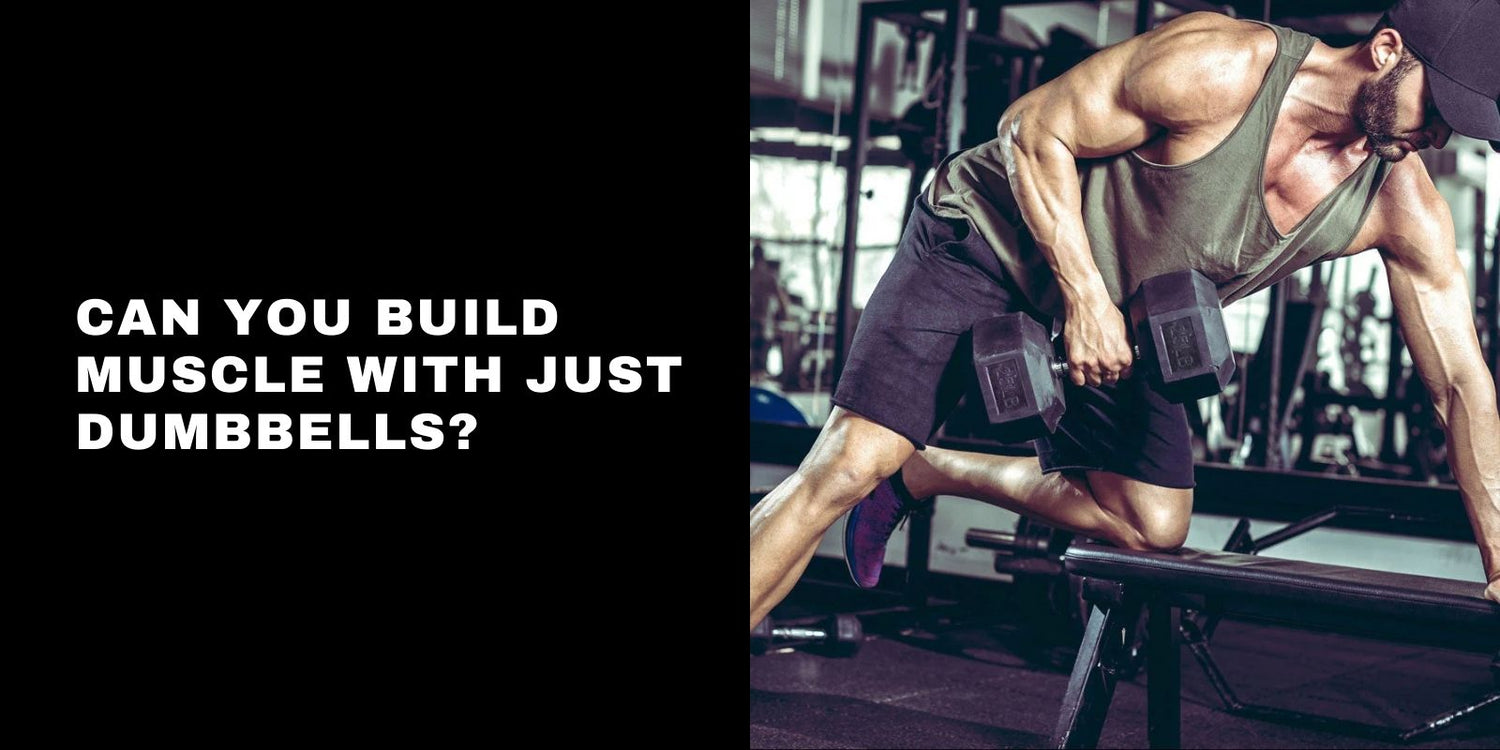
Yes, you can build serious muscle with just dumbbells if your workouts create enough tension, volume, and progression.
Dumbbells can train every major muscle group at home, especially when you use smart exercise selection, full range of motion, and consistent overload.
Key Takeaways
- Dumbbells can build muscle: Muscle growth depends on tension, effort, weekly volume, and progression, not on one specific type of equipment.
- Training close to failure matters: Most working sets should finish with about 0 to 3 reps in reserve while still using clean form.
- Wide rep ranges work: Both moderate and higher rep sets can support hypertrophy when the set is challenging enough.
- Light weights can still be useful: Single limb work, slower tempo, shorter rest, and higher reps can make limited dumbbells more effective.
- Recovery drives results: Protein, sleep, calories, and consistency determine whether your training stimulus turns into visible muscle.
Quick Start in 5 Minutes
Start with a 3 day full body dumbbell plan and run it for 8 to 12 weeks before changing the program.
Use weights that make the last few reps difficult, track your reps, and increase difficulty when the top of the rep range becomes easy.
- Train: 3 non consecutive days per week.
- Effort: Stop most sets with 0 to 3 reps in reserve.
- Progress: Add reps, load, sets, tempo control, or harder variations.
- Recover: Eat enough protein and sleep consistently.
- Evaluate: Review strength, measurements, and workout logs after 8 to 12 weeks.
Who This Dumbbell Muscle Building Guide Is For
This guide is for home gym users who want to build muscle without relying on barbells, racks, or commercial gym machines.
It works best for beginners and intermediate lifters who have fixed dumbbells, adjustable dumbbells, or a growing home dumbbell setup.
- Home lifters: You want a simple strength plan that fits an apartment, garage, basement, or spare room.
- Beginners: You want a low friction way to learn squats, presses, rows, hinges, curls, raises, and core work.
- Intermediate lifters: You need smarter progression when your current dumbbells start to feel light.
- Space limited users: You need compact equipment that still supports full body training.
How Muscle Growth Works
Muscle growth happens when training creates a strong enough stimulus and your body recovers from that stimulus over time.
The muscles do not know whether you are using a barbell, cable, machine, or dumbbell, they respond to tension, effort, range of motion, and repeated progression.
- Mechanical tension: This is the main training signal created when your muscles produce force against resistance.
- Progressive overload: This means making training gradually harder through more weight, more reps, more sets, better control, or harder exercise variations.
- Training volume: This refers to the total number of challenging sets you perform for each muscle across the week.
- Recovery: This is where the body repairs, adapts, and prepares for the next training session.
Why Dumbbells Are Enough for Building Muscle
Dumbbells are enough for muscle growth because they can load the main movement patterns your body needs to train.
With the right plan, dumbbell workouts can cover pushing, pulling, squatting, hinging, lunging, carrying, and isolation work.
- Greater range of motion: Dumbbells often allow a deeper stretch and more natural movement than a fixed bar path. Fuller ranges of motion may support hypertrophy in some resistance training contexts.[1]
- Independent limb control: Each side works separately, which helps expose strength differences between the left and right side.
- Joint friendly movement: Dumbbells let the wrists, elbows, and shoulders find a more natural path during presses, rows, curls, and raises.
- Home gym efficiency: A compact dumbbell setup can support hundreds of exercises without taking over the room.
For a simple starting point, browse the RitFit dumbbells collection to understand the main dumbbell options for home strength training.
What Muscles Can You Build With Dumbbell Workouts?
Dumbbell workouts can train every major muscle group when the program includes both compound lifts and isolation exercises.
The key is to cover movement patterns, not just random exercises.
- Chest: Dumbbell bench press, floor press, incline press, and flyes.
- Back: One arm rows, bent over rows, pullovers, and rear delt flyes.
- Shoulders: Overhead press, lateral raises, front raises, and rear delt raises.
- Quads: Goblet squats, split squats, lunges, and step ups.
- Hamstrings and glutes: Dumbbell Romanian deadlifts, hip thrusts, glute bridges, and single leg RDLs.
- Arms: Biceps curls, hammer curls, skull crushers, kickbacks, and overhead triceps extensions.
- Core: Suitcase carries, farmer carries, weighted crunches, Russian twists, and plank rows.
For more targeted movement help, use the single arm dumbbell row guide and the dumbbell fly form guide to tighten technique on key upper body exercises.
Rules for Building Muscle With Dumbbell Workouts
To build muscle with dumbbells, train each major muscle with enough hard sets and make those sets gradually more challenging.
Research on resistance training suggests that hypertrophy can occur across different loading zones when training is performed with enough effort.[2]
- Train each major muscle weekly: Cover chest, back, shoulders, quads, hamstrings, glutes, arms, calves, and core.
- Use hard working sets: Most sets should end when you have only a few controlled reps left.
- Track your reps: Write down exercises, dumbbell weight, reps, sets, and notes about form quality.
- Progress slowly: Add difficulty only when your current form is consistent and pain free.
- Repeat long enough: Stay with a plan for at least 8 to 12 weeks before judging results.
What Weight Dumbbells Should You Use to Build Muscle?
Use dumbbells that make the final 2 to 3 reps challenging while still allowing clean, controlled form.
Different exercises need different loads, so one pair of dumbbells rarely fits every movement perfectly.
| Exercise Type | Best Weight Feel | Common Rep Range | Example Exercises |
|---|---|---|---|
| Compound upper body | Moderate to heavy | 6 to 12 reps | Dumbbell bench press, overhead press, rows |
| Compound lower body | Heavy or single limb focused | 8 to 15 reps | Goblet squat, split squat, Romanian deadlift |
| Isolation work | Light to moderate | 10 to 20 reps | Curls, lateral raises, flyes, triceps extensions |
| Core and carries | Controlled but challenging | 20 to 60 seconds | Farmer carries, suitcase carries, weighted crunches |
If you are unsure where to start, the guide on what weight dumbbells to use can help you match dumbbell size to your current strength level.
How Many Sets and Reps Should You Do?
Most lifters should start with 8 to 15 hard sets per muscle per week and adjust based on recovery and progress.
Evidence suggests weekly volume is an important variable for hypertrophy, but more is not always better if recovery breaks down.[3]
- Beginners: Start with 2 to 3 sets per exercise and 3 full body sessions per week.
- Intermediate lifters: Use 3 to 4 sets per exercise and consider an upper lower split.
- Large muscles: Quads, glutes, chest, and back usually tolerate more total work than smaller muscles.
- Small muscles: Biceps, triceps, side delts, and calves often respond well to moderate to higher reps.
- Recovery check: Reduce volume if performance drops for several workouts in a row.
Essential Dumbbell Exercises for Muscle Growth
The best dumbbell exercises are the ones that let you train hard, use good control, and repeat progress over time.
Build your plan around a few reliable movements instead of changing exercises every session.
| Muscle Group | Primary Exercises | Helpful Notes |
|---|---|---|
| Chest | Dumbbell bench press, floor press, flyes | Use a controlled stretch and avoid forcing painful shoulder depth. |
| Back | One arm row, bent over row, pullover | Pull with the elbow and keep the torso stable. |
| Shoulders | Overhead press, lateral raise, rear delt fly | Use lighter loads for raises and avoid swinging. |
| Legs and glutes | Goblet squat, split squat, lunge, RDL | Use single leg work when your dumbbells feel too light. |
| Arms | Curls, hammer curls, skull crushers, overhead extensions | Keep the upper arm controlled and avoid turning isolation work into momentum work. |
| Core | Suitcase carry, farmer carry, weighted crunch, plank row | Brace the trunk and keep the rib cage stacked over the pelvis. |
For more upper body training ideas, see the shoulder workout with dumbbells and the best dumbbell chest exercises.
3 Day Full Body Dumbbell Workout Plan
This 3 day dumbbell plan is the simplest place to start because it trains the full body multiple times per week.
Perform it on non consecutive days and rest 60 to 120 seconds between hard sets.
| Exercise | Sets | Reps | Main Muscles |
|---|---|---|---|
| Goblet Squat | 3 | 8 to 12 | Quads, glutes, core |
| Dumbbell Bench Press or Floor Press | 3 | 8 to 12 | Chest, shoulders, triceps |
| One Arm Dumbbell Row | 3 | 8 to 12 per side | Back, biceps, rear delts |
| Dumbbell Romanian Deadlift | 3 | 10 to 15 | Hamstrings, glutes, spinal erectors |
| Dumbbell Overhead Press | 2 to 3 | 8 to 12 | Shoulders, triceps, upper chest |
| Farmer Carry | 2 to 3 | 30 to 60 seconds | Grip, traps, core |
4 Day Upper Lower Dumbbell Split
A 4 day upper lower split is better when you want more volume and more recovery between similar muscle groups.
Use this structure after you can complete the 3 day full body plan with consistent form and recovery.
| Day | Focus | Exercise Examples |
|---|---|---|
| Day 1 | Upper body push and pull | Bench press, one arm row, overhead press, curls, triceps extensions |
| Day 2 | Lower body | Goblet squat, split squat, Romanian deadlift, calf raise, suitcase carry |
| Day 3 | Rest or light mobility | Walking, stretching, easy core work |
| Day 4 | Upper body volume | Incline press, bent over row, lateral raise, rear delt fly, hammer curl |
| Day 5 | Lower body volume | Lunge, step up, single leg RDL, hip thrust, loaded carry |
How to Progress When You Only Have Light Dumbbells
Light dumbbells can still build muscle when you increase difficulty without increasing the actual weight.
Low load training can be productive when sets are taken close enough to failure and the exercise is performed with control.[4]
- Add reps: Move from 8 reps toward 15 or 20 reps before changing the exercise.
- Slow the lowering phase: Use a 3 second lower to increase control and time under tension.
- Use single limb exercises: Switch from goblet squats to split squats, lunges, step ups, or single leg RDLs.
- Shorten rest periods: Reduce rest slightly when the weight is too easy and form is still stable.
- Add pauses: Pause in the stretched position on rows, RDLs, split squats, and flyes.
- Increase weekly sets: Add one set to a muscle group only when recovery is still strong.
When Should You Upgrade Your Dumbbells?
You should upgrade your dumbbells when you can complete the top of your rep range with clean form and still have several reps left in reserve.
For home lifters, a set like RitFit Hex Rubber Dumbbells can make progressive overload easier because you can move up in practical weight jumps.
- Upgrade compound lift weights first: Rows, presses, squats, and Romanian deadlifts usually need heavier dumbbells sooner.
- Keep lighter pairs: Smaller dumbbells are still valuable for lateral raises, rear delts, curls, flyes, and warm ups.
- Plan storage early: A compact rack such as the RitFit A Frame Dumbbell Rack Stand helps keep a home setup cleaner and safer.
- Compare full sets: The best dumbbell sets for home gym guide can help you decide whether to buy pairs gradually or choose a larger set.
Recovery, Nutrition, and Consistency
Training creates the signal for growth, but recovery determines whether that signal becomes muscle.
Protein supplementation and adequate total protein intake can support resistance training adaptations, especially when daily intake is otherwise insufficient.[5]
- Protein: Aim for a consistent protein intake across the day instead of relying on one large meal.
- Calories: A small calorie surplus helps muscle gain, while maintenance calories can still support recomposition for some beginners.
- Sleep: Most adults should prioritize 7 to 9 hours of sleep because poor sleep can affect recovery, performance, and training consistency.
- Rest days: Use rest days to recover, walk, stretch lightly, or practice mobility instead of adding more hard training.
- Consistency: A simple plan performed well for 12 weeks beats a complex plan performed randomly.
Common Mistakes With Dumbbell Only Training
The biggest dumbbell training mistakes are using weights that are too easy, changing plans too often, and skipping lower body work.
Fix these issues before adding more exercises or more training days.
- Going too light: The final reps should feel challenging without turning sloppy.
- Ignoring legs: Split squats, lunges, step ups, and RDLs are essential when you do not have a squat rack.
- Swinging the weight: Momentum reduces muscle tension and makes progress harder to measure.
- Skipping records: Without a log, it is hard to know whether you are actually progressing.
- Training every set to failure: Failure can be useful, but doing it constantly may hurt recovery and technique.
What Are the Limits of Dumbbell Only Training?
Dumbbells are highly effective, but they are not perfect for every goal forever.
Very advanced strength goals, maximal lower body loading, or powerlifting specific training may eventually require barbells, racks, or machines.
- Lower body loading can become difficult: You may outgrow goblet squats before you outgrow split squats or lunges.
- Grip may limit some lifts: Heavy rows and RDLs can challenge the hands before the target muscles are fully fatigued.
- A bench expands options: A stable bench allows incline pressing, chest supported rows, seated shoulder work, and more controlled fly variations.
- Progress may require more pairs: A single pair can work at first, but multiple weights make long term progression easier.
FAQs
Can you really build muscle with only dumbbells?
Yes. You can build muscle with only dumbbells when your sets are hard enough, your exercise selection covers the whole body, and your weekly training volume is consistent. Dumbbells are especially effective for home lifters because they support presses, rows, squats, hinges, lunges, curls, raises, and loaded carries.
What weight dumbbells should I use to build muscle?
Use dumbbells that make the final 2 to 3 reps difficult while your form stays controlled. For most people, heavier pairs work best for squats, presses, rows, and Romanian deadlifts, while lighter pairs are better for raises, curls, flyes, and triceps extensions.
Can light dumbbells build muscle?
Yes. Light dumbbells can build muscle if you take sets close to failure and make the exercise harder over time. Add reps, slow the lowering phase, use single arm or single leg variations, shorten rest periods, or add sets when increasing weight is not possible.
How many days a week should I do dumbbell workouts?
Train with dumbbells 3 to 5 days per week depending on your recovery and schedule. Beginners usually do well with 3 full body sessions, while intermediate lifters may prefer an upper and lower split that gives each muscle enough weekly hard sets.
Are dumbbell workouts enough for legs?
Yes. Dumbbell workouts can train legs effectively when you use unilateral exercises and controlled tempo. Bulgarian split squats, reverse lunges, goblet squats, step ups, and dumbbell Romanian deadlifts can make limited weights feel much heavier while targeting quads, glutes, hamstrings, and calves.
Do dumbbells build muscle as well as barbells?
Dumbbells are enough for most home lifters who want muscle, strength, and better body composition. Barbells and machines can help with very heavy loading, but dumbbells still provide progressive overload, full body exercise options, unilateral work, and joint friendly movement paths.
When should I upgrade my dumbbells?
You are ready to upgrade when you can reach the top of your rep range with clean form and several reps left in reserve. Start by adding heavier pairs for compound lifts, then expand lighter jumps for isolation exercises and accessory work.
Should beginners start with dumbbell workouts?
Yes. Beginners should start with dumbbell workouts because they are simple, scalable, and easy to learn at home. Start with full body sessions, practice clean movement patterns, avoid sharp pain, and progress slowly before adding more volume or more advanced exercises.
Conclusion
You can build muscle with just dumbbells when your workouts are hard, structured, and progressive.
Start with full body training, use clean form, track your reps, recover well, and upgrade your dumbbells when your current weights no longer challenge you.
Important disclaimer: This article is for general educational purposes only and is not medical advice. If you have shoulder, neck, back, elbow, wrist, hip, knee, or ankle pain, a recent injury or surgery, numbness, tingling, unexplained weakness, or dizziness, consult a qualified clinician before training. Stop any exercise that causes sharp pain.
References
- Schoenfeld BJ, Grgic J. Effects of range of motion on muscle development during resistance training interventions: a systematic review. SAGE Open Med. 2020;8:2050312120901559. doi:10.1177/2050312120901559
- Schoenfeld BJ, Grgic J, Van Every DW, Plotkin DL. Loading recommendations for muscle strength, hypertrophy, and local endurance: a re-examination of the repetition continuum. Sports (Basel). 2021;9(2):32. doi:10.3390/sports9020032
- Baz-Valle E, Balsalobre-Fernández C, Alix-Fages C, Santos-Concejero J. A systematic review of the effects of different resistance training volumes on muscle hypertrophy. J Hum Kinet. 2022;81:199-210. doi:10.2478/hukin-2022-0017
- Lopez P, Radaelli R, Taaffe DR, et al. Resistance training load effects on muscle hypertrophy and strength gain: systematic review and network meta-analysis. Med Sci Sports Exerc. 2021;53(6):1206-1216. doi:10.1249/MSS.0000000000002585
- Morton RW, Murphy KT, McKellar SR, et al. A systematic review, meta-analysis and meta-regression of the effect of protein supplementation on resistance training-induced gains in muscle mass and strength in healthy adults. Br J Sports Med. 2018;52(6):376-384. doi:10.1136/bjsports-2017-097608