








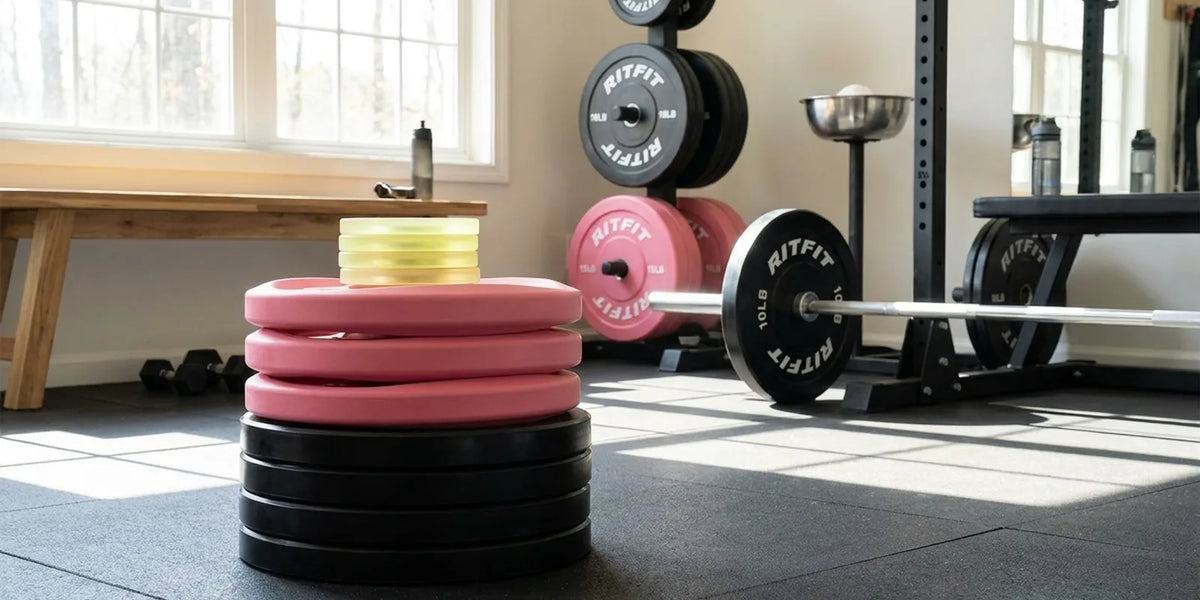
Why are change plates so expensive?
5 lb plate can cost more per pound than a 45 lb plate.
Fractional plates and deep dish plates carry a similar premium for similar reasons.
This guide explains those three cost drivers, separates fractional plates from change plates, and covers what deep dish construction actually buys you. It closes with selection criteria for increment size, hole diameter, and storage so you buy the right small plates once.
Quick Answer: Change plates cost more per pound because tight weight tolerances are as hard to hit on a small plate as a large one, tooling cost spreads over a shorter production run, and carriers charge a minimum parcel fee either way. What you buy is the ability to make small, repeatable jumps.
Key Takeaways
- Price per pound, not price: Small plates can cost more per pound than 45 lb plates because precision, tooling volume, and shipping minimums do not shrink with the plate.
- Fractional versus change: Fractional plates start at 0.25 lb and share one diameter across the set, while change plates run from about 1.1 lb to 11 lb and grow wider as they get heavier.
- Micro loading is the point: A pair of small plates counts twice on the bar, so a pair of 0.25 lb plates adds 0.5 lb and lets a stalled press keep moving.
- Fit comes first: Check hole diameter against your bar or dumbbell handle before you buy, because a 1 inch plate will not seat on a 2 inch Olympic sleeve.
- Buy the set, not the pair: Programs usually call for several increments, so a set covering 0.25, 0.5, 0.75, and 1 lb handles more situations than one heavy pair.
What Are Change Plates and Fractional Plates?
Change plates and fractional plates are small weights that let you add weight in finer jumps. In the United States the standard plates are 10 lb, 25 lb, 35 lb, and 45 lb, and one equipment guide defines anything under 10 lb as a change plate.
- Fractional plates: The lightest tier, starting at 0.25 lb. One brand sells them at a single 4.25 inch diameter across the whole set, in steel with a powder coat, ranging from 0.25 lb to about 2.2 lb.
- Change plates: The next tier up, running from about 1.1 lb to 11 lb, built as rubber over a metal insert, with diameter growing from 5.2 inches at 0.5 kg to 9.1 inches at 5 kg.
- Full size plates: The 10 lb to 45 lb plates a program is built around, and the ones that set the size of a normal jump.
- Deep dish plates: A shape rather than a weight class, with a raised center hub and a recessed face instead of a flat profile.
The practical difference comes down to how fine a jump you need and how much room the sleeve gives you. A weight plates category usually lists all of these families side by side, which makes the size difference obvious at a glance.
"The standard bar length is a little over 7 feet, has '2-inch'/50mm diameter sleeves for loading the plates on, and weighs 20kg/44.1lbs. For home gym purposes, a 28.5 or 29mm bar will be the most durable and provide the best service over time. NEVER buy a 32mm bar. They are either junk, or a specialty squat bar that a home gym doesn't need."
Mark Rippetoe, Strength Coach and Author of Starting Strength, How to Build a Home Gym
"Quality rubber plates with steel sleeves plates easy on the hardwood floors I don't normally drop my weights, but it's nice to know you can"
Ed, Verified Buyer, RitFit Olympic Bumper Weight Plates - 2-inch
Why Do Change Plates Cost More Per Pound Than Full-Size Plates?
Change plates cost more per pound because the costs that dominate plate manufacturing do not shrink with the plate. Precision, tooling, and shipping stay close to fixed while the weight you are paying for drops.
Precision gets harder as the plate gets lighter
A 45 lb plate is typically held to about 1% manufacturing tolerance, which is roughly 0.45 lb of acceptable error, and that same absolute error on a 0.5 lb plate would nearly double its weight. One equipment guide notes that hitting a tight target is about as hard on a tiny plate as on a full size one, while the penalty for missing is far larger.
Tooling cost does not shrink with the plate
A mold for a high volume plate can spread its cost across tens of thousands of units until it amounts to pennies per plate. Small plates sell in far lower volume, so the same mold cost gets spread across a shorter production run and lands on each plate at a higher rate.
Shipping minimums punish small, heavy items
Carriers charge a minimum fee just to enter a parcel into their system, and one guide puts that floor at roughly 9, 11, or 14 dollars before packing materials and labor. A one pound pair of plates and a ten pound pair pay a similar minimum, so shipping cost per pound is much higher on the lighter order.
That is the whole explanation, and none of it is a markup on the plate itself. For context on the other end of the scale, see what bumper plates cost per pound once volume and material are on your side.
Why Do Fractional Plates Cost More Than Change Plates?
Fractional plates cost more than change plates because they are solid steel with a machined hub and a powder coat. Change plates bond rubber over a metal insert, and the extra material, coating, and machining steps are what you pay for.
- Solid steel body: A machined steel plate consumes more raw material per pound of finished weight than a rubber coated plate with a smaller insert.
- Tighter target weight: The lighter the plate, the less error a lifter can tolerate, so a smaller share of a production run passes inspection.
- One diameter across the set: Fractional sets hold a single 4.25 inch diameter so every plate stacks and stores the same way, which removes a sizing decision but adds steel.
- Smaller production runs: Fractional plates sell in lower volume than any other plate tier, so tooling and setup cost is divided among fewer units.
The same logic shows up in cast iron weight plates, where solid metal and a machined finish always carry a higher cost per pound than a coated plate of identical weight. If you already run solid metal, a matching steel strip Olympic plate keeps the finish and feel consistent across the rack.
Do Deep Dish Plates Cost More, and When Are They Worth It?
Deep dish plates cost more than flat plates because a raised hub and a recessed face use more material. The extra machining makes up the rest of the premium, and whether it is worth paying depends on how you handle the plates.
- They protect your hands: The recessed face leaves a lip you can wrap your fingers around, which matters most on plate raises and other movements where you hold the plate itself.
- They sit flatter on the sleeve: A deep hub puts more of the plate in contact with the sleeve, which reduces wobble on a loaded bar.
- They are heavier to move: The same nominal weight arrives as a thicker, more awkward object, which is worth considering if you store plates overhead.
- They cost more per pound: Extra material alone raises the unit cost before you add the machining time.
If you never hold a plate in your hands and only load it on a bar, a flat plate does the same job. If plate raises are part of your upper body work, the shape earns its keep, and it is worth checking whether a grip plate gives you the same hand position for less money.
How Do Fractional Plates Help You Add Small Weight Increments?
Fractional plates let you keep adding weight when the next standard jump is bigger than a lift can absorb. Because you load one plate per side, the total added to the bar is double the plate weight, so a pair of 0.25 lb plates adds 0.5 lb and a pair of 1 lb plates adds 2 lb.
- Start from a weight you own: Drop back to the last load you completed cleanly, then build forward in the smallest increment you have.
- Progress on a schedule: Adding 2 lb per week is a real, trackable gain across a training block, even though one jump feels invisible on the bar.
- Use them on the right lifts: Presses, rows, and curls respond far better to small jumps than squats and deadlifts, which tolerate larger ones.
- Keep technique fixed: The point is staying inside your form, so a small plate that lets you grind out a sloppy rep has stopped doing its job.
Research on resistance training links progression of volume load with muscular adaptation, which is the mechanism micro loading leans on [1]. A wave loading trial found that lighter and heavier starting loads produced similar gains in strength [2].
Micro loading is not permanent, because once a lift stalls at the same weight even with the smallest plate you own, session to session increases have run their course. At that point it is time to change reps, sets, or the exercise itself, and what a fitness plateau is explains the wider picture.
Do Change Plates Fit Your Bar and Your Dumbbells?
Change plates fit only when their hole diameter matches the sleeve they slide onto. Olympic bars use a 2 inch sleeve, most standard bars and adjustable dumbbell handles use a 1 inch sleeve, and a plate drilled for one will not seat properly on the other.
- Measure before you buy: A tape measure across the handle or sleeve takes seconds and settles the question faster than any product photo.
- Standard drilling suits adjustable handles: A set drilled for a 1 inch handle is the version that slides onto adjustable dumbbells, which is why the RitFit Mini Rubber Weight Plates Standard Set is sold as a standard set.
- Olympic plates need a bar: A 2 inch plate is designed for the sleeve on an Olympic bar and will sit loose on a thinner handle.
- Watch the stack height: Once a stack of small plates reaches the end of the sleeve, the collar has nothing left to grip.
Fit is not only about the hole. Deep dish and rubber coated plates add thickness, so several small plates eat sleeve length faster than their weight suggests, and a guide to Olympic plate sizes helps you match hole and diameter before ordering.
"The RitFit dumbbells are phenomenal quality! Adding them to my home gym has made all the difference!"
Letha C. Verified Buyer, RitFit PVC-Coated Round Dumbbells Set with Rack
How Do You Choose the Right Small Plates for Your Setup?
Choose small plates by settling the finest increment your program needs, then confirming diameter, hole size, and storage. A set covers more situations than a single pair, and one training guide puts typical fractional plate set pricing at roughly 15 to 40 dollars as of September 2026.
Match the increment to the lift
Upper body presses and curls are where small jumps matter most, while squats and deadlifts usually keep moving on standard plates. A study comparing load progression with repetition progression found similar adaptations either way, so when the smallest plate you own is still too much, adding a rep is a valid way forward [3].
Check diameter and hole size before you buy
Change plate diameters grow with the weight, from 5.2 inches at 0.5 kg up to 9.1 inches at 5 kg, while fractional sets hold a single size across the range. Confirm the sleeve diameter first, because a mismatched hole will not seat.
Plan where the plates will live
Small plates vanish inside a crowded rack. A short peg, a labeled bin, or a dedicated shelf keeps the increments you use most within reach and stops a 0.5 lb pair from going missing mid block.
Kilo change plates follow standard competition increments and are color coded to match, which matters if you plan to compete, while fractional plates are unlikely to see a platform. For the rest of the set, see how to choose the right plate set.
RitFit Mini Rubber Weight Plates Standard Set for Exact Micro-Jumps
The RitFit Mini Rubber Weight Plates Standard Set is a small plate set built for exact micro-jumps. The rubber coating keeps the plates quiet against each other and protects the finish on everything stacked beside them.
- Durability: Rubber bonded over a solid core resists chipping far better than a bare metal edge, which matters when plates get set down hard on a rack shelf.
- Versatility: Standard drilling fits 1 inch handles, so one set works on adjustable dumbbells and a standard bar instead of forcing two purchases.
- Performance: Verified buyers describe the set as well built and good for adding a few extra pounds when needed, and one notes that the plates store easily alongside the rest of a rack.
- Value: A set covers several increments at once, which is the practical way to buy small plates because one pair rarely covers a whole program.
- Fit: The rubber coating adds a little thickness, so check sleeve length before stacking several small plates behind your working weight.
If your rack already runs on 2 inch plates, pair the standard set with bumper plates or a pink bumper plate set so the small plates have a matching family to sit beside.
"We got these mini plates free. The coating on them is amazing. My wife loves the color and they have came in very useful placing them on the weight stacks M1 Pro."
Travis O. Verified Buyer, RitFit Mini Rubber Weight Plates Standard Set
How Can You Use Change Plates for Forward Raises and Overhead Plate Raises?
Change plates double as hand weights for forward plate raises and overhead plate raises. The deep dish shape and the cutouts on a grip plate matter more here than they do on a loaded barbell.
- Forward plate raise: Hold the plate at the sides, keep a soft bend in the elbows, and raise it to about shoulder height before lowering under control.
- Overhead plate raise: Press the plate overhead in a straight line, keep the ribs down, and stop short of a lower back arch.
- Grip position changes the feel: Cutout grip holes lock your hands into one spot, while a plain plate lets you rotate your grip as fatigue builds.
- Small jumps keep the sets honest: A lighter plate lets you add reps or time instead of wrecking your shoulder position with a heavier load.
If raises are a regular part of your upper body work, a grip plate with cutouts gives your hands a fixed position, and the bars and plates range shows which sizes carry the shape.
FAQs About Change Plates and Fractional Plates
Why do change plates cost more per pound than 45 lb plates?
Change plates cost more per pound because precision, tooling, and shipping do not scale down. A 0.5 lb plate faces the same tolerance challenge as a 45 lb plate, but a small production run spreads tooling cost over fewer units. Carriers also charge a minimum parcel fee regardless of weight.
Are fractional plates worth buying?
Yes. Fractional plates let you add small, repeatable jumps when the next standard increment is too large. Over months those small increases add up, and they keep upper body lifts such as the overhead press moving instead of stalling. A basic set stores easily.
Can you use change plates with dumbbells?
It depends on the handle. Change plates are drilled for a 1 inch standard sleeve or a 2 inch Olympic sleeve, so they fit a matching dumbbell handle. Loading them on a mismatched handle leaves the plates loose, and they may not seat flat against the collar.
What size are fractional plates?
Fractional plates are small. Many are only about 4.25 inches across and hold a single diameter across the whole set, so a 0.25 lb plate looks the same as a 1 lb plate. That uniform size keeps them balanced inside a gym bag and easy to stack.
How small a jump can fractional plates make?
A pair of 0.25 lb fractional plates changes the bar by 0.5 lb, and a pair of 1 lb plates changes it by 2 lb. Because you load one plate per side, the total added weight is double the individual plate weight, which gives you very fine control.
Do you need deep dish plates for a home gym?
No. Deep dish plates are a preference, not a requirement. Their raised hub and recessed face add material and machining, which is part of why they cost more. They can sit more stable on a sleeve and protect your hands during plate raises, but flat plates load and lift perfectly well.
Conclusion
Change plates and fractional plates cost more per pound because precision, tooling, and shipping do not shrink with the plate, not because small plates carry a hidden markup. Weigh that against what they buy you, which is the ability to keep a stalled press moving in jumps your technique can absorb.
Check the sleeve diameter first, buy a set rather than a single pair, and store the increments where you can actually reach them. Start with the smallest jump your program calls for, and check the RitFit discount guide before you order.
Disclaimer
This article is general fitness information and is not medical or rehabilitation advice. Consult a qualified healthcare professional before starting a new training program or training through pain or injury.
References
1. Peterson MD, Pistilli E, Haff GG, Hoffman EP, Gordon PM. Progression of volume load and muscular adaptation during resistance exercise. Eur J Appl Physiol. 2011;111(6):1063-71. doi:10.1007/s00421-010-1735-9. PMCID: PMC4215195
2. Wood PP, Goodwin JE, Cleather DJ. Lighter and heavier initial loads yield similar gains in strength when employing a progressive wave loading scheme. Biol Sport. 2016;33(3):257-61. doi:10.5604/20831862.1201912. PMCID: PMC4993141
3. Plotkin D, Coleman M, Van Every D, et al. Progressive overload without progressing load? The effects of load or repetition progression on muscular adaptations. PeerJ. 2022;10:e14142. doi:10.7717/peerj.14142. PMCID: PMC9528903





