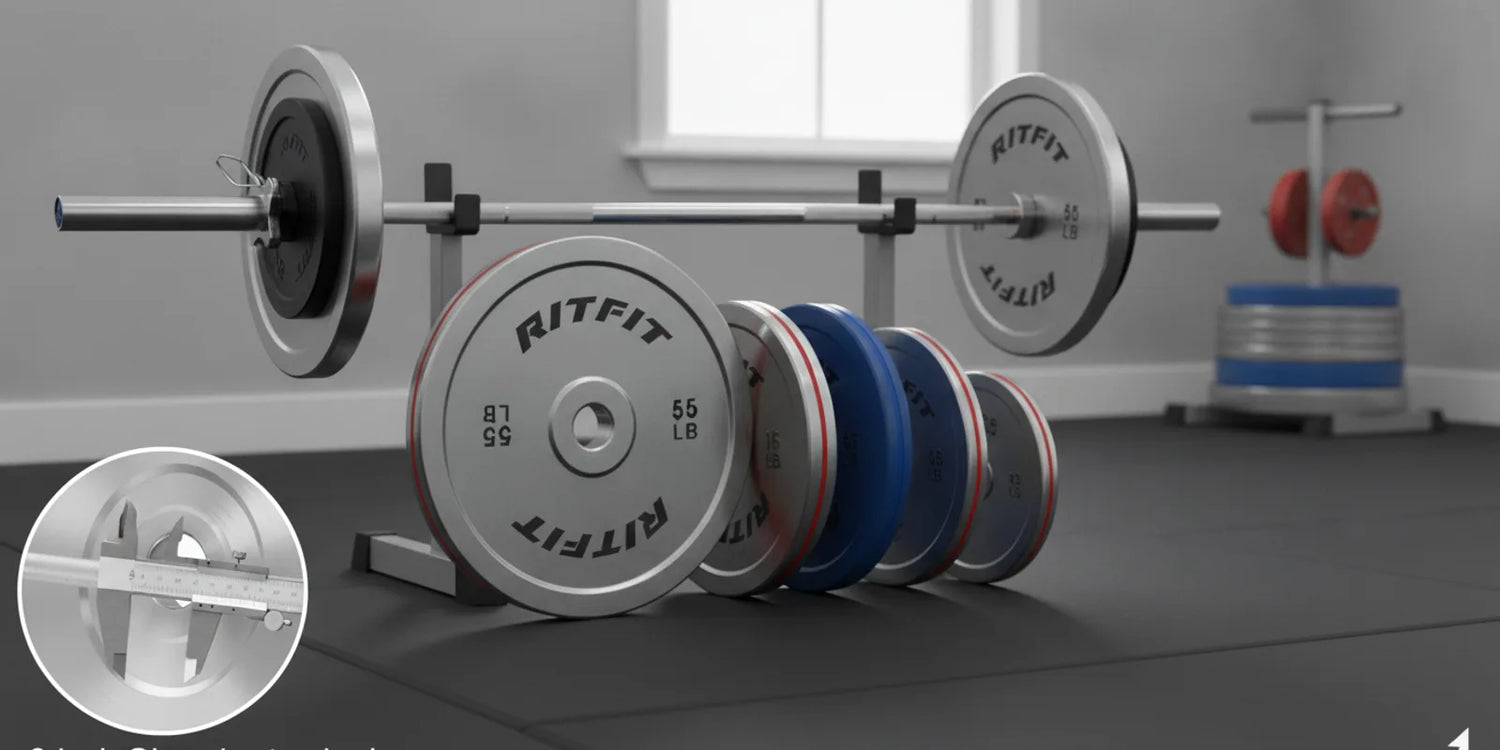
What size are Olympic plates? The short answer is that the defining size is the 2-inch center hole, not the weight or the diameter you see stamped on the plate.
This guide breaks down the three sizes that matter, the hole, the diameter, and the thickness, so you buy plates that actually fit your bar.
Quick Answer: Olympic plates are defined by a 2-inch center hole, about 50.4mm, so they fit the 50mm sleeves of an Olympic barbell. Competition bumper plates share a 450mm diameter, while iron plates shrink in diameter as the weight drops, and thickness rises with the load.
Key Takeaways
- Hole defines it: An Olympic plate has a 2-inch, roughly 50.4mm, center hole, versus 1 inch on a standard plate.
- Bumpers are uniform: Competition bumper plates all measure 450mm, or 17.72 inches, in diameter regardless of weight.
- Iron shrinks: Iron and steel Olympic plates get smaller in diameter as the weight goes down.
- Thickness limits load: Thicker plates take up more sleeve space, capping how much total weight fits on the bar.
- Weights and colors: Common sizes run 2.5 to 45 lb, with competition colors coding each kilogram plate.
What size are Olympic plates, exactly?
Olympic plates are sized by a 2-inch center hole, close to 50.4mm, which is the one measurement that separates them from standard plates. Their diameter and thickness then vary by weight and plate type.
- The constant: The 2-inch hole never changes across weights, so every Olympic plate fits the same 50mm bar sleeve.
- The variables: Diameter and thickness shift depending on whether you buy bumpers or iron plates and how heavy each plate is.
Getting the size right matters because progress depends on consistent, progressive loading, and an umbrella review found that resistance training two to three times per week builds muscle mass, strength, and physical function in healthy adults[1]. Browse the full Weight Plates range to see the options.
Why is the 2-inch hole what makes a plate Olympic?
The 2-inch hole is what makes a plate Olympic because it matches the 50mm sleeves on an Olympic barbell. Standard plates use a 1-inch, roughly 25mm, hole and will not lock onto an Olympic bar safely.
- Olympic hole: About 50.4mm, slightly larger than the 50mm sleeve so plates slide on without jamming.
- Standard hole: Around 25mm, paired with lighter home barbells and older adjustable sets.
"The standard bar length is a little over 7 feet, has '2-inch'/50mm diameter sleeves for loading the plates on, and weighs 20kg/44.1lbs."
Barbell Logic, Strength Coaching Resource, Barbell Logic
How do Olympic and standard plates compare?
The gap comes down to hole diameter and the bar each is built for, so mixing the two systems creates a loose, unsafe fit.
- Fit: Olympic plates need an Olympic bar, sold in the Olympic Barbells collection.
- Upgrade path: Most lifters standardize on 2-inch plates because the sleeve fit is universal across bars and plate-loaded machines.
What is the diameter of an Olympic plate?
An Olympic plate diameter depends on its type, so there is no single number. Competition bumper plates hold a fixed 450mm diameter, while iron plates shrink as the weight drops.
Why are bumper plates all 450mm?
Bumper plates share one diameter so a dropped, loaded barbell lands evenly and bounces safely. The International Weightlifting Federation sets this competition size at 450mm, about 17.72 inches, within 1mm.
- Uniform contact: Every bumper from 10 to 45 lb reaches the floor together, protecting the plates and the bar.
- Drop ready: This is why the Bumper Plates category suits Olympic lifts like the snatch and clean and jerk.
How does iron plate diameter change with weight?
Iron and steel Olympic plates get smaller in diameter as the weight decreases, unlike uniform bumpers. Only the heaviest 45 lb or 20 kg iron plate typically reaches the full 450mm size.
- Space saving: Smaller light plates keep an Iron Plates set compact and stackable.
- Not for dropping: Iron plates are thinner and harder, so they are not designed to be dropped like bumpers.
How thick are Olympic plates and how many fit on a bar?
Olympic plate thickness rises with weight and depends heavily on material, which decides how much total load fits on the bar. Thin steel plates pack more weight into less sleeve space than thick rubber bumpers.
- Material gap: A 45 lb steel plate is far thinner than a 45 lb bumper, so steel lets you load more before the sleeve runs out.
- Sleeve limit: Every bar sleeve has finite length, so thickness caps your maximum load and leaves room for collars.
- Long-term cost: Plan thickness early, because switching from bumpers to steel later to fit more weight means rebuying plates.
If your goal is heavy pulls and squats in a tight space, thinner steel from the Bars And Plates lineup stretches your sleeve budget the furthest. Barbell load level also shapes muscle recruitment, with heavier loads driving greater activation in one trial measuring pressing muscle activity[2].
What weights and colors do Olympic plates come in?
Olympic plates come in standard denominations that let you make small, progressive jumps in load. Common sizes are 2.5, 5, 10, 25, 35, and 45 pounds, or 1.25, 2.5, 5, 10, 15, 20, and 25 kilograms.
- Pound sets: 2.5, 5, 10, 25, 35, and 45 lb cover most home and commercial loading needs.
- Kilogram sets: 1.25 through 25 kg follow the international competition scale.
- Competition colors: Red marks 25kg, blue is 20kg, yellow is 15kg, green is 10kg, and white is 5kg, so lifters read the load at a glance.
Small increments matter because loading level shapes the strength, hypertrophy, and endurance response, with different rep and load ranges driving different adaptations[3]. Color-coded steel from the RitFit Vintage Color Coded Steel Olympic Plates 2 Inch set brings that quick-read system to a home setup.
How do you pick the right RitFit 2-inch Olympic plates?
Pick your RitFit 2-inch plates by matching plate type to how you train and how much floor space you have. All of them share the 2-inch hole, so they fit any Olympic bar you own.
Which plate fits your goal and space?
Your choice comes down to whether you drop the bar and how much you value a compact, budget-friendly footprint.
- Heavy lifting on a budget: The RitFit Silver Steel Strip Olympic Plates 2 Inch stay thin so you can load more weight in less sleeve space.
- Olympic lifting and drops: The RitFit High Grade Color Bumper Plates 2 Inch absorb dropped reps and protect your floor.
- Style plus durability: The RitFit Fleck Bumper Plates 2 Inch pair a tough rubber build with a distinctive look.
All of these plates earn their price by lasting across years of progressive loading rather than needing replacement as you get stronger. Check exact specs on the Color Bumper Plates Technical Specification page before buying.
What mistakes should you avoid when buying Olympic plates?
The most common mistake is confusing the hole size with the weight, then buying plates that do not fit the bar. Matching the 2-inch hole to a 50mm sleeve is the first check.
- Wrong hole size: Buying standard 1-inch plates for an Olympic bar leaves them loose and unsafe.
- Ignoring thickness: Loading only thick bumpers can run out of sleeve room before you hit your target weight.
- Skipping small plates: Without 2.5 and 5 lb plates, you cannot make small progression jumps between heavier increments.
Match your plate hole to your bar sleeve first, then choose type and increments based on your training and space.
FAQs About Olympic Plate Size
What size hole do Olympic plates have?
Olympic plates have a 2-inch center hole, about 50.4mm, so they slide onto the 50mm sleeves of an Olympic barbell. Standard plates use a smaller 1-inch hole, roughly 25mm. The hole size, not the weight or diameter, is what officially makes a plate Olympic rather than standard.
Are all Olympic plates the same diameter?
No. Competition bumper plates all share a 450mm, or 17.72-inch, diameter so they land together when dropped. Iron and steel Olympic plates instead shrink in diameter as the weight drops, so a 10-pound iron plate is noticeably smaller across than a 45-pound plate on the same bar.
Do Olympic plates fit on a standard barbell?
Not properly. Olympic plates have a 2-inch hole and will slide loosely on a 1-inch standard bar, which is unsafe. Olympic plates are made for Olympic bars with 50mm sleeves. Match the plate hole to your bar sleeve rather than mixing the two systems together.
How thick is an Olympic plate?
Thickness rises with weight and material. Thin steel plates pack more weight into less sleeve space, while rubber bumpers of the same weight are much thicker. Thickness matters because it limits how much total load fits on the bar sleeves before you run out of room for collars.
What weights do Olympic plates come in?
Common Olympic denominations are 2.5, 5, 10, 25, 35, and 45 pounds, or 1.25, 2.5, 5, 10, 15, 20, and 25 kilograms. Competition plates are color coded, with red for 25kg, blue for 20kg, yellow for 15kg, green for 10kg, and white for 5kg to speed loading.
Conclusion
What size are Olympic plates comes down to one constant and two variables. The 2-inch hole defines them, while diameter and thickness shift by type and weight.
Match the hole to your bar, pick bumpers for dropping or steel for compact heavy loading, then start progressing. Explore current offers on the RitFit sales page to build your set.
Disclaimer
This article is for general educational purposes and does not replace professional training or medical guidance. Consult a qualified coach or healthcare provider before starting a new loading program.
Save on your next RitFit order
Tap the button to copy your code, then paste it at checkout.
References
1. Currier BS, Lowisz CV, Phillips SM. The influence of resistance exercise training prescription variables on skeletal muscle mass, strength, and physical function in healthy adults: An umbrella review. J Sport Health Sci. 2024;13(1):47-60. PMCID: PMC10818109
2. Krol H, Golas A. Effect of Barbell Weight on the Structure of the Flat Bench Press. J Strength Cond Res. 2017;31(5):1321-1337. PMCID: PMC5400411
3. Schoenfeld BJ, Grgic J, Van Every DW, Plotkin DL. Loading Recommendations for Muscle Strength, Hypertrophy, and Local Endurance: A Re-Examination of the Repetition Continuum. Sports (Basel). 2021;9(2). doi:10.3390/sports9020032. PMCID: PMC7927075