








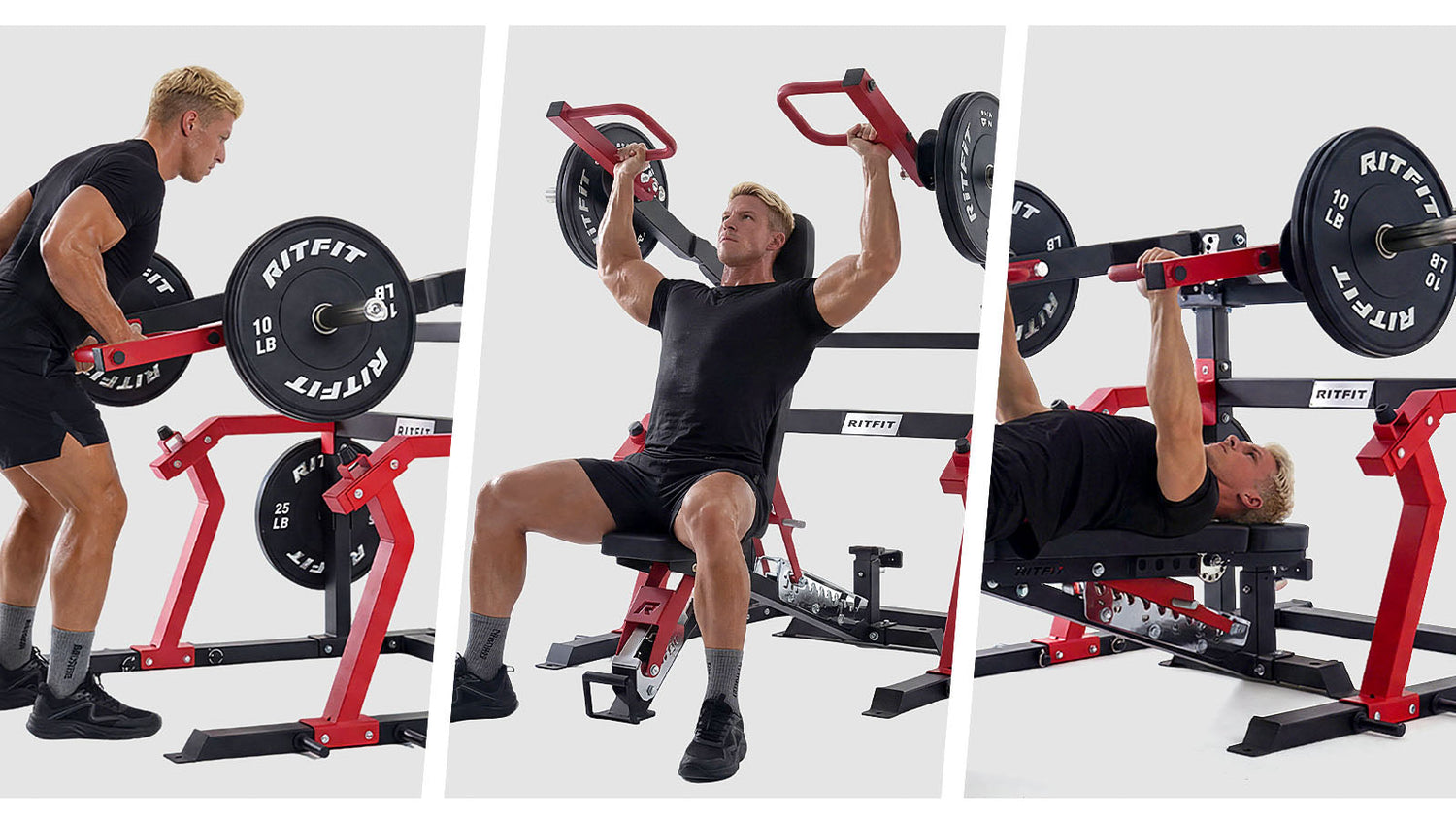
Chest press and shoulder press machines sit a few feet apart on most gym floors, and buyers often assume one is a stand-in for the other. They are not: one loads the pecs through a horizontal push, and the other loads the deltoids through a vertical push.
This guide answers the machine-level questions directly, covering what each station trains, whether the two are interchangeable, which one to buy when you only have room for one, and how to program both on a single 2-in-1 frame.
Quick Answer: Chest press and shoulder press machines are not the same exercise and are not interchangeable. The chest press drives the handles forward and makes the pectoralis major the prime mover, while the shoulder press drives overhead and makes the deltoids the prime mover, so pick the chest press for chest volume, the shoulder press for overhead strength, and a 2-in-1 frame when floor space decides.
 Click the image to visit the RITFIT Black Friday Deals page.
Key Takeaways
- Different exercises, overlapping helpers: The chest press and shoulder press share the triceps and anterior deltoid, but only one makes the pectoralis major the prime mover.
- Angle decides the muscle: A horizontal path belongs to the chest, an overhead path belongs to the delts, and the incline in between hands work to the front delts as it steepens.
- No swap: Replacing one press with the other leaves the skipped pattern untrained, because strength follows the joint angle you practice.
- Buy the missing job: Choose the station that covers the training your current setup cannot do, not the one with the louder reputation.
- One frame can cover both: A 2-in-1 press keeps two patterns in one footprint, which matters more than brand loyalty when a garage has one open bay.
Are Chest Press and Shoulder Press Machines the Same Exercise?
No, a chest press machine and a shoulder press machine are different exercises that happen to share two assisting muscles. The chest press drives the handles forward along a roughly horizontal path, and the shoulder press drives them overhead along a vertical path.
Both stations load the triceps and the anterior deltoid, which is why a hard set of either leaves the front of the shoulder tired. The difference is which muscle carries the set, because the pectoralis major owns the horizontal push and the deltoids own the overhead one.
Four differences decide how each machine fits a program:
- Pressing plane: The chest press moves your upper arm across the front of your body, while the shoulder press moves it upward beside your head.
- Prime mover: The pectoralis major leads on the chest press, and the deltoid group leads on the shoulder press.
- Support: Both stations hold your torso, but the shoulder press asks more of your ribs and shoulder blades because the load finishes above you.
- Load ceiling: Most lifters press more on the chest press, because the range is shorter and the torso is pinned against a pad.
Confusion usually starts at the upper chest, where an incline chest press and a shallow overhead press can look alike from across the room. The angle decides the muscle, not the label on the frame.
Free-weight versions add a cost that machines remove. Research on instability training shows that unstable conditions raise the demand on the core while lowering the force you can produce, which is why a guided path lets you push closer to your limit.[1]
What Does a Chest Press Machine Train?
A chest press machine trains the pectoralis major as the prime mover, with the anterior deltoid and triceps assisting, while a pad holds your torso in place. The fixed handle path removes the balance demand of a barbell, so you can take a set close to failure without a spotter.
Horizontal adduction is the job. Your upper arm travels across the front of your body, which is the action the pec fibers are built to produce, and the resistance stays in front of the shoulder instead of above it.
How Do You Set the Seat and Handles?
Set the seat so the handles sit level with the middle of your chest, then adjust the back pad until your shoulders stay against it for the whole rep.
Grip width changes the feel more than the muscle. A wider grip stretches more pec fibers at the start, and a closer grip adds triceps travel, but neither turns the movement into a different exercise.
Range matters more than load. Stop the return when your hands reach the level of your ribs if a deeper stretch bothers your shoulders, and keep that same range on every set so your numbers mean something.
If you want the free-weight version of the same pattern for comparison, the breakdown of dumbbell vs barbell bench press shows where a machine fits into that choice.
What Does a Shoulder Press Machine Train?
A shoulder press machine trains the deltoids as the prime mover, with the triceps extending the elbow and the upper trapezius helping to elevate the shoulder girdle. The path is vertical, so your hands finish above your head rather than in front of your sternum.
The anterior and lateral heads do most of the lifting, while the posterior head works to keep the humeral head centered in the socket. Dense electromyography work on overhead pressing confirms the deltoid and triceps act as the prime movers, with excitation shifting as the press path changes.[4]
Why Does Setup Matter More Here?
Set the seat so the handles start at shoulder height, and keep the back pad close to upright so your ribs stay stacked over your hips.
Overhead range is limited by shoulder mobility rather than by strength. If your lower back arches to finish a rep, the seat is too low or the load is too heavy for the range you own.
Shoulder control is trainable, and exercise selection changes the neuromuscular demand placed on the joint.[2] That is why a machine press with a fixed path is often the easier place to build overhead volume before adding a free bar.
The three delt heads contribute differently, and the guide to which delts the shoulder press works breaks down which head leads.
Where Does a Chest Press Stop and a Shoulder Press Begin?
The dividing line is the angle of the press, not the name printed on the frame. As the path rotates from horizontal toward vertical, the anterior deltoid takes over from the pectoralis major, and the triceps keep contributing at both ends.
That is why an incline press is the confusing middle. A shallow incline still belongs to the chest, a steep incline is a shoulder press with a bench under it, and the handoff happens gradually rather than at one setting.
A simple rule works on any machine: if the handles finish in front of your collarbone, treat the set as chest work, and if they finish above your forehead, treat it as shoulder work.
A physical therapist who coaches pressing has put a number on where the shift begins:
It's pretty conclusive.
30 degrees is a really good place for most of us!
The steeper you go the more the effort gets shifted towards the front delts.
Jeff Cavaliere, Physical Therapist and Strength Coach, former Head Physical Therapist for the NY Mets, ATHLEAN-X, in ATHLEAN-X on incline bench angle
Chest Press vs Shoulder Press Machine: How Do They Compare?
Chest press and shoulder press machines differ on pressing plane, prime mover, load potential, and fatigue cost, and those four points decide which one belongs in a session. The table below compares the two stations as they are used in a home or commercial gym.
| Factor | Chest Press Machine | Shoulder Press Machine |
|---|---|---|
| Pressing plane | Horizontal, hands finish in front of the chest | Vertical, hands finish overhead |
| Prime mover | Pectoralis major | Deltoids |
| Assistants | Anterior deltoid, triceps | Triceps, upper trapezius |
| Typical load | Higher, with a supported torso and a shorter range | Lower, limited by overhead range and shoulder stability |
| Setup demand | Seat height and grip width | Seat height, back pad angle, and shoulder mobility |
| Fatigue cost | Local to the chest and triceps | Local to the shoulders plus more stabilizer demand |
| Best use | Chest volume after a bench press or fly | Overhead strength before chest work |
The comparison describes how each station is trained, not how one brand performs against another.
Loads do not translate between the two. A chest press number tells you very little about the shoulder press you can handle, because the joint angle and the working muscle are different.
Can One Machine Replace the Other?
No, one machine cannot replace the other, because strength and size follow the joint angle and the muscle you actually load. A chest press builds capacity in the horizontal plane, and a shoulder press builds it overhead, so a swap leaves the skipped pattern untrained.
Some qualities do carry over. Both stations train the triceps through elbow extension, both load the anterior deltoid, and both let you add hard sets without a spotter, which is why a machine-only upper body can still hold up.
A 2023 systematic review and meta-analysis compared free-weight and machine-based strength training and found similar gains in maximal strength and hypertrophy, with the largest differences appearing in task-specific tests.[5] The choice between machine and free weight therefore matters less than the choice between pressing planes.
What does not transfer is the skill of pressing overhead. Overhead range, shoulder control, and the coordination to keep your ribs down under a load are trained by the vertical press, and a chest press never asks for them.
If you press overhead with a bar instead, the setup in this guide to the Smith machine shoulder press and the cues for the Smith machine overhead press cover the standing version.
Muscle is less fussy than strength. Sets taken close to failure build size across a wide load range, so the machine that lets you repeat hard sets usually decides the growth outcome.[6]
If You Can Only Buy One Machine, Which Should You Choose?
Buy the chest press first if your program is built around bench pressing, and the shoulder press first if overhead strength is the priority. For a home gym with one open bay, a 2-in-1 frame removes the choice entirely.
- Chest first: You train chest twice a week, your shoulders already get overhead work from dumbbells, and you want a station that survives heavy volume.
- Shoulder first: You play an overhead sport, your bench is limited by shoulder comfort rather than chest strength, or your chest work is already handled by a bar and bench.
- One frame instead of two: Floor space and budget are the real constraints, and both patterns need to live in the same corner.
- Skip both: A Smith machine or rack with a bench already covers pressing, and a dedicated station would duplicate work you can do now.
The 2-in-1 chest and shoulder press machine covers both patterns from one plate-loaded station, with 6 arm angles and 7 handle positions on two dials. Its listed capacity is 500 lb including body weight, it loads 2 inch Olympic plates, and the footprint measures 45.5 by 53 inches.
The frame and structural welds carry a lifetime warranty, with one year of coverage on non-structural parts for the original purchaser in the lower 48 states.
Dial positions, safety-stop height, and the first session are covered step by step in the RitFit Gorilla setup guide.
If budget sets the ceiling, the roundup of the best chest and shoulder press machine under $600 compares the options, and the RitFit strength machine collection lists the current lineup.
How Do You Program Both Presses on One Machine?
Put the shoulder press first in a session that trains both, because overhead work is limited by shoulder stability and the smaller muscle group fatigues first. Follow it with the chest press, which tolerates more volume and a heavier load.
A workable template for one upper-body day:
- Shoulder press: 4 sets of 6 to 8 reps, stopping two reps short of failure.
- Chest press: 3 sets of 8 to 12 reps, with the last set close to failure.
- Second chest angle: 2 sets of 12 to 15 reps on the lowest incline the frame allows.
- Triceps: 2 sets of 12 to 15 reps after the presses, since the elbows are already warm.
If chest and shoulders live on separate days, keep the same order inside each session and let the second press be the lighter one. Moving between the two settings should take seconds on a 2-in-1 frame, which makes a press superset practical when time is tight.
Standing versions of the same lift add a core demand that a seated machine removes, so a seated press is usually the better choice on a day when you also squat or deadlift.[3]
Adding load is the last variable to change. Hold the range and the tempo steady for two sessions before you add plates, because a rep that only counts on a shortened range is not a strength gain.
What Should You Check Before Buying a 2-in-1 Press Machine?
A 2-in-1 press is worth buying only if its arm dial reaches a true overhead path and its safety stops catch a failed lift. Three checks decide that, and only the first one is hard to find on a spec sheet.
Arm angle range, handle positions, and safety stop height are the three. A frame that shifts only a few degrees is a chest press with an extra label.
- Arm angle range: The dial has to travel from a low, chest-level press to an overhead press, not from flat to slightly less flat.
- Handle positions: A neutral grip and an angled grip should both feel secure at the bottom of the rep, where a bad fit shows up first.
- Safety stops: Set them so a failed rep ends above your chest and below your chin, at a height you can hold and unload.
- Footprint and plates: Measure the floor space, then budget for plates, because plate-loaded stations ship without them.
Price is only part of the cost. Budget for plates and floor protection before you compare two machines on sticker price, since a cheap frame plus two hundred pounds of iron rarely stays cheap.
Warranty terms are worth reading for the same reason, because frame coverage and parts coverage usually run on different clocks.
FAQs About Chest Press and Shoulder Press Machines
Are chest press and shoulder press the same exercise?
No. The chest press is a horizontal push that makes the pectoralis major the prime mover, while the shoulder press is a vertical push that makes the deltoids the prime mover. They share the triceps and the anterior deltoid as assistants, but neither one trains the other's main muscle through its full range.
Can you do a shoulder press on a chest press machine?
No, because the handle path on a chest press runs forward rather than overhead. Pushing the handles upward from a chest press station turns the movement into a partial incline press, which loads the front delts but never trains the overhead range or the shoulder control a real shoulder press requires.
Which builds more muscle, the chest press or the shoulder press?
Neither one wins outright, because they build different muscles. The chest press adds volume to the pectoralis major with the triceps assisting, and the shoulder press adds volume to the deltoids. Choose by the muscle you want to grow, then use hard sets close to failure to make either one productive.
Can you build an upper body with only these two machines?
You can build a solid pressing base with them, but not a complete upper body. Two presses cover the chest, front delts, and triceps, while your back, rear delts, biceps, and grip need rowing, pulldown, or pull-up work that neither station provides.
Is the shoulder press machine bad for your shoulders?
Not inherently. A fixed vertical path can bother some lifters if the handles start too low or the seat forces an awkward reach, so set the seat at shoulder height and use a range you can control. Sharp pain during the press is a reason to stop and get the shoulder assessed, not a reason to push through.
Should you do chest press or shoulder press first in a workout?
Do the shoulder press first when both are in the same session. Overhead pressing depends on shoulder stability and a smaller muscle group, so fatigue from a heavy chest press shows up quickly in the vertical press, while the chest press keeps working well after the shoulders are tired.
Do chest press numbers carry over to the shoulder press?
Not reliably. The two movements use different joint angles and different prime movers, so a strong chest press does not predict a strong overhead press. Treat the two loads as separate records and progress each one on its own range and tempo.
Is a 2-in-1 chest and shoulder press machine worth it for a home gym?
It is worth it when floor space is the binding constraint and you want both pressing patterns without two machines. Check that the arm dial reaches a true overhead position and that the safety stops sit where a failed rep can be escaped before you buy any combined frame.
Conclusion
Chest press and shoulder press machines are different tools, and the difference is the pressing plane rather than the brand on the frame. Buy the one that fills the gap in your program, and buy a 2-in-1 frame when floor space makes the decision for you.
Keep the range honest, add load slowly, and check the RitFit discount guide before you order either station.
Disclaimer
This article is general training education, not medical advice or an individualized program. If you have shoulder pain, a previous injury, or a condition that affects how you press overhead, use a comfortable range and get clearance from a qualified professional before you load the movement.
References
1. Behm DG, Drinkwater EJ, Willardson JM, Cowley PM. The use of instability to train the core musculature. Applied Physiology, Nutrition, and Metabolism. 2010;35(1):91-108.
2. Launder KG, Riemann BL, Lephart SM. Influence of exercise on the neuromuscular control of the shoulder. Journal of Strength and Conditioning Research. 2008;22(2):405-413.
3. Saeterbakken AH, Fimland MS. Muscle activity of the core during bilateral, unilateral, seated and standing resistance exercise. European Journal of Applied Physiology. 2013;113(7):1671-1678.
4. Padovan R, Toninelli N, Longo S, et al. High-Density Surface Electromyography Excitation in Front vs. Back Overhead Press Prime Movers. J Hum Kinet. 2026;103:81-96. doi:10.5114/jhk/205466. PMCID: PMC13551356
5. Haugen ME, Vårvik FT, Larsen S, Haugen AS, van den Tillaar R, Bjørnsen T. Effect of free-weight vs. machine-based strength training on maximal strength, hypertrophy and jump performance - a systematic review and meta-analysis. BMC Sports Sci Med Rehabil. 2023;15(1):103. doi:10.1186/s13102-023-00713-4. PMCID: PMC10426227
6. Schoenfeld BJ, Grgic J, Van Every DW, Plotkin DL. Loading Recommendations for Muscle Strength, Hypertrophy, and Local Endurance: A Re-Examination of the Repetition Continuum. Sports (Basel). 2021;9(2). doi:10.3390/sports9020032. PMCID: PMC7927075





