
Counterbalance vs non counterbalanced Smith machine designs differ in one mechanical point: whether an internal counterweight offsets the bar carriage so light sets feel lighter, or whether you handle the bar's full published weight from the first repetition. This guide compares the two designs on effective bar weight, training performance, maintenance, and long term cost.
You will get a lifter by lifter decision path, the four published numbers worth checking before checkout, and a model by model view of the RitFit line. Mechanism detail stays in our separate guide to how a counter balanced Smith machine works.
Quick Answer: A counterbalanced Smith machine offsets the bar carriage with an internal counterweight so the felt starting resistance drops to roughly zero to fifteen pounds, while a non counterbalanced unit makes you lift the bar's full published weight, often twenty five to forty five pounds, from the first rep. Choose counterbalanced for light and warm up work, and non counterbalanced for heavier working sets.
Key Takeaways
- Effective bar weight: A counterbalanced Smith machine trims the felt starting resistance to roughly zero to fifteen pounds, while a non counterbalanced unit keeps the bar's full listed weight in play from the first rep.
- Who each design suits: Beginners and high volume light work favor counterbalance, while lifters running medium to heavy working sets usually prefer the unassisted bar.
- Performance evidence: Pooled data across 13 studies and 1016 participants found no direct difference between machine based and free weight training for strength, jump performance, or hypertrophy.
- What to check before buying: Confirm the published Smith bar weight, frame capacity, upright gauge, footprint, and warranty term, because counterbalance is not always stated on a listing.
- RitFit placement: RitFit separates its line by Basic Smith and 3D Smith movement and publishes Smith bar weights of 33 lb on the M1 and M2 and 30.75 lb on the BUFFALO.

Counterbalanced vs Non-Counterbalanced Smith Machine: What Actually Differs
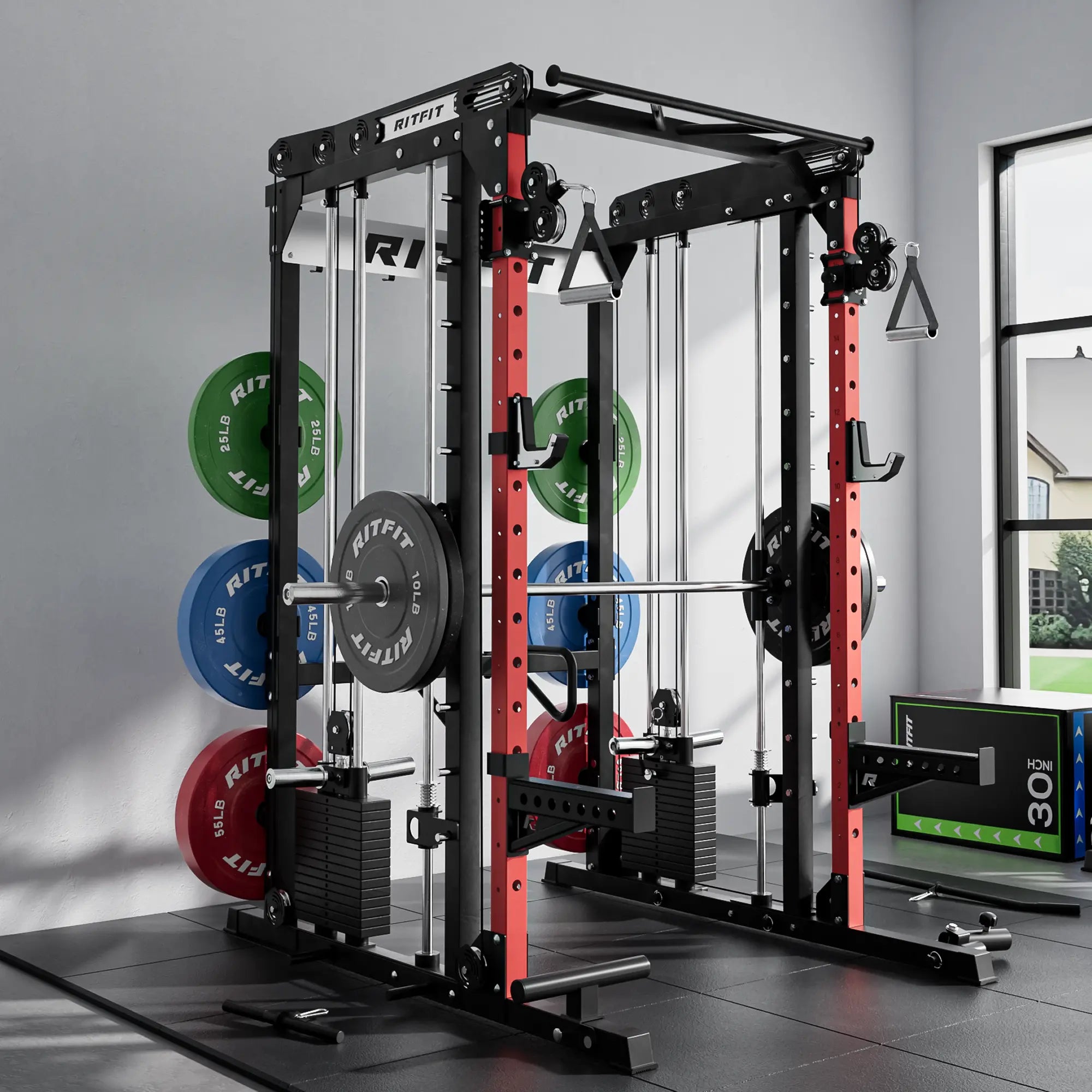
Counterbalanced and non counterbalanced Smith machines differ in whether an internal counterweight offsets the bar carriage before you load a plate. On a counterbalanced unit, cables, pulleys, and a counterweight inside the uprights reduce the resistance you feel at the start of a set. On a standard unit, the carriage rides directly on the guide rods and you manage the bar's full listed weight from the first repetition.
- Mechanism: Counterbalanced designs route the carriage through a cable and pulley system tied to internal counterweights, while standard designs use a direct sliding carriage on linear guide rods.
- Felt starting resistance: Counterbalanced units reduce the empty bar feel to roughly zero to fifteen pounds, while standard units start at the bar's published weight.
- Part count: Counterbalanced adds cables, pulleys, and counterweights, while standard designs keep the moving parts to guide rods, bearings, and the carriage.
- Who notices most: Beginners, lifters running high repetition accessory work, and anyone who warms up with very light loads.
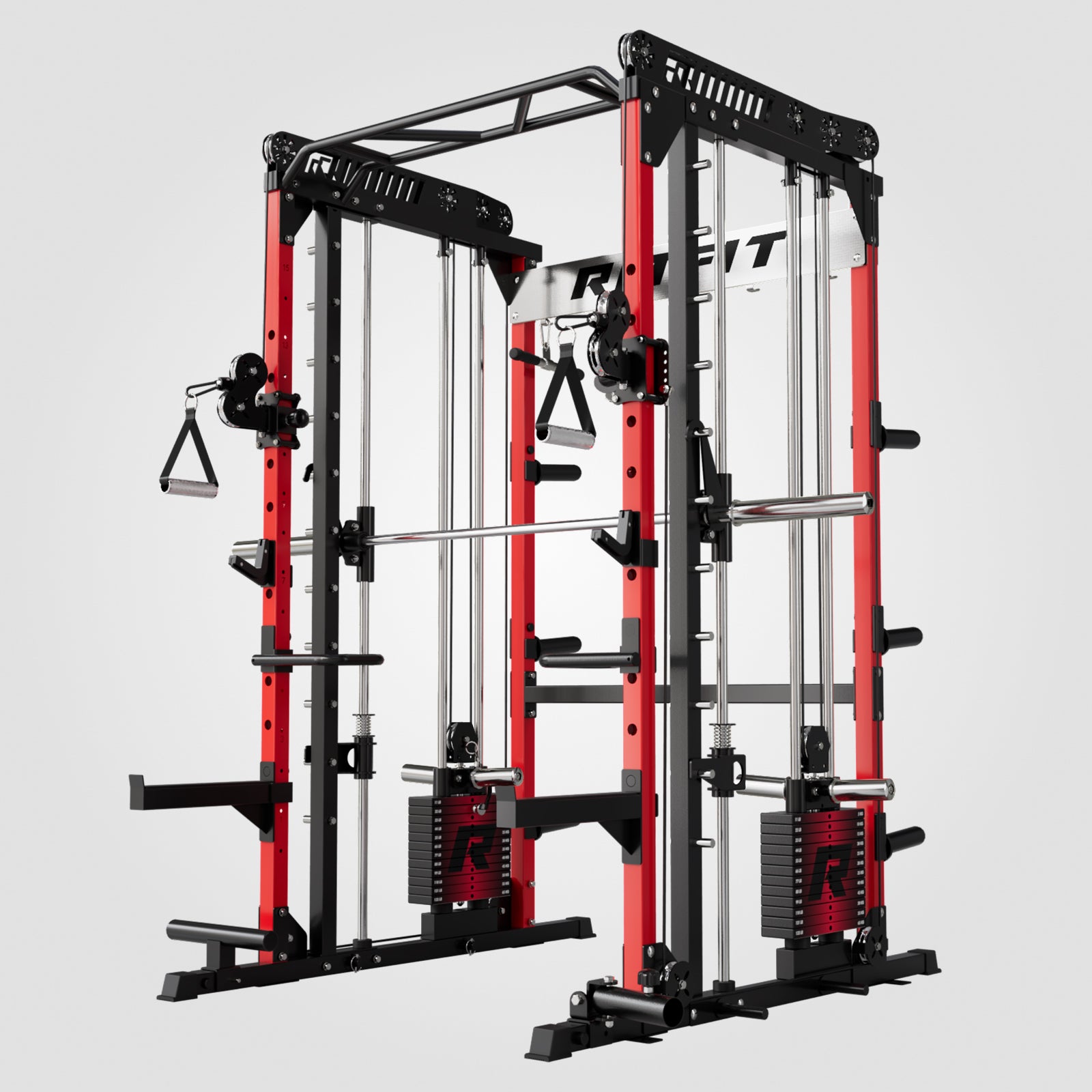
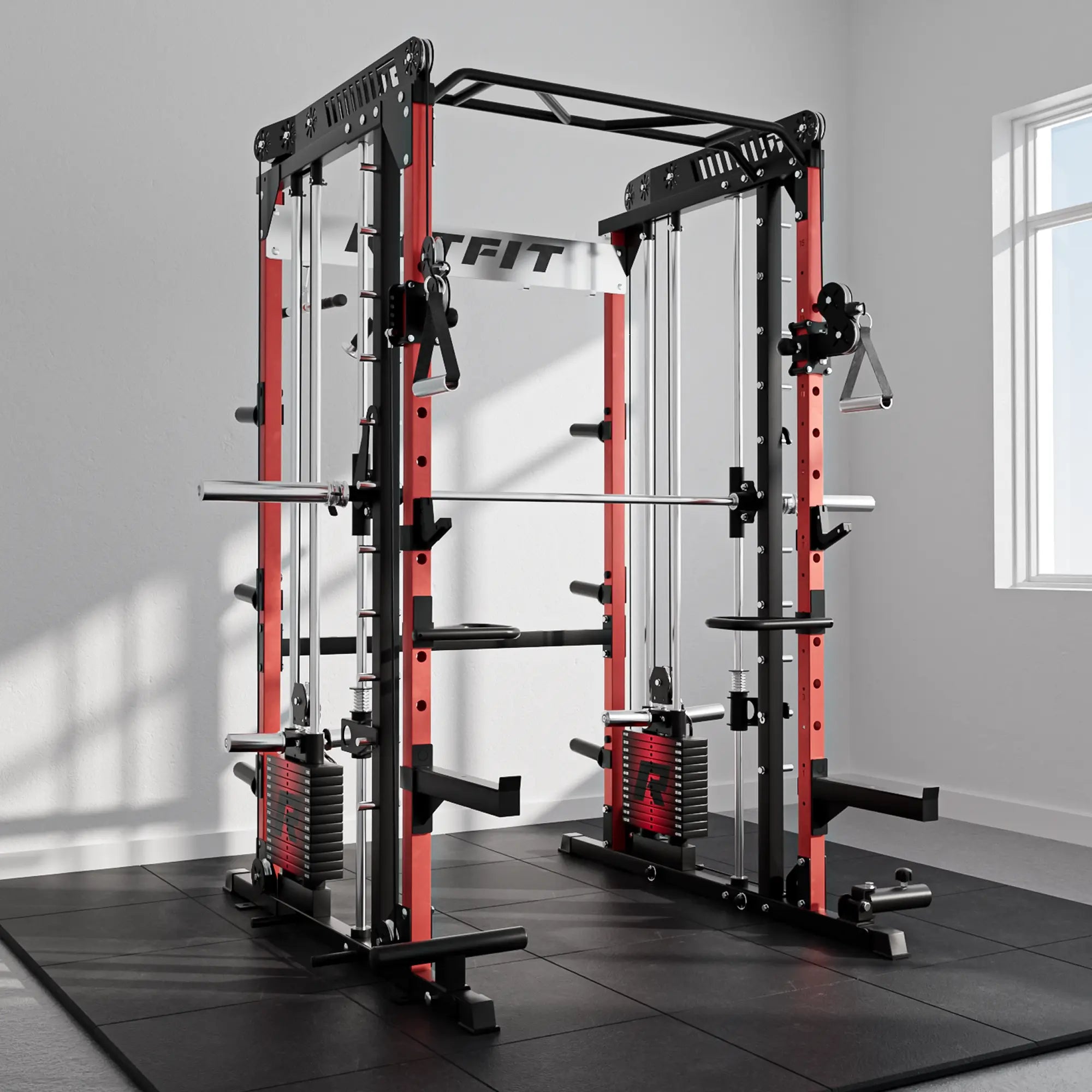
The counterweight geometry itself deserves a full walkthrough, and our guide to how a counter balanced Smith machine works covers the pulley and counterweight arrangement in detail. This article stays on the buying question, and if you are still choosing a category, the RitFit Smith machine collection shows how the line is organized by Smith type, frame gauge, and built in storage.
How Does a Counterbalance System Change Effective Bar Weight?
Effective bar weight on a counterbalanced Smith machine is much lower than the physical mass of the barbell, because the counterweight carries part of the carriage load for you. That offset is what lets a beginner press, row, or overhead press without first managing the bar's own mass. Published dealer listings put the felt starting resistance on counterbalanced units at roughly zero to fifteen pounds, while a standard Smith bar is listed at a fixed starting weight, such as the 25 lb bar on one Body-Solid standard model.
- Light load precision: With less unassisted bar mass in the way, a small plate change feels closer to the true change in resistance.
- Warm up efficiency: A counterbalanced bar lets you ramp into a working weight instead of starting every session at the bar's full mass.
- Heavy load ceiling: The counterweight offsets a fixed amount, so at working weights the felt difference between the two designs narrows.
- What it does not change: The counterbalance does not add resistance, alter the bar path, or replace progressive overload.
The guided path also changes how a given load behaves. In a load velocity study of 75 recreational male lifters, predicted and measured percent 1RM did not cross validate between free weights and a Smith machine, with coefficients of variation of 14.07 percent or more [1].
RitFit publishes its own reference points here: 33 lb for the Smith bar on the M1 and M2 and 30.75 lb on the BUFFALO, so you can compare listings on the same number instead of guessing.
Counterbalanced vs Non-Counterbalanced Smith Machines: Pros and Cons
Choosing between a counterbalanced and a non counterbalanced Smith machine comes down to how much unassisted bar weight you want present in every set. The table below lines up the mechanical and practical differences that matter at the point of purchase.
| Dimension | Counterbalanced Smith machine | Non-counterbalanced Smith machine |
|---|---|---|
| Effective unloaded bar weight | Roughly 0 to 15 lb felt starting resistance, varies by brand | The bar's published weight, about 25 to 45 lb on listed models |
| Mechanism | Internal cable, pulley, and counterweight offset the carriage mass | Bar carriage rides directly on the guide rods |
| Moving parts | More, including cables, pulleys, and counterweights | Fewer, mainly guide rods, bearings, and the carriage |
| Best fit | Beginners, light accessory work, warm up sets, high volume light loading | Lifters running medium to heavy working sets who want the full bar mass |
| Maintenance focus | Lubricate and inspect cables, pulleys, and guide rods | Lubricate and inspect guide rods and carriage bearings |
Design-level summary compiled from published manufacturer and dealer listings. Exact starting weights vary by model, so confirm the Smith bar weight on each product page.
The practical trade is simple to state.
Counterbalanced designs buy you a lighter, more controllable starting point and ask for a little more routine maintenance, while non-counterbalanced designs keep the load honest at every set and stay mechanically simple.
Neither design makes a set easier once the plates are on, because the counterweight offsets a fixed bar mass rather than reducing your working load.
Which Type Should You Choose for Your Training and Space?
The right type depends on how much of your training happens at light loads versus medium and heavy working sets. The table below maps lifter profiles onto starting points inside the RitFit line.
| Lifter profile | RitFit starting point | Why it fits |
|---|---|---|
| Compact garage gym, first serious setup, 2x2 frame is enough | RitFit M1 PRO Smith Machine | 1600 lb frame capacity in a 20.9 sqft footprint, with a Basic Smith and a published 33 lb bar for light and moderate loading |
| Small space, want a lat pulldown and cable work in one footprint | RitFit PSR05 2.0 Multifunctional Smith Machine | Smith machine plus lat pulldown station in one frame, covered by a 3 year basic warranty on the Smith machine |
| Mixed experience household or beginner first program | Any Basic Smith or 3D Smith frame with a built in stack | Faster resistance changes between sets suit shared racks and higher repetition work |
| Heavier working sets and low ceiling basement | Any frame within 84 to 86 inch rack height | Published rack heights of 84 to 86.14 inches clear most basement ceilings while leaving frame capacity headroom |
Model and dimension data as published on ritfitsports.com in October 2026. Confirm current configuration on each product page.
Two profiles settle the design question quickly. Choose a counterbalanced design if most of your volume sits in light or warm up territory, if a beginner or a mixed experience household shares the rack, or if your first sets each session stay under a plate. Choose a non-counterbalanced design if your sessions are built around medium to heavy working sets and you want the bar's real mass present from the first rep.
Do Counterbalanced Smith Machines Change Training Performance?
Changing the counterbalance does not change the training stimulus of a heavy working set, because the offset only trims the felt load at the light end of the range. The evidence on guided bar training is steady across outcomes. A systematic review and meta-analysis pooled 13 studies with 1016 participants and found no direct difference between free weight and machine based strength training for dynamic strength, isometric strength, countermovement jump, or hypertrophy [2].
Stability requirements follow the same pattern. In a seven week program, 59 men trained at low, medium, or high stability and showed similar improvement in muscle thickness, rate of force development, and maximum voluntary isometric contraction [3].
The Smith machine group improved more in the trained exercise than in the untrained ones, so gains tracked the session you actually run rather than proving one design superior.
Guided bar setup still deserves attention. In twelve resistance trained men, force output dropped in the sticking region of a one repetition maximum Smith machine squat, which the authors describe as a poor biomechanical region for force production [4].
That is an argument for dialing in foot position, bench angle, and bar height, not for or against a counterweight.
- For strength: Machine based and free weight training produced comparable direct comparison results, so the counterbalance is not the variable that decides your progress.
- For hypertrophy: Muscle thickness changes tracked the training program rather than the implement, which keeps the design choice in the comfort and setup column.
- For warm ups: A counterbalanced bar genuinely changes what the first two or three sets feel like, which matters more for beginners and high repetition work.
- For heavy sets: At working weights the counterweight offset becomes a small share of total load, so the two designs converge.
"He used the Smith machine a lot, he used a lot of machines a lot. He still did some free weight stuff as well too and that should help lend this idea that there's not one that is definitively better than the other."
Joe Bennett, Hypertrophy Coach, Hypertrophy Coach Breaks Down Jay Cutler's Quad Training (Fitness Volt)
Maintenance, Durability, and Long-Term Cost Compared
Durability and cost on a Smith machine are driven by frame gauge, rated capacity, and warranty coverage rather than by the counterbalance itself. That means the two designs differ far less on the spec sheet than two different models do.
- Durability: RitFit lists 2 inch by 3 inch 13 gauge steel and an 1800 lb maximum on the RitFit Buffalo Wild Smith Machine, then steps up to 3 inch by 3 inch 11 gauge A36 steel and a 2500 lb frame capacity on the RitFit M3 Pro Smith Machine.
- Versatility: Basic Smith and 3D Smith are the two movement options in the line, and either frame still runs cable, landmine, and pull up work, so the design choice rarely shrinks your exercise list.
- Warranty: RitFit lists a 3 year basic warranty on the M1 Smith Machine with Cable Crossover and the PSR05 Smith Machine with Lat Pulldown, covering 3 years on frames, 1 year on parts, and 90 days on cover and upholstery, plus a 5 year basic warranty on the BPC05 Multifunctional Smith Machine and a 35 day return window.
- Performance: Buyer feedback on the line most often reports smooth cable travel and stable frames under working loads, which tracks the rated capacities rather than the counterbalance question.
- Value: The built in stack is the real cost step, because it moves a setup from plate loaded to selectorized resistance, while the counterbalanced versus standard choice sits inside the same price band.
On maintenance, the counterbalanced design asks for a two part routine: lubricate the guide rods, and also inspect and lubricate the cables, pulleys, and counterweight path. A non-counterbalanced design reduces that list to the guide rods and carriage bearings, which is why buyers who want the fewest service points often stay with the standard bar.
Which RitFit Smith Machine Fits Each Design and Budget?
RitFit places every Smith machine in its line on the same decision axes: Basic Smith or 3D Smith movement, frame gauge, footprint, and built in storage. Prices and specifications below are as published on ritfitsports.com in October 2026.
| Model | Price | Frame | Capacity | Footprint | Smith type | Stack |
|---|---|---|---|---|---|---|
| M1 PRO (no stack) | $1,299.99 | 2x2 14-gauge steel | 1600 lb | 20.9 sqft | Basic Smith | 264 lb optional |
| M2 3D | $2,199.99 | 2.36x2.36 13-gauge steel | 2000 lb | 22.8 sqft | 3D Smith | 286 lb optional |
| M3 Pro | $3,099.99 | 3x3 11-gauge A36 steel | 2500 lb | 21.5 sqft | Basic Smith | 360 lb built in |
| BUFFALO | $1,899.99 | 2x3 13-gauge steel | 1800 lb | 38.1 sqft | Basic Smith | 30.75 lb Smith bar |
Specifications and prices as published on ritfitsports.com in October 2026. Confirm current pricing, stack configuration, and warranty terms on each product page.
Choose the RitFit M1 PRO for a Compact 2x2 Footprint
The entry setup suits a one car garage or basement corner, pairing a 1600 lb frame capacity with a 20.9 sqft footprint. Step up to the M1 PRO Smith Machine weight stack package when you want selectorized resistance without adding another machine.
"It doesn't take up a ton of space. It took about 4 hours for one person to assemble. It's perfect!"
Margo S. Verified Buyer, RitFit M1 PRO Smith Machine Weight Stack Home Gym Package
Choose the RitFit M2 for 3D Smith Movement
The RitFit M2 adds a 3D Smith option that moves vertically and horizontally, on a 2000 lb frame with 2.36 inch 13 gauge uprights. If you are deciding between the two smallest frames, our RitFit M1 vs M2 Smith machine comparison walks through that choice in detail.
"We love our 3d smith machine. It took me and my wife a few hours to put it together. Pretty straight forward. Great machine and products."
EVAN E. Verified Buyer, RitFit M2 Multi-Functional Modular Home Gym Smith Machine Tailored to All Fitness Levels
Choose the RitFit M3 Pro When Frame Capacity Leads
The heaviest frame in the line carries a 2500 lb capacity on uniform 3x3 11 gauge uprights in a 21.5 sqft footprint, with a Basic Smith module rated 352 lb dynamic and 572 lb static. It suits lifters who expect to keep adding load for years rather than upgrading the rack later.
Choose the RITFIT BUFFALO for a Wider Platform
The widest footprint in the group spreads a 38.1 sqft platform around the carriage and lists a 30.75 lb Smith bar, which suits lifters who want more room for squat and split squat foot positions. Buy the whole setup at once with the RitFit BPC06 All-In-One Smith Machine if you would rather not add modules over time.
"The buffalo machine is so smooth and gets the job done every time. It has literally changed my life for the better."
Grant S. Verified Buyer, RitFit BUFFALO Smith Machine Home Gym Package with Lat Pull Down and Cable Crossover
FAQs About Counterbalance vs Non Counterbalanced Smith Machines
Is a counterbalanced Smith machine better than a non counterbalanced one?
No single design is better for every lifter. A counterbalanced Smith machine offsets the bar carriage mass so light sets feel closer to the weight you load, while a non counterbalanced unit keeps the bar's real weight in play from the first repetition. The better choice depends on whether you train many light or warm up sets or want the full bar mass through your working sets.
How much lighter does a counterbalanced Smith bar feel at the start of a set?
It varies by model. Published descriptions put the felt starting resistance on a counterbalanced unit at roughly zero to fifteen pounds, while non counterbalanced units carry their listed bar weight, which is often around twenty five to forty five pounds before you add plates. Check the published Smith bar weight on each product page before you buy.
Who should buy a non counterbalanced Smith machine?
Lifters who mostly train medium to heavy working sets often prefer a non counterbalanced unit because the bar's full mass stays in the equation from the first repetition. Simpler internals also mean fewer cables and pulleys to inspect and lubricate. Beginners and anyone running many light or warm up sets usually get more value from a counterbalanced design instead.
Do RitFit Smith machines use a counterbalance system?
RitFit product pages publish Smith bar weight, for example thirty three pounds on the M1 and M2 and thirty point seven five pounds on the BUFFALO, but they do not advertise a counterbalance system. RitFit separates its line by Basic Smith and 3D Smith movement instead. Confirm counterbalance status on the current listing before you buy either design.
Does counterbalance affect strength or muscle growth?
Counterbalance changes the felt starting load, not the stimulus of a heavy working set. Pooled data across thirteen studies and 1016 participants found no difference between free weight and machine based training in the direct comparison for strength, jump performance, or hypertrophy. Strength changes track the modality you train, so pick the design that matches how you set up and load your sets.
What four published numbers should a buyer check before choosing either design?
Check four published numbers. First the Smith bar weight, which sets your effective starting resistance. Second the frame capacity and upright gauge, which set how much load the rack handles. Third the footprint and ceiling clearance for your space. Fourth the warranty terms, which RitFit lists by model and by part.
Conclusion
Counterbalance vs non counterbalanced Smith machine is a load feel decision rather than a quality ranking. Pick counterbalanced for light and warm up work, and a standard bar when your sessions live in medium to heavy working sets.
Whichever design you choose, confirm the published Smith bar weight, frame capacity, footprint, and warranty term first, then time the purchase with the RitFit discount guide.
Disclaimer
This article provides general product and training information about Smith machine designs and is not medical advice. Consult a qualified professional before starting a new strength program, especially if you have an existing health condition or are returning to training after time away.
References
1. Liao K, Bian C, Chen Z, et al. Repetition velocity as a measure of loading intensity in the free weight and Smith machine Bulgarian split squat. PeerJ. 2023;11:e15863. doi:10.7717/peerj.15863. PMCID: PMC10437032
2. Haugen ME, Vårvik FT, Larsen S, Haugen AS, van den Tillaar R, Bjørnsen T. Effect of free-weight vs. machine-based strength training on maximal strength, hypertrophy and jump performance - a systematic review and meta-analysis. BMC Sports Sci Med Rehabil. 2023;15(1):103. doi:10.1186/s13102-023-00713-4. PMCID: PMC10426227
3. Saeterbakken AH, Olsen A, Behm DG, Bardstu HB, Andersen V. The short- and long-term effects of resistance training with different stability requirements. PLoS One. 2019;14(4):e0214302. doi:10.1371/journal.pone.0214302. PMCID: PMC6443166
4. van den Tillaar R, Kristiansen EL, Larsen S. Is the Occurrence of the Sticking Region in Maximum Smith Machine Squats the Result of Diminishing Potentiation and Co-Contraction of the Prime Movers among Recreationally Resistance Trained Males?. Int J Environ Res Public Health. 2021;18(3). doi:10.3390/ijerph18031366. PMCID: PMC7908405