








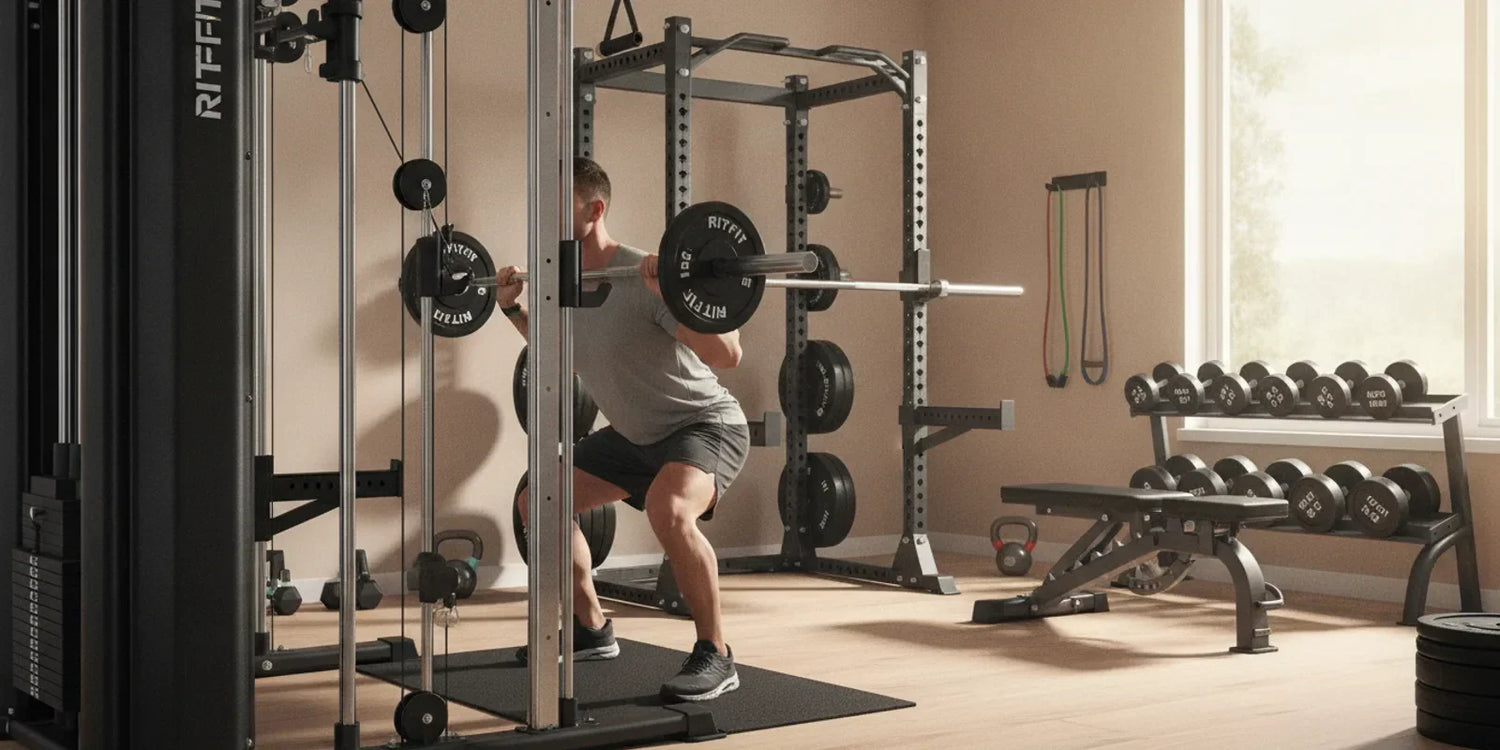
A counter balanced Smith machine uses an internal cable, pulley, and counterweight system to offset the physical mass of the barbell during exercise.
This comprehensive guide details how counterbalance systems operate, evaluates effective starting weights across major designs, and outlines optimal home gym training applications.
Quick Answer: A counter balanced Smith machine uses integrated counterweights and pulleys to offset barbell mass, reducing the effective starting bar weight to approximately zero to 15 pounds. This design provides lifters with a safe, accessible starting resistance for compound exercises while maintaining the stability and safety features of a fixed barbell track.
Key Takeaways
- Mechanical Offset: Internal cables, pulleys, and counterweights neutralize the majority of the steel bar mass.
- Starting Weight: Effective unloaded bar resistance drops from the traditional 35 to 45 pounds down to 0 to 15 pounds.
- Target Audience: Novice trainees, multi-user households, and individuals in physical recovery gain substantial safety advantages.
- Dynamic Response: High-velocity explosive lifts can generate brief cable slack, temporarily altering upward momentum.
- Equipment Selection: Home gym owners must distinguish between total frame load capacity and initial unweighted bar resistance.
What Is a Counter Balanced Smith Machine?
A counter balanced Smith machine is a guided barbell apparatus equipped with counterweights that neutralize most of the empty barbell's physical mass. This specialized system allows trainees to perform foundational pressing and squatting movements against minimal initial resistance.
- Fixed Guide Rods: Hardened steel linear guide rails restrict barbell movement to a secure vertical or slightly inclined plane.
- Mechanical Counterweight: Hidden counterbalance weights connected via aircraft-grade cables continuously offset the downward gravitational pull of the carriage.
- Adjustable Safety Catches: Mechanical lockouts positioned along the frame permit rapid re-racking without requiring a human spotter.
Modern home lifters often explore versatile packages within the Smith Machine category to build complete strength stations. Understanding counterbalance mechanics ensures you select the optimal configuration for your specific training goals.
How Does the Counterbalance Mechanism Work?
The counterbalance mechanism functions through high-tensile steel cables routed through top-mounted pulleys directly to internal counterweights housed inside the vertical uprights. As the user lowers the barbell, the counterweights ascend, providing a constant upward tension that offsets the bar's natural weight.
- Dual Pulley Routing: Low-friction pulleys ensure fluid cable travel across the entire vertical range of motion.
- Counterweight Balancing: Precision-calibrated steel weights inside the uprights match or closely mirror the mass of the bar and sliding carriage.
- Linear Bearing Sleeves: Premium guide bushings slide smoothly along polished steel rods to prevent rotational sticking under load.
This balanced tension remains active throughout both eccentric and concentric phases of every repetition. High-end all-in-one machines also integrate dual pulley options found in a Cable Machine setup for comprehensive exercise variety.
How Is a Counter Balanced Smith Machine Different From a Traditional One?
A counter balanced Smith machine provides a substantially lighter starting bar resistance than a traditional fixed-weight unit because internal weights offset the bar carriage. Traditional models require lifters to manage the full 35 to 45-pound unweighted barbell mass from the first repetition.[1]
| Feature / Dimension | Counter Balanced Smith Machine | Traditional Fixed-Weight Smith Machine |
|---|---|---|
| Effective Unloaded Bar Weight | 0 to 15 lbs (0 to 6.8 kg) | 35 to 45 lbs (15.9 to 20.4 kg) |
| Primary Mechanical Mechanism | Pulleys and internal counterweights | Direct sliding carriage on guide rods |
| Beginner and Rehab Suitability | Exceptionally high for all strength levels | Requires baseline strength to manage bar |
| Upper Body Isolation Starting Point | Permits ultra-light deltoid and arm training | Starting weight may fatigue smaller muscles |
| Frame Complexity & Upright Footprint | Slightly wider uprights housing counterweights | Standard compact upright profile |
Data reflects standard engineering specifications across commercial and premium home gym manufacturers.
Lifters looking for heavy compound pressing often compare these configurations with commercial units like the Multifunctional Smith Machine to balance footprint and functionality.
What Does Effective Bar Weight Actually Mean for Lifters?
Effective bar weight represents the net downward force felt by the lifter when holding an unloaded barbell on a Smith machine. While the physical steel bar and carriage assembly may weigh 35 to 50 pounds, counterweights offset that mass to produce a featherlight starting load.
- True Bar Weight: The physical structural mass of the steel bar, carriage assembly, and rotating locking hooks.
- Net Starting Resistance: The true weight minus the counterbalancing force exerted by the internal counterweight system.
- Plate Loading Linearity: Every Olympic plate loaded onto the sleeves adds 100 percent of its stated weight directly to your working set.
When tracking progressive overload in training logs, always record plate weight separately from estimated effective bar resistance. This precision helps maintain accurate training logs across different gym environments.
Who Is a Counter Balanced Smith Machine Best For?
A counter balanced Smith machine is ideal for beginners, multi-user home gyms, and athletes focusing on strict hypertrophy or post-injury rehabilitation. Research indicates that guided resistance equipment provides high motor unit activation while reducing stability demands, facilitating safe training execution.[2]
- Novice Trainees: Learning squat and overhead press biomechanics without struggling against a heavy starting bar accelerates skill acquisition.
- Multi-User Garage Gyms: Family members with differing strength capacities can share a single machine comfortably without intimidating starting loads.
- Physical Recovery: Controlled linear movement with near-zero starting resistance enables gentle joint mobilization and progressive loading.
- Isolated Muscle Groups: Exercises targeting smaller muscle groups like overhead triceps extensions or lateral raises benefit from low starting increments.
Pairing guided barbell work with dedicated lower-body equipment in a Leg Machine routine allows comprehensive quad and hamstring development without joint overload.
Does a Counter Balanced Bar Perform Differently During Explosive Lifts?
A counter balanced bar can exhibit momentary mechanical slack during ballistic movements if the upward acceleration of the barbell exceeds the gravitational acceleration of the internal counterweights. Biomechanical research highlights that bar velocity and acceleration profiles influence force transfer across guided and free-weight modalities.[3]
- Controlled Hypertrophy Repetitions: Standard lifting cadences with smooth eccentric and concentric phases maintain consistent cable tension and flawless counterbalancing.
- High-Velocity Jump Squats: Explosive hip extension can briefly outpace counterweight descent, leading to a momentary change in perceived bar resistance at peak velocity.
- Heavy Strength Lifts: Under substantial plate loads, bar acceleration naturally stabilizes, rendering counterbalance inertia negligible during heavy sets.
For standard progressive resistance training, the counterbalance mechanism provides smooth and dependable resistance throughout every repetition.
What Are the Key Limitations to Consider Before Buying?
The primary limitations of counter balanced Smith machines involve their fixed linear trajectory and increased mechanical complexity compared to basic power racks. Trainees must understand these operational factors before investing in home gym equipment.
- Fixed Bar Pathway: The rigid vertical or angled track eliminates natural three-dimensional barbell drift, requiring lifters to position their joints correctly.
- Internal Maintenance: Enclosed cables and pulley wheels require periodic lubrication and inspection to ensure whisper-quiet operation over years of use.
- Equipment Weight: Integrated counterweights add physical mass to the overall frame structure, requiring a solid level floor surface.
Carefully evaluating your ceiling height and available floor footprint ensures seamless integration into your dedicated garage or basement training space.
Which RitFit Smith Machines Feature Counterbalanced Engineering?
RitFit engineers robust home gym systems that integrate smooth linear guide rods, precision bearings, and multi-functional cable stations to support full-body development. Both the popular M1 and heavy-duty M3 series provide exceptional lifting safety and biomechanical support.
- Compact Home Workhorse: The M1 Multi Functional Home Gym Smith Machine provides an all-in-one footprint with linear bearings and integrated cables for small gym spaces.
- Commercial-Grade Power Station: The M3 Power Rack Cable Crossover Smith Machine combines high-capacity frame engineering with dual cable crossover capabilities for advanced lifters.
- Versatile Exercise Library: Integrated multi-grip pull-up bars and modular attachments allow lifters to program complete upper and lower body workouts.
"The smith machine is great because it's going to take a lot of the pressure out of your shoulders because it's supporting itself and you can do a little bit more weight on here. So it can help you break some barriers too, and also if you don't have a spotter you can utilize the tabs, put that right here so if you drop it it'll just bounce and then you won't hurt yourself."
Jeff Cavaliere, MSPT, CSCS, Smith Machine Bench Press (YouTube)
FAQs About Counter Balanced Smith Machines
What does counterbalanced mean on a Smith machine?
A counterbalanced Smith machine features internal counterweights linked to the barbell carriage via high-tensile cables and pulleys. This mechanical system continuously offsets the physical weight of the steel bar. As a result, lifters experience a substantially lighter starting bar resistance before adding Olympic weight plates.
Is a counterbalanced Smith machine better for beginners?
Yes, a counterbalanced Smith machine is exceptionally beneficial for novice lifters. The reduced starting resistance allows beginners to learn movement mechanics for squats and overhead presses without straining under a heavy empty bar. It also accommodates multi-user households where lifters possess different baseline strength levels.
How much does a counterbalanced Smith machine bar weigh?
The effective starting weight of a counterbalanced Smith bar typically ranges between zero and 15 pounds. In contrast, standard non-counterbalanced Smith bars generally feel like 35 to 45 pounds. Always check the manufacturer specification sheet to verify exact unweighted carriage resistance.
Can a counterbalanced Smith machine handle heavy squats?
Yes, a counterbalanced Smith machine handles heavy squats with complete stability and safety. The counterbalance mechanism only affects the unweighted bar resistance, while the structural frame and guide rods dictate total load capacity. Most high-grade home units support hundreds of pounds in added plates.
Does a counterbalanced Smith machine work for bench press?
A counterbalanced Smith machine is highly effective for flat and incline bench pressing. The light starting bar provides a safe warmup and allows lifters to target chest musculature without shoulder strain. Adjustable safety catches allow you to push pressing sets to absolute fatigue safely.
Conclusion
A counter balanced Smith machine provides the optimal balance of guided safety, smooth linear tracking, and accessible starting resistance for home gym lifters. By neutralizing heavy unweighted bar mass, this versatile equipment empowers beginners and experienced trainees alike to execute progressive overload with total confidence.
Explore the complete line of home strength packages and learn how to maximize your savings with the RitFit discount guide to build your dream garage gym today.
Disclaimer
This content is provided strictly for educational and informational purposes and does not constitute formal medical or training advice. Always consult a certified fitness professional or physician before beginning any new high-intensity strength training program.
References
1. Wang L. A comparison of muscle activation and concomitant intermuscular coupling of antagonist muscles among bench presses with different instability degrees in untrained men. Front Physiol. 2022;13:940719. doi:10.3389/fphys.2018.01481. PMCID: PMC9486837
2. Saeterbakken AH, Olsen A, Behm DG, Bardstu HB, Andersen V. The short- and long-term effects of resistance training with different stability requirements. PLoS One. 2019;14(4):e0214302. doi:10.1371/journal.pone.0214302. PMCID: PMC6443166
3. Loturco I, Mcguigan MR, Freitas TT, et al. Squat and countermovement jump performance across a range of loads: a comparison between Smith machine and free weight execution modes in elite sprinters. Biol Sport. 2022;39(4):1043-1048. doi:10.5114/biolsport.2022.112085. PMCID: PMC9589332





