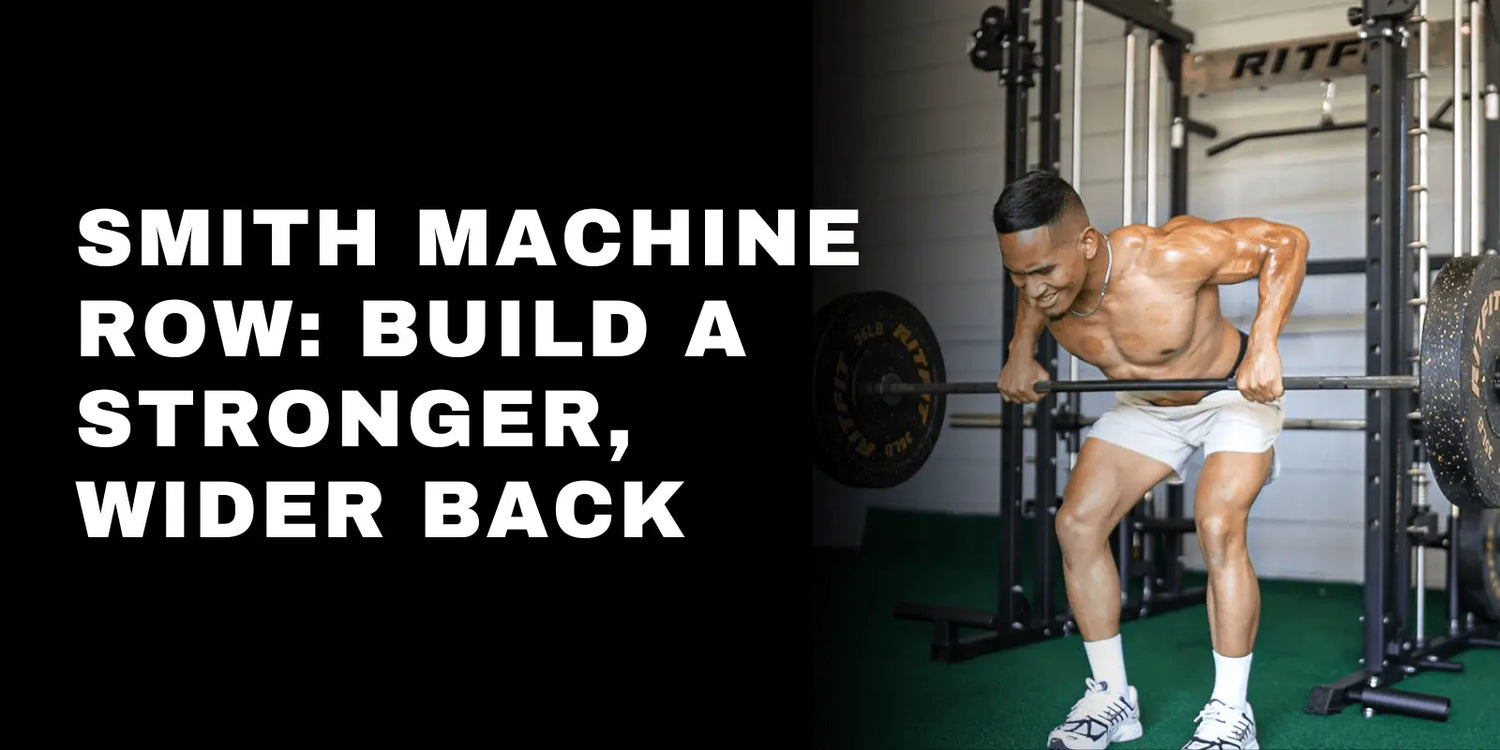
The Smith machine row is a controlled horizontal pulling exercise that builds back thickness and lat width along a fixed, guided track. Mastering proper setup, foot alignment, and hinge mechanics allows you to maximize lat activation while minimizing lower back strain.
This comprehensive guide details the step-by-step form cues, target muscle anatomy, comparison with free-weight barbell rows, and variations to optimize your training routine.
Quick Answer: To do a Smith machine row, set the bar at knee height, hinge at the hips at a 30-to-45-degree angle with a neutral spine, grip the bar slightly outside shoulder width, and row toward your lower ribcage by driving your elbows backward while retracting your shoulder blades.
Key Takeaways
- Prime Target Muscles: The Smith machine row targets the latissimus dorsi, rhomboids, middle and lower trapezius, rear deltoids, and biceps brachii.
- Fixed-Path Stability: Guided track rails eliminate balance limitations, allowing isolated back recruitment and safe high-intensity loading without a spotter.
- Setup Precision: Setting the bar at knee height and establishing a stable 30-to-45-degree hip hinge ensures optimal lat engagement and lower back protection.
- Grip Versatility: Alternating between overhand, underhand, and chest-supported variations shifts tension between upper back thickness and lower lat sweep.
- Controlled Eccentric: Resisting the bar along the fixed descent produces greater hypertrophic tension compared to uncontrolled momentum-based pulling.
What Is the Smith Machine Row?
The Smith machine row is a fixed-track horizontal pulling exercise designed to build mid-back thickness and lat width with maximal mechanical stability. Because the barbell is locked into vertical or slightly angled guide rails, lifters can isolate pulling mechanics without fighting rotational balance demands.
This compound movement serves as an exceptional strength-building tool for both beginner and advanced lifters. Before beginning, understanding what a Smith machine is and exploring options in the Smith machine collection can help you tailor your setup to your specific home gym space.
Which Muscles Does the Smith Machine Row Work?
The Smith machine row primarily targets the latissimus dorsi, rhomboids, middle and lower trapezius, and posterior deltoids, while the biceps brachii and brachialis assist during elbow flexion.[3] Your spinal erectors and abdominal core act as isometric stabilizers throughout the hip hinge position.
- Latissimus Dorsi: Drives shoulder extension and adduction, creating significant lat activation across the full pulling stroke.
- Rhomboids and Middle Trapezius: Retract and stabilize the scapulae at peak contraction to build dense mid-back thickness.
- Rear Deltoids: Assist in horizontal shoulder abduction, particularly when using a wider overhand grip.
- Biceps Brachii and Forearms: Provide necessary elbow flexion force and gripping endurance to hold the bar securely.
- Spinal Erectors and Core: Brace the lumbar spine isometrically to maintain an uncompromised hinge angle against gravitational load.
For lifters seeking complementary horizontal pulling variations, pairing this lift with how to do Smith machine inverted rows provides comprehensive back development.
Why Should You Do the Smith Machine Row?
The Smith machine row provides superior mechanical stability and repeatable bar tracking, allowing lifters to train close to muscular failure with minimal lumbar fatigue. Research demonstrates that machine-based resistance training produces hypertrophy gains equivalent to free-weight training while reducing balance constraints.[1]
- Enhanced Stability: Guided linear bearings remove multidirectional bar sway, directing tension directly into the target musculature.
- Consistent Mind-Muscle Connection: Lifters can focus entirely on lat contraction and scapular retraction without expending neural energy on stabilizer balance.
- Built-In Solo Safety: Safety catch pins allow lifters to train heavy to technical failure in a home gym without requiring a human spotter.
- Precise Progressive Overload: The standardized bar path makes it straightforward to track strength gains across consecutive training blocks.
For dedicated home gym environments, versatile stations like the M1 Multi Functional Home Gym Smith Machine or the heavy-duty M3 Power Rack Cable Crossover Smith Machine provide integrated safety catches and smooth carriage travel.
"Few pieces of equipment in the home exercise industry are as comprehensive and versatile as this all-in-one gym system. The robust system provides a natural, centered bar path for compound lifts like squats, presses, and rows, and incorporates a dual cable crossover station with a full rack of precision-engineered attachments."
, Tom Eskey, CF-L1, CPT, Home Gym Equipment Reviewer at Garage Gym Revisited
How Do You Perform the Smith Machine Row with Proper Form?
To perform the Smith machine row correctly, establish a stable hip hinge at a 30-to-45-degree angle, unhook the bar with a pronated grip, and pull toward your lower sternum by driving your elbows backward. Maintain a braced core and controlled tempo throughout both the concentric pull and eccentric lowering phases.
- Step 1: Set Bar and Safety Pin Height: Adjust the bar to sit around mid-thigh or just below the patella, setting safety catches slightly below your lowest pulling point.
- Step 2: Establish Foot Placement: Stand with feet hip-width apart, aligned so that the bar hangs directly over your mid-foot when in the hinged position.
- Step 3: Execute the Hip Hinge: Push your hips backward with soft knees until your torso reaches a 30-to-45-degree angle relative to the floor, maintaining a neutral lumbar spine.
- Step 4: Grip and Unrack: Grasp the bar just outside shoulder width with a pronated or supinated grip, rotating the bar to unlock the safety hooks.
- Step 5: Row with Elbow Drive: Pull the bar smoothly toward your lower ribcage by leading with your elbows, pausing for one second at peak contraction to fully squeeze your shoulder blades.
- Step 6: Control the Eccentric Descent: Lower the bar under control over two to three seconds until your arms reach full extension without rounding your thoracic spine.
How Does the Smith Machine Row Compare to the Barbell Row?
The Smith machine row emphasizes isolated back hypertrophy through a fixed linear path, whereas the free-weight barbell row demands greater posterior chain activation and whole-body stabilization. Both exercises offer distinct biomechanical advantages depending on your training priorities and available equipment.[2]
| Feature | Smith Machine Row | Free-Weight Barbell Row |
|---|---|---|
| Bar Path | Fixed vertical or angled track | Free, unconstrained arc |
| Stabilizer Demand | Lower stabilizer and balance requirement | High core, hip, and ankle stabilization |
| Hypertrophy Isolation | High lat and mid-back focus to failure | Distributed across full kinetic chain |
| Solo Safety | Integrated twist-lock safety hooks | Requires bumper plates or floor drop |
| Setup Repeatability | Highly consistent across sets | Sensitive to slight posture variations |
Comparison reflects standard biomechanical profiles across fixed-rail machines and standard Olympic barbells.
What Are the Best Smith Machine Row Variations?
The best Smith machine row variations include the underhand (supinated) row, the Smith Pendlay row, and the chest-supported incline Smith row. Modifying grip orientation and torso support shifts mechanical tension between the upper back, latissimus dorsi, and biceps.[4]
- Underhand Smith Machine Row: Using a supinated grip brings elbows closer to the ribcage, placing greater mechanical tension on the lower lats and biceps.
- Smith Pendlay Row: Starting each repetition from a dead stop on the safety catches builds explosive horizontal pulling strength and enforces strict torso mechanics.
- Chest-Supported Smith Row: Placing an incline bench inside the rack eliminates lower-back fatigue entirely, enabling pure upper-back and rear-delt overload.
What Are Common Smith Machine Row Mistakes to Avoid?
Common Smith machine row mistakes include standing too upright, pulling with the wrists instead of the elbows, and dropping the weight without controlling the eccentric phase. Correcting these form errors preserves spinal integrity and maximizes lat tension throughout the movement.[5]
- Standing Overly Upright: Allowing the torso to rise above 45 degrees converts the row into a high shrug, shifting tension away from the lats and onto the upper trapezius.
- Pulling with Hands Instead of Elbows: Flexing the wrists excessively overactivates the forearms; focus on pulling your elbows past your torso to drive full back contraction.
- Ignoring the Fixed Rail Angle: If your machine features a 7-degree angle, face the direction where the bar travels up and back toward your torso during the pull.
- Rushing the Eccentric Lowering: Dropping the bar quickly wastes significant hypertrophic stimulus; lower the weight under strict 2-second control.
- Overloading Beyond Form Thresholds: Using excessive load causes momentum swinging and spinal rounding, defeating the stability benefits of the machine.
For lifters looking to expand their pulling options with functional cables, integrating a Cable Machine or Multifunctional Smith Machine station provides versatile multi-angle resistance.
Who Should Incorporate the Smith Machine Row?
The Smith machine row is ideal for beginner lifters mastering hinge mechanics, solo home gym enthusiasts seeking built-in safety, and bodybuilders targeting back hypertrophy without lower back fatigue. It provides a reliable alternative when free-weight barbell rows cause excessive spinal erector strain.
- Beginners: Fixed guide rails provide an intuitive learning curve for mastering elbow trajectory and lat engagement.
- Solo Home Lifters: Twist-lock safety mechanisms ensure safe training to muscular fatigue without needing an external spotter.
- Hypertrophy Enthusiasts: High stability enables greater motor unit recruitment in the latissimus dorsi and rhomboids.
- Lifters with Lower Back Sensitivities: Stable footing and predictable bar tracking reduce unwanted shear forces on the lumbar spine.
FAQs About How to Do Smith Machine Rows
What muscles does the Smith machine row work most?
The Smith machine row mainly trains the lats, mid traps, rhomboids, rear delts, and biceps. Your core and spinal erectors still work to hold position, but the fixed bar path can make the movement feel more stable than a free weight barbell row.
Is the Smith machine row good for beginners?
Yes. The Smith machine row is beginner friendly because the fixed path reduces balance demands and makes setup easier to repeat. It still requires a hip hinge, a braced torso, and controlled reps, so start light and learn the position before chasing heavy loads.
How low should the bar be for a Smith machine row?
Set the bar around lower thigh to just below knee height for most lifters. The best position is the one that lets you hinge without rounding your back, row to the lower chest or upper abs, and keep tension on the back through the full rep.
Should you use an overhand or underhand grip for the Smith machine row?
Both grips can work, but they shift the feel of the exercise. An overhand grip usually feels better for upper back emphasis, while an underhand grip often lets many lifters feel more lat and biceps involvement, provided the wrists, elbows, and shoulders stay comfortable.
Can the Smith machine row replace barbell rows?
The Smith machine row can replace barbell rows for some programs, especially when your goal is stable back training with less balance demand. A barbell row usually asks more from the posterior chain and stabilizers, so the better choice depends on your goal, skill, and equipment.
Why does the Smith machine row feel awkward sometimes?
The Smith machine row often feels awkward when foot placement, torso angle, or machine track angle does not match your natural pulling path. Try adjusting stance, bar height, and grip width, then slow the lowering phase so you can find a smoother path and stronger back contraction.
Conclusion
The Smith machine row is an exceptionally effective compound exercise that combines high mechanical stability with direct lat and upper-back tension. By dialing in your hip hinge, setting the appropriate bar height, and controlling the eccentric tempo, you can safely build a thicker, stronger back.
Whether you are outfitting a garage gym or refining your weekly split, integrating structured Smith machine rows ensures consistent progress. To explore affordable heavy-duty equipment packages, check out the RitFit discount guide before making your next home gym addition.
Disclaimer
This article is provided for general educational and informational purposes only and does not substitute for personalized medical advice, physical therapy evaluation, or professional strength coaching. Consult a qualified physician or healthcare provider before initiating any new resistance training regimen, especially if you have pre-existing spinal, shoulder, or wrist injuries.
References
1. Haugen ME, Vårvik FT, Larsen S, Haugen AS, van den Tillaar R, Bjørnsen T. Effect of free weight vs machine based strength training on maximal strength, hypertrophy and jump performance: a systematic review and meta analysis. BMC Sports Sci Med Rehabil. 2023;15:103. doi:10.1186/s13102-023-00713-4. PMCID: PMC10426107
2. Aerenhouts D, Clarys P, Taeymans J, Delecluse C. Using machines or free weights for resistance training in adults: a randomized controlled trial. Int J Environ Res Public Health. 2020;17(21):7848. doi:10.3390/ijerph17217848. PMCID: PMC7663484
3. Oliva Lozano JM, Muyor JM. Core muscle activity during physical fitness exercises: a systematic review. Int J Environ Res Public Health. 2020;17(12):4306. doi:10.3390/ijerph17124306. PMCID: PMC7345638
4. Padovan R, Cè E, Longo S, Tornatore G, Trentin C, Esposito F, Coratella G. High density surface electromyography excitation of prime movers in the narrow vs wide grip seated row exercise. J Hum Kinet. 2025:1-16. doi:10.5114/jhk/209550.
5. Serafim TT, de Oliveira ES, Maffulli N, Migliorini F, Okubo R. Which resistance training is safest to practice? A systematic review. J Orthop Surg Res. 2023;18:296. doi:10.1186/s13018-023-03781-x. PMCID: PMC10127271