








Table of Contents
- Why Is It Important to Know the Differences Between Slam Ball, Wall Ball, and Medicine Ball?
- What Are the Differences Between the Three Major Types of Exercise Balls?
- How Heavy Should Your Ball Be?
- Sample Full-Body Workout Using a Slam Ball, Medicine Ball, and Wall Ball
- Safety Tips & General Disclaimer
- FAQs: Wall Ball vs. Slam Ball vs. Medicine Ball
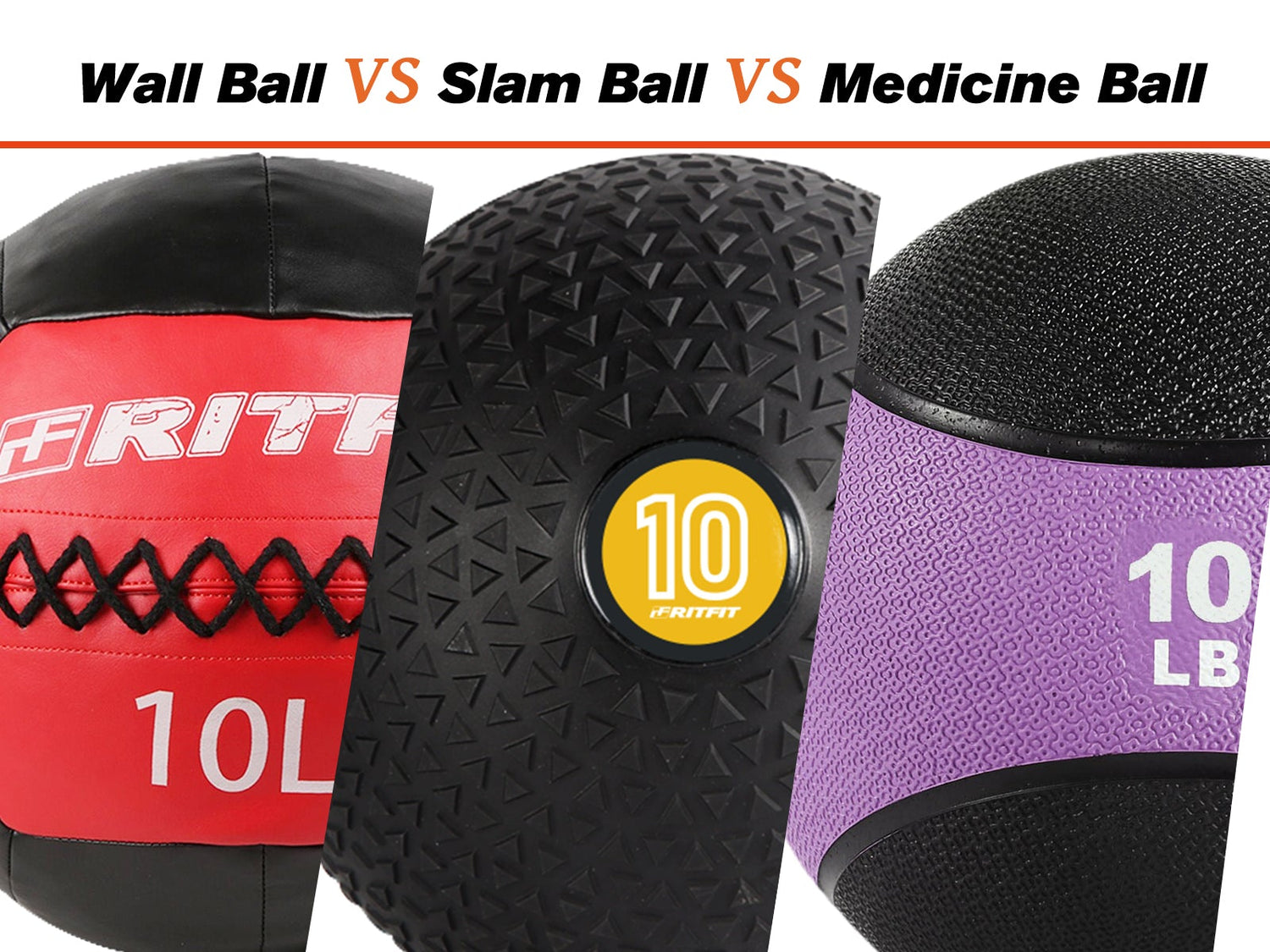
If you’ve ever walked into a gym and seen a whole row of different “weighted balls,” it’s totally normal to feel confused about which one to pick up. Slam balls, medicine balls, and wall balls all look somewhat similar, but they’re built differently, feel different in your hands, and are meant for different types of exercises.
Using the wrong ball for the wrong exercise can do more than just make your workout less effective. It can damage the equipment, increase your risk of injury, and slow down your progress. If you’re building a home gym and want to invest in a couple of versatile tools instead of buying everything, understanding the differences between these three gym balls is essential.
In this guide, we’ll break down what each ball is, what it’s best for, which moves to avoid, and how to choose the right ball and weight for your training.
Why Is It Important to Know the Differences Between Slam Ball, Wall Ball, and Medicine Ball?
Not all “weighted balls” are designed to be treated the same way. Some are meant to be slammed into the floor repeatedly; others are built for throws, catches, or controlled core work.
If you ignore these design differences, you can:
- Split or leak the ball by using it for the wrong type of impact.
- Get unexpectedly “rebounded” by a ball that bounces more than you thought.
- Put unnecessary stress on your joints by forcing a ball into movements it wasn’t built for.
This is especially important for beginners. For example, aggressively slamming a medicine ball can cause it to bounce back toward your face or chest, and trying to do wall-ball-style throws with a dead, non-bouncing slam ball feels awkward and disrupts your rhythm.
Each ball is engineered with specific materials, filling, and bounce level so it shines in certain exercises and feels wrong or unsafe in others. Once you understand these roles, you’ll perform the right movements with the right tool and get more benefit out of every rep.
What Are the Differences Between the Three Major Types of Exercise Balls?
Slam balls, medicine balls, and wall balls differ in four key areas:
- Bounce level
- Construction and filling
- Typical size and weight range
- Ideal exercises and “do not use for” cases
Here’s a side-by-side overview to make it easy:
| Ball Type | Bounce Level | Construction & Filling | Typical Weight Range | Best For | Avoid Using For |
|---|---|---|---|---|---|
| Slam Ball | No bounce (“dead” ball) | Thick rubber shell with sand or similar heavy filling that doesn’t rebound | 10–50 lb (heavier options common) | Floor slams, explosive power work, conditioning, athletic drills | Wall throws against hard surfaces, high-rebound work |
| Medicine Ball | Light bounce | Dense rubber shell, usually air-filled, sometimes with handles | 4–20 lb | Core training, rotational work, partner tosses, controlled strength drills | High-force floor slams or repeated heavy impact throws |
| Wall Ball | Moderate, soft bounce | Larger, soft outer shell with rubber granules and fiber filling for even weight distribution | 9–33 lb | Wall-ball throws, squat-to-throw combos, conditioning circuits | Ground slams (due to rebound and shell stress) |
Next, let’s look at each ball in more detail and see how to use it correctly.
1. Slam Ball
What Is a Slam Ball?
A slam ball, also known as a "dead ball," is made to be picked up and thrown hard into the ground without bouncing back.
It has a thick, tough rubber shell and is filled with something that feels like sand and absorbs shock. When it hits the floor, it just stops.
Slam balls are usually the heaviest and most durable of the three because they don't bounce back. They can take many high-impact slams on the right surface, which is why they are so popular for conditioning and power work in home gyms and functional training spaces.
What Can You Do With a Slam Ball?
Slam balls work well both as a replacement for free weights in some movements and as a unique tool for explosive, full-body exercises.A study in the Journal of Strength and Conditioning Research confirmed that medicine ball slams elicit high muscular activation in the rectus abdominis and upper body, making them effective for power development[1].
Common slam ball exercises include:
- Overhead slams
- Lateral or rotational throws
- Squat to press and slam
- Broad jump to forward chest pass
- Carry variations (bear hug carries, front carries, shoulder carries)
The defining movement, of course, is the classic slam.
Here are 3 steps to perform a safe and powerful overhead slam with a slam ball.
Step 1 – Set up:
Stand with your feet about shoulder-width apart and hold the slam ball at chest level. Hold your core tight and lift the ball over your head while keeping your ribs down. Don't arch your lower back too much.
Step 2 – Slam with your whole body:
Snap your hips, engage your core, and pull down with your arms to hit the ball hard against the floor. As you slam, let out a sharp breath. As the ball goes down, your knees and hips should bend, not stay locked.
Step 3 – Reset with a safe pickup:
Stand up straight, with your back straight and your spine neutral, and pick up the ball from the floor. Do not round your lower back. While you learn the pattern, start with a lighter slam ball and do 8–10 controlled reps for 2–3 rounds.
Benefits of Slam Ball Training
Slam ball training is fantastic for building explosive power, conditioning, and mental toughness. Because you’re moving the ball quickly and using your whole body, you’re challenging:
- Shoulders, triceps, and lats
- Core and obliques
- Glutes, quads, and hamstrings
- Grip and forearms
Unlike slow, grinding lifts, slam ball work teaches you to generate power and then absorb force, which carries over well to sports, everyday activities, and fat-burning conditioning workouts.
Medicine Ball
What Is a Medicine Ball?
A medicine ball, or "med ball" for short, is a small, round ball that bounces a little and is lighter than slam balls.
It has a thick rubber or synthetic shell and is usually filled with air. Some designs have handles built in to make it easier to hold and move around.
It's easy to hold a medicine ball with both hands, and it's great for core training, rotational power, and partner drills. They feel more natural for long-distance chest passes, rotational throws, and precise target work because they are smaller than wall balls.
What Can You Do With a Medicine Ball?
People mostly use medicine balls for strength and conditioning exercises that involve controlled throws, catches, and core work instead of slams that hit hard. Popular medicine ball exercises include:
- Medicine ball V-ups or sit-ups with a reach
- Rolling push-ups with one hand on the ball
- Plank variations with hands or forearms on the ball
- Chest passes and rotational throws with a partner or against a wall
Because the ball is smaller and easier to grip, it works very well for partner workouts and longer-distance passing drills.
Why You Should Not Slam a Medicine Ball
Medicine balls are not designed for brutal, repeated floor slams. They have more bounce than slam balls, and their shell is not engineered to absorb constant high-impact collisions with the ground.
If you try to use a medicine ball for heavy slams:
- It can bounce back unpredictably toward your face, chest, or knees.
- You risk splitting the outer shell or damaging the internal structure of the ball.
Save the high-force slams for a true slam ball, and keep the medicine ball for rotational, core, and partner-based work.
How to Perform a Medicine Ball Diagonal Chop (6 Steps)
The diagonal chop is one of the best functional exercises you can do with a medicine ball. It works your core, hips, and shoulders all at the same time.
- Stand with your feet about shoulder-width apart, facing forward, and hold the medicine ball close to your chest.
- Rotate slightly toward one side and lift the ball up and across your body, ending above your shoulder on that side.
- Engage your core and hips, then “chop” the ball down diagonally toward the opposite hip or outside of your knee.
- Move your hips and torso along with the movement so that your whole body turns, not just your arms.
- At the bottom, stop the motion for a moment, then bring the ball back to the starting position above your shoulder.
- Finish all of the reps on one side before moving to the other.
Keep the weight light enough that you can move quickly but still be able to control the ball and your spine.
The advantages of working out with a medicine ball
Using a medicine ball is a fantastic way to build core strength, rotational power, and coordination throughout your body.EMG analysis shows that rotational throws significantly activate the external obliques and spinal stabilizers, enhancing core stiffness[2].
Depending on the exercise, you’ll challenge:
- Shoulders and upper back
- Triceps and chest
- Glutes and hamstrings
- Deep core and oblique muscles
These movements translate well to real-life tasks, like lifting, twisting, and carrying, and they’re also widely used in sports performance programs for golfers, tennis players, baseball athletes, and more.
Wall Ball
What Is a Wall Ball?
Wall balls are bigger, softer balls with weights that are made for drills that involve throwing and catching from a wall or target.
They are filled with rubber granules and fiber to make the weight even and give them a comfortable, slightly forgiving feel when they hit something.
A wall ball is noticeably bigger than both a slam ball and a standard medicine ball—often close to the size of a small beach ball. Common weights range from about 9 lb to 33 lb, with the larger size making it easier to rest against your chest during squats and catches.
What Can You Do With a Wall Ball?
Wall balls are excellent for high-rep conditioning and full-body power drills. Here are some classic wall ball workouts:
- Many CrossFit workouts use the famous "wall ball" squat to throw.
- Side throws into a wall to build rotational power
- Catching and throwing balls over your head or at your chest level
- Crunch throws are when you throw the ball from a sit-up position to a wall or a partner.
Wall balls have a larger diameter, which makes them harder to throw because they create more air resistance. This means that even lighter weights can feel tough when you throw them quickly and often.
Why Wall Balls Are Not Meant for Ground Slams
Just like medicine balls, wall balls are not built for heavy ground slams. Their soft shell and internal filling are optimized for absorbing force against a wall and your body—not for being spiked into the floor.
When you slam a wall ball into the ground:
- The ball's size and construction make its bounces unpredictable.
- The seams and outer shell are under stress they weren’t designed to handle, which can shorten the life of the ball or cause splitting.
Use wall balls only for throws, catches, and conditioning circuits that take place on the wall. For any movement that involves repeatedly smashing the ball into the floor, use a slam ball.
Benefits of Wall Ball Training
Wall ball training is a fantastic way to work on strength, power, and conditioning all at once.Research on high-intensity functional training highlights that exercises like wall balls elevate heart rate and VO2 max to levels comparable to traditional aerobic interval training[3].
Wall ball drills can get better with the right load:
- Muscle strength, especially in the legs, hips, and upper body
- High-rep sets for building muscular endurance
- Heart health and ability to work
Your whole body is working together, including your quads, glutes, hamstrings, abs, chest, shoulders, triceps, lats, and spinal erectors.
How Heavy Should Your Ball Be?
Choosing the right weight is just as important as choosing the right type of ball. Here are general guidelines for most home lifters:
Beginners
- Medicine ball/wall ball: 6–10 lb.
- Slam ball: 10–20 lb is recommended for beginners while they learn the movement.
Intermediate lifters
- Medicine ball/wall ball: 10–20 lb.
- Slam ball: 20–30 lb for controlled but powerful slams
Advanced lifters
- Select a weight that you can move explosively for 6–10 reps while keeping excellent form. The ball is too heavy if your technique stops working.
When in doubt, start with less weight. First, work on moving smoothly and without pain. Then, as your technique and confidence grow, slowly add more weight.
Sample full-body workout using a slam ball, medicine ball, and wall ball
Want to put all three into action? Try this simple circuit.
Perform 3–4 rounds:
- 10 Slam Ball Overhead Slams
- 10 Medicine Ball Diagonal Chops (each side)
- 12 Wall Ball Squat-to-Throws
- 30–45 seconds rest between rounds
This mix works on explosive power, core strength, and conditioning in a short, effective workout. Choose a weight that allows you to perform each repetition with good form consistently.
Safety Tips & General Disclaimer
To keep your training safe and effective, keep these guidelines in mind:
- Use slam balls only for floor slams and high-impact throws.
- Avoid slamming medicine balls or wall balls into the ground to prevent rebound injuries and equipment damage.
- When you pick up a ball from the floor, keep your spine straight. Bend at your hips and knees, not by rounding your back.
- If you feel sharp pain, dizziness, or joint pain that doesn't feel like normal muscle fatigue, stop right away.
If you have a history of back, shoulder, or joint problems, or if you're new to working out hard, talk to a qualified healthcare or fitness professional before starting a high-impact program with weighted balls.
Final Words
It's true that slam balls, medicine balls, and wall balls are all very useful, but they can't be used in place of each other. Each one has a clear purpose, the best exercises to do with it, and situations where you shouldn't use it.
When you know these differences, it's easy to pick the right ball for your home workouts. Start with one or two balls that fit your goals, work on the basic movements, and slowly increase the weight and intensity of your workouts.
Choose your ball, find a safe place to train, and get moving. Your next great full-body workout could be just one throw away.
References
- Escamilla RF, Lewis C, Bell D, et al. Core muscle activation during Swiss ball and traditional abdominal exercises. J Orthop Sports Phys Ther. 2010;40(5):265-276. doi:10.2519/jospt.2010.3073
- Oliva-Lozano JM, Muyor JM. Core Muscle Activity During Physical Fitness Exercises: A Systematic Review. Int J Environ Res Public Health. 2020;17(12):4306. Published 2020 Jun 16. doi:10.3390/ijerph17124306
- Helgerud J, Høydal K, Wang E, et al. Aerobic high-intensity intervals improve VO2max more than moderate training. Med Sci Sports Exerc. 2007;39(4):665-671. doi:10.1249/mss.0b013e3180304570
FAQs: Wall Ball vs. Slam Ball vs. Medicine Ball
1. What is the main difference between a slam ball, a wall ball, and a medicine ball?
A slam ball is a no-bounce “dead” ball for floor slams, a wall ball is a large soft ball for wall throws, and a medicine ball is a smaller ball for core and partner drills.
2. Can I use a medicine ball for slams?
No. Medicine balls aren’t designed for high-impact floor slams. They can bounce back unpredictably, and the shell may crack. Use a slam ball for all heavy slam exercises.
3. Is it safe to slam a wall ball on the ground?
No. Wall balls are meant for wall throws, not floor slams. Ground slams can stress the seams, damage the filling, and cause awkward rebounds that increase injury risk.
4. Which ball is best for beginners working out at home?
Most beginners do well with one lighter medicine ball (for core and partner drills) and one moderate-weight slam ball (for basic slams and conditioning). This combo covers most home workouts.
5. How do I choose the right weight for each type of ball?
Start lighter than you think:
-
Medicine/wall ball: 6–10 lb for most beginners
-
Slam ball: 10–20 lb to learn form
Increase weight only when you can keep solid technique.
6. Do I need all three types of balls in my home gym?
Not necessarily. If you love explosive slams, start with a slam ball. If you focus on core and partner work, a medicine ball is enough. Add a wall ball later if you enjoy wall-throw conditioning.
7. What kind of floor or wall do I need to use these balls safely?
Use slam balls on sturdy, non-slippery floors (like rubber gym flooring or concrete). Wall balls and medicine balls should be thrown against solid walls or targeted panels that can handle impact.
8. Can I use these balls if I have joint or back issues?
Maybe—but you must be cautious. Choose lighter weights, avoid high-impact slams, and prioritize controlled movements. If you have existing pain or injuries, talk to a healthcare or fitness professional first.
9. Are these balls good for weight loss and conditioning?
Yes. High-rep wall ball sets, slam ball circuits, and medicine ball core work can all raise your heart rate, burn calories, and build muscle, which supports fat loss when combined with proper nutrition.
10. Can kids or teenagers use slam balls, wall balls, and medicine balls?
They can, with light weights, simple movements, and close supervision. Focus on technique and fun, not heavy loads or maximum-effort slams.
11. Can I use these balls outdoors?
Usually yes, but avoid sharp surfaces and extreme heat or cold. Rinse off dirt, let them dry, and store them indoors to extend the life of the rubber and stitching.
12. How do I clean and care for my gym balls?
Wipe them down with a mild soap solution or gym-safe disinfectant, then dry with a towel. Avoid harsh chemicals and storing them in direct sunlight or near high heat sources.





