








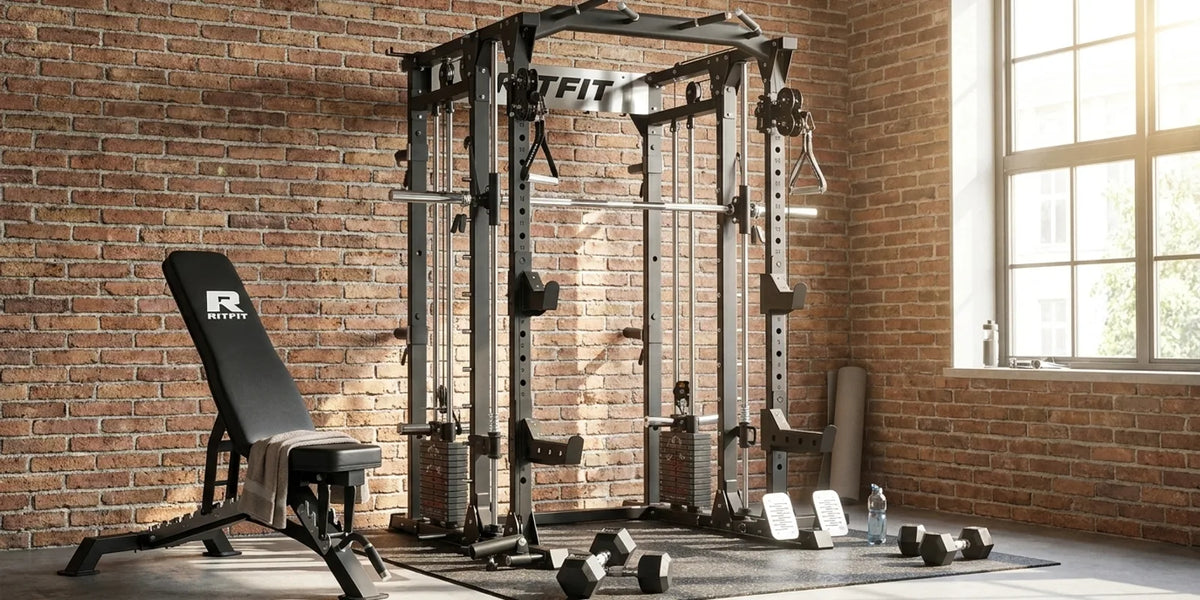
A dual action smith machine combines a guided Smith bar with dual cable pulleys on a single frame, so barbell lifts and cable isolation work share one footprint. This guide covers how the dual pulley system works, what the cited studies say about Smith training, and which RitFit model fits your gym.
Expect straight numbers on pulley ratios, exercise menus, safety hardware, and space requirements. Every spec comes from official RitFit product pages, and every training claim ties to a cited study or a spec sheet.
Quick Answer: A dual action smith machine is a single station that pairs a guided Smith bar with dual cable pulleys, so you can squat, press, and row on the bar, then switch to cable crossovers, pulldowns, and curls without changing equipment. The dual pulley system adds independent left and right resistance for balanced, space-efficient home training.
Key Takeaways
- One frame, two systems: A dual action smith machine pairs a guided Smith bar with dual cable pulleys, covering barbell and cable training in one station.
- Pulley ratios matter: The RitFit Buffalo Wild switches between 1:1 and 2:1 resistance, so one rack handles heavy rows and fast isolation work.
- Research-backed bar work: A 2022 study found no significant difference in prime mover activation between Smith and free-weight bench press at 60% of 1RM in untrained men.
- Real footprints: RitFit dual action models span 21.5 sq ft for the M3 Pro to 28.9 sq ft for the Buffalo Wild, with heights near 85 in.
- Solo-safe design: Adjustable catch hooks and long safety arms let you press heavy at home without a spotter.
What Is a Dual Action Smith Machine?
A dual action smith machine is one rack that pairs a guided Smith bar with a dual pulley cable system. Barbell lifts and cable exercises share the same footprint instead of filling your gym with separate machines.
The name describes the two training actions living on one frame. Action one is the guided barbell, a bar that rides on rails with catch hooks along the uprights, and action two is the dual cable system that behaves like a compact functional trainer.
Shoppers also search for a dual pulley smith machine or a smith machine with cable crossover, and all three names point to the same category. RitFit's smith machine collection spans everything from a compact smith machine with lat pulldown for tight rooms to full dual cable racks for dedicated garage builds.
- Guided barbell: squats, presses, rows, and shrugs on a fixed bar path with safety catches at multiple heights.
- Dual pulleys: crossovers, pulldowns, curls, and face pulls with independent left and right resistance.
- Hybrid resistance: weight stacks for pin-loaded speed, plate posts for barbell loading, or both on hybrid frames.
For a garage builder, the appeal is consolidation, because one all-in-one rack replaces a separate Smith station and a separate cable station. That saves floor space and one whole purchase in the same move.
How Does a Dual Pulley Smith Machine Work?
A dual pulley smith machine runs an independent cable track on each side of the rack. That lets your left and right arms work under separate resistance, and on the Buffalo Wild the ratio switches between 1:1 and 2:1.
The core of the system is cable independence. Per the official spec sheet, the Buffalo Wild Smith Machine with adjustable dual cable system uses two independent cable tracks per side with a 2.6 m maximum pull distance, so each arm pulls its own load through its own path.
The pulley ratio controls how much stack weight you feel at the handle. A 1:1 ratio in dual cable mode delivers the full selected load for heavy rows and pulldowns, while a 2:1 ratio in single cable mode halves the felt resistance and doubles cable travel speed for high-rep lateral raises, face pulls, and other fast isolation work.
Resistance comes from weight stacks, plate posts, or a hybrid of both. The stack side gives you pin-selected progressive overload between sets, and the plate side keeps barbell loading simple for squats and presses.
The Smith bar itself rides on a linear bearing carriage with multiple catch positions along the uprights, and the M3 Pro home gym smith machine with cable crossover uses a true 2.2 m Olympic-length bar on a 10-position quick rack system. Some models, like the M2 3D, let the bar travel in 3D mode with slight forward and backward drift that mirrors a natural bar path, or lock it into standard fixed mode.
What Are the Benefits of a Dual Action Smith Machine?
The main benefit is one station covering both barbell and cable training, plus unilateral resistance a traditional Smith cannot offer. You also get two-user capacity and faster resistance changes in the same footprint.
Each benefit shows up in how you actually train, not just on the spec sheet. Here is what changes when the dual pulley system joins the rack.
- Full-body sessions without station-hopping: move from Smith squats and bench presses straight to cable crossovers, lat pulldowns, and triceps pushdowns, where a traditional Smith rack would leave you walking to a separate cable machine or skipping accessory work entirely.
- Unilateral training that fixes imbalances: because each cable track loads one side at a time, your stronger arm cannot steal the rep from your weaker arm the way it can on a shared barbell, which matters for rows, curls, and presses.
- Two lifters at once: with independent tracks per side, one person can do cable rows while a partner does pulldowns, turning a shared garage gym into a real two-person setup.
- Faster progressive overload: a selector pin moves you from set to set in seconds on stack-equipped models, with no plate handling between exercises.
The M1 multi-functional home gym smith machine and the M1 smith machine with cable crossover system show how the same architecture scales into smaller garages. Stack-ready packages add selector-pin loading later without replacing the frame.
What Does Research Say About Smith Machine Training?
Research shows comparable prime mover activation between Smith and free-weight pressing in untrained men, with gains following the specificity principle. Both bar styles build muscle, and each transfers best to its own pattern.
A 2022 study of untrained men measured the pectoralis major, anterior deltoid, and triceps brachii during bench pressing at 60% of 1RM and found no significant difference in prime mover activation between the Smith machine and the free-weight barbell[1]. The same paper described the Smith press as a suitable option for lifters who had not yet developed the stabilization skills free weights demand.
A 2019 training study tracked two groups for 7 weeks and found the Smith machine group improved most on the trained Smith exercise, while the free-weight group transferred strength better to non-trained tasks[2]. Both groups improved muscle thickness similarly, which supports using the guided bar as a primary training tool rather than a fallback.
For dual action owners, the practical read is balance. The guided barbell covers confident heavy pressing and squatting, and the dual pulleys cover the unilateral and constant-tension work a fixed bar cannot provide.
What Exercises Can You Do on a Dual Pulley Smith Machine?
One station covers barbell squats, presses, and rows plus cable crossovers, pulldowns, face pulls, and curls. The Smith bar handles your heaviest compounds and the dual pulleys handle isolation and unilateral accessories.
Treat the rack as three training zones. The lists below map each zone to the movements and the training purpose behind them.
- On the guided Smith bar: back squats, bench and incline presses, overhead presses, bent-over rows, shrugs, and hip thrusts, with the lowered Buffalo Wild bar engineered for extra depth on rows, hip thrusts, and deadlifts.
- On the dual pulleys: cable crossovers and mid chest flyes, lat pulldowns, straight-arm pulldowns, face pulls, triceps pushdowns, biceps curls, lateral raises, and woodchops for core rotation.
- On the frame: pull-ups and chin-ups at the top bar, plus landmine and pegboard attachments on models like the M3 Pro for rotational work and accessory storage.
The full-body flow is what makes the category click for home lifters. A partner or a programming app can chain squats, presses, and cable finishers without anyone re-racking the room.
An M1 smith machine home gym package bundles the bar, cables, bench, and weights so the exercise menu above is ready on day one.
How Safe Is a Dual Action Smith Machine for Home Training?
A dual action smith machine suits solo training because the guided bar catches on safety hooks at any rack height. Cable exercises also keep resistance off your balance line entirely.
The safety stack has layers. The Smith bar rides a fixed path, so it cannot drift forward or backward mid-rep, and the Buffalo Wild offers 12 adjustable catch positions per side so the bar can be set down at any point in the range of motion.
Rack-level backup comes next. The M3 Pro ships with 22 in safety arms rated at 650 lb static and a 10-position quick rack system, which gives solo benchers two independent fail-safe layers under the bar.
Home context matters too. A US emergency department study estimated about 70,302 injuries involving mechanical home exercise equipment across 2007 to 2011, most tied to treadmills, and flagged unsupervised children as a higher-risk group[3].
The practical takeaway for a shared garage or basement is simple. Keep the cable zone clear of chairs and toys, supervise younger family members, and match working loads to the official ratings, such as the 352 lb dynamic Smith capacity on the M3 Pro.
An all-in-one smith machine with 260 lb weight stacks keeps selector-pin resistance in reach for newer lifters learning movement patterns before barbell loads.
Dual Action vs Traditional Smith Machine: Which Fits Your Gym?
A dual action smith machine keeps the guided bar and adds dual cable stations to a traditional fixed-bar Smith. You trade a slightly larger footprint for cable work, unilateral training, and two-user capacity.
A traditional Smith machine gives you the fixed vertical bar and nothing else. Every cable movement then needs a second machine, a second footprint, and a second line in the budget.
| Feature | Traditional Smith Machine | Dual Action Smith Machine |
|---|---|---|
| Barbell training | Fixed vertical bar on rails with catch hooks | Same guided bar, plus 3D bar path options on models like the M2 3D |
| Cable training | None without a separate machine | Dual pulleys with independent left and right resistance |
| Simultaneous users | One lifter at a time | Two lifters on independent-track models like the Buffalo Wild |
| Resistance source | Plates loaded on the bar | Weight stacks, plate posts, or hybrid systems |
| Footprint | Smaller frame | 21.5 to 28.9 sq ft across RitFit dual action models |
| Best fit | Barbell-only lifters with tight space | Lifters who want cables, unilateral work, and room to grow |
Category comparison reflects RitFit's official spec sheets for the M3 Pro, M2 3D, and Buffalo Wild.
Within the RitFit line, the split is about how much cable you want. Single-tower machines pair the bar with one lat station, while the multifunctional smith machine frames and the Buffalo smith machine home gym package with weight stack add full crossover capability with stack resistance.
The M2 3D sits in an interesting middle position, because one reviewer notes its bar can be used in 3D mode with forward and backward drift or locked as a standard fixed Smith machine, which changes the feel of squats and presses without changing the frame.
What Should You Look for When Buying a Dual Action Smith Machine?
Check for dual independent cable tracks, a selectable 1:1 and 2:1 ratio, stack capacity, bar rating, and a workable footprint. Match those numbers to your ceiling height, floor plan, and long-term attachment plans.
Dual Tracks and Pulley Ratio
Start with the cable system, because it defines the category. Look for two independent tracks per side like the Buffalo Wild setup, and treat a selectable 1:1 and 2:1 pulley ratio as a major plus, since it turns one stack into both a strength tool and an endurance tool.
Weight Stacks or Plate-Loaded Resistance
Stacks win on speed and family usability, and plates win on raw loading flexibility. The M3 Pro carries 180 lb of built-in stacks per side at a 2:1 ratio, while hybrid systems like the Buffalo Wild combine stack and plate loading on one frame.
Frame Capacity, Bar Rating, and Footprint
Compare the frame rating, the Smith bar rating, and the real floor area before anything else. The M3 Pro pairs a 2,500 lb frame capacity with a 352 lb dynamic and 572 lb static Smith rating on a 21.5 sq ft footprint with an 84 in height, and the Buffalo Wild counters with a 2,200 lb frame on 28.9 sq ft at 85.2 in tall.
Which Should You Choose: Buffalo Wild, M3 Pro, or M1 Pro?
| If you want | RitFit model | Why it fits |
|---|---|---|
| The heaviest frame and three native stations | M3 Pro | 2,500 lb frame, 180 lb stacks per side, 29 cable positions on 21.5 sq ft |
| Maximum dual cable training for two users | Buffalo Wild | Two independent tracks per side, 1:1 and 2:1 ratios, 2.6 m pull distance |
| A value entry with a built-in stack | M1 Pro with weight stack | 264 lb stack option paired with the M1 cable crossover system |
| A bar that moves with you | M2 3D | 3D bar path adds forward and backward drift to the guided rail |
Recommendations stay inside the RitFit lineup and cite official spec sheets for every number.
On value, judge the price against what you would otherwise buy separately, meaning a Smith station, a functional trainer, a pull-up bar, and storage. A dual action frame bundles all four, and packages like the M1 Pro smith machine weight stack package or the BPC06 all-in-one smith machine home gym package include the bench and weights in one delivery.
Plan the second year, not just delivery day. Stack add-ons, lat pulldown attachments, landmine mounts, and lever arms extend the same frame, and the limited edition M3 home gym smith machine with cable crossover shows how finish options let the rack grow with the room instead of getting replaced.
The RITFIT M2 3D Pro is a solid budget-friendly all-in-one home gym that works as a half-rack, a dual-cable functional trainer, lat-pulldown / low row machine, and perhaps the most unique feature: A 3D smith machine that can be used in 3D mode or as a standard fixed smith machine.
Eugene, Home Gym Equipment Reviewer, RITFIT M2 3D Pro Modular Home Gym Review - Good value?
FAQs About Dual Action Smith Machines
What is a dual action smith machine?
A dual action smith machine is a single station that combines a guided Smith bar with dual cable pulleys on one frame, so you can move from barbell squats and presses straight to cable crossovers, pulldowns, and curls without changing equipment. Models like the RitFit Buffalo Wild add two independent cable tracks per side, which unlocks unilateral training and two-person workouts on the same rack.
Is a dual pulley smith machine good for building muscle?
Yes, a 2022 study of untrained men found that prime mover activation in the chest, front delts, and triceps did not differ significantly between the Smith machine and free-weight bench press at 60% of 1RM, and a separate study tracked over 7 weeks showed Smith training produced strong gains on the trained exercise itself. Dual pulleys add unilateral cable work, which helps each side carry its own load and corrects side-to-side imbalances.
What is the difference between 1:1 and 2:1 pulley ratios?
A 1:1 ratio means the handle resistance equals the selected stack weight, which suits heavy strength work such as rows and pulldowns, while a 2:1 ratio halves the felt resistance and speeds up cable travel for higher-rep isolation work like lateral raises and face pulls. The RitFit Buffalo Wild switches between 1:1 and 2:1 modes so one station covers both training styles.
Can two people train at the same time on a dual action smith machine?
Yes, on models with independent dual cable tracks, because each side runs its own cable path and resistance, so one lifter can do cable rows while another does pulldowns or curls. The RitFit Buffalo Wild is built for exactly this setup, with two independent cable tracks per side and a 2.6 m maximum pull distance for full range of motion.
How much space does a dual action smith machine need?
Plan for the footprint plus working clearance, since the RitFit M3 Pro needs 21.5 sq ft and the Buffalo Wild needs 28.9 sq ft with an 85.2 in overall height. Add roughly 3 ft of clearance on the cable sides for full range of motion, and check your ceiling against the rack height plus your reach during pull-ups.
Is a dual action smith machine safe for training alone?
The guided bar makes solo lifting safer than free weights because the bar cannot drift and can catch on adjustable safety hooks at any rack height, and the RitFit M3 Pro adds 22 in safety arms rated at 650 lb static for a second fail-safe layer. A US emergency department study counted about 70,302 home equipment injuries from 2007 to 2011, so keep children away from unsupervised equipment and keep the training zone clear.
Conclusion
A dual action smith machine turns one footprint into a complete strength platform, with guided barbell work on the Smith bar, unilateral cable training on the dual pulleys, and two-user capacity on independent-track models. Match the frame rating, stack size, and footprint to your real training, and measure the ceiling before you order.
Choose the configuration that leaves room to grow, from the value-focused M1 Pro stack package to the dual-track Buffalo Wild and the three-station M3 Pro. Before ordering, check current bundles and seasonal pricing on the RitFit discount guide.
Disclaimer
This article is for general fitness information only and is not medical or professional advice. Consult a qualified professional before starting any new training program, and always follow the manufacturer's assembly instructions, weight ratings, and safety guidelines for your equipment.
References
1. Wang L. A comparison of muscle activation and concomitant intermuscular coupling of antagonist muscles among bench presses with different instability degrees in untrained men. Front Physiol. 2022;13:940719. PMCID: PMC9486837
2. Saeterbakken AH, Olsen A, Behm DG, Bardstu HB, Andersen V. The short- and long-term effects of resistance training with different stability requirements. PLoS One. 2019;14(4):e0214302. PMCID: PMC6443166
3. Graves JM, Iyer KR, Willis MM, Ebel BE, Rivara FP, Vavilala MS. Emergency department-reported injuries associated with mechanical home exercise equipment in the USA. Inj Prev. 2014;20(4):281-5. doi:10.1136/injuryprev-2013-040833. PMCID: PMC4306571





