A dumbbell handle grip is the only part of the weight your body actually touches, so its shape sets the ceiling on every set. Rotation, shaft thickness, head shape, and add-on sleeves all change how load reaches your hands and wrists, and the wrong match shows up as slipping fingers or a tired forearm before your target muscle quits.
This guide walks through the four handle variables that matter, matches each one to real training in a garage gym or home gym, and stays honest about what a handle can and cannot fix for you.
Quick Answer: A dumbbell handle grip comes down to four choices: rotating sleeves cut wrist torque on fast lifts, thin shafts suit smaller hands, thick shafts and fat grips raise grip demand, and hex heads keep the weight from rolling. For presses, rows, and curls, a fixed medium shaft remains the better default.
Key Takeaways
- Rotating sleeves: A bearing sleeve cuts wrist torque on dumbbell snatches and swings, but it does not build grip strength by itself.
- Thin versus thick shafts: A thinner handle lets most hands wrap further around the shaft, while a thicker one raises the squeeze needed to hold the same weight.
- Fat grips: Add-on sleeves increase handle diameter and grip demand, which turns a light pair of dumbbells into a forearm challenge.
- Head shape: Hex heads sit flat on a floor, round heads roll, and neither shape changes how the shaft sits in your palm.
- Maintenance: A clean, dry shaft keeps a knurl working longer than any add-on you can buy.
What Are the Parts of a Dumbbell Handle?
A dumbbell handle has five working parts, and each one changes how the weight feels in your hand. The shaft sets the handle diameter, the knurl adds traction, the sleeve or collar locks the head in place, and the head shape decides whether the dumbbell rolls between sets.
- Shaft and handle diameter: The steel between the collars is the part you close your hand around, and its diameter decides how far your fingers can wrap.
- Knurling: A cut pattern in the shaft that adds friction for a pronated grip, a neutral grip, and everything between once your palms get sweaty.
- Sleeve or collar: The sleeve holds the head and, on some dumbbells, spins on a bearing so the weight can rotate during fast lifts.
- Head shape: Rubber hex heads sit flat on a garage gym floor, while round heads roll unless they rest on a rack.
- Finish: Chrome and rubber coatings both resist rust, but they wear at different rates where your hands sit all session.
A fixed handle welds the shaft to the head, so the entire dumbbell moves as one piece, which is why most Dumbbells in a home gym use it. Rotating models add a bearing inside the sleeve instead of a weld.
"Knurling is a textured grip on the barbell that helps you hold on securely, even when your hands get sweaty. It's key for stability, especially with heavy lifts."
Umo Callins, CPT, Board-Certified Sports Dietitian, Independent, Best Barbell (Yahoo Health / HuffPost 2025)
"Comfortable and grippy handles, cool design on the end, and it was delivered faster than Amazon!"
John L. Verified Buyer, RitFit PVC-Coated Round Dumbbells in Pairs
Do Rotating Handles Beat Fixed Handles?
Rotating handles beat fixed handles on fast lifts, where a spinning sleeve stops the weight from twisting your wrist. On a press, row, or curl, that same rotation adds nothing, and a fixed shaft gives you a more predictable bar path under load.
| Handle type | Where it wins | What it costs you |
|---|---|---|
| Rotating sleeve | Dumbbell snatch, high pull, swing | More parts to wear and a higher price |
| Fixed shaft | Bench press, row, curl, carry | No relief from wrist torque on fast reps |
| Threaded collar | Changing load on one adjustable pair | Slower weight changes and collars that loosen |
Comparison reflects how each handle construction behaves in home gym use rather than any single brand spec sheet.
Rotation is a comfort feature, not a strength feature. RitFit builds the same idea into its RitFit AuraSpin Grip Plates for fast plate work, so a spinning grip is available without buying a second dumbbell set.
How Does Handle Thickness Change Your Grip?
A thicker handle forces a wider finger spread, so your forearm flexors must squeeze harder to hold the same weight. A thinner handle lets most lifters close their fingers further around the shaft, which usually feels more secure on presses and rows.
| Handle feel | Who it suits | Effect on the load |
|---|---|---|
| Thin shaft, near 1 inch (25 mm) | Smaller hands, beginners, high-rep sets | Easier wrap and a more secure hold |
| Standard 28.5 to 29 mm | Most home gym lifters | Balanced traction and palm comfort |
| Thick shaft, 2 inches and up | Grip-focused blocks and thick bar work | The same weight feels noticeably heavier |
Diameter ranges follow common barbell and dumbbell handle sizing rather than a single manufacturer sheet.
Load is what drives adaptation, and that logic applies to your hands as much as your chest. A network meta-analysis of resistance training found that loads at or above roughly 60% of one-rep max drive greater strength gains than lighter loads, which is exactly why a thicker shaft feels heavier at a fixed weight. [1]
Grip work also does not need complicated equipment. One handgrip protocol used 32 sets of 5-second maximal squeezes with 5 seconds rest between sets, and the authors reported 97% compliance across 51 postmenopausal women, so a simple tool and a consistent routine can carry the training load. [2]
"The standard bar length is a little over 7 feet, has '2-inch'/50mm diameter sleeves for loading the plates on, and weighs 20kg/44.1lbs. For home gym purposes, a 28.5 or 29mm bar will be the most durable and provide the best service over time. NEVER buy a 32mm bar. They are either junk, or a specialty squat bar that a home gym doesn't need."
Mark Rippetoe, Strength Coach and Author of Starting Strength, Starting Strength, How to Build a Home Gym (Starting Strength)
What Are Fat Grips and When Do They Help?
Fat grips are add-on sleeves that thicken a dumbbell handle so your fingers cannot close as far around it. The narrower wrap raises the squeeze needed on every rep, which turns a light pair of dumbbells into a genuine grip challenge.
- When they help: Warm-up sets, carries, curls, and any block where grip endurance is the goal.
- When to skip them: Heavy pressing, maximum carries, and any set where a slipping handle would be unsafe.
- How to add them safely: Start with one size and drop the load, because the same weight now demands more squeeze per rep.
- What they do not do: They do not build a stronger chest or back, and they do not replace loaded carries.
Carries remain the better grip builder for most people training at home. A 2019 systematic review in Sports Medicine Open found that loaded carries are high-intensity full-body exercises that target the grip, core, and postural muscles, with applications for athletic performance and general conditioning. [3]
Do Round and Hex Heads Change How You Grip?
Round and hex heads barely change your grip, but they change where you can safely leave the dumbbell between sets. The shaft does the gripping work, while the head only decides whether the weight rolls across the floor.
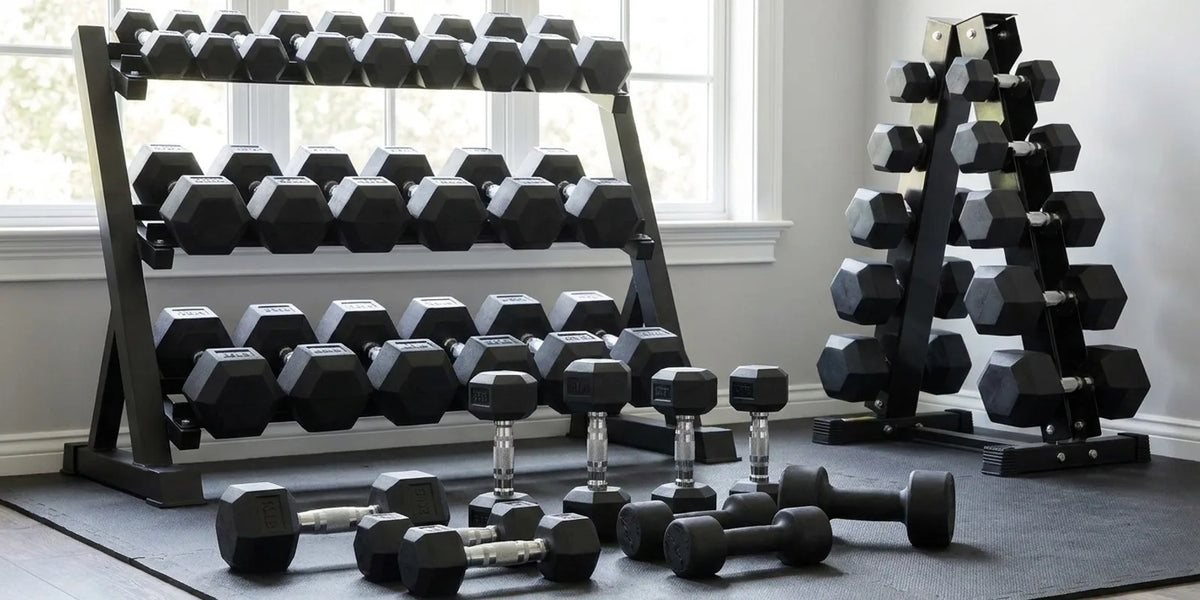
- Hex heads: Flat sides keep the dumbbell still on a garage gym floor and make stacking on a rack predictable.
- Round heads: A smooth roll means a round pair belongs on a rack, or it will drift under a bench mid-session.
- Decagon and other multi-sided heads: More faces than a hex, so they settle faster but cost more to machine.
- Grip feel: Head shape does not change handle diameter, knurl depth, or how the shaft sits in your palm.
If you want the flat-to-floor behavior, start with Hexagon Dumbbell Sets, and compare them against PVC-Coated Dumbbells only if you plan to store the pair on a rack.
"Was hesitant about adding a dumbbell set when I already had the cable-pulley system, but figured it would make a great addition to the overall gym. The weights have a great feel to them. Kind of odd that there is no 40# set, but I can live without that...may add that set later on."
Robert H. Verified Buyer, RitFit Rubber Hex Dumbbell Set with Rack
Which Dumbbell Handle Grip Fits Your Training?
The handle that fits your training depends on whether you press, carry, or move fast under load. Presses and rows reward a fixed medium shaft, carries reward a shaft you can hold for distance, and snatches reward a rotating sleeve.
| If you mostly | Choose | Why it fits |
|---|---|---|
| Press, row, and curl | Fixed knurled shaft, medium diameter | Predictable bar path at heavy loads |
| Snatch or swing | Rotating sleeve | Less wrist torque on fast reps |
| Change load often | Adjustable pair with fixed handles | One handle covers many weights |
| Train grip endurance | Thick shaft or add-on fat grip | Raises demand on every rep |
Mapping is based on how each handle construction behaves in common home gym training blocks.
For the fixed handle case, RitFit Rubber Hex Dumbbells pair knurled steel shafts with rubber hex heads, and the ToughFit Decagon PEV Dumbbells add extra flat faces. A Adjustable Dumbbells pair covers the changing-load case, and Dumbbells A Rack Package keeps every handle off the floor.
Carries tie the whole decision together, because a handle you can hold for distance matters more than a handle that looks aggressive. A 2024 study measured muscle activation in 20 participants during loaded carries, which is the practical reason carries belong in a grip plan. [4]
"Handles are awesome, fit in hand very nicely making it easy to grip when lifting!!!"
David D. Verified Buyer, RitFit Pink PVC-Coated Round Dumbbells in Pairs
How Do You Keep Dumbbell Handles Grippy?
Keep dumbbell handles grippy by cleaning the shaft, drying your palms, and checking the knurl for wear. Chalk helps when sweat is the problem, and a rack stops round heads from rolling into a wall.
- Clean the shaft: A damp cloth removes the oily residue that fills a knurl and quietly kills traction.
- Dry your hands: Sweat is the fastest way to lose a grip, so keep a towel within reach of the bench.
- Use chalk sparingly: A light dusting adds friction, while a heavy cake fills the knurl and dries your skin.
- Check for wear: A polished patch where your palm sits means the knurl is gone and the handle needs replacing.
- Store on a rack: A rolling dumbbell is how handles, floors, and toes get damaged between sessions.
"Great quality! Handles are thick and they are built well.."
Erik B. Verified Buyer, ToughFit Decagon PEV Dumbbells
FAQs About Dumbbell Handles
Do rotating dumbbell handles build more grip strength?
No. Rotating handles change how the weight moves, not how hard your hand has to squeeze. The sleeve spins on a bearing so the dumbbell can turn during a snatch or a swing, which cuts the twisting force that reaches your wrist. Grip strength still comes from holding load and from carries. A 2019 systematic review in Sports Medicine Open found that loaded carries are high-intensity full-body exercises that target the grip, core, and postural muscles, so treat carries as your grip builder and rotation as a comfort feature.
Are thin dumbbell handles better than thick ones?
It depends on your hand size and your goal. A thinner shaft lets most lifters wrap their fingers further around the handle, which usually feels more secure on presses and rows. A thicker shaft spreads the load across a wider strip of palm and forces a harder squeeze, so the same weight feels heavier in your hands. For a home gym, match the handle to your palm width first, then add a thickener only after the base handle feels easy.
What size dumbbell handle is best for small hands?
Look for a handle your middle finger and thumb can overlap slightly when you wrap the shaft. Many standard dumbbell and barbell handles sit near 1 inch (25 mm) or in the 28.5 to 29 mm range that coaches recommend for a durable bar. If your fingers barely reach around the shaft, drop the weight and pick a thinner handle rather than forcing a wide grip that rolls open mid-set.
Do fat grips really work on dumbbells?
Yes, as a difficulty dial rather than a magic upgrade. A fat grip sleeve adds diameter to the handle, so your fingers cannot close as far and your forearm flexors work harder to hold the same load. That makes light dumbbell work feel demanding and can build grip endurance over time. Skip them for heavy pressing or any set where a slipping handle would be unsafe, and never stack them on an already thick shaft.
Should beginners use rotating or fixed dumbbell handles?
Fixed handles are the simpler starting point. A welded shaft gives beginners a stable, predictable grip on presses, rows, and curls, which is where most new lifters spend their first months. Rotating handles pay off for fast, Olympic style movements like dumbbell snatches, where a spinning sleeve keeps the weight from fighting your wrist. Pick fixed first and add a rotating pair only when your program includes explosive lifts.
How do you stop dumbbells from slipping out of your hands?
Clean the handles, dry your palms, and check the knurl. Chalk or a light grip aid helps when sweat is the problem, and a towel keeps oily residue off a chrome shaft. If the knurl has worn smooth or the handle spins freely when it should not, the handle is the issue rather than your grip. Round heads also roll on the floor, so store them on a rack instead of leaving them loose between sets.
Conclusion
Choosing a dumbbell handle grip comes down to four variables: rotation, shaft diameter, head shape, and whether you add a fat grip. Buy for the lift you actually train, and treat rotation and thickness as comfort and difficulty dials rather than strength builders.
Start with a fixed medium shaft for presses and rows, then add a rotating pair or a thickener only when your program asks for it. Check current bundles and codes on the RitFit discount guide before you order.
Disclaimer
This article is general fitness information about dumbbell handle design and is not medical advice. Stop the set and consult a qualified professional if you feel wrist, hand, or forearm pain that does not settle with rest.
References
1. Lopez P, Radaelli R, Taaffe DR, et al. Resistance Training Load Effects on Muscle Hypertrophy and Strength Gain: Systematic Review and Network Meta-analysis. Med Sci Sports Exerc. 2021;53(6):1206-1216. doi:10.1249/MSS.0000000000002585. PMCID: PMC8126497
2. Bentley DC, Thomas SG. Maximal intermittent handgrip strategy: design and evaluation of an exercise protocol and a grip tool. Clin Interv Aging. 2016;11:589-601. PMCID: PMC4869642
3. Hindle BR, Lorimer A, Winwood P, Keogh JWL. The Biomechanics and Applications of Strongman Exercises: a Systematic Review. Sports Med Open. 2019;5(1):49. PMCID: PMC6901656
4. Ellestad SH, Holcomb TP, Swiergol AM, Holmstrup ME, Dicus JR. The Quantification of Muscle Activation During the Loaded Carry Movement Pattern. Int J Exerc Sci. 2024;17(1):480-490. PMCID: PMC11042841