








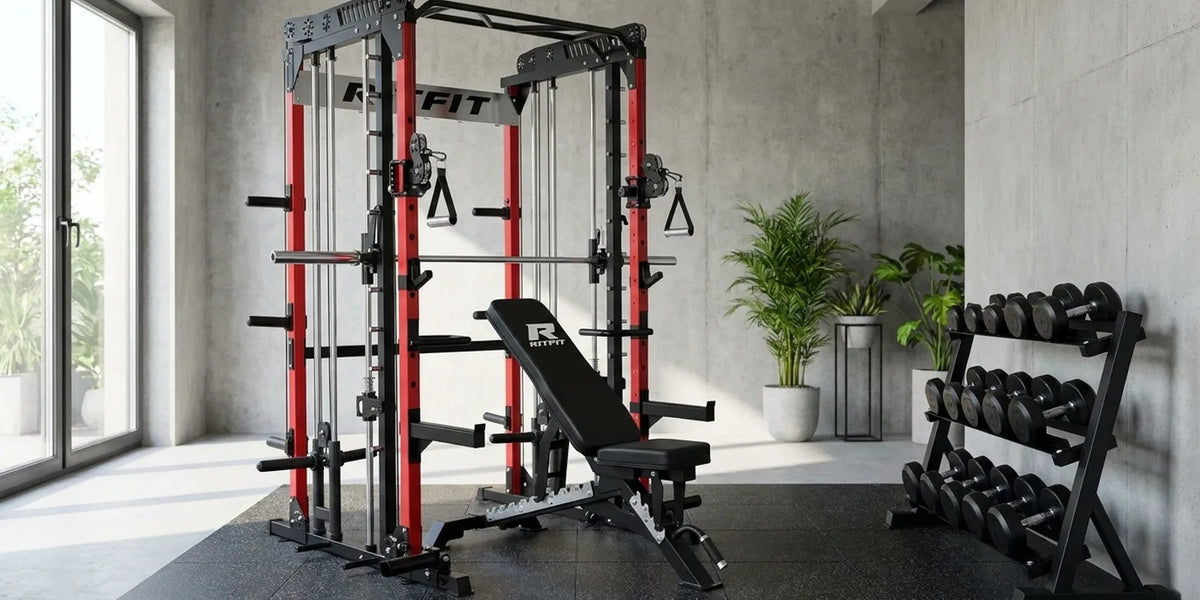
Choosing an easy to assemble smith machine comes down to six verifiable signs: partial pre-assembly, modular boxes, clear instructions, video support, simple tool needs, and realistic space requirements. This guide turns those signs into a checklist you can run against any product page before you spend a dollar.
You will learn how to read box counts and shipping weights, how to measure your ceiling before delivery day, and why the RitFit M1 PRO earns the top pick for buyers who want a full gym without a complicated build.
Quick Answer: An easy to assemble smith machine ships partially pre-assembled, arrives in labeled modular boxes, and includes a printed manual plus a video guide, so two people with basic hand tools can finish the build in several hours. The RitFit M1 PRO fits that checklist with four boxes, none heavier than 108.92 lb.
Key Takeaways
- Pre-assembly: A smith machine that ships partially pre-assembled cuts hours off setup, and RitFit states the M1 PRO arrives this way with a printed manual and video guide.
- Box logistics: The M1 PRO ships in 4 boxes for the rack, none heavier than 108.92 lb, while the M3 Pro arrives as a single 1,231.3 lb crate.
- Space: Measure first, because the M1 PRO stands 85.3 inches tall, needs an 8 ft ceiling with 1 to 2 ft of clearance, and covers 20.9 sqft.
- Verified specs: 2 x 2 inch 14-gauge steel, a 1,600 lb frame capacity, a 352 lb Smith capacity, and 15 cable positions anchor the M1 PRO value case at $1,299.99.
- Ownership: A 3-year frame warranty, 1-year bolts and pulleys coverage, and M1 PRO-only attachments keep long-term upgrade costs predictable.
What Makes a Smith Machine Easy to Assemble?
An easy to assemble smith machine shows six verifiable traits, all checkable before you order. None of them require guesswork, a showroom visit, or special expertise.
- Pre-assembly level: Frames that arrive with subassemblies already bolted together cut hours off the build, and RitFit states the M1 PRO ships partially pre-assembled.
- Modular design: A rack split across several moderate boxes is far easier to carry into a garage or basement than one giant crate, and it lets you stage parts step by step.
- Instructions and video guides: A printed manual plus an official step-by-step video means you can watch the exact step before you attempt it.
- Tool requirements: Machines that need only basic hand tools keep the build accessible, with no drills or specialty equipment in the parts list.
- Helper requirements: Honest brands publish how many people the build realistically takes, so you can schedule a friend before delivery day.
- Space and floor prep: Knowing the rack height, footprint, and anchoring options in advance prevents the classic mid-assembly surprise.
If you are still deciding between machine types, our Smith machine vs power rack comparison explains how the guided bar path changes what you can train. The six traits above apply to whatever frame you end up choosing.
Why Does a Smith Machine Suit Solo Home Training?
A smith machine suits solo home training because the fixed vertical bar path removes the balance demands of free weights. Safety catches let you rack the bar at any height, which is what allows solo lifters to train hard without a spotter.
The loading question has been studied directly. One study used kinematic and electromyographic measurements to document how back squats change between submaximal and maximal loading, giving coaches measurable reference points for barbell programming[1].
That research context matters for buyers because the everyday promise of a smith machine is simple: you can approach a set confidently, knowing the bar is guided and the catches are there. For a wider look at what the machine category does for a home gym, our smith machine benefits guide covers the training and space advantages in depth.
Next, I do Smith machine squats for the quads and glutes.
Here I get as deep as I can and explode out of the hole.
Doing these on the Smith allows me to push my last set to failure without worrying about dumping the bar.
Jeff Nippard, Science-Based Natural Bodybuilder and Powerlifter, JeffNippard.com, Jeff Nippard's Science-Backed Leg Workout for Massive Quads
"Really solid product especially for the price. Some minor bends in the smith bars that don't affect functionality much. Fit perfectly in my space when I flipped the pullup bar upside down. Just need to buy myself some more floor mats and get some attachment storage."
Mason N. Verified Buyer, RitFit M1 PRO Multi-Functional Smith Machine with Cable Crossover System and Squat Rack for Home Gym
How Can You Spot an Easy Assembly Before You Buy?
You can predict assembly difficulty before buying from five product page signals. Check box count, per-box weight, pre-assembly statements, manual availability, and video support, and treat a missing signal as a warning, not a neutral fact.
- Box count and per-box weight: The M1 PRO lists 4 boxes with none heavier than 108.92 lb, while the RitFit M3 Pro ships as a single 1,231.3 lb crate, and that difference decides whether you need a friend or a freight plan.
- Pre-assembly statements: Look for explicit language such as ships partially pre-assembled, and treat anything vaguer as unknown until you confirm it with support.
- Manual availability: A downloadable user manual before purchase signals organized documentation, and the M1 PRO product page links its assembly guide directly.
- Video support: An official assembly video turns the most confusing steps into a follow-along build you can pause and replay.
- Support and warranty signals: A 3-year frame warranty plus reachable support protects you if a part arrives damaged mid-build.
If you own or are considering the compact RitFit PSR05 2.0, you can see what a full walkthrough looks like in our RitFit PSR05 assembly guide, which this article deliberately does not duplicate. This guide stays at the choosing level so you can pick the right machine first, then follow its specific manual.
Which RitFit Smith Machine Should You Choose?
The RitFit M1 PRO is the right default for most home gyms, with larger frames serving heavier training. The matrix below maps each verified option to the buyer it fits, using only RitFit's own published specifications.
| Buyer profile | Top pick | Why it fits | Verified signals |
|---|---|---|---|
| First all-in-one, tightest budget, easiest build | RitFit M1 PRO | Partially pre-assembled frame with printed manual, video guide, and manageable boxes | $1,299.99, 4 boxes under 110 lb each |
| Plate-free training out of the box | M1 PRO with 264 lb stack | Same verified frame plus built-in selectorized resistance | $2,199.99 on the official compare table |
| Floating bar path for freer pressing | 3D Smith models | A middle ground between guided and free lifting, described by third-party testers as a genuinely different training feel | From $2,199.99 |
| Heaviest training and light commercial use | RitFit M3 Pro | 2,500 lb frame with 360 lb built-in stacks, but one massive crate demands real delivery planning | $3,099.99, 1 crate at 1,231.3 lb |
| Smallest footprint and low ceilings | RitFit PSR05 2.0 | Compact smith machine sized for tight rooms and modest headroom | Compact footprint for small spaces |
Buyer profiles are illustrative. Prices, box counts, and specifications come from RitFit's official product pages and comparison table as of this writing.
| Model | Price | Frame capacity | Rack steel | Footprint | Delivery |
|---|---|---|---|---|---|
| M1 PRO | $1,299.99 | 1,600 lb | 2 x 2 inch 14-gauge | 20.9 sqft | 4 boxes |
| M1 PRO with stack | $2,199.99 | 1,600 lb | 2 x 2 inch 14-gauge | 20.9 sqft | 7 boxes |
| M2 3D | $2,199.99 | 2,000 lb | 2.36 x 2.36 inch 13-gauge | 22.8 sqft | n/a |
| M2 Pro 3D | $3,099.99 | 2,000 lb | 2.36 x 2.36 inch 13-gauge | 22.8 sqft | n/a |
| M3 Pro | $3,099.99 | 2,500 lb | 3 x 3 inch 11-gauge | 21.5 sqft | 1 crate, 1,231.3 lb |
Data source: RitFit official comparison table and product pages, 2026.
The full smith machine collection covers every configuration above, and the height fit guide helps you match user height to the right frame. If you want the freer pressing path, the 3D Smith options move the bar in a floating range instead of a fixed vertical line.
Training in the floating range means your primary movers and the stabilizing muscles around the lift both have a job to do. For hypertrophy work at moderate to sub-maximal loads, that middle ground produces a training feel that is genuinely different from a standard Smith machine.
BJ Nelson, Head of Field Testing, The Iron Clinic, RitFit M2 Pro 3D Review
Why the RitFit M1 PRO Is Our Top Pick for Easy Assembly
The RitFit M1 PRO earns the top pick by pairing verified easy-setup logistics with a full platform at $1,299.99. Every claim below comes from RitFit's official spec sheet, so you can verify each number yourself before ordering.
- Durability: The 2 x 2 inch 14-gauge steel frame carries a 1,600 lb capacity and weighs 339 lb assembled, so heavy bench presses and squats stay planted without wobble in a garage gym.
- Versatility: Fifteen cable positions with a 2:1 pulley ratio, an 11-position Smith system rated for 352 lb, and a 465 lb pull-up bar cover presses, rows, squats, and crossover work in one 20.9 sqft footprint.
- Warranty: RitFit covers the frame and welding for 3 years, bolts and pulleys for 1 year, and rates the machine for home and light commercial use.
- Performance: Verified buyers describe the cable system as smooth and the frame as solid, which is the everyday payoff of linear bearings and spring-back protection on the Smith carriage.
- Value: At $1,299.99 for the rack or $2,199.99 with the 264 lb stack, one platform replaces several single-purpose stations in the space of one.
The 33 lb Smith bar keeps starting weights friendly for newer lifters, and our guide to how much a smith machine bar weighs explains why that number matters for progressive overload. If your priority is the absolute easiest build in the lineup, the next section covers exactly what the setup demands.
"Solid all in one rack. The pulleys and smith machine are so smooth. Ample room to store attachments and barbells. Time consuming assembly but easy"
Khristian P. Verified Buyer, RitFit M1 PRO Multi-Functional Smith Machine with Cable Crossover System and Squat Rack for Home Gym
What Tools, Help, and Space Do You Need for Smith Machine Setup?
Plan on basic hand tools, two people, several hours, and a measured space before delivery day. The M1 PRO fits those requirements exactly, according to RitFit's own assembly FAQ.
- Step 1, ceiling: The rack stands 85.3 inches tall including the pull-up bar, so RitFit recommends an 8 ft ceiling plus 1 to 2 ft of clearance around the rack for safe movement.
- Step 2, footprint: Mark out the 20.9 sqft footprint plus working room for a bench and plate storage before the boxes arrive.
- Step 3, floor and anchoring: The rack is freestanding, but RitFit recommends bolting it down when your floor allows, for added stability under heavy squats and presses.
- Tools: Basic hand tools, the wrenches and Allen keys packed with the hardware, are all the build requires, with no drill needed.
- Helpers: Most users report two people and several hours for the full setup, so schedule a friend before day one rather than during it.
Low ceiling rooms need a different planning approach, and our low ceiling home gym setup guide covers the measurement details. The official assembly video below shows the real pace of a RitFit smith machine build, box by box.
Is the RitFit M1 PRO Worth the Price?
Yes, the M1 PRO justifies its price at $1,299.99 for a full training platform in one footprint. That price buys a verified 1,600 lb rack, a cable crossover, and a Smith station together in 20.9 sqft, coverage that would otherwise need three separate stations.
The value case also has a training science dimension. In one trial, researchers compared quadriceps activation and perceived effort between the leg press and the smith machine squat[2], and a systematic review of electromyographic activity during leg press variants gives coaches reference data for programming guided lower body work[3].
If you want plate-free training out of the box, the M1 PRO weight stack package adds the 264 lb stack at $2,199.99, and the 3-year frame warranty protects either configuration. Spread across years of use, the price behaves less like a purchase and more like a membership you eventually own outright.
"This thing is amazing for the price. Solid build quality. Shipped super fast, packing was done very well. Lifts have improved from my previous routine and now are much safer due to the smith machine benefits."
Walter S. Verified Buyer, RitFit M1 PRO Multi-Functional Smith Machine with Cable Crossover System and Squat Rack for Home Gym
What Are the Long-Term Upgrade Options for Your Smith Machine?
M1 PRO owners expand with machine-specific attachments, a 264 lb stack, and an upright upgrade as training grows. Every add-on below is listed by RitFit as made only for the M1 PRO, which is exactly what protects your investment from compatibility guesswork.
- Lever arms: The LAM1 adjustable lever arm adds plate-loaded arm training for $239.99.
- Cable training: The TAM1 tornado arm at $219.99 and the LDM1 lat pulldown attachment expand the angles your cable system can hit.
- Weight stack: The WSM1 set adds 264 lb of selectorized resistance, and the RTM1 DIY dual ratio kit lets you tune the pulley ratio to your training style.
- Frame upgrade: The FUM1 11-gauge upright frame strengthens the rack for heavier long-term use.
- Storage: The PBM1 pegboard keeps attachments and small gear off the floor and within reach.
Spreading those upgrades across a year or two turns one purchase into a phased home gym build, which is the most predictable way to manage long-term costs. The attachments also make the M1 PRO a platform decision rather than a single machine decision, since the frame you assemble once keeps accepting new stations.
5 Common Mistakes to Avoid When Assembling a Smith Machine
The most common smith machine assembly mistakes come from skipping preparation, and all of them are avoidable. Stop and reassess whenever a step feels unsafe rather than pushing through.
- Mistake 1, starting without reading: Read the manual fully and watch the assembly video before opening box one, because mid-build reading is where errors multiply.
- Mistake 2, ignoring box weights: Check per-box weights before carrying anything downstairs, and use a friend or a dolly for anything near 100 lb.
- Mistake 3, raising uprights alone: Uprights are the tipping hazard, so stage a second person for that step even if you complete the rest solo.
- Mistake 4, skipping the anchor decision: Decide on bolting down before loading heavy weights, because retrofitting an anchor under a loaded rack is the worst possible moment to do it.
- Mistake 5, forgetting clearance: Measure ceiling height and side clearance first, because discovering a low joist mid-build means partially tearing the frame back down.
Safety stop condition: if any part arrives damaged or a bolt hole will not line up, stop the build and contact support before loading any weight. A paused build costs a day, while a rushed one can cost the frame.
FAQs About Choosing an Easy to Assemble Smith Machine
How long does it take to assemble the RitFit M1 PRO Smith Machine?
The M1 PRO ships partially pre-assembled, so most setups take two people several hours rather than a full weekend. Each of the four boxes stays under 110 lb, which makes carrying parts into a garage or basement manageable. The included manual covers every step, and RitFit's official assembly video walks you through the build.
What tools do I need to assemble a smith machine at home?
The M1 PRO needs only basic hand tools, typically the wrenches and Allen keys packed with the hardware. You do not need a drill, welder, or specialty equipment. Lay out every bolt and bracket before you start, keep the hardware sorted by step, and follow the printed manual alongside the official video guide for the smoothest build.
Do I need two people to assemble a smith machine?
Yes, plan on two people for most full-size smith machines, including the M1 PRO. The uprights and assembled frame sections are heavy and awkward to hold square while you bolt them, and a second set of hands keeps every step safer. A single experienced builder can finish smaller frames alone, but two people is the safe default.
How much ceiling height does a smith machine need?
Measure before you order, because headroom matters more than floor space. The M1 PRO stands 85.3 inches tall including the pull-up bar, so RitFit recommends an 8 ft ceiling plus 1 to 2 ft of clearance around the rack for safe movement. If your ceiling sits lower, look at compact models designed specifically for tight spaces.
Can I bolt the M1 PRO to the floor, or is it freestanding?
The M1 PRO is freestanding and arrives with everything needed for a stable build, but RitFit recommends bolting it down when your floor allows. Anchoring adds stability for heavy squats and rack pulls and removes any wobble during aggressive sets. On a rented slab or rubber gym flooring, the rack remains safe if you load it evenly.
Does the RitFit M1 PRO come with an assembly guide and video?
Yes. Every M1 PRO ships with a printed user manual and assembly guide, and RitFit publishes step-by-step video instructions online for the full build. The same resources cover weight stack installation if you add the 264 lb set later. Support is available for troubleshooting, and the machine carries a 3-year frame warranty.
Conclusion
Picking an easy to assemble smith machine is a research task, not a gamble: demand partial pre-assembly, count the boxes, check the manual and video support, and measure your ceiling before ordering. Run that checklist against a few product pages and the right machine for your space reveals itself quickly.
If you want the shortest path, the RitFit M1 PRO passes every check with verified specs, four manageable boxes, and a 3-year frame warranty. Browse current offers in the RitFit discount guide before you check out.
Disclaimer
This guide covers general smith machine selection and setup planning and is not professional installation, structural, or medical advice. Verify ceiling height, floor condition, and anchor requirements for your space, follow the manufacturer's instructions, and consult a qualified professional before heavy lifting or if you have any health concerns.
References
1. Yavuz HU, Erdag D. Kinematic and Electromyographic Activity Changes during Back Squat with Submaximal and Maximal Loading. Appl Bionics Biomech. 2017;2017:9084725. doi:10.1155/2017/9084725. PMCID: PMC5435978
2. Migliaccio GM, Dello Iacono A, Ardigò LP, et al. Leg Press vs. Smith Machine: Quadriceps Activation and Overall Perceived Effort Profiles. Front Physiol. 2018;9:1481. doi:10.3389/fphys.2018.01481. PMCID: PMC6206431
3. Martín-Fuentes I, Oliva-Lozano JM, Muyor JM. Evaluation of the Lower Limb Muscles' Electromyographic Activity during the Leg Press Exercise and Its Variants: A Systematic Review. Int J Environ Res Public Health. 2020;17(13). doi:10.3390/ijerph17134626. PMCID: PMC7369968





