Balance exercises train the neuromuscular system to control posture, coordinate movement, and respond to unexpected shifts in your center of gravity. They benefit everyone from recreational gym-goers to competitive athletes, not just older adults focused on fall prevention.
This guide covers how balance training works, the most effective exercises, programming recommendations backed by research, and the equipment that makes consistent balance work possible at home.
Table of Contents
Key Takeaways
- Multiple Modalities Work: A 2023 meta-analysis found that aerobic, resistance, balance, and multicomponent training all improve static balance in older adults, with no significant difference between training types.
- Resistance Training Counts: A meta-analysis of 13 randomized controlled trials found resistance training alone significantly improved functional reach, single-leg stance, and timed up-and-go scores, making it a time-efficient balance training option.
- Longer Programs Yield Greater Gains: A systematic review of 20 RCTs confirmed that balance training improves postural sway and functional balance, with larger effect sizes associated with longer-duration training programs.
- Progressive Challenge Is Essential: Advancing from two-legged to single-leg stances, then to unstable surfaces like a balance pad, systematically increases proprioceptive demand and drives continued adaptation.
- Frequency Matters More Than Volume: Two to three short sessions per week, practiced consistently over several weeks, produce more reliable balance improvements than infrequent longer workouts.
What Is Balance Training?
Balance training is any structured practice that challenges your ability to maintain or recover a stable posture under varying conditions, using exercises that create controlled instability to stimulate the proprioceptive and vestibular systems.
The goal is to develop neuromuscular control, which is the coordination between your muscles and nervous system that allows you to react quickly and efficiently to shifts in your center of gravity during everyday movement and athletic activity.
Key Benefits of Balance Exercises
Balance training produces adaptations that extend well beyond preventing falls, improving athletic performance, joint stability, and movement efficiency across all fitness levels.
- Reduced fall risk: Strengthening the stabilizer muscles around the ankles, knees, and hips improves your ability to recover from unexpected weight shifts.
- Improved joint stability: Proprioceptive training increases muscle activation around joints, reducing injury risk during sport and daily activity.
- Better athletic performance: Enhanced postural control translates directly to more efficient movement in running, lifting, and agility-based sports.
- Stronger core engagement: Most balance exercises require sustained core activation to maintain an upright torso, building functional trunk stability.
- Neuromuscular efficiency: The nervous system learns to recruit stabilizing muscles faster and more precisely, improving overall movement quality.
The Best Exercises to Improve Balance
These five exercises progress from stable to unstable surfaces and from bilateral to unilateral loading, covering a full range of balance training demands. Start with the first two before advancing to the more challenging variations.
Single-Leg Stand
Stand on one foot with a slight bend in the knee, hold for 20-30 seconds per side, and progress by closing your eyes or standing on a balance pad to increase proprioceptive difficulty.
Balance Pad Exercises
Performing any standing exercise on an unstable surface forces your stabilizer muscles to work continuously throughout the set, making routine movements like squats or overhead presses significantly more demanding on the balance system.
Heel-to-Toe Walk
Walk in a straight line placing the heel of your front foot directly against the toes of your back foot with each step, which challenges dynamic balance and coordination along the mediolateral axis.
Single-Leg Deadlift
Hinge forward at the hip while extending one leg behind you, using a light pair of exercise weights to add resistance as your balance control improves over time.
Lateral Step-Ups
Step laterally onto a box or step with one foot and drive through that heel to stand fully upright, training the hip abductors and gluteus medius that are central to frontal-plane stability.
Resistance Training and Balance
Dedicated balance exercises are effective, but resistance training alone produces meaningful balance improvements without requiring a separate training block. A meta-analysis of 13 randomized controlled trials found resistance training significantly improved functional reach, single-leg stance duration, and timed up-and-go scores in older adults, and star excursion balance test results in the general adult population.[1]
A 2023 systematic review and meta-analysis comparing multiple training types found that aerobic, resistance, balance, and multicomponent programs all improved static balance in older adults, with no statistically significant difference in outcomes between modalities.[2]
The practical implication is that if you are already doing a consistent resistance training program, adding targeted balance work may improve results at the margin, but it is not a prerequisite for improved stability. Choose the approach that fits your available time and training goals.
How to Program Balance Training
Research supports two to three balance training sessions per week as an effective frequency for most adults, with session length being less important than consistency over multiple weeks. A systematic review of 20 RCTs confirmed that balance training improves postural sway and functional balance compared to no training, and that longer-duration programs produce larger effect sizes.[3]
For practical programming, a useful structure is 10-15 minutes of balance-focused work either as a standalone session or as a warm-up before your main lift. Start with stable surface exercises, add unstable surfaces after 2-3 weeks, then introduce unilateral loading as your control improves.
- Beginner (weeks 1-2): Single-leg stands and heel-to-toe walks on a flat surface, 3 sets of 20-30 seconds per exercise.
- Intermediate (weeks 3-4): Add balance pad exercises and bodyweight single-leg deadlifts, 3 sets per side.
- Advanced (week 5+): Introduce light loading on single-leg exercises, add eyes-closed variations, and combine balance demands with upper-body movements.
Equipment That Supports Balance Training
Most balance exercises require minimal equipment, but a few tools meaningfully extend the range of training stimuli available to you at home.
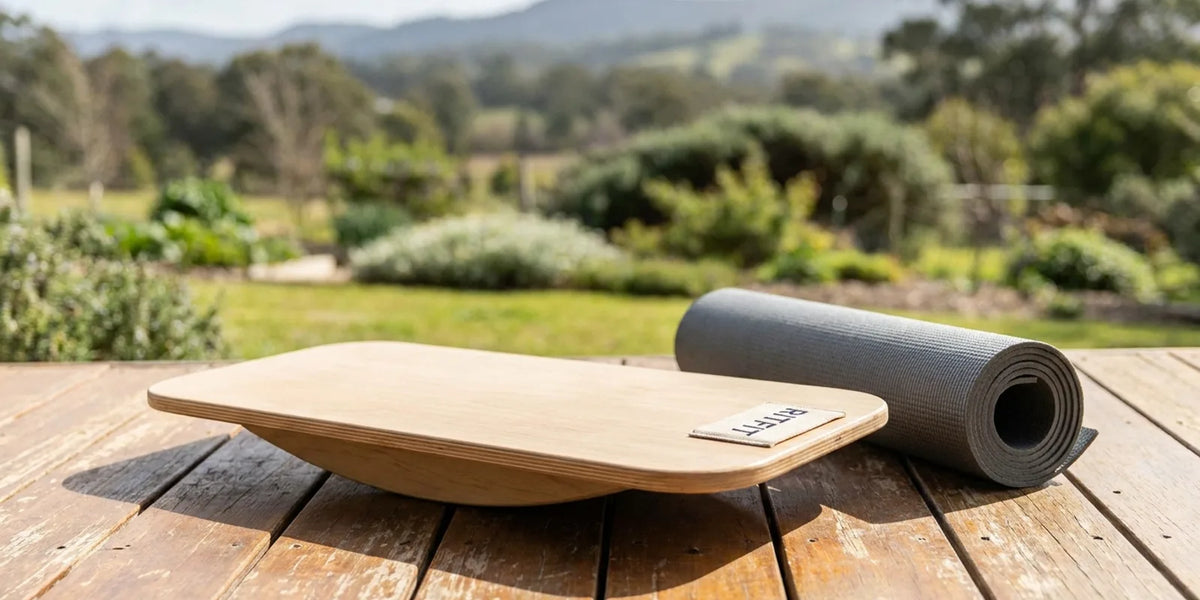
- Balance pad: An unstable foam or air-filled surface that increases proprioceptive demand during any standing exercise, from simple holds to loaded squats and pressing movements.
- Dumbbells or kettlebells: Adding load to single-leg exercises like deadlifts and lateral step-ups progressively challenges the stabilizer muscles as you grow stronger, a key driver of continued adaptation.
- Exercise ball: Useful for seated balance drills and anti-rotation core work, both of which complement standing balance training by improving trunk stability. See exercise ball exercises for specific options.
Equipment for balance and stability work is often considered a medical expense. Check whether your plan covers a HSA/FSA-eligible exercise equipment purchase before buying.
Best Complementary Exercises
Balance training produces the best results when paired with exercises that build the strength and mobility it depends on. The following movements address the lower-body strength, hip stability, and core control that underpin good balance.
- Glute bridges: Strengthen the posterior chain and improve hip extension force production, both of which support single-leg stability.
- Side-lying hip abduction: Directly targets the gluteus medius, the primary muscle responsible for frontal-plane balance control during walking and running.
- Plank variations: Build anti-extension and anti-rotation core strength that transfers directly to upright balance demands.
- Calf raises: Strengthen the ankle plantar flexors and improve ankle proprioception, which is the first point of contact for balance correction on unstable surfaces.
Adding calorie-burning exercises to your weekly schedule alongside balance training supports overall fitness without competing with the neuromuscular adaptations you are building.
FAQs About Exercise for Balance
What are the best exercises to improve balance?
Single-leg stands, heel-to-toe walks, lateral step-ups, single-leg deadlifts, and balance pad exercises are among the most effective options. Resistance exercises also significantly improve balance test scores, making them a practical addition to any training program, even without dedicated stability work.
How often should you do balance exercises?
Most guidelines recommend balance training two to three times per week. Research confirms that longer-duration programs produce greater improvements in postural control and stability, so maintaining a consistent schedule over several weeks matters more than maximizing session length on any single day.
Can resistance training improve balance?
Yes. A meta-analysis of 13 randomized controlled trials found resistance training alone improved functional reach, single-leg stance duration, and timed up-and-go scores in older adults. It also improved star excursion balance test results in general adult populations, making it a time-efficient balance training strategy.
What equipment helps with balance training at home?
A balance pad introduces an unstable surface that increases proprioceptive demand during any standing exercise. Dumbbells or kettlebells add progressive load to single-leg movements like deadlifts and step-ups, systematically challenging the stabilizer muscles as your balance control and strength improve over time.
Is balance training only for older adults?
No. Balance training benefits people of all ages by improving neuromuscular control, joint stability, and athletic performance. Research shows it reduces postural sway in general adult populations and enhances sport-specific movement quality in active individuals, making it a valuable component of any fitness program.
Conclusion
Balance training improves neuromuscular control and postural stability through consistent, progressive challenge, whether that comes from dedicated balance exercises, resistance training, or a combination of both.
Start with single-leg stands and heel-to-toe walks, progress to unstable surfaces like a balance pad, and pair your balance work with lower-body strength exercises for complete stability development.
Disclaimer
This article is intended for informational and educational purposes only and does not constitute medical advice, diagnosis, or treatment. If you have a pre-existing injury, vestibular condition, or any health concern affecting your balance, consult a qualified healthcare professional or certified personal trainer before starting a new exercise program.
References
1. Šarabon N, Kozinc Ž. Effects of resistance exercise on balance ability: systematic review and meta-analysis of randomized controlled trials. Life. 2020;10(11):284. https://pmc.ncbi.nlm.nih.gov/articles/PMC7697352/
2. Labata-Lezaun N, Rodríguez-Rodríguez S, López-de-Celis C, et al. Effectiveness of different training modalities on static balance in older adults: a systematic review and meta-analysis. Life. 2023;13(5):1193. https://pmc.ncbi.nlm.nih.gov/articles/PMC10222379/
3. Zech A, Hübscher M, Vogt L, Banzer W, Hansel F, Pfeifer K. Balance training for neuromuscular control and performance enhancement: a systematic review. J Athl Train. 2010;45(4):392-403. https://pmc.ncbi.nlm.nih.gov/articles/PMC2902034/