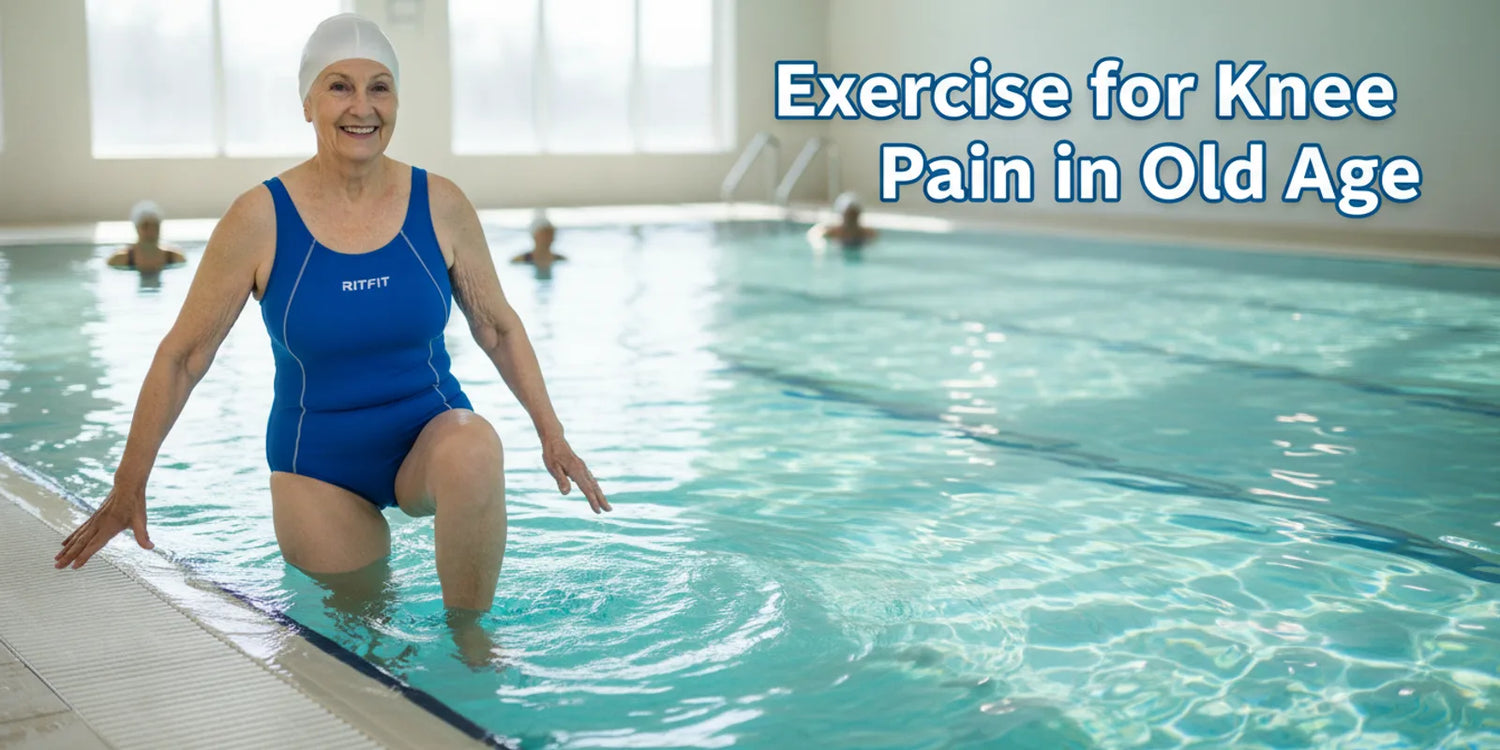
Knee pain becomes more common with age, but staying still often makes stiff, aching joints feel worse rather than better. Gentle, low-impact exercise can build the muscles that support and protect your knees.
This guide shares safe, joint-friendly moves designed for older adults, with clear reps, progression tips, and stop rules. It is general fitness guidance, not medical advice.
Table of Contents
- Why Do Knees Hurt More as We Age?
- Is It Safe to Exercise Knees in Old Age?
- 8 Low-Impact Exercises for Knee Pain in Older Adults
- How Often and How Many Reps Should You Do?
- Closed-Chain vs Open-Chain: Which Is Knee-Friendly?
- What Mistakes Should You Avoid and When Should You Stop?
- What Home Equipment Makes Knee Exercises Easier?
Key Takeaways
- Movement helps: Gentle exercise can ease knee pain and stiffness while strengthening the muscles that protect the joint.
- Go low-impact: Closed-chain moves like sit-to-stands, step-ups, and reverse lunges are gentle on aging knees.
- Start small: Aim for two to three sessions per week, begin with a few reps, and build up gradually over time.
- Strengthen the quads: Strong thigh muscles share the load with the knee joint and improve everyday function.
- Listen to your body: Mild soreness can be normal, but sharp pain or swelling means stop and check with your doctor.
Why Do Knees Hurt More as We Age?
Knees often hurt more with age because cartilage thins, muscles weaken, and conditions like osteoarthritis become more common, leaving the joint less cushioned and supported. A network meta-analysis of 39 studies with 2646 participants reported that all five exercise types studied reduced pain and stiffness and improved function in people with knee osteoarthritis, compared with no activity.[1]
- Muscle loss: Thigh and hip muscles naturally shrink with age, so the knee absorbs more force during everyday movement.
- Joint wear: Cartilage and lubrication decline over time, which can bring stiffness and aching, especially after sitting.
Movement helps the joint stay nourished and mobile, while stronger muscles act like shock absorbers. Doing nothing tends to make stiffness and weakness worse.
Is It Safe to Exercise Knees in Old Age?
For most age-related aches and mild osteoarthritis, gentle low-impact exercise is considered safe and helpful, and it rarely damages the joint when done within a comfortable range. Sharp pain, swelling, or a recent injury are signs to pause and seek guidance first.
- Check first: Talk to your doctor before starting, especially with a diagnosed joint condition, recent injury, or surgery.
- Stay pain-aware: Work in a range that feels manageable, since mild soreness can ease as you build strength.
This guidance is for general fitness, not for treating a specific medical condition. If you have a diagnosis, follow the advice of your healthcare team.
8 Low-Impact Exercises for Knee Pain in Older Adults
The most knee-friendly exercises strengthen the quadriceps, hamstrings, and glutes while keeping impact low and movement controlled. Building these muscles matters because in a randomized clinical trial of 100 patients aged 50 to 75 with knee osteoarthritis, an eight-week quadriceps strengthening program improved pain, function, and quality of life.[2]
Start with the gentle isometric moves, then add the standing exercises as you feel stronger. You can find 5 best home exercises for knee pain relief useful as a companion routine.
1. Quad Set
Sit or lie with your leg straight, then tighten the thigh muscle and press the back of the knee down, holding for five seconds before relaxing.
2. Straight-Leg Raise
Lie down with one knee bent and the other leg straight, then lift the straight leg a few inches, hold briefly, and lower slowly.
3. Seated Knee Extension
Sit tall in a chair and slowly straighten one knee until the leg is out in front, hold for a moment, then lower with control.
4. Sit-to-Stand
From a sturdy chair, stand up and sit back down slowly without using your hands, which trains the same muscles you use daily.
5. Reverse Lunge
Step one foot back and lower into a gentle lunge, keeping your weight in the front heel, then push back to standing using support if needed.
6. Step-Ups
Step up onto a low, stable step leading with one leg, control the movement, and use a handrail for balance and confidence.
7. Glute Bridge
Lie on your back with knees bent and feet flat, then squeeze your glutes and lift your hips a few inches before lowering slowly.
8. Calf Raises
Stand near a counter for support and rise onto the balls of your feet, since strong calves help stabilize the knee when walking.
The video below demonstrates several of these knee-strengthening movements with senior-friendly form cues.
A stability ball exercise routine can add a gentle, low-impact option as you progress.
How Often and How Many Reps Should You Do?
A practical starting point for older adults is two to three sessions a week, beginning with a few repetitions and building up slowly. A review of exercise for knee osteoarthritis found that moderate-intensity activity around three times weekly for 20 to 60 minutes appears optimal for symptom control, and any dose of regular exercise was beneficial, including for older and more severe cases.[3]
- Begin gently: Try 2 to 3 reps of each move at first, resting between efforts, then add 1 to 2 reps every few days.
- Progress to sets: Work toward 2 sets of 8 to 12 reps as movements become comfortable and pain-free.
- Add resistance later: Once bodyweight feels easy, a light band or ankle weight adds gentle load for continued gains.
Consistency matters more than intensity. Short, regular sessions beat occasional hard workouts for aging knees.
Closed-Chain vs Open-Chain: Which Is Knee-Friendly?
Closed-chain moves, where your foot stays planted on the ground, are usually gentler on aging knees because the joint is supported and force is shared across the leg. Open-chain moves, where the foot moves freely, can feel less stable for some people with knee pain.
"In a reverse lunge, the knee on the working leg is supported from the very beginning of the exercise. The front leg starts and stays in a closed chain position, in contact with the ground, so the stability of the front leg and knee joint is enhanced."
Jeff Cavaliere, MSPT, CSCS, Physical Therapist and Strength Coach, Athlean-X
- Closed-chain examples: Sit-to-stands, reverse lunges, step-ups, and glute bridges keep the foot grounded and the knee stable.
- Use with care: Seated knee extensions are open-chain but fine in a pain-free range, so reduce the range if you feel strain.
Adding balance exercises alongside these moves can further improve knee stability and walking confidence.
What Mistakes Should You Avoid and When Should You Stop?
The most common mistakes are pushing through sharp pain, progressing too quickly, and using poor form that lets the knee cave inward. Stop the exercise right away if you feel sharp pain, notice swelling, or your knee locks or gives way.
- Do not rush: Skipping the gradual build-up often triggers flare-ups, so add reps slowly and rest when needed.
- Mind your alignment: Keep your knee tracking over your foot during squats and step-ups rather than letting it drift inward.
- Know the red flags: Sharp pain, marked swelling, locking, or instability mean stop and check with a healthcare professional.
A little soreness early on can be normal, but pain that lingers or worsens is a signal to ease off and seek advice. Reviewing knee support and wraps may help if you want extra stability for certain movements.
What Home Equipment Makes Knee Exercises Easier?
Most of these exercises need nothing more than a sturdy chair for support and balance. As you progress, simple gear like a light resistance band, ankle weights, or light dumbbells can add gentle, controlled resistance.
- Start with a chair: A stable chair, wall, or handrail keeps you secure so you can move with confidence.
- Add light load: A pair of light exercise weights lets you progress sit-to-stands and leg lifts safely.
- Try bands: Adjustable resistance cable handles provide smooth tension that is kind to sore joints.
If cost is a concern, a guide to HSA and FSA-eligible exercise equipment can help you budget for home gear. A simple step-up exercise guide and basic grip and support accessories round out a beginner-friendly setup.
FAQs About Exercise for Knee Pain in Old Age
Is it safe to exercise if I have knee pain in old age?
For most age-related aches and mild osteoarthritis, gentle low-impact exercise is considered safe and helpful, and it can ease pain and stiffness. However, you should always check with your doctor before starting, especially if you have a recent injury, swelling, or a diagnosed joint condition.
How often should seniors do knee strengthening exercises?
A reasonable starting point for many older adults is two to three sessions per week, building up gradually over time. Moderate activity around three times weekly is helpful for symptom control. Start with a few repetitions, rest between sets, and add reps slowly as the movements become easier and comfortable.
Which exercises are gentlest on aging knees?
Closed-chain, low-impact moves where your foot stays on the ground tend to be gentlest, such as sit-to-stands, reverse lunges, step-ups, glute bridges, and isometric quad sets. Seated knee extensions and straight-leg raises are also gentle starting points. Avoid high-impact activities like jogging or jumping if they trigger pain.
Can exercise make my knee osteoarthritis worse?
No. When done within a pain-free range and with good form, appropriate strengthening exercise generally does not damage osteoarthritic knees and often improves function. Mild soreness early on can be normal, but sharp pain, swelling, locking, or giving way are signs to stop. Speak with a professional if symptoms persist or worsen.
What equipment do I need for knee exercises at home?
Most of these exercises need nothing more than a sturdy chair for support and balance. As you progress, a light resistance band, ankle weights, or light dumbbells can add gentle resistance. A wall, handrail, or counter nearby is useful for stability so you can focus on controlled, confident movement.
Conclusion
Knee pain in old age does not have to mean staying still. Gentle, low-impact exercises that strengthen the muscles around the joint can reduce pain, improve function, and help you stay active and independent.
Start with the seated moves, progress to standing exercises two to three times a week, and listen to your body. Talk to your doctor first, especially if you have a diagnosed condition.
Disclaimer
This article provides general fitness information only and is not medical advice, diagnosis, or treatment for any knee condition. Consult a qualified healthcare professional before starting any new exercise program, especially with a diagnosed joint condition, injury, or persistent pain.
References
1. Mo L, Jiang B, Mei T, Zhou D. Exercise Therapy for Knee Osteoarthritis: A Systematic Review and Network Meta-analysis. Orthopaedic Journal of Sports Medicine. 2023;11(5):23259671231172773. https://pmc.ncbi.nlm.nih.gov/articles/PMC10280533/
2. Imoto AM, Peccin MS, Trevisani VF. Quadriceps strengthening exercises are effective in improving pain, function and quality of life in patients with osteoarthritis of the knee. Acta Ortopedica Brasileira. 2012;20(3):174-9. https://pmc.ncbi.nlm.nih.gov/articles/PMC3718434/
3. Whitfield M, Tomlinson OW. Optimal exercise modalities and doses for therapeutic management of osteoarthritis of the knee. Frontiers in Aging. 2025;6:1458983. https://pmc.ncbi.nlm.nih.gov/articles/PMC11832510/