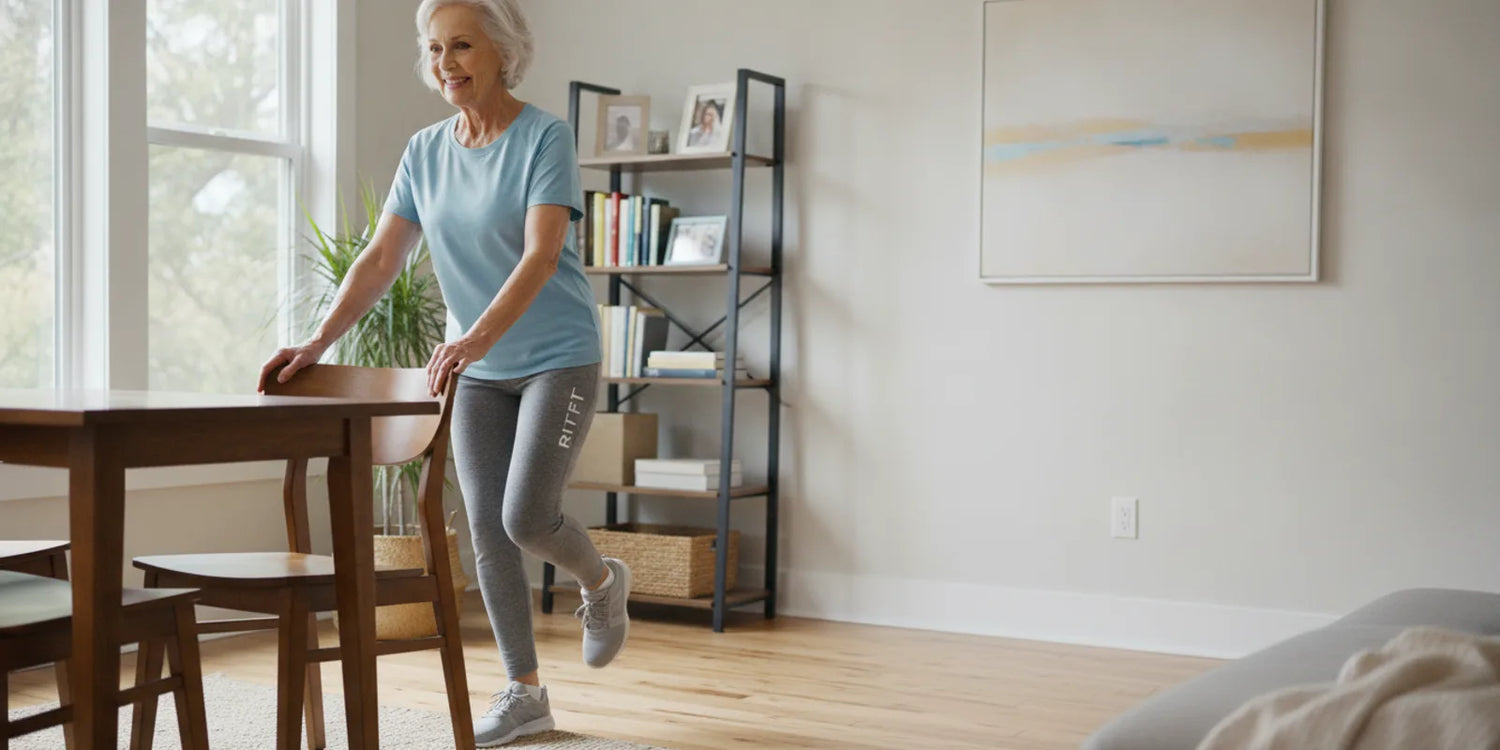
Staying strong and steady is one of the best ways to keep your independence as you age. This guide gives generally healthy older adults a safe, home based plan of strength and balance exercises to help reduce fall risk.
You will get a quick self test to pick your starting level, simple moves you can do with a chair, and clear rules for when to progress or stop.
Table of Contents
- Why Do Strength and Balance Matter More After 65?
- How Do You Pick a Safe Starting Level?
- Which Strength Exercises Build Fall Resistant Legs?
- Which Balance Exercises Should You Practice?
- How Often and How Many Reps Should You Do?
- What Are the Common Mistakes and When Should You Stop?
- What Equipment Helps Older Adults Train at Home?
Key Takeaways
- Train two things: Combine strength moves and balance drills, since both lower fall risk in older adults.
- Start where you are: Use the one leg stand test to choose an easy, medium, or harder starting level.
- Stay supported: Keep a sturdy chair or counter within reach until each move feels stable.
- Be consistent: Aim for strength work 2 or more days a week plus regular walking.
- Know your limits: Stop on sharp pain or dizziness, and get medical clearance before you begin.
Why Do Strength and Balance Matter More After 65?
Strength and balance matter more after 65 because muscle and steadiness naturally decline with age, and that loss is what drives most falls. A systematic review and meta analysis of randomized controlled trials found that exercise improves balance function and reduces fall risk in older adults[1].
- Leg strength: Stronger legs make it easier to rise from a chair, climb stairs, and catch yourself if you stumble.
- Steadiness: Balance practice trains the reflexes that keep you upright on uneven ground.
- Confidence: Feeling stable reduces fear of falling, so you stay active and keep your independence.
You cannot remove every risk, but the right routine meaningfully lowers your chances of a fall and a serious injury. The same foundations apply whether you are 65 or well into your 80s.
"The only way to build real strength with an eye towards longevity is to make sure you're focusing on this, because your flexibility, mobility, and stability are the true foundation of where you want to focus if you want to build lasting strength."
Jeff Cavaliere, MSPT, CSCS, Physical Therapist and former Head Physical Therapist for the NY Mets, Athlean-X
How Do You Pick a Safe Starting Level?
You pick a safe starting level with a simple one leg stand test that shows how steady you are right now. Hold a chair or counter, stand on one leg, and time how long you stay balanced before you wobble or set your foot down.
The 30 Second One Leg Stand Self Test
If you cannot let go without wobbling or putting your foot down, start at the easiest level with full hand support, and if you can hold close to 30 seconds unsupported you can begin at the most challenging level.
- Level 1: You need to hold on the whole time, so keep both hands on support for every exercise.
- Level 2: You hold on occasionally, so use light fingertip support and progress slowly.
- Level 3: You can manage about 30 seconds unsupported, so you can try moves with less support.
Setting Up a Safe Space
Clear a space near a sturdy chair or kitchen counter you can reach, and wear well fitting shoes with good grip rather than socks or loose slippers.
Which Strength Exercises Build Fall Resistant Legs?
The strength exercises that build fall resistant legs focus on standing up, rising onto your toes, and controlling your knees and hips. These moves target the muscles you use every day to walk, climb, and recover from a stumble.
Sit to Stand From a Chair
Sit at the front of a sturdy chair with feet flat, then stand up and sit back down with control, using your hands on the seat or a counter only if needed. Aim for 10 to 15 repetitions.
Standing Heel Raises
Hold the back of a chair, push up onto your tiptoes as high as you can, then lower your heels slowly to strengthen your calves and ankles. Repeat 10 to 15 times.
Standing Knee Curls and Leg Extensions
Holding support, lift one heel toward your buttock for a knee curl, then in a chair straighten one leg out front for a leg extension, doing 10 to 15 each side.
Wall Push Ups and Seated Band Rows
Wall push ups build upper body strength with low risk, and seated rows with an elastic band strengthen your back and arms while you stay supported.
- Seated option: Do strength moves sitting down if standing feels unsafe, then progress to standing versions later.
- Add load gently: Once a move feels easy, add light dumbbells, ankle weights, or a band for resistance.
For more variations you can explore these leg exercises and these resistance band exercises you can do at home.
Which Balance Exercises Should You Practice?
The balance exercises you should practice progress from a wide stance to a narrow stance to standing on one leg. In one trial, older women with a history of falls who trained 3 times a week for 8 weeks improved their standing balance and reduced postural sway[3].
Feet Together to Tandem to One Leg Holds
Start with feet shoulder width apart and hold for 10 seconds, work up to 30 seconds, then progress to feet together, heel to toe, and finally one leg stands as your steadiness improves.
Side Stepping and Heel to Toe Walking
Step sideways along a counter and walk heel to toe in a straight line to train the dynamic balance you use when turning or navigating tight spaces.
- Use support smartly: Reduce your hold from full grip, to fingertips, to hovering hands as you get steadier.
- Add resistance: An 8 week home program of balance plus elastic band exercises improved strength and balance even in adults over 75[2].
Once standing balance feels solid, you can challenge yourself further with tools like wobble board exercises or exercise ball exercises, always keeping support nearby.
How Often and How Many Reps Should You Do?
You should do muscle strengthening exercises on 2 or more days a week and practice balance most days, since balance drills are gentle and safe to repeat. According to MedlinePlus, older adults should also aim for about 150 minutes of aerobic activity such as walking each week.
Reps, Sets, and When to Add Light Weight or Bands
Begin with a few repetitions of each move and build toward 10 to 15 reps, resting a minute or less between exercises and adding light load only once a move feels easy and stable.
Pairing Strength Days With Walking Days
Alternate strength and balance days with walking days, for example exercises on Monday and a 10 to 30 minute walk on Tuesday, to cover both goals without overdoing it.
The short routine below from the National Institute on Aging shows how warm up, strength, and balance moves fit together in a single home session.
To build your weekly walking habit, you might also read about the benefits of treadmill exercises.
What Are the Common Mistakes and When Should You Stop?
The most common mistake is progressing too fast and letting go of support before you are steady enough. Rushing into harder moves or skipping the warm up raises your fall risk instead of lowering it.
- Holding your breath: Breathe steadily through each move rather than tensing and holding your breath.
- Poor footwear: Avoid socks and loose slippers, which slide and reduce your grip on the floor.
- No support nearby: Always keep a chair or counter within reach during balance work.
Stop any exercise that causes sharp pain, chest tightness, dizziness, or unsteadiness that could lead to a fall, and talk to your doctor if symptoms continue. People managing conditions like blood pressure should review safe options, such as the best exercises for high blood pressure.
What Equipment Helps Older Adults Train at Home?
The equipment that helps older adults train at home is simple and optional, since a sturdy chair and a counter cover most beginner exercises. As you get stronger, light resistance tools add gentle load so you can keep progressing safely.
- Elastic bands: A set of resistance bands adds adjustable, low impact resistance for seated and standing moves.
- Light dumbbells: A pair of light dumbbells helps progress arm curls and overhead raises once bodyweight feels easy.
- Why bands help: Learn more about what resistance bands help with for low impact strength.
If you want a compact set to start with, a dumbbell and rack package keeps light weights organized and within reach at home.
FAQs About Exercises for Elderly
What are the safest exercises for elderly people to start at home?
Begin with seated and supported moves such as sit to stand from a sturdy chair, standing heel raises while holding a counter, and feet together balance holds. These build leg strength and steadiness with minimal fall risk. Always keep a chair or counter nearby for support, and progress to unsupported versions only once each move feels stable.
How often should older adults do strength and balance exercises?
Aim for muscle strengthening exercises on at least 2 days a week and balance practice on most days, since balance drills are low intensity and safe to repeat. Pair these with about 150 minutes of walking or other aerobic activity weekly. Start with a few repetitions per move and gradually build up as your strength and confidence improve.
Do seniors need equipment to exercise for fall prevention?
No, many effective moves like sit to stand, heel raises, and balance holds need only a sturdy chair or counter for support. As you get stronger, light dumbbells, ankle weights, or an elastic resistance band can add gentle load to keep progressing. Equipment is optional, so begin with bodyweight versions and add resistance only when the basics feel easy.
When should an older adult stop exercising and call a doctor?
Stop any exercise that causes sharp pain, chest tightness, severe shortness of breath, dizziness, or unsteadiness that could lead to a fall. Talk to your doctor before starting if you feel light headed, have blurred vision, ringing ears, or numbness in your feet. Always get medical clearance first if you have health conditions or balance problems.
How do I know which difficulty level to begin at?
Try standing on one leg while holding a chair and timing yourself. If you cannot let go without wobbling or putting your foot down, start at the easiest level with full hand support. If you can hold briefly with occasional support, choose the middle level. If you manage close to 30 seconds unsupported, begin at the hardest level.
Conclusion
A safe home routine for older adults combines simple strength moves with progressive balance drills, always with support nearby. Pick your level, stay consistent, and add walking through the week.
Start with seated and supported versions, then reduce your hold and add light resistance only as each move feels stable and easy.
Disclaimer
This article offers general fitness information for healthy older adults and is not medical advice, rehabilitation guidance, or treatment for any injury or condition. Talk with your doctor or a physical therapist before starting a new exercise program, especially if you have balance problems or health concerns.
References
1. Yu H, Zhong J, Li M, Chen S. Effects of exercise intervention on falls and balance function in older adults: a systematic review and meta-analysis. PeerJ. 2025;13:e20190. https://pmc.ncbi.nlm.nih.gov/articles/PMC12536800/
2. Cho SI, An DH. Effects of a Fall Prevention Exercise Program on Muscle Strength and Balance of the Old-old Elderly. Journal of Physical Therapy Science. 2014;26(11):1771-4. https://pmc.ncbi.nlm.nih.gov/articles/PMC4242952/
3. Zouita S, Zouhal H, Ferchichi H, et al. Effects of Combined Balance and Strength Training on Measures of Balance and Muscle Strength in Older Women With a History of Falls. Frontiers in Physiology. 2020;11:619016. https://pmc.ncbi.nlm.nih.gov/articles/PMC7786296/