








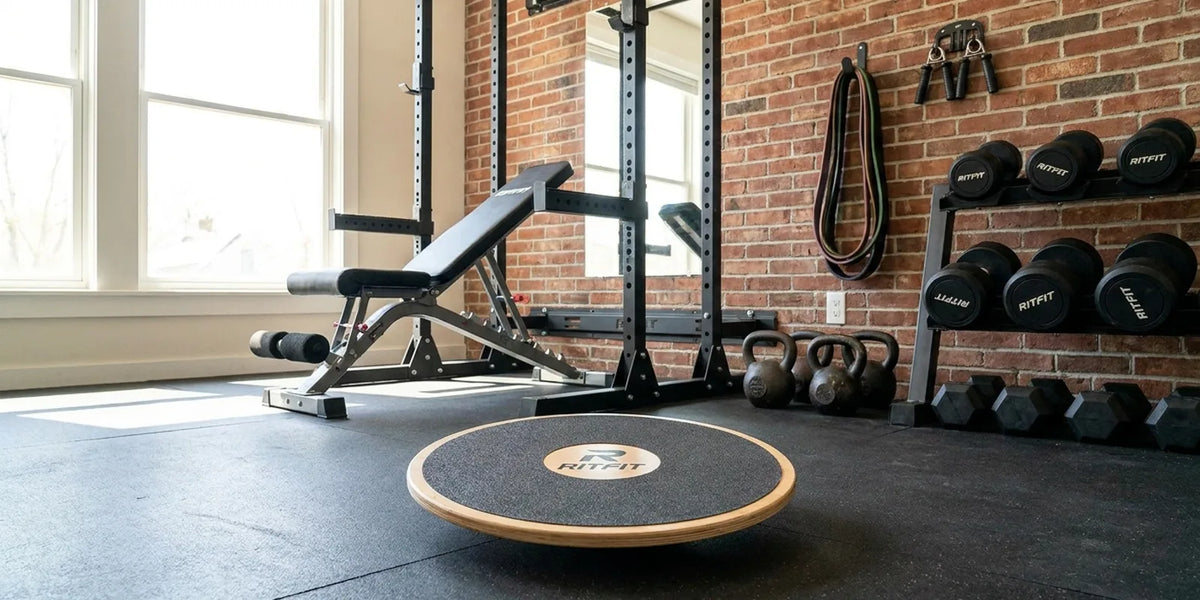
A wobble board is a small, rounded platform balanced on a fulcrum that rocks in every direction. It is one of the most effective pieces of home gym equipment for building balance, ankle strength, and core control.
This guide covers the benefits of balance board training, step-by-step wobble board exercises for every level, and the safety rules that keep you injury-free. You do not need prior experience to start.
Quick Answer: Wobble board exercises train your ankles, lower legs, and core by forcing small stabilizer muscles to work on an unstable surface. Beginners start with basic standing balance, then progress through side-to-side taps, balancing squats, kneeling spins, and eyes-closed holds on a mat, mastering each level before advancing.
Key Takeaways
- Balance: Regular wobble board training strengthens the stabilizer muscles in your ankles, feet, and lower legs.
- Core: Side-to-side taps and balancing squats force your core to fire constantly to keep the board level.
- Progression: Start with standing balance, then add movement, then close your eyes with a spotter nearby.
- Frequency: Three short sessions a week are enough to build balance without overloading your joints.
- Safety: Use a mat or thin carpet and keep enough space and support around you at all times.
What Are the Benefits of Wobble Board Training?
Wobble board training improves balance by strengthening the small stabilizer muscles around your ankles, feet, and core. It is a standard tool in balance training and ankle rehabilitation programs.
- Ankle strength: Balancing on an unstable surface forces the muscles and tendons around the ankle to work harder, which helps people with weak ankles.
- Core control: Keeping the board level requires constant, small adjustments from your core and lower body.
- Stability: Standing balance work transfers to everyday tasks such as walking, climbing stairs, and sport.
- Rehabilitation: Physical therapists often use balance boards as part of recovery from ankle sprains and other lower-leg injuries.
Balance training is especially valuable for older adults who want to stay steady on their feet, and you can pair it with other low-impact routines such as our exercises for elderly guide.
How Do You Start Balancing on a Wobble Board?
Stand on the board with your hands loosely at your sides and try to keep it steady and level for as long as you can. Start with about 30 seconds and build up from there.
- Set up safely: Place the board on a thin carpet or workout mat before you step on it.
- Feet: Stand with your feet hip-width apart and your knees slightly soft.
- Focus: Look at a fixed point ahead instead of watching your feet.
This basic balancing hold is the foundation for every other exercise in this guide, so spend a few sessions getting comfortable with it.
Side-to-Side Taps: How Do They Build Core Control?
Side-to-side taps build core control by asking you to lean left and right so the edge of the board touches the ground. Move slowly and control the motion with your core rather than your arms.
- Position: Stand on the board with bare feet and keep your arms relaxed.
- Motion: Tilt to one side until the board edge touches the floor, then return to center.
- Repeat: Alternate sides for 60 seconds at a controlled pace.
This movement trains the same core and waistline muscles targeted by our exercises for stomach and exercises for waistline guides.
How Do You Perform the Balancing Squat?
The balancing squat combines a squat with balance work. Begin with your feet hip-width apart and your legs straight, then sink down as if sitting in a chair while keeping your head and shoulders in a vertical line.
- Engage first: Brace your core before you start to descend.
- Depth: Sink only as deep as you can control without wobbling.
- Return: Slowly straighten your legs and come back to standing.
Once you feel stable here, you can combine this with other lower-body work such as our leg exercises guide.
How to Do the Kneeling Spin?
The kneeling spin is an intermediate exercise where you kneel on the board with your hands on your hips and rotate slowly using your abdominals. It trains core rotation and control on an unstable surface.
- Position: Kneel on the board with your knees hip-width apart and your hands on your hips.
- Motion: Rotate your upper body slowly in one direction while your hips stay centered.
- Reverse: After a few rotations, slow down and switch to the opposite direction.
Stop the movement if you feel the board tipping past your control point, and return to standing balance before trying it again.
The Eyes Shut Exercise: Why Do You Need a Spotter?
The eyes shut exercise removes visual balance cues and is only for advanced users with a spotter nearby. Balancing without sight makes your inner ear and proprioceptors do all the work.
- Setup: Balance on the board with your eyes open and lift one foot off the ground.
- Close: Close your eyes and switch which foot carries your weight.
- Spotter: Have a spotter ready to catch you if you lose your balance.
Build up to this move slowly, and only after the other exercises feel automatic.
"What I advise in most cases is, instead of looking for a spotter to take you through those areas of a lift that are more difficult, think of other ways you can improve your ability to complete that lift, if strength is your goal."
Jeff Cavaliere, MSPT, CSCS, Physical Therapist and Strength Coach, former Head Physical Therapist for the NY Mets, Athlean-X
How Often Should You Train With a Wobble Board?
Train with a wobble board two to three times a week for ten to fifteen minutes per session. This gives your joints time to adapt while still building balance steadily.
- Start small: One or two sessions a week for the first two weeks.
- Progress: Add a third session and longer holds as balance improves.
- Listen: Stop any exercise that causes joint pain or dizziness.
You can slot balance work around other home routines such as our ab roller exercises or aerobic stepper exercises for beginners guides.
Wobble Board Safety: What Should You Watch For?
Wobble board safety starts with the surface. Always place the board on a thin carpet or workout mat, never on a hard floor where you can slip and injure yourself.
- Mat: Use a non-slip mat and check that it does not slide before you step on.
- Space: Keep a wall, rail, or stable surface nearby for support in early sessions.
- Level: Do not attempt advanced moves until basic balancing feels steady.
Instability tools share the same training principles, so our exercise ball exercises guide explains similar progressions for balance and core work.
FAQs About Wobble Board Exercises
How often should I use a wobble board?
Use a wobble board two to three times per week for about ten to fifteen minutes each session.
Balance training is effective in short, consistent doses.
Rest days between sessions let your ankle and core muscles adapt.
Start with three sessions and adjust based on how your body feels.
Is a wobble board good for weak ankles?
Yes.
A wobble board strengthens the stabilizer muscles around your ankles by forcing them to work on an unstable surface.
Physical therapists often use balance boards during ankle rehabilitation.
Start with short balancing sessions and progress slowly.
Stop if you feel sharp pain in the joint.
Can beginners use a wobble board?
Yes.
Beginners should start with basic standing balance and place the board on a mat or thin carpet.
Keep a wall or stable surface nearby for support in the first sessions.
Master steady balancing before moving to side-to-side taps or squats.
Progress one level at a time.
Should I use a wobble board on a hard floor?
No.
A wobble board on a hard floor can slip out from under you and cause a fall.
Place it on a thin carpet or workout mat to keep it stable.
Check that the mat does not slide before you step on.
This simple step prevents most training injuries.
How long should I balance on a wobble board?
Start with holding a steady balance for about 30 seconds on each side.
Build up to one to two minutes as your ankles and core get stronger.
Longer holds add little extra benefit for most people.
Focus on quality and control rather than duration.
Is the wobble board good for balance training after injury?
Balance boards are a common tool in ankle rehabilitation because they retrain stability.
You should only use one after your doctor or physical therapist approves it.
Start with assisted balance near a wall and short sessions.
Never push through pain during rehabilitation.
Conclusion
Wobble board exercises are a simple, low-cost way to build balance, strengthen your ankles, and train your core at home. Start with standing balance, add side-to-side taps and balancing squats, and progress to advanced moves only when the basics feel steady.
Use a mat, keep support nearby, and train two to three times a week. Pair your wobble board with other home workouts to build a complete routine, and browse the RitFit sale for equipment that fits your home gym.
Disclaimer
Wobble board training involves risk of falling and injury. Consult your doctor or a physical therapist before starting if you have a history of ankle, knee, or balance problems, and stop any exercise that causes pain.





