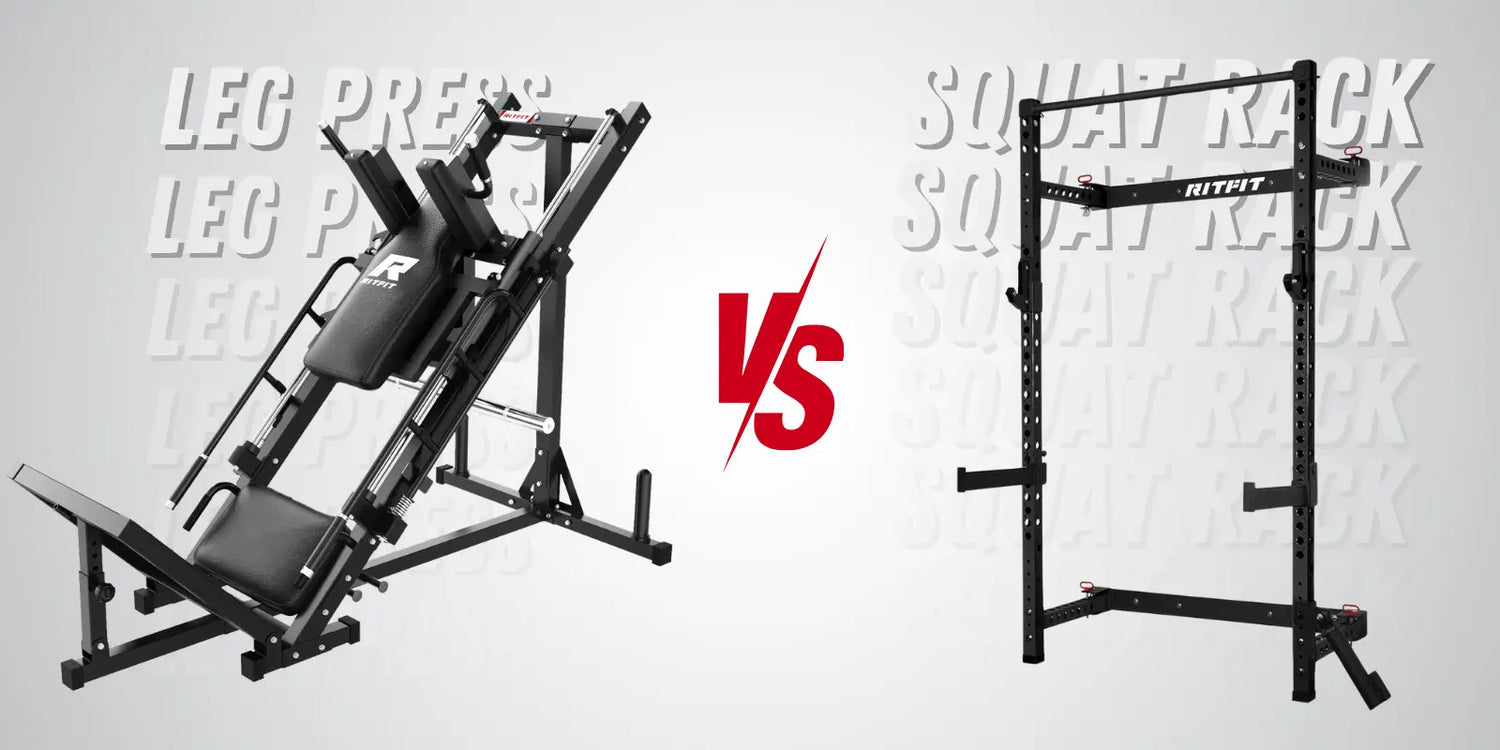
Leg press vs squat rack is really a one-machine question, and the answer depends on the job your program cannot cover today.
This comparison covers what each station trains, the floor and ceiling each one needs, how they behave when you lift alone, and how far each can grow with you.
Quick Answer: A squat rack is the better single purchase when you still need squats, lunges, presses, and pulling in one footprint, while a leg press is the better single purchase when supported lower-body volume is your only gap. The rack trains more patterns, and the leg press trains the quads harder with less skill and spinal load.
Key Takeaways
- Different jobs: A rack is a training platform that covers squat, hinge, press, and pull patterns, while a leg press is a single-purpose tool that covers one movement family extremely well.
- Coverage beats force: Buy the station that fixes the movement you cannot train at home today, not the one that lets you load the most plates.
- Space fails differently: Racks are limited by ceiling height and standing room, and leg presses are limited by the long rectangle the carriage travels through.
- Solo training favors the sled: A fixed path and a backrest make hard leg sets easier to finish alone, while a rack depends on correctly set safeties.
- Expansion favors the frame: Racks absorb hack squat, belt squat, and pulley attachments, and a leg press stays a leg press.
Which Machine Fits a One-Machine Home Gym?
A squat rack wins when you still need to squat, hinge, press, and pull, and a leg press wins when lower-body volume is your only gap.
Buyers stall on this question because both machines load the legs heavily, so the choice reads as a strength contest rather than a coverage question. It is a coverage question.
Work through three checks before you compare price:
- Coverage: List the patterns you cannot train with the equipment you already own. If squats, hinges, presses, or rows are on that list, only one of these machines can fix it.
- Skill: A leg press asks for load and depth control. A rack asks for bracing, foot position, and bar path awareness, which takes weeks to learn.
- Headroom: A sled tolerates a low ceiling. A rack does not, and no attachment solves that.
If two of those three answers point at a rack, the rack is the purchase even when the leg press looks more appealing in a showroom.
The comparison below is the short version. Everything after it explains the reasoning behind each row.
| Factor | Leg Press | Squat Rack |
|---|---|---|
| Primary job | Supported lower-body volume | Whole-body compound lifting |
| Skill to start | Low | Moderate |
| Spinal load | Minimal | Direct |
| Exercise range | Press, hack squat, calf raise | Squat, press, hinge, pull, carry |
| Space limit | Length in front of the pad | Ceiling height and standing room |
| Training alone | Forgiving | Depends on safeties |
| Expansion | Fixed after purchase | Attachments add stations |
The table describes how each machine is used in a home gym, not how one brand performs against another.
One more consideration belongs in this first decision. If you lift in a rental, a basement, or a room you may leave, a leg press travels through doorways and stair turns more easily than a tall frame.
For the wider version of this argument, the breakdown of power rack vs squat rack explains what the different frame styles buy you.
What Does a Leg Press Train That Free Weights Cannot?
A leg press trains the quadriceps, glutes, hamstrings, calves, and adductors while a backrest carries your trunk, so the legs fail before your position does.[1]
Knee and hip extension do the work, and the pad removes the balance and spinal loading that a free-weight squat adds.
Free-weight squats train the same muscles but charge you for balance, bracing, and spinal loading on every rep.
The difference is not which muscles switch on. It is which system quits first.
On a sled, the answer is almost always local leg fatigue, which is exactly the signal you want when the goal is more quad work.
Foot placement changes the feel more than the pattern:
- Higher and wider: More hip and adductor contribution, plus a longer stretch at the bottom.
- Lower and narrower: More knee travel, which usually feels quad dominant and is less kind to sensitive knees.
A systematic review of leg press variants found the quadriceps dominating the signal across setups, with limited evidence that stance changes shift emphasis as much as lifters assume.[1]
That is why the sled scales so well for volume. You can take a hard set close to failure without a spotter, a safety catch decision, or a tired trunk turning the last rep into a spinal lift.
Beginners also learn effort faster here, because load and depth are the only variables that matter in week one.
The tradeoff is honest. A leg press builds the legs and teaches you almost nothing about standing under a load, so it cannot prepare you for a barbell squat or a carry.
If you are moving from a plain sled to a combo frame, the walkthrough on how to use a leg press hack squat machine covers the setup change and the hack squat position.
Squats are my favorite exercise, but a lot of people can't do them because of various lower-back issues.
In that case, the leg press is also a really good exercise for building the thigh.
It baffles me that so many people don't think the leg press is useful.
It's such a simple movement that works so well.
John Meadows, IFBB Pro Bodybuilder and Coach (Mountain Dog Training) at Mountain Dog Diet, in Mountain Dog Training for Legs (Muscle & Fitness)
Why a Rack Still Covers More Ground Per Square Foot
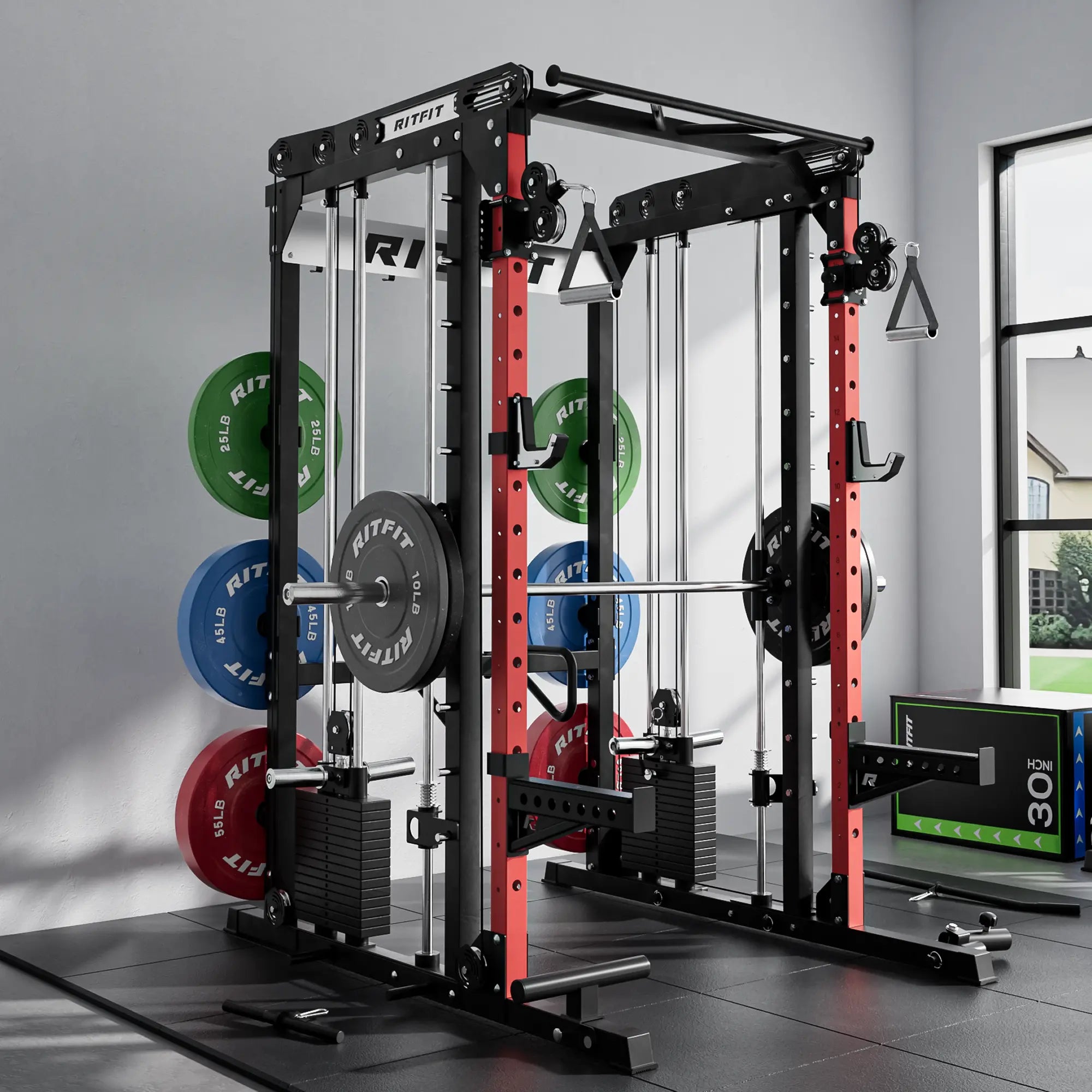
A rack covers more training per square foot because one frame supports squats, front squats, split squats, lunges, hip thrusts, calf raises, presses, and rows.
A leg press covers a single movement family, however well it covers it.
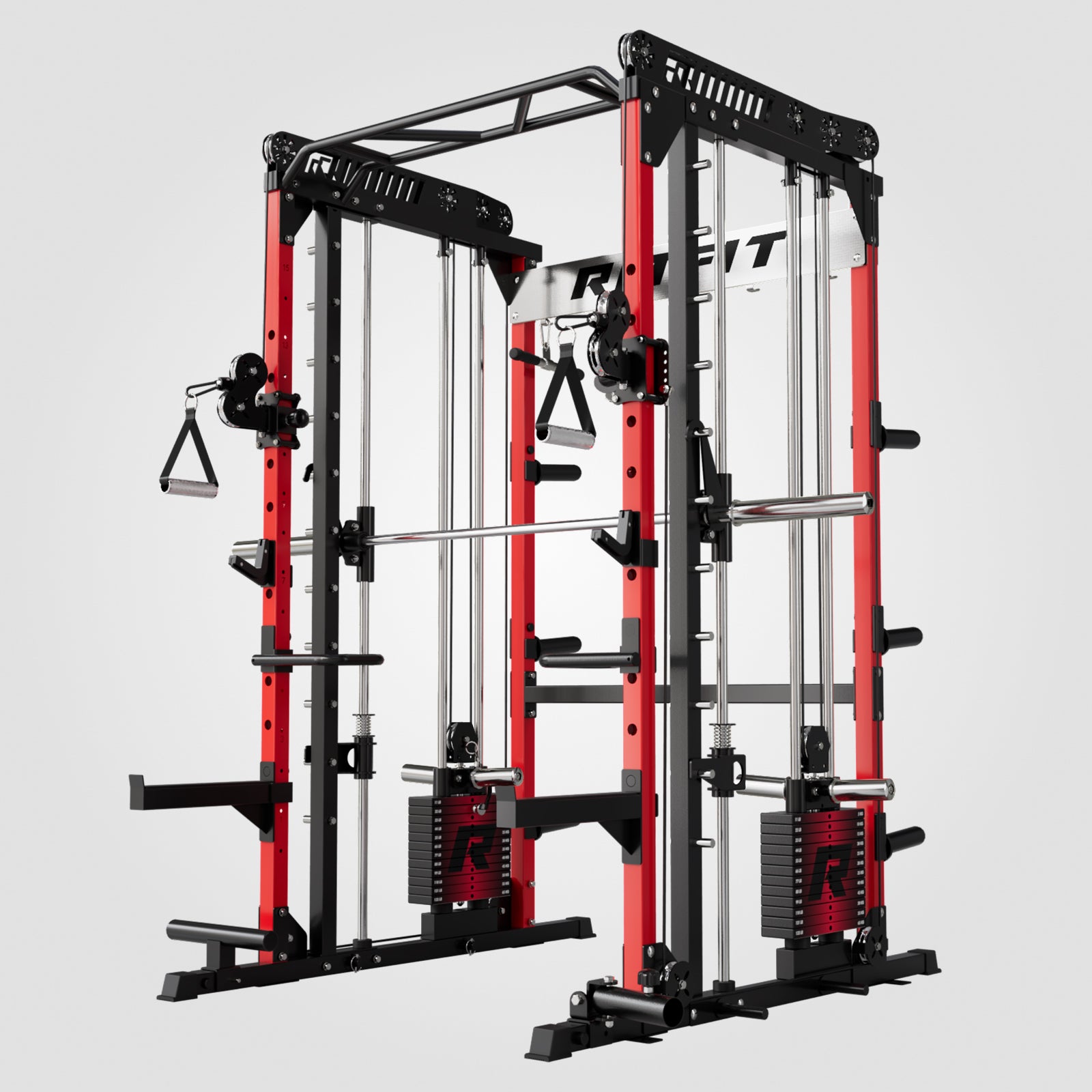
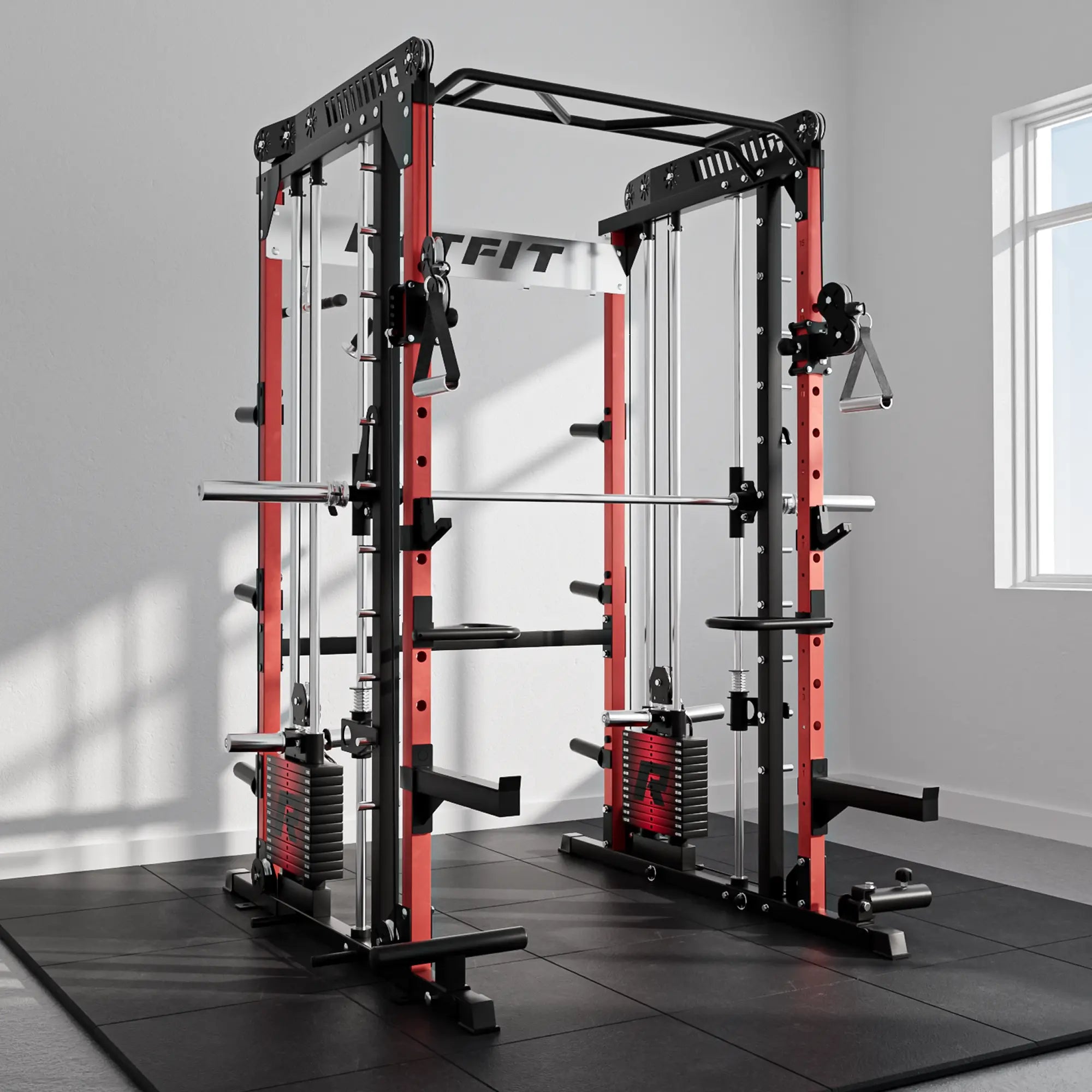
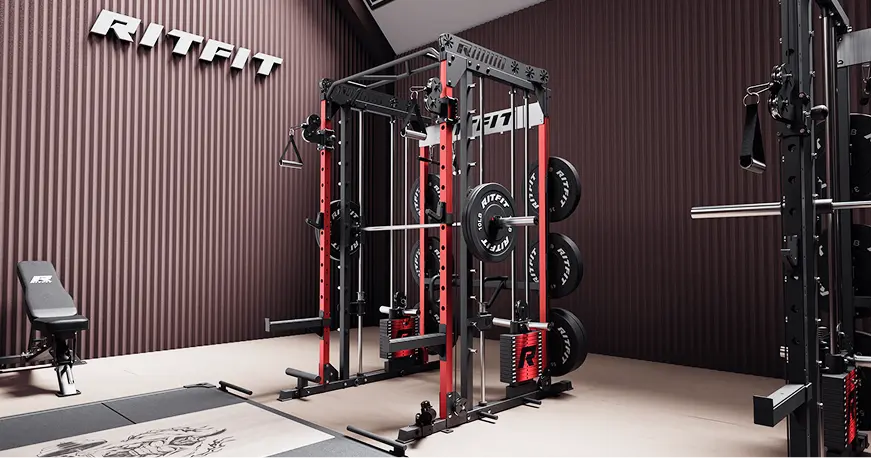
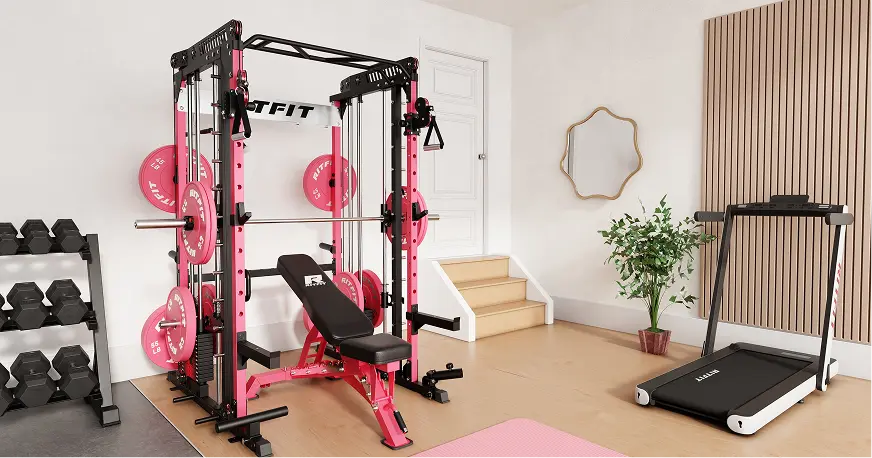
RitFit builds that coverage in layers. The RitFit M1 PRO pairs a guided bar with a cable crossover and a pull-up bar, and the published figures are a 352 lb Smith bar capacity, 11 bar height settings, 15 cable positions, and a 2:1 pulley ratio.
That combination is what makes a rack a platform rather than a squat stand. You can bench in it, row in it, and press in it without adding another frame.
If a lat pulldown matters more than a crossover, the RitFit PSR05 puts a pulldown station on the same footprint, and the RitFit BUFFALO carries both a lat pulldown and a cable crossover.
At the entry end, the RitFit PPC02 power cage does less, and it still holds a bar for squats and presses.
Nothing on the leg press side competes with that list per square foot. The RitFit Smith machine collection shows the current frames side by side if you want to compare station counts.
The tradeoff is skill and setup time. Every movement on a rack asks you to set your feet, brace, and control a path, and that cost is why some lifters stall on racks and thrive on sleds.
A rack also adds a second kind of work you may not want. Loading and unloading a bar, changing plates between stations, and resetting safeties all take minutes that a plate-loaded sled does not.
How Much Floor Space and Ceiling Height Each One Needs
A rack is limited by height and a leg press is limited by length, so measure your ceiling first and your free floor second.
That single sentence prevents most returned orders.
Racks are tall. The RitFit M1 PRO publishes 82.8 inches of clearance under its pull-up bar, which is worth checking against your joists before you order rather than after delivery.
Add the room you need to stand behind the bar, load plates, and step in and out, then compare that total with the floor you can actually keep clear.
Leg presses are long. A 45 degree sled sends the carriage forward and up, so the machine claims a rectangle in front of the back pad that you cannot share with a bench, a rack, or a walkway.
Headroom matters far less on that side, which is why sleds suit basements and spare rooms with low joists.
Both machines need a delivery path. Measure the door, the stair turn, and the landing before you buy, because a frame that will not fit through a doorway becomes a frame you resell at a loss.
Assembly space is the step buyers forget. You need room to lay the frame flat and walk around it, and that footprint is usually larger than the machine will be when it is standing.
The guide to standard squat rack dimensions covers the clearances that matter when you plan a room around a frame.
Noise, Safety, and Training Without a Spotter
A leg press is the quieter and more forgiving machine when you train alone, while a rack asks you to set safeties correctly on every solo set.
Neither is dangerous by design, but they fail in different ways.
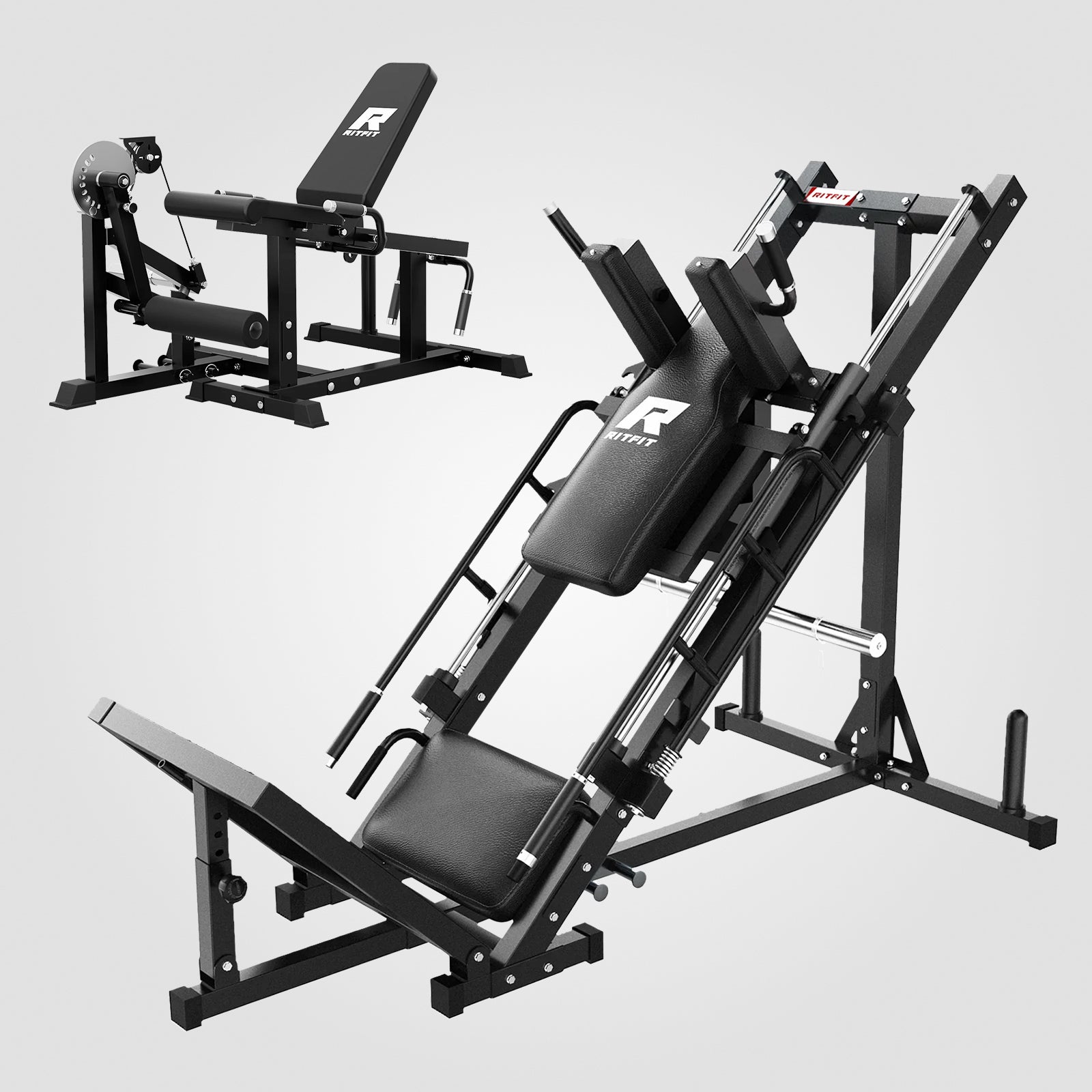
On a sled, the carriage runs on guide rods and the load stops where you stop it. RitFit builds the BLP01 with a cushioning pad under the carriage, which softens the bottom of the rep and takes the edge off plate noise.
On a rack, noise comes from the bar, the plates, and the pins, and it travels through a concrete floor into the room above.
Rubber mats and controlled lowering do more for that than any machine choice, and they cost a fraction of a second frame.
Safety is a setup question rather than a machine question. A sled narrows the ways a rep can fail because the path is fixed and the carriage re-racks at a height you choose before the set starts.
A rack gives you a bar you can leave on the safeties, but only when those safeties sit at the right height for the lift you are doing.
If you train alone at home, set the safeties one notch below your lowest controlled position and test that setting with an empty bar before you load it.
Beginners should also treat the first month on a rack as a positioning project. Learn where your feet go, how deep you can sit without your back rounding, and how the bar feels when it leaves the hooks.
Can You Add Leg Press Work to an Existing Rack?
You can add hack squat work to a rack, but an attachment gives you a guided squat pattern rather than a true leg press.
The distinction matters when your goal is maximum quad volume with minimum setup.
The RitFit AT02A hack squat attachment fits 2x2, 2x3, and 3x3 inch uprights and turns a compatible rack into a hack squat station.
That covers the hack squat pattern well, and it does not give you the reclined torso and fixed foot plate that make a sled comfortable for high-rep pressing.
The load path is the giveaway. On an attachment you still carry the carriage with your shoulders and steer it with your feet, and on a sled the back pad carries you.
If a sled is the missing piece, buying a sled is the honest answer. Attachments extend a rack, and they do not replace a machine built around one job.
One exception is worth knowing. If your rack already carries a cable system, you can add pressing volume with cable work and postpone the sled decision for a season.
The RitFit leg press machine collection lists the frames that own that job outright.
Three Home Setups and Which Station Wins Each One
Three common home gyms produce three different answers, and none of them requires owning both machines.
Match your room and your program to the closest case before you look at a single listing.
- Garage with tall ceilings and one lifter: The rack wins. You get squats, presses, rows, and pull-ups from one footprint, and the ceiling is the only thing that would have stopped you.
- Basement with low joists and a bar already on a stand: The leg press wins. Headroom is the binding constraint, and a sled turns a room you cannot squat in into a room where you can still train legs hard.
- Spare room with a rack already assembled: Add a hack squat attachment or a sled rather than a second frame. You are buying volume, not coverage.
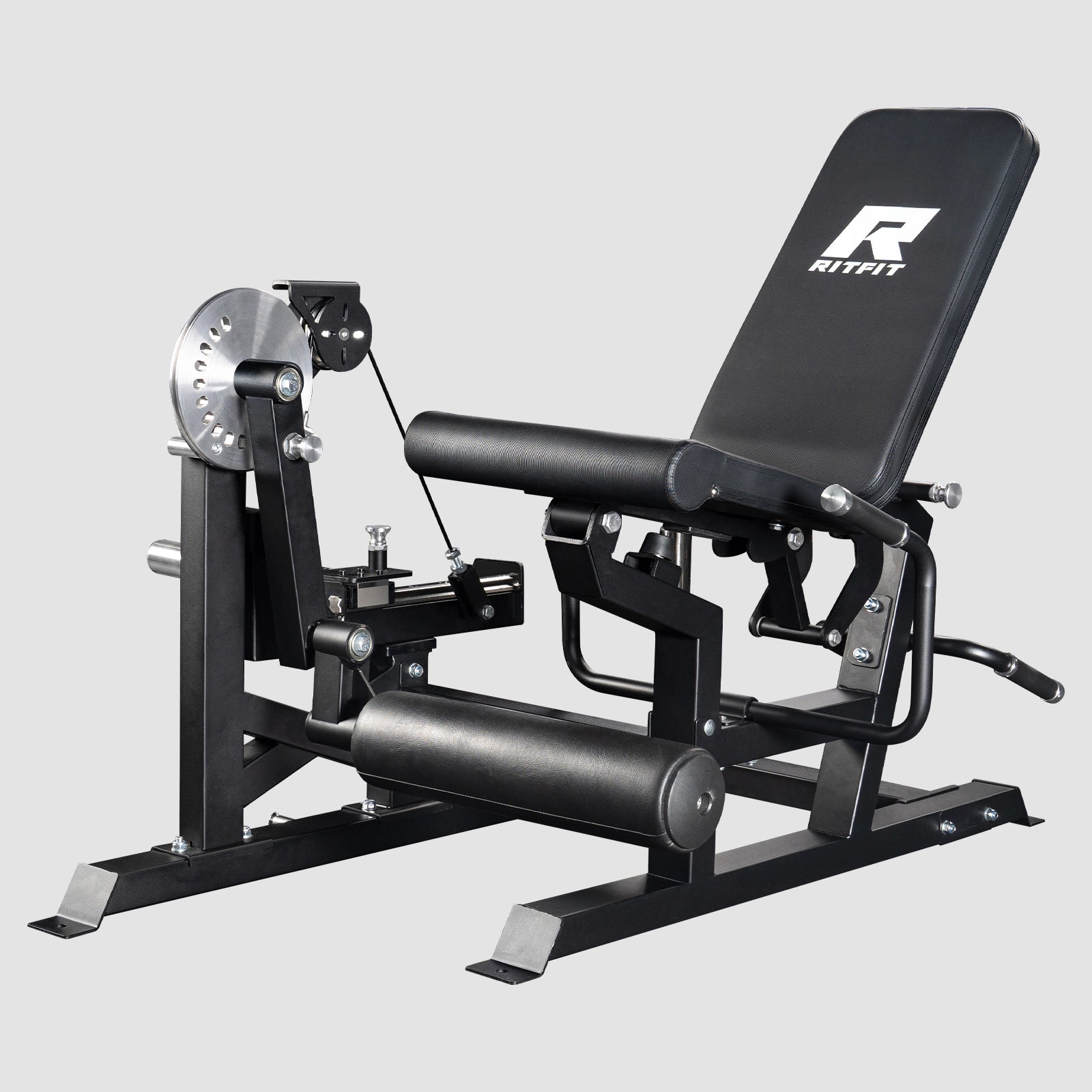
If you already own a leg extension and leg curl unit such as the RitFit PLC01, the leg press question changes.
That unit covers knee flexion and extension on its own, so the sled's main advantage shrinks and the rack becomes the better use of floor space.
The opposite is true when your only lower-body tool is a pair of dumbbells. In that room, a sled adds more usable leg work per dollar than another bar.
Write the answer down before you shop. A decision made in a showroom, in front of the machine you find most impressive, rarely survives the first month at home.
Should You Buy the BLP01 for a Small Room Leg Press?
The RitFit BLP01 is the practical pick for a small room because its adjustable footboards let you reach full depth with your back on the pad.
Its five hack squat settings and three leg press settings are the reason that fit is possible.
The RitFit Gazelle Pro keeps the same three-station layout and sells range of motion as its advantage instead.
That difference matters more than it sounds. A footboard that sits too far forward pushes your hips off the pad, and no amount of leg strength fixes a position you cannot reach.
The BLP01 also publishes a cushion over two inches thick behind the shoulders and back, and it is listed at $799.99.
Both machines cover leg press, hack squat, and calf raise work on a guided carriage.
For a small room, the test is which settings let you reach full depth without your lower back rounding off the pad.
Adjustability buys that fit, so count the positions before you count the stations.
Delivery matters as much as footprint here. A combo frame arrives in several boxes, and the longest of them decides whether the machine reaches your room at all.
The RitFit BLP01 vs Gazelle Pro comparison walks through the frame and station differences in more detail.
"This is a well constructed leg press/ hack sqwat machine. It was easy to assemble and works perfectly!"
Nate W. Verified Buyer, RitFit BLP01 3-in-1 Leg Press and Hack Squat Machine
What the RitFit Warranty Covers
RitFit covers the structural frame of its racks and leg press machines for life and the small parts for one year, for the original purchaser.
The split is identical across both product families, which keeps this part of the decision simple.
| Model | Category | Frame and structural welds | Parts and non-structural components |
|---|---|---|---|
| M1 PRO, PSR05, BUFFALO | Power cage | Lifetime | 1 year |
| BLP01, Gazelle Pro, PLC01 | Strength equipment | Lifetime | 1 year |
| AT02A | Rack attachment | Not listed as a frame | 1 year |
Terms read from the RitFit warranty page in November 2026. Coverage applies to the original purchaser, starts on the order date, is not transferable, and does not apply outside the lower 48 states.
Labor and assembly fees stay with the buyer even inside the warranty period, and cosmetic wear is excluded.
Confirm the current terms on the official page before you order, because policies change and a product page can lag behind them.
FAQs About Leg Press and Squat Rack Training
Is a leg press or a squat rack better for building leg muscle?
Both build leg muscle when the sets are hard and progressive, and the leg press usually makes hard quad sets easier to repeat because your torso is supported. A squat rack adds balance, bracing, and standing coordination, which builds skill alongside size. Choose the sled for pure lower-body volume and the rack when you also need the standing pattern.
Can a leg press replace squats completely?
A leg press can build quadriceps, glutes, and hamstring size without squats, but it cannot replace the balance, trunk strength, and standing coordination that squats train. Lifters who only press lose practice under a load. Use the sled as your main lower-body driver and keep at least one standing pattern in the week if you care about carrying strength.
How much space does each machine need?
A rack needs ceiling height for the frame, the pull-up bar, and your own head, plus clear floor behind the bar and on both plate sides. A leg press needs a longer rectangle because the carriage travels forward and up. Measure the ceiling first, then the clear floor, then the doorway the boxes must pass through.
Is a leg press safer than a squat rack?
The leg press is more forgiving for most lifters because the path is fixed and the carriage stops where you stop it, so a failed rep is easy to end. A rack is safe when the safeties sit at the correct height for the lift. Neither machine removes the need to load sensibly and control the lowering phase.
Can you do a leg press on a squat rack?
Not a real leg press. Rack attachments such as a hack squat unit give you a guided squat pattern with shoulder pads and a moving carriage, and they do not provide the reclined torso and fixed foot plate of a sled. The attachment is a useful addition and a poor substitute for the machine.
Which one is better for a small apartment?
The leg press usually fits a low room better, because its constraint is length rather than height, and noise stays lower with a cushioned carriage. An apartment also brings neighbor noise into the decision, so rubber mats and controlled lowering matter on either machine. Measure the stair turn before you order anything.
Do leg press numbers carry over to squats?
Leg press strength transfers to squats only partly, because the two movements differ in torso position, bracing demand, and balance. A large leg press tells you that your legs can produce force, not that you can hold position under a bar. Expect a much lower starting squat and build the pattern separately.
Should I buy both machines eventually?
Buying both is reasonable once you have the floor space and a program that uses each one for a defined job. The usual order is a rack first for coverage, then a sled for supported volume. Buying both at once in a small room usually means one of them stays folded against a wall.
Conclusion
Leg press vs squat rack comes down to coverage rather than power. A rack gives you a platform for squats, lunges, presses, and pulls, and a leg press gives you the cleanest way to push the quads to failure without loading your spine.
Measure the ceiling, list the movements you cannot train today, and buy the station that answers the longer list. Run the RitFit discount guide check before you order either one.
Disclaimer
This article is general training education, not medical advice or an individualized program. If you have joint pain, a recent injury, or a condition that affects how you load your knees or spine, train with conservative loads and get clearance from a qualified professional first.
References
1. Martín-Fuentes I, Oliva-Lozano JM, Muyor JM. Evaluation of the Lower Limb Muscles' Electromyographic Activity During the Leg Press Exercise and Its Variants: A Systematic Review. Int J Environ Res Public Health. 2020;17(13):4626. doi:10.3390/ijerph17134626 PMCID: PMC7369968
2. Migliaccio GM, Dello Iacono A, Ardigò LP, Samozino P, Iuliano E, Grgantov Z, Padulo J. Leg Press vs. Smith Machine: Quadriceps Activation and Overall Perceived Effort Profiles. Front Physiol. 2018;9:1481. doi:10.3389/fphys.2018.01481 PMCID: PMC6206431
3. Straub RK, Powers CM. A Biomechanical Review of the Squat Exercise: Implications for Clinical Practice. Int J Sports Phys Ther. 2024;19(4):490-501. doi:10.26603/001c.94600 PMCID: PMC10987311
4. Wirth K, Keiner M, Hartmann H, Sander A, Mickel C. Effect of 8 Weeks of Free Weight and Machine Based Strength Training on Strength and Power Performance. J Hum Kinet. 2016;53:201-210. doi:10.1515/hukin-2016-0023 PMCID: PMC5260589
5. Schoenfeld BJ, Grgic J, Van Every DW, Plotkin DL. Loading Recommendations for Muscle Strength, Hypertrophy, and Local Endurance: A Re-Examination of the Repetition Continuum. Sports. 2021;9(2):32. doi:10.3390/sports9020032 PMCID: PMC7927075