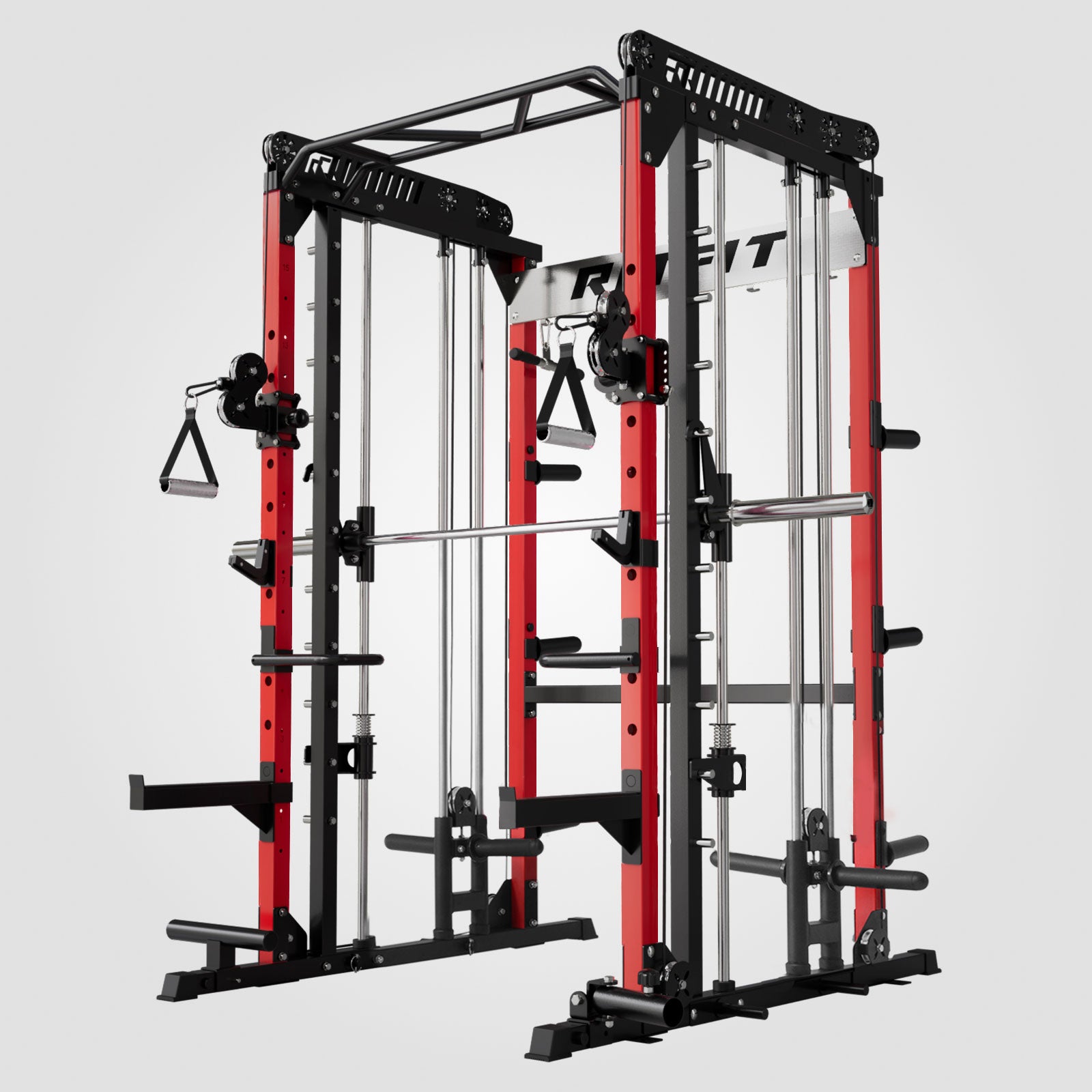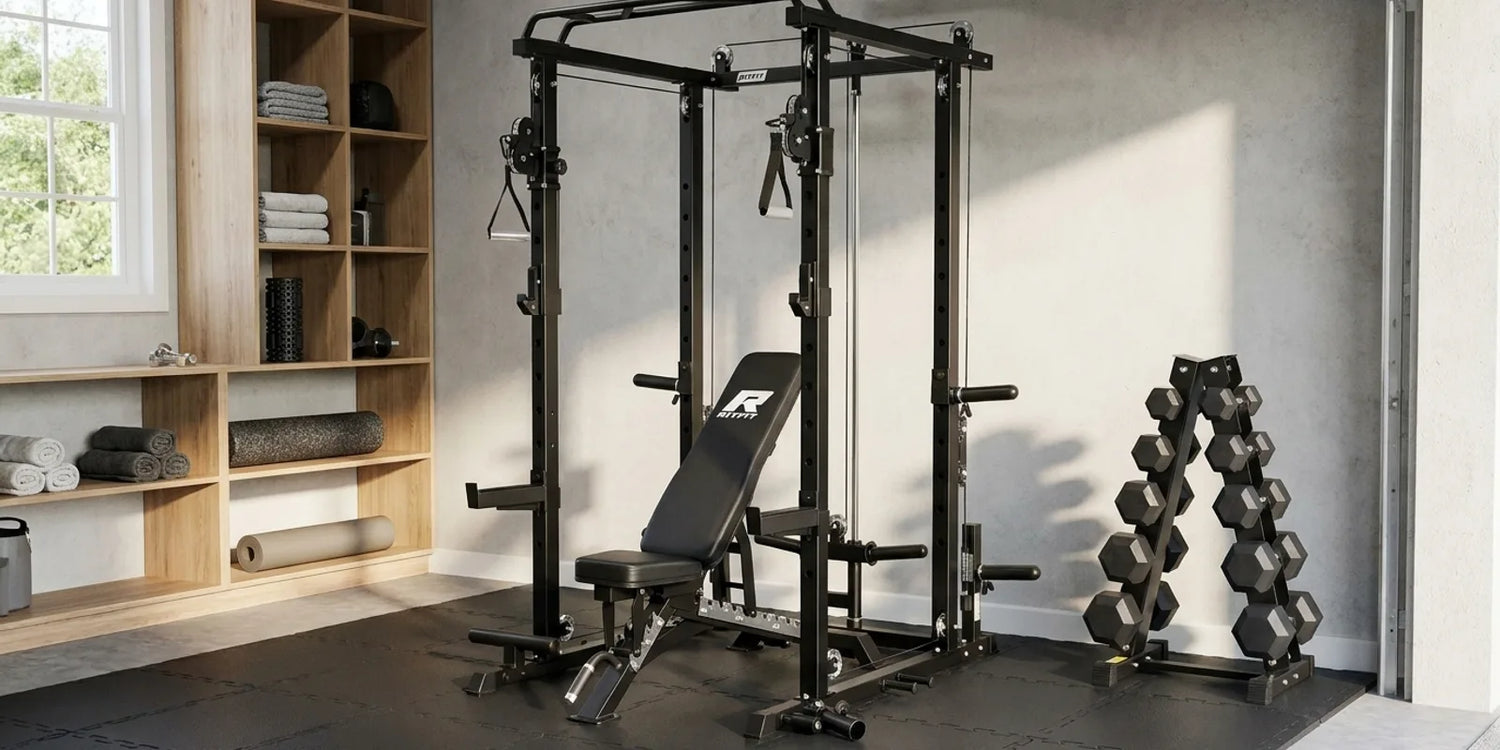
A foldable squat rack with a pulley system is a wall-mounted rack that holds a barbell for squats, presses, and pull-ups, while adding a cable pulley for lat pulldowns, cable rows, and accessory work. It folds flat against the wall when not in use, which makes it a strong fit for apartments and small home gyms.
This guide explains how much space these racks save, which specs actually matter, and how to decide if one suits your training. You will also find a sample small-space workout and practical measuring steps to use before you buy.
Quick Answer: A foldable squat rack with a pulley system combines a wall-mounted barbell rack with a cable pulley in one frame that folds flat when not in use. It saves significant floor space while still allowing squats, presses, pull-ups, and cable exercises such as lat pulldowns and face pulls at home.
Key Takeaways
- Space savings: A folding squat rack uses far less floor than a freestanding rack and folds to a shallow depth against the wall when stored.
- Multi-function: The integrated pulley system adds lat pulldowns, cable rows, and face pulls to standard barbell work in one unit.
- Weight capacity: Quality folding racks are commonly rated in the 700-1500 pound range, and a modest plate capacity still supports meaningful squat progress.
- Installation: Secure mounting into a structural wall stud is essential for the safe use of any wall-mounted folding rack.
- Value: A foldable squat rack with a pulley is a practical choice when you want cable and barbell training without the footprint of a full-size rack.
What Is a Foldable Squat Rack With Pulley?
A foldable squat rack with a pulley system is a wall-mounted frame that holds a barbell for squats, presses, and pull-ups, plus a cable pulley for guided cable movements. It folds flat against the wall when not in use, so the floor is free for other activities between sessions.
- Barbell station: J-hooks hold the bar at a safe height for squats and presses, while safety arms catch the bar if you need to bail out of a lift.
- Pulley system: A high and low cable attachment with handles, a lat bar, and a short bar covers pulldowns, rows, and pushdowns without a separate cable machine.
- Pull-up bar: Most models add a top pull-up bar, giving you a vertical pull option with no extra equipment.
- Folding design: The uprights fold toward the wall, cutting the rack's stored depth dramatically while keeping the deployed footprint compact.
This makes the rack a compact all-in-one for lifters who want both barbell and cable training, and it fits well into the setups described in our guide to the Best Squat Rack For Small Space when floor area is tight.
How Much Space Does a Folding Rack Really Save?
Home gym reviewers report that full-size racks can take up 12-25 square feet of floor, while a folding rack deploys to only a few feet and then folds to a shallow depth against the wall. When folded, the rack returns most of the floor to you for storage, stretching, or other activities.
- Deployed footprint: The rack still needs enough open depth to load a barbell and walk into the squat position during a workout.
- Folded depth: Quality folding racks typically sit close to the wall when stored, which opens the center of the room.
- Ceiling height: The top bar or pull-up bar needs headroom, so a low-ceiling basement changes which model fits.
| Rack Type | Typical Floor Use |
|---|---|
| Freestanding power rack | Roughly 12-25 square feet |
| Folding rack deployed | About 3-14 square feet |
| Folding rack folded | Under 2 square feet against the wall |
Footprint ranges are typical figures reported by home gym reviewers and vary by model and size.
For exact measurements and clearance rules, see our breakdown of Squat Rack Dimensions before you commit to a layout.
Why Add a Pulley System to a Foldable Rack?
A pulley system turns a squat rack into a cable machine, adding exercises you cannot do with a barbell alone, such as lat pulldowns, cable rows, face pulls, and triceps pushdowns. This makes the rack a true full-body station while it still folds away between sessions.
- Vertical pull coverage: A lat bar and high pulley let you train the back and lats directly, which complements the push work of bench and overhead presses.
- Isolation and accessory work: Low cables handle rows, curls, and rear-delt work that are awkward with a barbell in a tight space.
- Unilateral options: Single-hand handles allow one-arm cable rows, presses, and raises that challenge stability on each side.
- Space saved: Adding a cable to the rack avoids a separate cable tower, which is exactly the trade-off covered in our Best Power Rack With Pulley System Under 1000 guide.
If you already own a rack, the same function can be added with Rack Attachments such as a pulley kit, which is a lower-cost route for an existing setup.
What to Look For in a Foldable Squat Rack With Pulley
Prioritize weight capacity, steel gauge, pulley quality, safety arms, and ease of installation when comparing folding squat racks with pulley systems. A 2024 study found that lighter and heavier loads produced comparable squat strength gains when total volume was matched, so a rack with a modest plate capacity is enough for meaningful progress.[1]
- Weight capacity and steel gauge: Look for heavy-duty steel with a capacity that covers your heaviest working sets, and check the rating for each barbell holder as well as the frame.
- Pulley system quality: Smooth cables, sealed bearings, and a sensible pulley ratio make pulldowns and rows feel like a gym cable station rather than a wobbly add-on.
- Safety arms and J-hooks: Long safety arms give you a larger bail-out area under the bar, which matters more in a compact rack where positioning is tighter.
- Installation and daily operation: Confirm the rack bolts into structural studs and that folding and unfolding takes under a minute, because you will do it every session.
The Power Rack Vs Squat Rack comparison explains how a full cage changes the trade-off if you later decide the folding format is not for you, and the RitFit P3 Power Cage With Smooth Cable System shows the all-in-one route when floor space is available.
Exercises You Can Do With a Foldable Rack and Pulley
A foldable rack with a pulley supports both barbell compound lifts and cable accessory work, covering your full body in one space-saving station. EMG data from a 2020 study found greater muscle activation in free-weight squat variations compared with machine isolation moves, so real barbell work is worth the setup.[2]
- Barbell movements: Back squat, front squat, bench press, overhead press, and rack pulls build the squat and press foundation the rack is built around.
- Cable movements: Lat pulldown, seated cable row, face pull, triceps pushdown, and one-arm cable raise train the back, shoulders, and arms.
- Pull-up bar: Chin-ups, pull-ups, and hanging core work add a vertical pull without any extra station.
A study published in PMC found that both squat and deadlift training produced significant lower body strength gains over 6 weeks of training, which means a rack that handles both lifts is a strong lower-body all-in-one.[3] For step-by-step bar setup and safety checks, see our How To Use A Squat Rack guide.
"Get some Chuck Taylors or wrestling shoes to see how a flat sole feels, and get some cheap weightlifting shoes to see how you like a raised heel."
Greg Nuckols, MA, Strength Researcher and Coach, Stronger By Science
What Does a Small-Space Workout Look Like?
A sample full-body session on a foldable squat rack with a pulley combines a barbell squat, a press, and cable accessory work in about 40 minutes. Keep rest short and rotate the movements each week so every muscle group gets trained at least twice.
- Back squat: 3 sets of 5-8 reps to build lower-body strength on the core lift.
- Bench or overhead press: 3 sets of 6-10 reps for the chest or shoulders.
- Lat pulldown: 3 sets of 10-12 reps to train the back and lats with the pulley.
- Seated cable row: 3 sets of 10-12 reps for mid-back thickness.
- Face pull: 3 sets of 15 reps to balance the rear delts and posture.
- Triceps pushdown or one-arm raise: 2 sets of 12-15 reps to finish the arms.
Train three days per week with a rest day between sessions, and add weight when you hit the top of each rep range with good form. A Racks Package bundles the rack with plates and a bench, which turns this routine into a single setup purchase.
What Mistakes Should You Avoid When Buying a Folding Rack?
The most common buying mistakes are ignoring ceiling height, skipping weight capacity checks, assuming the pulley matches a full cable machine, and treating wall mounting as optional. Measure your space and confirm the mounting point before you purchase.
- Forgetting ceiling height: A pull-up bar needs overhead clearance even when the rack folds low, so confirm the ceiling before choosing a model.
- Ignoring capacity: The frame, barbell holder, and safety arms each carry their own rating, and all of them must cover your heaviest loads.
- Expecting a full cable machine: A rack pulley offers smooth variable-resistance cable work, but it is not a weight-stack lat tower with the same plate range.
- Skipping stud checks: A folding rack transfers every pound into the wall, so mounting into structural studs is not negotiable.
How Do You Measure Your Space Before Buying?
Measure the ceiling height, the wall area for the rack, and the open floor depth the rack needs when deployed before you choose a folding squat rack. Leave at least 12 inches of clearance above your head when a loaded barbell is at its highest point.
- Ceiling height: Note the distance from the floor to the ceiling joists where the rack and pull-up bar will sit, and account for your barbell at full lockout.
- Wall area: Mark the stud locations with a stud finder and confirm the rack mounting pattern lines up with them before buying.
- Deployed depth: Allow enough open floor so you can unrack the bar and step back into the squat position without hitting a wall or bench.
- Swing path: Make sure nothing overhead blocks the bar path during presses or pull-ups.
Is a Foldable Squat Rack With Pulley Worth It?
For lifters short on floor space, a foldable squat rack with a pulley system is usually worth it because it delivers barbell and cable training in one unit that folds away. The trade-off is a lower absolute weight capacity and the need for a solid wall mount, so heavier lifters should compare capacity against their working weights.
- Small space route: Pair a folding or wall-mounted rack with the Ritfit Rack Attachment Aluminum Pulley Set to add cable function to a compact frame.
- Full-function route: If you have the floor space, an all-in-one cage with integrated cables gives more capacity and a bigger pulley station in a single footprint.
- Upgrade path: Start with the rack and add attachments over time instead of paying for unused function up front.
For a different take on space-saving home equipment, our Smith Machine Vs Squat Rack article compares the two most common home rack formats.
FAQs About Foldable Squat Racks With Pulley
What is a foldable squat rack with pulley?
A wall mounted squat rack that folds flat against the wall when not in use and includes a cable pulley system for exercises like lat pulldowns, cable rows, and face pulls. It combines barbell squat and press movements with cable work in one compact footprint, ideal for apartments and small home gyms.
How much space does a folding squat rack save?
Home gym reviewers report full-size racks can occupy 12 to 25 square feet, while most folding racks use only a few feet of floor when deployed and fold to a shallow depth against the wall. This frees the floor for other activities between sessions.
Can you do lat pulldowns on a foldable squat rack with pulley?
Yes.
The pulley system on a foldable squat rack typically includes a high cable position and a lat bar, letting you perform lat pulldowns, triceps pushdowns, and low cable rows.
The resistance is smooth and adjustable, covering much of the cable machine function at home.
Is a foldable squat rack with pulley as stable as a full power rack?
Foldable racks rely on a secure wall mounting and heavy duty steel for stability, and they support significant loads when installed correctly. They generally trade some depth and footprint for space savings, so heavier lifters should prioritize weight capacity and solid installation.
Do I need a wall to mount a foldable squat rack?
Yes, most foldable and wall mounted squat racks require a sturdy structural wall with a solid stud. The mounting hardware transfers the load into the wall, so confirming the stud location, material, and spacing before buying is essential for safe use.
What is the weight capacity of most foldable squat racks?
Weight capacity varies widely by model and steel construction, with many quality folding racks rated in the 700 to 1500 pound range. The limit applies to the rack frame, while each barbell holder and safety arm also carries its own rating, so both should be checked.
Conclusion
Choosing a foldable squat rack with a pulley system comes down to your space, ceiling height, and working weights.
It pairs barbell squats and presses with cable accessory work in a wall-mounted frame that folds flat, which makes it a strong option for apartments and small home gyms.
Measure your space, confirm the weight capacity, and mount the rack into a structural stud.
For a complete small-space setup, browse the RitFit sales page for racks, pulley attachments, and bundles that match your goals.
Disclaimer
Always follow the manufacturer's installation guide and confirm your wall can support the rack before mounting, and check every joint, fastener, and pulley for wear before each session. If you have an injury or health condition, consult a qualified professional before starting a strength training program.
References
1. Valenzuela-Barrero C, et al. Effects of light- vs. heavy-load squat training on velocity, strength, power, and total mechanical work in recreationally trained men and women. Biol Sport. 2024;41(2):3-11. doi:10.5114/biolsport.2024.131847. PMCID: PMC10955750
2. Bautista D, Durke D, Cotter JA, Escobar KA, Schick EE. A Comparison of Muscle Activation Among the Front Squat, Overhead Squat, Back Extension and Plank. Int J Exerc Sci. 2020;13(1):714-722. doi:10.70252/BTUH3630. PMCID: PMC7241624
3. Nigro F, Bartolomei S. A Comparison Between the Squat and the Deadlift for Lower Body Strength and Power Training. J Hum Kinet. 2020;73:145-152. doi:10.2478/hukin-2019-0136. PMCID: PMC7386153