








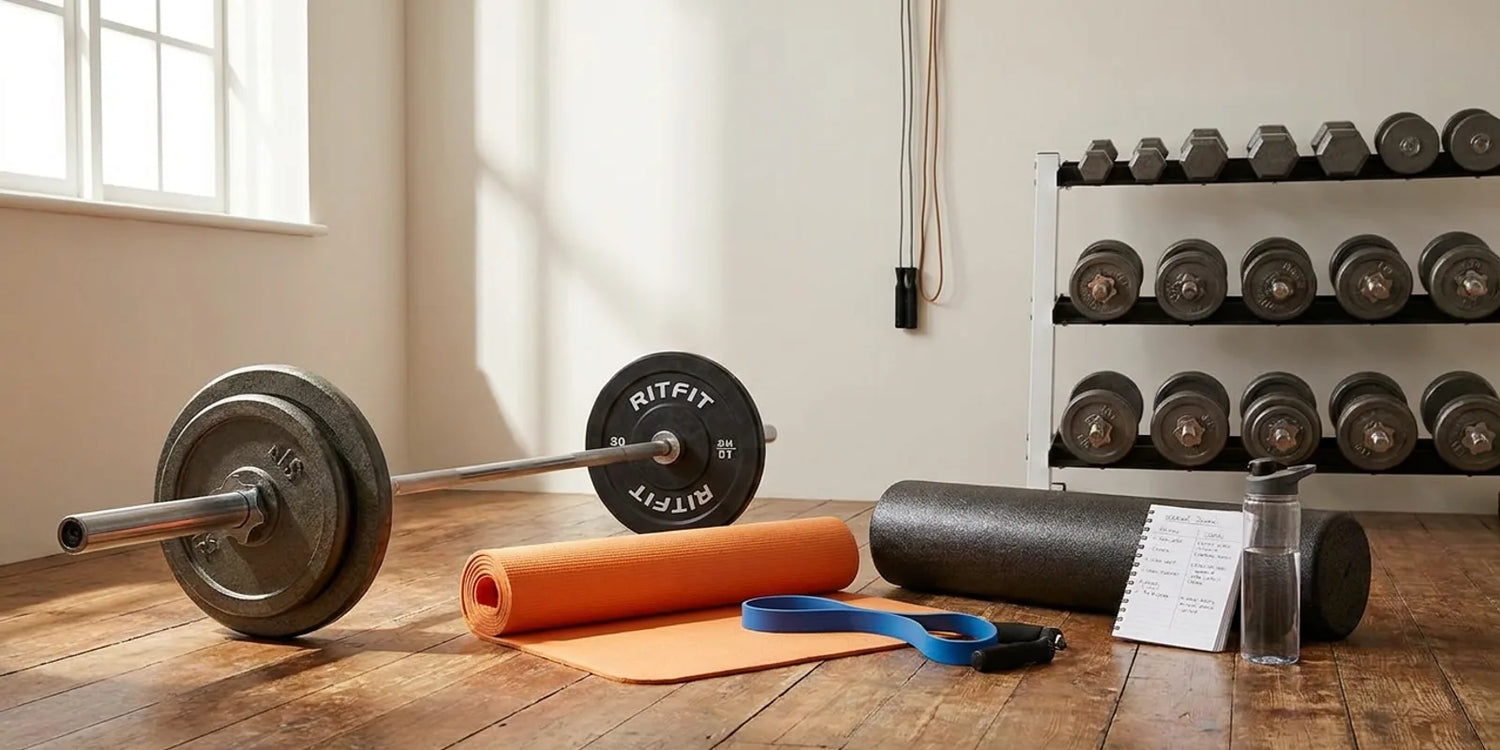
A full week workout plan for muscle gain for beginners is simpler than it sounds: train each major muscle group about twice a week, aim for roughly 10 sets per muscle group weekly, and add a small amount of weight or reps every week. You can run the whole plan at home with bodyweight, bands, or dumbbells.
Below you get the exact numbers for days, sets, reps and weekly progression, plus a ready-to-follow schedule. Start light, learn each movement pattern, and if you feel sharp pain, stop the exercise and check your form.
Quick Answer: A full week workout plan for muscle gain for beginners should include three to four training days, hit each major muscle group about twice weekly, and use three to four sets of six to fifteen reps per exercise. Beginners can run it at home with bodyweight, bands, or dumbbells, adding weight at the top of their rep range.
Key Takeaways
- Frequency: Train each major muscle group about twice a week, with two to four total training days.
- Volume: Work toward roughly 10 sets per muscle group per week for steady muscle growth.
- Sets and reps: Use three to four sets of six to fifteen reps per exercise, choosing a weight that challenges the last few reps.
- Progression: Add a small amount of weight or a rep when you finish the top of your range with clean form.
- At home: Bodyweight, resistance bands, and dumbbells all build muscle when you keep adding load over time.
What Actually Builds Muscle: Frequency, Volume and Load
Muscle growth comes from training each muscle group often enough, with enough volume and enough load, not from any single magic rep scheme. Research shows that consistent resistance training with multiple sets builds strength and muscle size in beginners [1].
- Frequency: How often you train a muscle group each week. Twice weekly is a practical target for beginners.
- Volume: The total number of hard sets per muscle group per week. This is the main driver of hypertrophy.
- Load: The weight you use relative to your strength. Loads that let you work in a 6 to 15 rep range build both strength and size.
You do not need to train every day, and you do not need heavy weights to start. What matters is showing up consistently, working each muscle group with a real challenge, and resting enough to recover.
If you are new to structured training, a beginner workout plan gives you a proven template to follow while you learn the basics.
How Many Days a Week Should a Beginner Train
Most beginners build muscle well with two to four training days per week, arranged so each muscle group is trained about twice weekly. Current guidelines recommend resistance training at least twice a week hitting all major muscle groups, and rest days are part of the plan, not a weakness.
- Two days a week: The minimum effective dose. Two full body sessions spaced apart still build muscle.
- Three days a week: The sweet spot for most beginners, with every major muscle group covered each session.
- Four days a week: Works well once you are comfortable, using an upper/lower split or a 4 day workout split.
Training the same muscle group every day is counterproductive because muscles grow and recover during rest. Aim to repeat a muscle group only after at least one rest day, and keep at least one full rest day in every week so your body can adapt.
How to Structure a Full Week Plan Across Your Muscle Groups
Structure a beginner week around full body or upper/lower sessions so every major muscle group is trained about twice in seven days. That means chest, back, shoulders, legs, core, biceps and triceps all get their turn, with a rest day before any muscle group repeats.
- Full body days: Each session covers push, pull and legs, so one or two sessions per week already hit everything.
- Upper/lower split: One day for push and pull muscles, one day for legs, repeated twice across the week.
- Exercise order: Put compound movements like squats, presses and rows early, then isolation moves like curls and extensions after.
The simplest beginner option is two or three full body circuit training for beginners sessions each week, because every session taxes all major muscle groups and recovery stays manageable. Whatever structure you choose, keep the total weekly volume consistent across the seven days.
"Once or twice a week of an effective routine can be sufficient to maintain muscle mass"
Eric Helms, PhD, Natural Pro Bodybuilder, Researcher and Coach, 3D Muscle Journey
How Many Sets and Reps You Need
A practical starting point is three to four sets of six to fifteen reps per exercise, building toward about ten sets per muscle group each week [2]. Four or more sets per muscle group weekly in a 6 to 15 rep range is a solid baseline for beginners [3].
| Goal | Reps per Set | Sets per Exercise |
|---|---|---|
| Strength | 6 to 8 | 3 to 4 |
| Muscle size | 8 to 12 | 3 to 4 |
| Endurance and skill | 12 to 15 | 3 |
Rep counts follow the 6 to 15 RM range recommended for beginners in the narrative review referenced below.
Choose a weight that lets you finish the last few reps with good form but still feeling challenging. Rest roughly 60 to 90 seconds between sets.
If overloaded equipment choices feel unclear, a guide to the best dumbbells for beginners to build muscle helps you pick a loadable setup that grows with you.
How to Progress Overload Safely Each Week
Add a small amount of weight or a rep or two when you can comfortably finish the top of your rep range with good form on all sets. For example, when 12 reps of a 10 to 12 range feel smooth, add a small increment and keep the same rep target, and back off if your form breaks down.
- Add reps first: If you are new to an exercise, add a rep or two each week before touching the weight.
- Then add weight: Once you hit the top of the range, increase by the smallest plate or dumbbell step available.
- Keep records: Write down your sets, reps and weights so you can see progression and know when to move up.
Progress slowly and deliberately. A leg training plan built on progressive overload shows how adding a small step each week stacks up into meaningful strength gains over eight weeks.
If a joint feels sharp pain rather than muscle fatigue, stop, reduce the load and check your technique before trying again.
Building Muscle at Home Without a Big Gym
Yes, you can build muscle at home without a big gym. Bodyweight moves like push-ups, squats, rows and glute bridges train every major muscle group, and resistance bands or dumbbells add load as you get stronger, which is exactly what beginner home training needs.
- Bodyweight basics: Push-ups, squats, lunges and glute bridges cover push, legs and core well.
- Bands: Anchor a band and you can do rows, presses and curls with light resistance, and research notes bands are a viable home option.
- Dumbbells: A pair of adjustable dumbbells adds scalable load without taking up space.
The key is progression: bodyweight only carries you so far, so add bands or dumbbells once an exercise gets easy. A single piece of equipment can cover a lot of ground, like the RitFit BLP01 leg workout package, which handles leg press, hack squat and calf raises in one machine.
And if you want the full picture on band-only training, this guide to gaining muscle with resistance bands shows how far bands can take you.
Your Full Week Beginner Muscle-Building Plan
This full week workout plan for muscle gain for beginners uses three training days and four rest days, so a beginner who trains Monday, Wednesday and Friday hits every major muscle group twice and gets two full rest days.
| Day | Session | Main Exercises | Sets x Reps |
|---|---|---|---|
| Monday | Full body A | Goblet squat, push-up, single arm row, glute bridge, plank | 3 x 8 to 12 |
| Tuesday | Rest | Walk or light mobility | 20 to 30 min |
| Wednesday | Full body B | Reverse lunge, dumbbell shoulder press, lat pulldown or band row, bicep curl, side plank | 3 x 8 to 12 |
| Thursday | Rest | Walk or light mobility | 20 to 30 min |
| Friday | Full body C | Bodyweight squat, bench press or push-up variation, seated row, tricep dip, dead bug | 3 x 8 to 12 |
| Saturday | Rest | Active recovery | 20 to 30 min |
| Sunday | Rest | Full rest day | None |
Substitute any exercise with a similar movement you can do at home. Warm up with 5 minutes of light cardio and one easy set of each exercise before working sets.
Every exercise in this plan has a home variation, so you are covered whether you train in a garage gym or a small corner of your living room. For a machine-based option, a beginner kettlebell workout guide adds a compact, loadable tool to the same schedule.
Watch the video below to see how a full body machine session looks when everything is set up properly.
FAQs About a Full Week Workout Plan for Muscle Gain for Beginners
How many days a week should a beginner train to build muscle
Most beginners build muscle well with two to four training days per week, arranged so each muscle group is trained about twice weekly.
Current guidelines recommend resistance training at least twice a week hitting all major muscle groups.
Rest days matter for recovery and growth.
How many sets and reps should a beginner do
A practical starting point is three to four sets of six to fifteen repetitions per exercise, aiming for about 10 sets per muscle group each week overall.
Choose a weight that lets you finish the last few reps with good form but feeling challenging.
Build up gradually as you get stronger.
Can I build muscle at home without a gym
Yes.
Bodyweight moves like push-ups, squats, rows and glute bridges build muscle, and you can add resistance bands, dumbbells or a multi-functional home gym machine to keep progressing.
Research notes elastic bands and bodyweight are viable for home-based strength training.
How do I know when to increase the weight
Increase the load when you can comfortably complete the top of your rep range with good form on all sets, for example finishing 12 reps of a 10 to 12 range.
Add a small amount of weight and keep the same rep target.
If form breaks down, keep the current weight a little longer.
Is it okay to train the same muscle every day
No.
Muscles grow and recover during rest, so training the same muscle group every day can lead to poor recovery and injury risk.
Aim to train each muscle group roughly twice a week with at least a day of rest before repeating it.
This balances stimulus with recovery.
Conclusion
A full week workout plan for muscle gain for beginners does not need to be complicated. Train each major muscle group about twice a week, build toward 10 sets per muscle group weekly, and add a little weight or a rep when an exercise gets comfortable.
Start with the three day full body schedule above, log your sets and weights, and do session A first. When you outgrow your setup, check the current RitFit sales page for the best value on home gym gear.
Disclaimer
This article is for general information only and is not medical advice. Consult a qualified professional before starting a new exercise program, especially if you have an injury, and stop any exercise that causes sharp pain.
References
1. Currier BS, Mcleod JC, Banfield L, et al. Resistance training prescription for muscle strength and hypertrophy in healthy adults: a systematic review and Bayesian network meta-analysis. Br J Sports Med. 2023;57(18):1211-1220. doi:10.1136/bjsports-2023-106807. PMCID: PMC10579494
2. Currier BS, D'Souza AC, Singh MAF, et al. American College of Sports Medicine Position Stand. Resistance Training Prescription for Muscle Function, Hypertrophy, and Physical Performance in Healthy Adults: An Overview of Reviews. Med Sci Sports Exerc. 2026;58(4):851-872. doi:10.1249/MSS.0000000000003897. PMCID: PMC12965823
3. Iversen VM, Norum M, Schoenfeld BJ, Fimland MS. No Time to Lift? Designing Time-Efficient Training Programs for Strength and Hypertrophy: A Narrative Review. Sports Med. 2021;51(10):2079-2095. doi:10.1007/s40279-021-01490-1. PMCID: PMC8449772





