Hack squats for quads deliver one of the most targeted quad-loading stimuli available on a machine, making them a staple for intermediate and advanced lifters who want serious thigh development without the spinal demands of heavy barbell squats.
This guide covers the exact biomechanics that make the hack squat so quad-dominant, the optimal foot placement for maximum activation, step-by-step form cues, load selection, the most common mistakes that kill quad gains, and a complete programming framework to fit hack squats into your leg day.
Quick Answer: Hack squats are one of the most effective machine exercises for quad hypertrophy. The fixed incline and upright torso shift nearly all load onto the quadriceps, while deep knee flexion creates a strong stretch under load. Use a low foot position, reach parallel on every rep, and perform 3 sets of 8-12 reps with a slow eccentric.
Key Takeaways
- Quad Dominance: The hack squat machine's fixed incline and upright torso shift primary load onto all four quadriceps heads, making it more quad-specific than a conventional back squat.
- Foot Placement Matters: A low, hip-width foot position with toes angled 15-30 degrees out maximizes forward knee travel and quad stretch at the bottom, which is the key driver of hypertrophy.
- Go Deep: Descend until your thighs reach parallel or just below; cutting depth short eliminates the most productive portion of the range of motion for quad growth.
- Slow the Eccentric: One study found that a 4-second eccentric tempo produced significantly greater vastus lateralis hypertrophy compared to a 1-second eccentric in a 7-week squat protocol.[3]
- Program It Second or Third: Place hack squats after one compound movement like the barbell squat or leg press, using 3-4 sets of 8-12 reps, and progress load when you can complete all reps with full depth.
Why Is the Hack Squat So Effective for Quad Growth?
The hack squat is highly effective for quad growth because its fixed incline forces an upright torso position that shifts mechanical load almost entirely onto the quadriceps, while the forward knee travel produces a deep stretch under load at the bottom of each rep. This combination of high quad-specific tension and deep range of motion creates an optimal environment for muscle hypertrophy in all four heads of the quadriceps femoris.
The biomechanical advantage comes down to two interlocking factors. In a conventional back squat, the torso leans forward to maintain balance, distributing load across the hips and erector spinae alongside the quads. On the hack squat machine, the back pad locks the torso into a consistent incline, removing that forward lean entirely.
Your knees must therefore travel farther forward over your toes to complete the movement, generating pronounced knee flexion and a deep quad stretch at the bottom position.
- Upright Torso Effect: The fixed back pad eliminates the forward lean that recruits glutes and erectors in free-weight squats, concentrating demand on the quadriceps.
- Forward Knee Travel: Greater anterior knee translation increases the moment arm at the knee joint, loading the quads more intensely through a longer effective range of motion.
- Stretch-Mediated Tension: As Brad Schoenfeld, PhD, has written in his research on hypertrophy, training muscles in a lengthened position, where the muscle is under load at its greatest stretch, produces superior hypertrophic gains compared to training in a shortened range. The hack squat's deep bottom position achieves exactly this for the quadriceps.
- Reduced Spinal Load: Coaches note that EMG data suggest hack squats place less shear force on the spine than heavy barbell squats, meaning less axial fatigue and more energy available for quad-focused training volume.
- Quad CSA and Strength: Research in PeerJ found that vastus medialis cross-sectional area was the strongest predictor of squat strength, with all three vastii muscles showing a moderate-to-strong correlation with external squat load.[1] Building quad mass directly translates to greater squat performance.
- Functional Carryover: One 6-week study found that a quad-dominant training program including hack squats improved vastus lateralis motor unit recruitment and functional performance, including sit-to-stand and stair-climbing ability, compared to a general functional training program.[2]
What Muscles Does the Hack Squat Work?
The hack squat primarily targets the quadriceps femoris, working all four heads, with particular emphasis on the vastus lateralis and rectus femoris through the deep knee flexion range. Secondary muscles include the glutes, adductors, and calves, which assist during the drive phase but receive considerably less stimulus than in a conventional back squat.
Primary Muscles
- Vastus Lateralis: The outer quad sweep, loaded heavily through the deep range of motion and forward knee travel that the hack squat machine enforces.
- Vastus Medialis: The teardrop muscle above the inner knee, which research identifies as the strongest predictor of squat strength output and is trained through full depth.[1]
- Rectus Femoris: The only quad head that crosses both the hip and knee joint; it receives high activation during the hack squat because the upright torso keeps the hip in a relatively neutral position.
- Vastus Intermedius: The deep central quad head beneath the rectus femoris, engaged throughout the full squatting range.
Secondary Muscles
- Glutes: Contribute to hip extension during the drive phase, especially when the foot position is set higher and wider on the platform.
- Adductors: Inner thigh muscles recruited for hip stability throughout the movement, particularly with a wider toe-out stance.
- Calves (Gastrocnemius and Soleus): Assist in maintaining heel contact with the platform and contribute modestly to the push through the bottom position.
- Core Stabilizers: Isometrically brace the torso against the back pad, though the machine handles most stabilization demands.
How Do You Perform a Hack Squat with Proper Form?
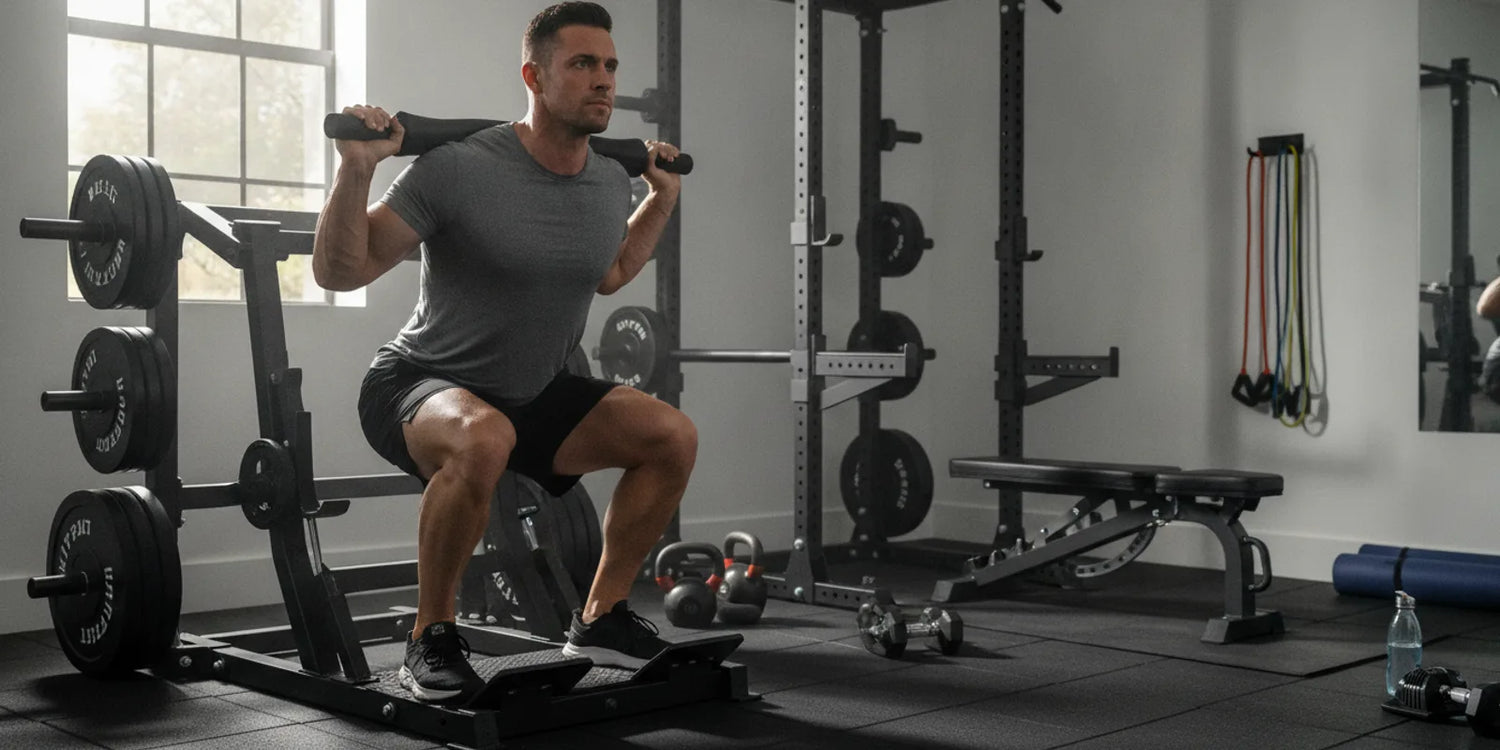
Proper hack squat form starts with the body fully supported against the back and shoulder pads, feet placed low on the platform at hip-width, and a controlled descent that allows the knees to travel forward over the toes until the thighs reach parallel or just below. The drive back to the start should push through the full foot while keeping a slight bend at the top to maintain continuous quad tension.
Machine Setup and Body Positioning
- Adjust Pad Height: Set the shoulder pads so they rest firmly on your shoulders without causing discomfort or requiring you to rise on your toes to release the safeties.
- Back Flat Against the Pad: Press your entire back against the back pad throughout the set; if your lower back peels away during the descent, your feet need to move slightly higher or wider.
- Foot Position (Default): Place feet low on the platform at approximately hip-width apart, with toes angled out 15-30 degrees to match your hip anatomy.
- Hand Grip: Hold the side handles firmly for stability but do not pull or push on them to assist the movement; grip is for safety only.
- Brace: Take a breath in, lightly brace your core, and release the safety handles before beginning the descent.
The Descent: Letting the Knees Travel Forward
- Allow Forward Knee Travel: Do not fight the forward movement of your knees over your toes; this anterior travel is the mechanical mechanism that creates the quad stretch and is the whole point of the exercise.
- Control the Eccentric: Lower with a deliberate 2-4 second count, maintaining heel contact with the platform throughout.
- Target Depth: Descend until your thighs are at parallel to the platform or just below; this ensures a full quad stretch and maximum hypertrophic stimulus.
- Heels Stay Down: If your heels rise before reaching parallel, adjust foot placement slightly higher or wider until you can hit full depth with heels flat.
The Drive: Pushing Through Full Foot
- Push Through the Entire Foot: Drive simultaneously through the heels and balls of the feet, not just the heels; rising onto the toes reduces quad tension and increases knee shear.
- Knees Track Over Toes: Keep your knees aligned with your toe direction throughout the drive; caving inward reduces stability and shifts load off the quads.
- Stop Short of Full Lockout: Leave a slight bend at the knee at the top of the rep to keep continuous tension on the quadriceps and protect the joint from hyperextension forces.
- Exhale on the Drive: Breathe out as you push through the concentric phase, keeping your core braced until you reach the top position.
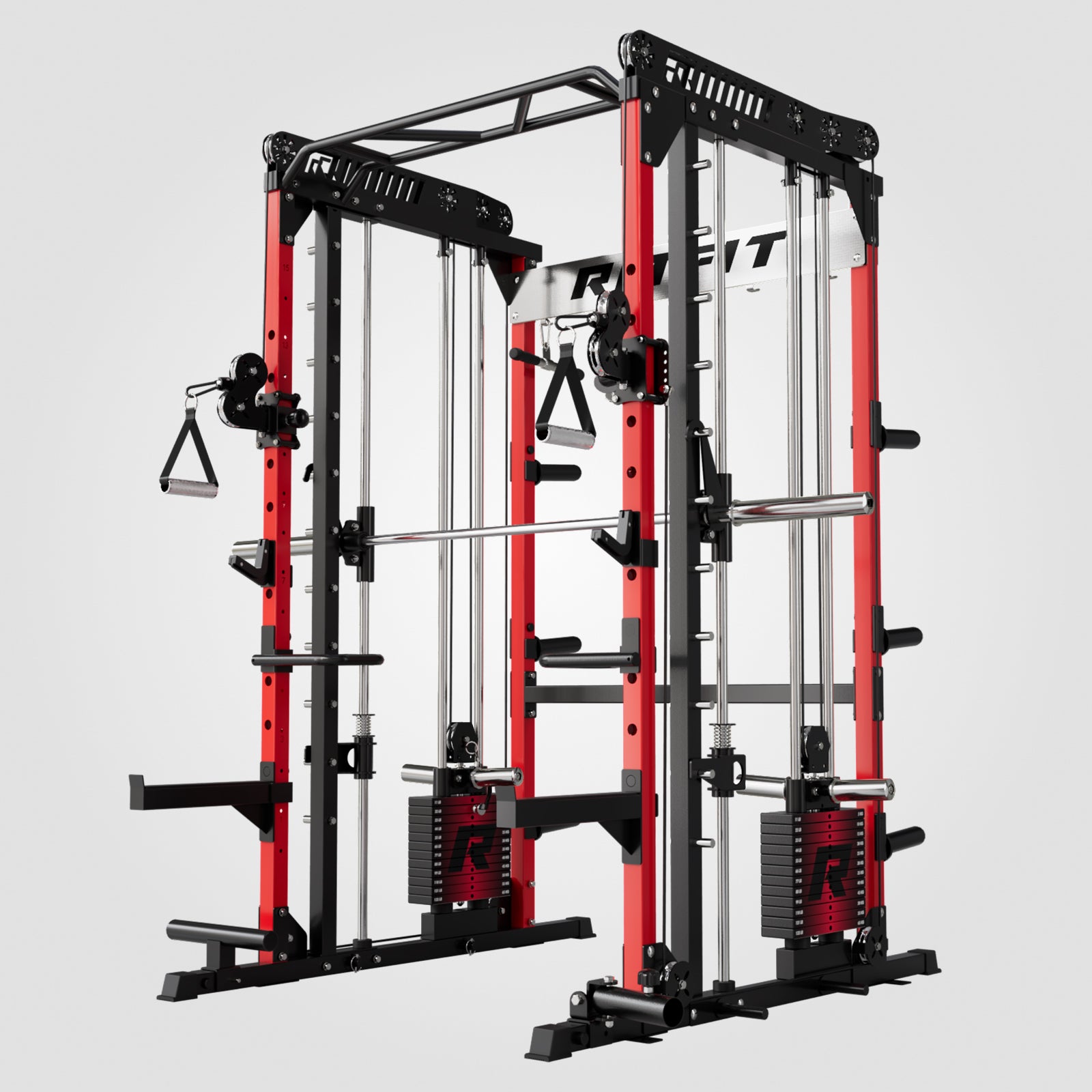
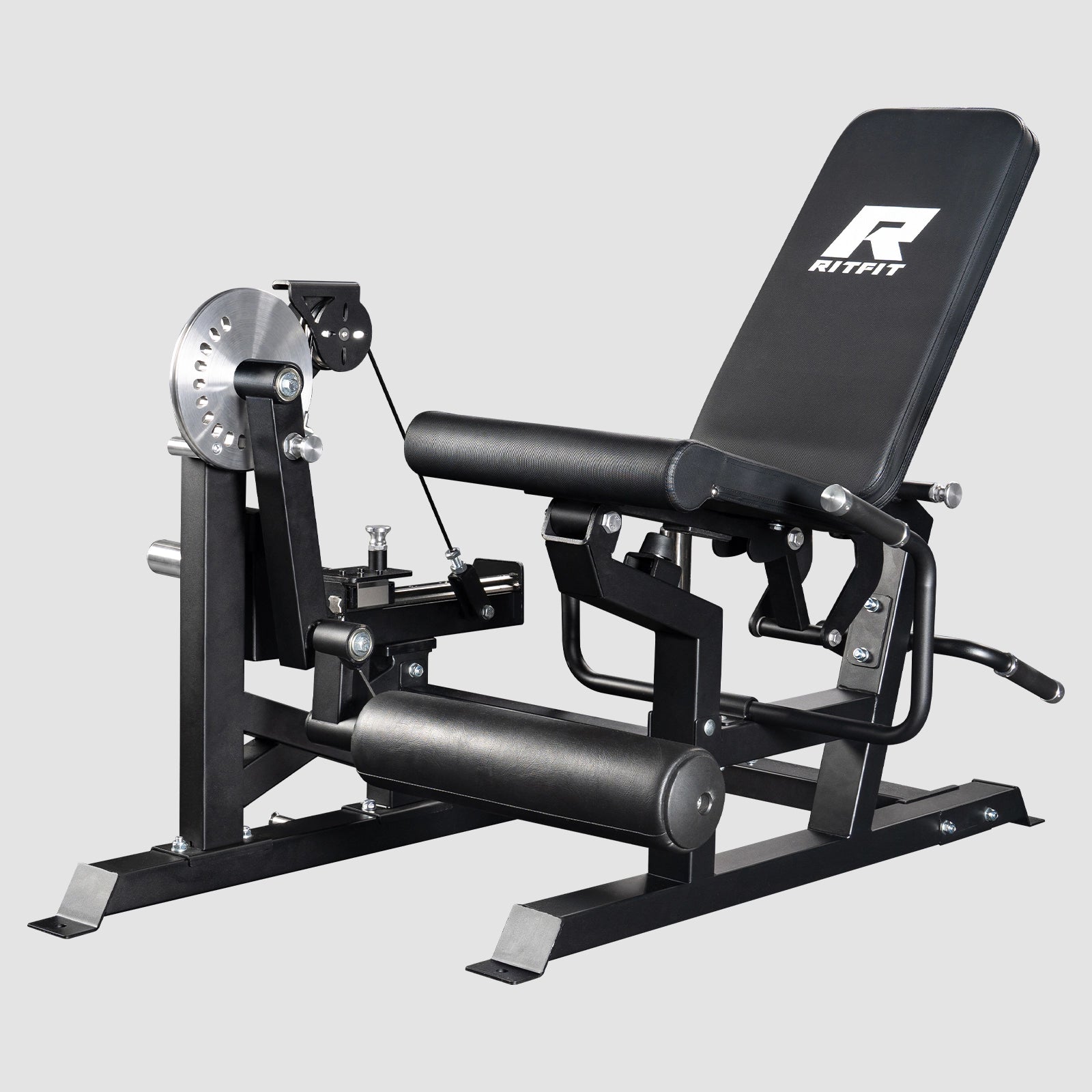
For a reliable combo machine that replicates the same upright torso mechanics at home, the RitFit 3-in-1 Leg Press and Hack Squat Machine delivers a dedicated hack squat station alongside a full leg press capability in a single footprint.
Which Foot Position Maximizes Quad Activation?
A low foot position on the hack squat platform, set at approximately hip-width with toes angled 15-30 degrees outward, maximizes quad activation by increasing forward knee travel and deepening the stretch on the quadriceps at the bottom of each rep. Higher foot placement shifts more emphasis toward the glutes and hamstrings.
Low Foot Position: The Quad-Priority Setup
- Platform Placement: Position the heels near the lower portion of the platform, with the midfoot roughly centered or slightly toward the bottom edge.
- Effect: This position forces maximum forward knee travel, producing the deepest quad stretch under load, which coaches consistently identify as the primary driver of quad-dominant stimulus on this machine.
- Toe Angle: Angle toes out 15-30 degrees to match your hip socket orientation and allow natural knee tracking; going straight forward increases ankle mobility demands and often causes heel rise.
- Best For: Quad mass building, especially targeting the vastus lateralis and vastus medialis through their full working range.
High and Wide: Shifting Emphasis to Glutes and Hamstrings
- Platform Placement: Move feet toward the upper portion of the platform and widen the stance beyond shoulder width.
- Effect: Reduces forward knee travel and increases hip flexion, directing more work toward the glutes and hamstrings, with less quad stretch at the bottom.
- Drive Cue: Push primarily through the heels to maximize glute and hamstring recruitment in this position.
- Best For: Posterior chain emphasis or when you want variety in a single workout using the same machine.
Narrow Stance: Targeting the Outer Quad Sweep
- Platform Placement: Bring feet closer together than hip-width, still low on the platform, toes pointing forward or with minimal outward angle.
- Effect: Places additional emphasis on the outer quad (vastus lateralis), which contributes to the visible outer sweep of the thigh.
- Note: This position creates more knee stress for some individuals due to the reduced base of support; introduce it gradually once standard form is solid.
- Best For: Lifters specifically targeting outer quad development as part of a varied leg day approach.
The RitFit Gazelle Pro Leg Press and Hack Squat Machine offers an adjustable foot platform that accommodates all three foot positions, making it a versatile home gym option for experimenting with stance variations. If you already own a power rack, the RitFit AT02A Hack Squat Rack Attachment converts it into a hack squat station at a fraction of the cost.
To understand how these foot position mechanics compare to free-weight movements, the guide on hack squat vs barbell squat breaks down the trade-offs in detail.
How Much Weight Should You Use and When Should You Add More?
Start with a weight that allows you to complete 3 sets of 10-12 reps with full depth and a controlled 2-3 second descent, without your back peeling away from the pad or your heels rising before parallel. Beginners should begin with 2 sets of 10-12 reps and build to 3 sets before increasing the load.
- Beginner Starting Point: Begin without weight or with a single plate per side, focusing entirely on depth and heel contact before adding load.
- Intermediate Loading: Once you can hit 3 sets of 12 reps with a 2-3 second eccentric at full depth, add one plate per side (typically 10-25 lb) at the next session.
- Progressive Overload Rule: Add weight only when you can complete all target reps across all sets with unchanged form; if depth decreases when you load up, the weight is too heavy for that session.
- Load vs. Depth Trade-off: On the hack squat machine, going heavier often tempts lifters to cut depth short, which removes the most productive bottom range. A lighter load taken to full depth produces more quad stimulus than a heavier load stopped above parallel.
- When to Add More: When you can complete 3 sets of 12 reps at full depth with 2-3 seconds on the way down for two consecutive sessions, increase the load by 10-20 lb and drop back to 3 sets of 8 reps to begin the next progression cycle.
If you are building a home gym and want a machine that scales with your strength, explore the best leg press hack squat combo for home gym to find the right capacity for your training level.
What Are the Most Common Hack Squat Mistakes?
The most damaging hack squat mistakes involve foot position, depth, and knee behavior during the drive, all of which reduce quad stimulus and can increase joint stress. Correcting these errors typically produces an immediate improvement in the quality of each rep.
Feet Too High on the Platform
Placing feet in the upper portion of the platform shifts load toward the glutes and away from the quads by reducing forward knee travel. Keep the heels in the lower half of the platform if quad development is the priority.
Cutting Depth Short
Stopping above parallel removes the deep quad stretch at the bottom, which is the portion of the range most responsible for hypertrophy stimulus. Lower until thighs reach parallel or slightly below on every rep.
Letting the Heels Rise
Heel rise signals that ankle mobility or foot position is limiting depth, and it transfers load forward onto the forefoot, reducing quad drive. Adjust foot placement slightly higher or wider until heels stay flat throughout the entire rep.
Full Lockout at the Top
Locking the knees out completely at the top removes tension from the quadriceps and shifts load into the passive structures of the knee joint. Stop just short of full extension to keep the quads under continuous load throughout the set.
Loading Too Heavy Too Soon
Overloading before form is established causes compensations like back rounding, heel rise, and shortened depth, all at once. Prioritize full-range reps at a manageable load and build from there.
When to Stop
If you experience sharp knee pain (not muscle fatigue) during the descent, especially in the front of the knee, stop the set immediately, reduce the load, and reassess your foot position and depth before continuing.
How Should You Program Hack Squats for Quad Hypertrophy?
Program hack squats as the second or third exercise in a leg day, after one primary compound movement such as a barbell squat or leg press, using 3-4 sets of 8-12 reps with a deliberate eccentric phase. This placement allows you to go heavy enough for growth stimulus while the primary compound has already warmed the joints and established motor patterns.
Where to Place It in Your Leg Workout
- Order: Never do hack squats as the first exercise; place them second or third after a primary compound lift so your quads and knees are thoroughly warmed up.
- Pairing: Hack squats pair well after barbell back squats or front squats as a machine follow-up, or as a primary machine movement followed by leg extensions and walking lunges.
Sets, Reps, and Eccentric Tempo
- Hypertrophy Range: 3-4 sets of 8-12 reps is the standard range for quad muscle growth, with loads that make the last 2-3 reps challenging while maintaining full depth.
- Eccentric Tempo: One 7-week study (n=18) found that a slower 4-second eccentric tempo produced significantly greater vastus lateralis hypertrophy compared to a 1-second eccentric tempo, with effect sizes of 1.74 vs. 1.37.[3] Deliberately slowing the descent to 3-4 seconds is a practical application of this finding.
- Rest Intervals: Rest 90-120 seconds between sets for a hypertrophy focus; extend to 2-3 minutes if you are prioritizing maximal strength and load.
Frequency and Progressive Overload
- Weekly Frequency: Training quads 2 times per week is sufficient for most intermediate lifters. One leg day could feature hack squats as the primary machine quad movement, with the second leg day using a different quad exercise such as leg press or Bulgarian split squats.
- Progressive Overload: Increase load when all sets are completed at the target rep range with full depth for two consecutive sessions; alternatively, add a set before adding weight.
- Deload: Every 4-6 weeks, reduce volume by 40-50% for one week to allow connective tissue recovery before the next loading phase.
The video below from Judd Lienhard covers the key reasons why the hack squat builds quad mass while staying back-friendly, including practical cues on depth and load selection:
For a detailed breakdown of how to use the machine itself, see how to use a leg press hack squat machine.
"Training muscles in a lengthened position, where the muscle is under load at its greatest stretch, produces superior hypertrophic gains compared to training in a shortened range. This is why exercises that achieve deep knee flexion under load are particularly effective for quad development."
Brad Schoenfeld, PhD, Exercise Science Researcher, CUNY Lehman College
What Are the Best Hack Squat Alternatives?
The best hack squat alternatives are movements that replicate the upright torso and deep knee flexion that make the machine so quad-dominant, with the Smith machine hack squat being the closest mechanical substitute when a dedicated machine is not available.
- Smith Machine Hack Squat: Positions the barbell behind the body on the Smith machine track, closely replicating the fixed bar path and upright torso of the machine version. The guide on Smith machine hack squat covers setup in full.
- Hack Squat Rack Attachment: The hack squat rack attachment guide explains how to use a rack-mounted attachment to perform the movement on a standard power rack without a dedicated machine.
- Leg Press (Low Foot Position): Placing feet low and close on the leg press sled increases knee travel and quad dominance, partially replicating the hack squat stimulus, though the lying angle changes the hip position compared to the hack squat.
- Bulgarian Split Squat: A free-weight option that loads the quad of the front leg through deep knee flexion; more demanding on hip mobility and balance, but highly effective for unilateral quad development.
- Goblet Squat: The front-loaded dumbbell or kettlebell forces an upright torso similar to the hack squat; suitable as a warm-up or accessory when machines are occupied.
- Front Squat: The barbell front rack position naturally creates an upright torso and increased quad demand compared to a back squat, though it requires significant wrist and upper body mobility.
For a broader look at the machine's capabilities beyond the hack squat position, the article on leg press hack squat machine benefits covers the full training advantages of combo units. Additionally, the RitFit Gazelle Leg Press Hack Squat Machine gives home gym users access to both the hack squat and leg press positions in a single space-efficient unit.
FAQs About Hack Squats for Quads
Are hack squats good for building quad mass?
Yes. Hack squats are one of the most effective machine exercises for quad hypertrophy. The fixed incline and upright torso force the quadriceps to do the majority of the work, while the deep range of motion creates a strong stretch under load. For serious quad development, they are a reliable staple of any leg day.
Where should I place my feet on the hack squat platform for more quads?
Place your feet low on the platform at approximately hip-width apart with toes angled out 15-30 degrees. This low position maximizes forward knee travel and increases the quad stretch at the bottom of each rep. Higher foot placement shifts emphasis toward the glutes and hamstrings, so keep your feet low if pure quad growth is the goal.
How deep should I go on the hack squat for quad hypertrophy?
Lower until your thighs reach parallel or just below. This depth ensures a full quad stretch and maximizes the hypertrophic stimulus. If your heels rise before reaching parallel, adjust your foot position slightly higher or wider until you can hit full depth comfortably.
How many sets and reps should I do for hack squats?
A practical starting point is 3 sets of 8-12 reps with a controlled 2-3 second descent. Beginners can start with 2 sets and build to 3 as strength improves.
One study found that a slower 4-second eccentric tempo may enhance vastus lateralis hypertrophy, so deliberately slowing the descent is worth incorporating once your form is solid.
What are common hack squat mistakes that reduce quad activation?
The most common mistakes include placing feet too high on the platform, cutting the depth short before thighs reach parallel, letting heels rise off the platform, and locking out fully at the top which removes constant tension from the quads. Correcting these errors, especially foot placement and depth, can significantly increase the quad stimulus you get from each set.
Can I do hack squats at home without a hack squat machine?
Yes. The Smith machine hack squat closely replicates the fixed bar path and upright torso of the machine version, making it an effective substitute. A RitFit Gazelle Pro combo machine is also a space-efficient option for a dedicated home gym setup.
Conclusion
Hack squats for quads are among the most reliable machine movements for building quad mass, combining an upright torso, deep knee flexion, and consistent bar path to maximize quad-specific tension on every rep. The key variables are foot placement, depth, eccentric control, and progressive load selection.
Start with a low foot position, reach parallel on every rep, slow the descent to 2-4 seconds, and add load only when form holds across all sets. Browse the full range of leg press and hack squat machines to find the right unit for your home gym.
Disclaimer
This article is intended for general fitness and educational purposes only and does not constitute medical or professional training advice. Consult a qualified healthcare provider or certified strength coach before beginning any new exercise program, especially if you have a history of knee, hip, or lower back issues.
Save on your next RitFit order
Tap the button to copy your code, then paste it at checkout.
References
1. Kojic F, Duric S, et al. Quadriceps femoris cross-sectional area and specific leg strength: relationship between different muscles and squat variations. PeerJ. 2021;9:e12435. doi:10.7717/peerj.12435
2. Followay B, Holland T, Rowley L. Effects of a quadricep-dominant vs. functional training program on activities of daily living, functional performance, and motor unit recruitment in older adults. Int J Exerc Sci. 2025;18(8):1096-1113. doi:10.70252/YHYC9630
3. Kojic F, Mandic R, Duric S. The effects of eccentric phase tempo in squats on hypertrophy, strength, and contractile properties of the quadriceps femoris muscle. Front Physiol. 2025;15:1531926. doi:10.3389/fphys.2024.1531926