








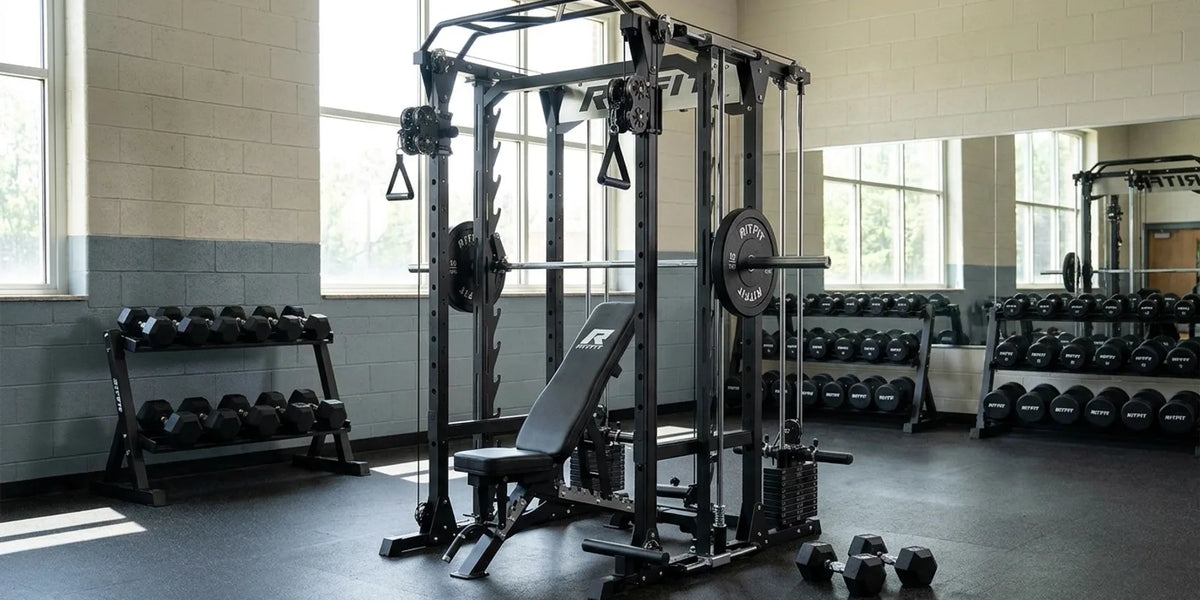
High school weight room equipment planning starts long before you choose a rack, because the room has to match the training needs, the class size, and the building itself. This guide walks athletic directors, strength coaches, and booster committees through the full sequence: needs, space, layout, throughput, safety, and procurement.
It then covers equipment categories, durability criteria, and budget tiers for both new builds and upgrades. It is written for a school facility, not for a home or basement gym, so the space math and buying steps follow institutional rules.
Quick Answer: A high school weight room needs roughly 60 to 75 square feet of usable space per athlete, stations scaled to the largest class period, and equipment chosen for durability and easy supervision. Plan the room around training needs and throughput first, then buy complete equipment categories that fit your budget tier.
Key Takeaways
- Space drives everything: Industry design guidance suggests 60 to 75 square feet per athlete, so a 40-athlete class needs about 2,400 to 3,000 square feet.
- Zone the room: A free-weight zone, rack zone, functional zone, and cardio and stretch zone keep traffic predictable.
- Throughput is station math: Count working stations, then divide your largest class period into rotations so nobody crowds a rack.
- Supervise as a system: A spotter rule, clear sightlines, and daily equipment checks keep a busy floor organized.
- Equipment is most of the budget: Equipment purchase often runs 50 to 60 percent of total project cost, so freight, install, and spares matter.
- Durability beats flash: Buy for institutional rep counts, steel gauge, weight capacity, and warranty terms rather than a single showcase machine.
What Training Needs Does a High School Weight Room Have to Support?
A high school weight room has to serve four training needs at once: maximal strength, explosive power, general conditioning, and low-intensity recovery work. Single-sport rooms can specialize, but a multi-sport room has to cover squats, presses, Olympic lifts, and conditioning inside one footprint.
- Maximal strength: Heavy squats, presses, and deadlifts need racks, bars, and plates rated for repeated near-maximal loads.
- Explosive power: Olympic lifts, jumps, and throws need platform space, bumper plates, and a clear drop zone.
- General conditioning: Sleds, carries, and circuits need open floor and functional training items.
- Low-intensity work: Warm-ups, mobility, and recovery sessions need open space and lighter dumbbells.
In-school resistance training improved physical fitness in a randomized controlled trial of pubertal students.[1] A separate review reports that youth resistance training is safe and effective when programs are designed and supervised by qualified adults.[2]
Map every sport you host to one of these needs before you draw the room, since a program built around a single sport leaves most of the space unused for the rest of the year.
How Much Space and Building Capacity Does a Weight Room Require?
A high school weight room needs about 60 to 75 square feet of usable floor area per athlete. That puts a 40-athlete class near 2,400 to 3,000 square feet once you add circulation and storage. Ceiling height, floor loading, and ventilation decide how much of that space you can actually use.
| Planning metric | Recommended value |
|---|---|
| Minimum space per athlete | 60 to 75 square feet |
| Power rack bar-to-bar spacing | 10 to 12 feet |
| Bench to wall or equipment | 6 to 8 feet |
| Machine station spacing | 3 to 4 feet |
| Circulation corridor width | 4 to 6 feet |
| Floor live loading | 150 to 250 pounds per square foot |
Ranges reflect commonly cited school weight room design guidance and vary by program size and local building code.
Floor loading, ceiling height, and ventilation
Weight room floors should be planned for roughly 150 to 250 pounds per square foot of live loading, above a standard classroom slab, so confirm the structure before you order heavy racks and free weights and plates.
- Flooring: Rubber tile or rolled rubber protects the slab, cuts noise, and marks each zone.
- Ceiling height: Measure to the lowest obstruction and keep at least 9 to 10 feet anywhere athletes press overhead.
- Ventilation: Size cooling and airflow for a full class period, because a crowded room heats up fast.
Common Mistakes in Weight Room Planning
The most common mistakes are sizing the room for an average class instead of the largest one, forgetting circulation and storage in the square footage, and ordering racks before confirming the slab and ceiling. Each one forces expensive changes later.
Zoning and Traffic Flow: How to Lay Out the Four Training Zones
A school weight room works best when it is split into four zones: a free-weight zone, a rack zone, a functional training zone, and a cardio and stretch zone. Grouping similar stations keeps athletes out of each other's way and lets one supervisor watch more of the floor.
Free-weight zone
Place dumbbells, benches, and a three-tier dumbbell rack along a wall so the heaviest handling happens at the edge of the room.
Rack zone
Line racks face to face with 10 to 12 feet between bars, and keep the heaviest barbells on platforms away from walkways.
Functional training zone
Keep an open, rubber-covered floor with functional training equipment, medicine balls, and plyo boxes for conditioning and power work.
Cardio and stretch zone
Move bikes and treadmills to the perimeter with 3 to 4 feet of separation and room behind each unit for a safe dismount.
Keep circulation corridors 4 to 6 feet wide so an athlete can cross the room without squeezing between loaded bars, and check that every zone keeps a clear sightline to the supervisor's post.
How Many Athletes Can Train at Once? Station Throughput and Scheduling
Throughput in a school weight room is set by station count, not floor area. A room with ten working stations supports about ten athletes lifting at once while the rest rotate through warm-up and accessory work. Divide your largest class size by usable stations to find how many rotations one period needs.
- Count stations honestly: Each rack, bench, platform, and cable unit is one station.
- Match class size to rotations: 40 athletes on 10 stations needs four rotations per period.
- Keep periods moving: Short blocks of 12 to 15 minutes per rotation keep every athlete active.
Plan around the busiest period of the week, then pair your station count with a high school weight room equipment checklist so the stations you count are the items you actually buy.
Safety and Supervision Systems for School Weight Rooms
Every school weight room needs a written supervision plan, a spotter rule for heavy sets, clear sightlines, and a daily equipment check. Together these process controls keep a crowded floor organized and predictable for staff and athletes.
Spotter rules, sightlines, and daily checks
Require a spotter on every heavy barbell set, arrange mirrors and lighting so a supervisor can watch the whole floor, and log a walk-through that checks pins, bolts, cables, and clips before each session.
A review of resistance training among young athletes reports that supervision and technique are the key variables that make the training safe and effective.[3] A commonly cited supervision benchmark is one qualified supervisor per 20 to 30 athletes during general training.
- Clear the floor: Keep walkways and rack zones free of stray plates and bags.
- Set a stop condition: Any loose bolt, frayed cable, or damaged floor tile takes that station out of service until it is repaired.
- Document checks: A simple daily log gives administrators a record of routine inspection.
The School Weight Room Procurement Process
The school procurement process runs from a budget request to a purchase order, delivery, and installation. Warranty terms and spare parts belong in the same contract as the equipment, so build the paperwork around a complete bill of materials that keeps racks, benches, and plates together.
Budget request, bid packets, freight, and spare parts
Districts usually require a formal quote or competitive bid above a set spend, so list every item with part number, quantity, and delivery so vendors can quote on equal terms.
- FF&E line items: Split furniture, fixtures, and equipment so freight and installation can be tracked separately.
- Freight and delivery: Ask for the carton count and whether delivery is curbside or inside placement.
- Install and anchoring: Budget labor for assembly and floor anchoring of racks and storage.
- Spare parts: Keep a small stock of pins, J-hooks, and bolts on site for quick repairs.
Budget planning guides often assume equipment purchase runs about 50 to 60 percent of total project cost, so reserve the rest for flooring, delivery, and installation. Detailed dollar figures live in our companion guide on how much a high school weight room costs.
Durability and Warranty: Selecting Equipment for Institutional Use
Durability in a school weight room comes down to institutional rep counts, steel gauge, weight capacity, and warranty coverage rather than a single premium feature. A rack rated for repeated daily sets and backed by a clear warranty will outlast a lighter unit that needs replacing mid-season.
Rep counts, steel gauge, weight capacity, and warranty terms
Ask how many sets per day a frame is rated for, what steel gauge the uprights use, what weight capacity the bench or rack carries, and what the warranty covers for frames versus moving parts.
- Rep counts: A class of students loads a rack far more times per day than a single home user ever will.
- Steel gauge and uprights: Heavier gauge and thicker uprights resist wobble under near-maximal loads.
- Weight capacity: Choose a rated capacity above your heaviest athlete plus the bar and plates.
- Warranty: Confirm frame coverage separately from cables, pads, and other wear parts.
One value-priced example is the adjustable weight bench, which suits a booster-funded or auxiliary space while a high-traffic varsity main room usually needs institutional-grade equipment with a higher rated capacity.
"How can you go wrong with more plates for your home gym! More Plates, More Dates!"
Ethan J. Verified Buyer, RitFit High-Grade Color Bumper Plates Olympic 2-Inch Rubber
Essential Equipment Categories for a High School Weight Room
A high school weight room is built from five core equipment categories: racks, benches, barbells, weight plates, and dumbbells, plus functional training items for conditioning. Buy a balanced set of categories rather than one showcase machine, because coverage serves more athletes per dollar.
- Racks: Power racks or squat stands anchor strength work and must handle repeated near-maximal loads.
- Benches: Adjustable benches cover pressing and accessory angles, and a heavy-duty adjustable bench supports higher capacities.
- Barbells and plates: Olympic bars with barbells and weight plates and bumper plates form the core of strength and power work.
- Dumbbells: A full range with a storage rack supports upper-body and single-arm work.
- Functional items: Cable units, medicine balls, and plyo boxes cover conditioning and power.
"Knurling is a textured grip on the barbell that helps you hold on securely, even when your hands get sweaty. It's key for stability, especially with heavy lifts."
Umo Callins, CPT, Board-Certified Sports Dietitian, Independent, Best Barbell (Yahoo Health / HuffPost 2025)
Budget Tiers for a High School Weight Room
School weight room budgets usually fall into three concept tiers. A starter room serves a small program, a developing room serves a growing multi-sport program, and a varsity-tier room serves a large school, and each tier changes station count and durability grade more than the categories you buy.
- Starter room: A few racks, benches, bars, and a dumbbell set sized to a compact space and its largest class.
- Developing room: More racks and platforms, a wider dumbbell range, and added functional items for a multi-sport schedule.
- Varsity-tier room: High station counts and institutional-grade capacity for the heaviest programs and daily double sessions.
Map your tier to a package in high school weight room packages by budget, then compare specific builds in weight room equipment for high schools.
FAQs About High School Weight Room Equipment
How much space does a high school weight room need per athlete?
Industry design guidance puts active training space at roughly 60 to 75 square feet per athlete. That means a class of 40 athletes needs about 2,400 to 3,000 square feet of usable floor area, and that figure excludes storage, offices, and circulation corridors. Small schools starting under about 600 students often plan a 1,200 to 2,000 square foot room, while larger programs plan well beyond 3,000 square feet. Size the room around your largest class period, not your average one, so every athlete has a safe working station.
What ceiling height does a school weight room require?
Plan for at least 9 to 10 feet of finished ceiling anywhere athletes press overhead, and measure to the lowest obstruction such as ducts, lights, or sprinkler heads. Pull-up bars and overhead press stations need clear vertical space above the bar, and a taller athlete should never touch anything at full extension. Where ceiling height is tight, move overhead work to the center of the room, keep deep racks away from soffits, and confirm clearances before you order. Measure on site rather than trusting old floor plans.
How many athletes can train at one time in a weight room?
Throughput depends on station count, not just floor area. Count each working station, where a power rack, a bench, a platform, and a cable unit each count as one, then divide available stations into your class size to see how many rotations you need. A room with ten stations supports ten athletes lifting at once while the rest warm up, stretch, or move through the functional zone. Rotating a 45 minute period in short blocks keeps every athlete active and keeps crowding down around the racks.
How long does it take to order and install school weight room equipment?
Plan a full planning cycle rather than a single purchase. Budget approval, quote or bid review, and purchase orders usually take several weeks to a few months depending on district rules, and freight delivery can add more time for large racks and heavy plate orders. Allow extra weeks for assembly and anchoring, plus a punch list to verify carton counts and parts. Ordering well before the season starts protects your schedule, and keeping spare hardware and a parts list on site shortens future downtime.
Is it cheaper to renovate an existing room or build a new weight room?
Yes. Renovating an existing space usually costs less than new construction because the structure, floor, and utilities already exist. New builds add foundation, walls, roof, mechanical work, and permitting, which push the total well above renovation. Renovation still requires checking floor loading and ceiling height before you commit, since a slab or low ceiling can limit what you install. Where the shell is sound, upgrading flooring, ventilation, and equipment often delivers the fastest usable facility for the money.
What equipment categories are essential for a high school weight room?
Start with the categories that cover the most athletes safely. Power racks or squat stands, adjustable benches, Olympic barbells, and bumper or iron plate sets form the core. Dumbbells and a storage rack add upper-body and accessory work, while functional items such as cable units, medicine balls, and plyo boxes cover conditioning. Add flooring, mirrors, and storage so the room stays organized. Buy complete categories rather than one premium item, because a balanced room serves more athletes per dollar than a single showcase machine.
Conclusion
A high school weight room succeeds when the room, the stations, and the equipment are planned as one system. Match the space to your largest class, zone the floor for supervision, and buy complete categories built for institutional use.
Start with the equipment checklist, set your budget tier, and confirm freight and warranty terms before you order. For current offers, review the RitFit discount guide before you finalize a purchase.
Disclaimer
This guide offers general planning information for school weight room projects and is not engineering, code, or medical advice. Confirm structural capacity, building code, and supervision requirements with qualified professionals and your district before you buy or install equipment.
References
1. Wan J, Li Z, Sun R, Gu J, Li Y, Zhang Q. In-school resistance training improves physical fitness in pubertal girls: a randomized controlled trial. BMC Sports Sci Med Rehabil. 2025;17(1):302. doi:10.1186/s13102-025-01351-8. PMCID: PMC12532916
2. Myers AM, Beam NW, Fakhoury JD. Resistance training for children and adolescents. Transl Pediatr. 2017;6(3):137-143. doi:10.21037/tp.2017.04.01. PMCID: PMC5532191
3. Faigenbaum AD, Myer GD. Resistance training among young athletes: safety, efficacy and injury prevention effects. Br J Sports Med. 2010;44(1):56-63. doi:10.1136/bjsm.2009.068098. PMCID: PMC3483033





