








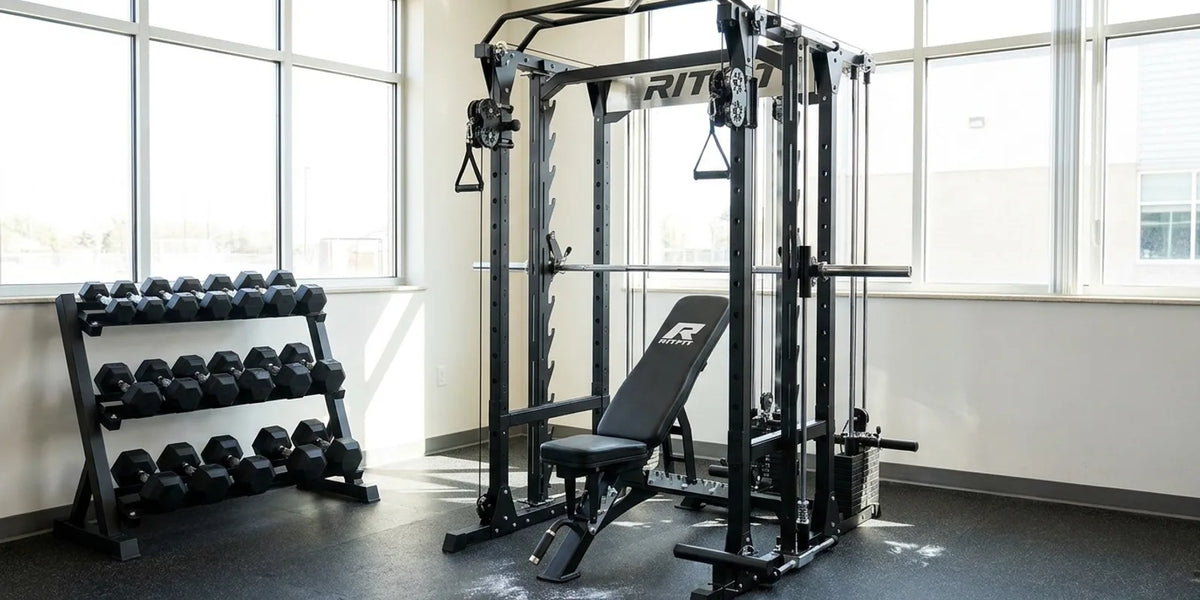
A high school weight room equipment checklist turns a long wish list into a defensible purchase order. Every line has to justify its floor space, its duty cycle, and its cost, because one room often serves several teams in the same afternoon.
This checklist groups items by weight room zone so a coach or athletic director can walk the room with a vendor and tick items off. Each line pairs the item with the selection criteria that separate school grade gear from a home setup.
Quick Answer: A high school weight room equipment checklist should cover six zones: core strength stations, free weight storage, functional and explosive tools, flooring and enclosure, safety and supervision gear, and a written management log. Schools should buy to the duty cycle of a shared room, not to the layout of a home basement gym.
Key Takeaways
- Shared duty cycle first: A school room is used by many students per hour, so throughput per station shapes the list more than total square footage.
- Supervision drives the purchase: Racks, spotter stands, and open sight lines follow from supervision rules, not from style.
- Specify by numbers: Rated weight capacity, steel gauge, hole spacing, and pad density belong in a school request document.
- Storage is not optional: Dumbbell racks, plate trees, and collars protect the equipment and the students who share it.
- Documentation protects the budget: An equipment ledger and a written inspection log support warranty claims and the next funding round.
Why a Home Basement Checklist Does Not Transfer to a School Weight Room
A school weight room is a shared, supervised training space that many students use in a single afternoon. That duty cycle quietly rewrites almost every line of a home basement checklist. Four differences drive most of the added cost and the added paperwork.
- Throughput per station: A home setup serves one lifter at a time, while a class of thirty needs enough racks, benches, and platforms that students are never stacked behind one bar.
- Supervision and inspection: A school must show who is watching each session and keep a written record that equipment was checked, which shapes rack layout, signage, and sight lines.
- Institutional grade durability: Frames, pads, and cables face hundreds of sets a week, so steel gauge, weight capacity, and serviceable parts matter more than the sale price.
- Freight, installation, and procurement: Purchase orders, delivery access, assembly, and warranty registration are part of a school project, not an add on after checkout.
A published review on youth resistance training concludes that the approach is safe and effective when programs are designed and supervised by qualified professionals.[1] For a facilities list, that finding translates into open sight lines, a spotter position at every bench, and racks that stay stable under repeated heavy sets.
The distinction is practical, because the basement gym equipment checklist on this site is written around one household, and most of its items assume a single lifter and light daily traffic.
What Core Strength Stations Does a High School Weight Room Need?
A high school weight room needs enough racks, adjustable benches, Olympic bars, plates, and dumbbells that one lifting group can train without queueing. Each item should be specified by rated weight capacity and steel gauge rather than by appearance.
- Power racks or cages: Look for 3x3 inch, 11 gauge steel uprights, a rated weight capacity above the heaviest student total, and hole spacing near one inch so J cups and safety arms adjust in small steps.
- Safety arms or straps: Every rack needs a catch height that stops a failed rep just below the chest or squat bottom position, rather than a bar that lands on the lifter.
- Adjustable benches: Check rated capacity, pad density, and whether the back pad locks at flat and at the main incline angles. RitFit's adjustable weight benches sit in a 1300 lb capacity tier, a useful reference for the floor a school grade bench should clear.
- Olympic bars: Specify 20 kg men's and 15 kg women's bars with a real knurl and a rated capacity above the plates the room owns. A standard Olympic bar weighs about 44 lb, so bar weight belongs in every load calculation.
- Plates: Bumper plates for platform work and iron plates for rack work, bought in pairs across the full range the strongest student will use.
- Dumbbells: A fixed set from light to heavy, sized to the number of students who train at the same time. The weights range covers bars, plates, and dumbbells for this zone.
For a new build or a booster funded auxiliary area, a budget tier is suited for the accessory stations and a low traffic corner, while the main rack line should stay institutional grade. Match each purchase to its real duty cycle, and let the highest traffic stations carry the highest specification.
"Every home gym starts with the rack and bench. All your heavy lifts (and bodyweight moves like pull-ups) take place in the rack. And today's home benches are the backbone of any gym, overloaded with so much functionality that you'll do everything from Nordic curls to hanging sit-ups on them."
Ebenezer Samuel, C.S.C.S. Fitness Director, Men's Health, How Our Fitness Director Overhauled His Garage Gym (Men's Health)
How Should Free Weights Be Stored and Organized?
Free weight storage should keep every dumbbell, plate, and bar within one step of its station and at waist height or below. Good storage protects the equipment, keeps aisles clear for supervision, and makes a missing pair obvious at the end of a session.
- Dumbbell racks: Three tier racks that hold pairs in order, so a student can find and return a weight without lifting it over another pair.
- Plate trees and plate storage: Upright trees with welded pegs sized to the plate hole, plus a bumper option for the platform area.
- Barbell storage: Horizontal or vertical racks that hold bars clear of walkways and keep the sleeves off the floor.
- Collars and clips: A set at every bar, because a loaded bar without a collar is a preventable hazard in a crowded room.
- Aisle and storage footprint: Plan the footprint so a loaded student can pass a coach without turning sideways.
- Labeling and accountability: Marked slots and a simple sign out sheet make missing items easy to trace.
RitFit's dumbbell storage racks show the three tier format that keeps pairs visible and reachable. The wider weight storage range covers racks and trees for both the free weight zone and the platform edge.
Which Functional and Explosive Training Tools Are Worth Buying?
Functional and explosive tools earn their space when they support warm ups, jumps, throws, and carries that a whole group can rotate through quickly. Keep this zone small and open, and choose equipment that is easy to reset between athletes.
- Plyo boxes: A set of heights with a non slip surface and a stable, fully assembled frame, never a box that rocks on landing.
- Medicine balls and slam balls: A range of weights that students can throw safely, matched to the wall or floor they are used against.
- Sleds and resistance trainers: A low friction sled plus a strip of turf or mat long enough for a short, repeatable push or drag.
- Mats and mobility gear: Dense mats for floor work and landings, plus bands for warm up activation.
- Jump ropes and markers: Light, inexpensive items that let a coach run a group warm up inside the same footprint.
Tools in this zone let a coach add progressive overload or speed work without tying up a rack. New buyers can compare options in the guide to weight room equipment for high schools.
Flooring, Mirrors, and Wall Protection
Flooring, mirrors, and wall protection are the parts of a weight room that students never notice until something fails. Rubber flooring, a lifting platform, secured mirrors, and wall panels protect the building, the equipment, and the people around them.
- Rubber flooring: Interlocking tiles or rolled rubber thick enough for dropped weights in the platform zone, and a firmer, easier to clean surface in walkways.
- Lifting platforms: A dedicated platform under each Olympic bar station, sized so the bar and the lifter stay inside the mat.
- Mirrors: Wall mirrors mounted with safety backing and set where a coach can watch technique, never loose glass at floor level.
- Wall protection: Impact panels behind throwing and rack areas to protect drywall and reduce noise.
- Airflow and climate: Ventilation and fans sized for a room with high traffic, because heat builds quickly once a full class starts working.
Plan this work before the racks land, because flooring and platform work costs far less while the room is still empty. The short video below shows a room stripped back and rebuilt around the equipment.
"How can you go wrong with more plates for your home gym! More Plates, More Dates!"
Ethan J. Verified Buyer, RitFit High-Grade Color Bumper Plates Olympic 2-Inch Rubber
Safety, Spotting, and Supervision Essentials
Safety and supervision gear should be bought together with the stations, because a rack without a spotter position or a collar is an incomplete purchase. The list covers spotter stands, floor locks, first aid, fire and egress points, and a posted supervision rule.
- Spotter stands: A stand at every bench press station, so spotting is done from behind the lifter rather than over the face.
- Floor locks or anchors: Every rack and storage unit fixed or locked so it cannot slide when a student racks a heavy bar.
- First aid and emergency access: A stocked kit, an AED, and an unobstructed path to the door.
- Fire and egress: Extinguishers at the posted location, nothing stored in front of exits, and a route that stays clear during a session.
- Supervision rule: A written maximum number of students per coach, which is the practical form of qualified supervision, plus a rule that no heavy set runs without a spotter.
- Signage: Posted rules for collars, racking, and footwear at the entrance.
A 2025 systematic review of supervised youth strength training screened 634 articles and included 22 studies, with the most effective programs running 6 to 12 weeks at 2 to 3 sessions per week.[2] A separate paper frames youth resistance training around qualified instruction and structured progression rather than unsupervised access.[3]
Read together, those findings make the supervision rule a specification rather than a poster, because the staffing plan decides how many racks and benches the room actually needs.
Weight Room Management and Documentation
Management and documentation turn a room full of equipment into an asset the school can maintain and defend at budget time. The list covers an equipment ledger, an inspection log, posted rules, and a warranty and spare parts register.
- Equipment ledger: Item, purchase date, serial number, and location for every major piece, kept in one shared file.
- Inspection log: A signed weekly and monthly maintenance schedule covering frames, fasteners, cables, pads, and bars.
- Warranty and spare parts register: Warranty terms, proof of purchase, and a small stock of the parts that fail first, such as cables, collars, and pads.
- Annual equipment audit: A yearly walk through with a short written report for the business office.
- Phased purchase plan: A staged buying order so the room improves every funding cycle instead of stalling after one large order.
| Build stage | Fund these zones first | Why it comes in this order |
|---|---|---|
| Stage one | Core strength stations and safety gear | The rack line and spotter equipment carry the highest traffic and the highest risk. |
| Stage two | Free weight storage and flooring | Storage clears aisles for supervision, and flooring protects the building under dropped weight. |
| Stage three | Functional tools and enclosure | Explosive tools and mirrors add capacity once the core room is safe and orderly. |
A planning order for phased school projects, not a product ranking.
Strong documentation also makes the next phase easier to fund. The guide to high school weight room equipment shows how the zones fit together, and the breakdown of how much a high school weight room costs shows where the money usually goes.
When funding arrives in stages, weight room packages by budget help a school plan the first build and the upgrades that follow.
FAQs About High School Weight Room Equipment Checklist
What equipment is essential in a high school weight room?
A high school weight room needs power racks or cages with safety arms, adjustable benches, Olympic bars and plates, dumbbells, and storage for all of it. Add plyo boxes and medicine balls for explosive work, rubber flooring for the platform area, and spotter stands. Every item should be specified by rated weight capacity, not by looks alone.
How much space does a high school weight room need?
Start from the number of lifters in a class, not from the room. Plan each station so a lifter can load a bar and a coach can walk behind it without stepping over another station. That usually means a dedicated platform or rack zone, a separate dumbbell and bench zone, and an open turf strip for jumps and carries.
How many power racks should a high school weight room have?
Count your largest lifting group and divide by the number of students who can work safely at one rack. Most schools land between four and eight racks for a team session. Racks are the slowest station to share, so under buying them forces waiting, while one spare rack is easier to justify than one spare dumbbell set.
What safety equipment does a school weight room require?
Safety arms or straps for every rack, spotter stands for bench work, collars for every loaded bar, floor locks so racks cannot slide, and a stocked first aid point near the door. Add clear sight lines and a posted supervision rule that sets a maximum number of students per coach during any working set.
How often should weight room equipment be inspected?
Run a short visual check before every session and a written inspection on a fixed weekly and monthly schedule. Log frame fasteners, cables and pulleys, bench pads, bar knurling, and plate condition. A dated log turns a loose bolt into a quick fix and gives the school a real record for warranty claims and for insurance reviews.
Can budget home gym equipment work in a school weight room?
Budget gear can work in a low traffic corner, a booster funded auxiliary area, or a first build, but it should not carry the main lifting stations. School weight rooms see many users per day, so the frame gauge, pad density, and serviceability matter more than the sale price. Match each item to its real duty cycle.
How should a coach document and maintain weight room equipment?
Keep one shared ledger with the model, serial number, purchase date, and location of every item. Add a weekly and monthly inspection sheet that a staff member signs, and record any repair or replacement in the same file. That written trail supports warranty claims, insurance reviews, and the next budget request.
Conclusion
A high school weight room equipment checklist works best as a living document that a coach, an athletic director, and a business office can all read. Buy to the duty cycle of a shared room, log what you own, and let the inspection record justify the next round of funding.
Start with the core stations, then add storage, flooring, and supervision gear in the order that removes the biggest bottleneck. New buyers can compare phased options in the RitFit discount guide before the next purchase window.
Disclaimer
This article provides general equipment planning guidance for school facilities and is not medical, safety certification, or legal advice. Schools should confirm local building, fire, and supervision requirements with qualified professionals and follow the manufacturer instructions for installation and use.
References
1. Faigenbaum AD, Myer GD. Resistance training among young athletes: safety, efficacy and injury prevention effects. Br J Sports Med. 2010;44(1):56-63. doi:10.1136/bjsm.2009.068098. PMCID: PMC3483033
2. Moreno-Torres JM, Garcia-Roca JA, Abellan-Aynes O, Diaz-Aroca A. Effects of Supervised Strength Training on Physical Fitness in Children and Adolescents: A Systematic Review and Meta-Analysis. J Funct Morphol Kinesiol. 2025;10(2). doi:10.3390/jfmk10020162. PMCID: PMC12101325
3. Zwolski C, Quatman-Yates C, Paterno MV. Resistance Training in Youth: Laying the Foundation for Injury Prevention and Physical Literacy. Sports Health. 2017;9(5):436-443. doi:10.1177/1941738117704153. PMCID: PMC5582694





