








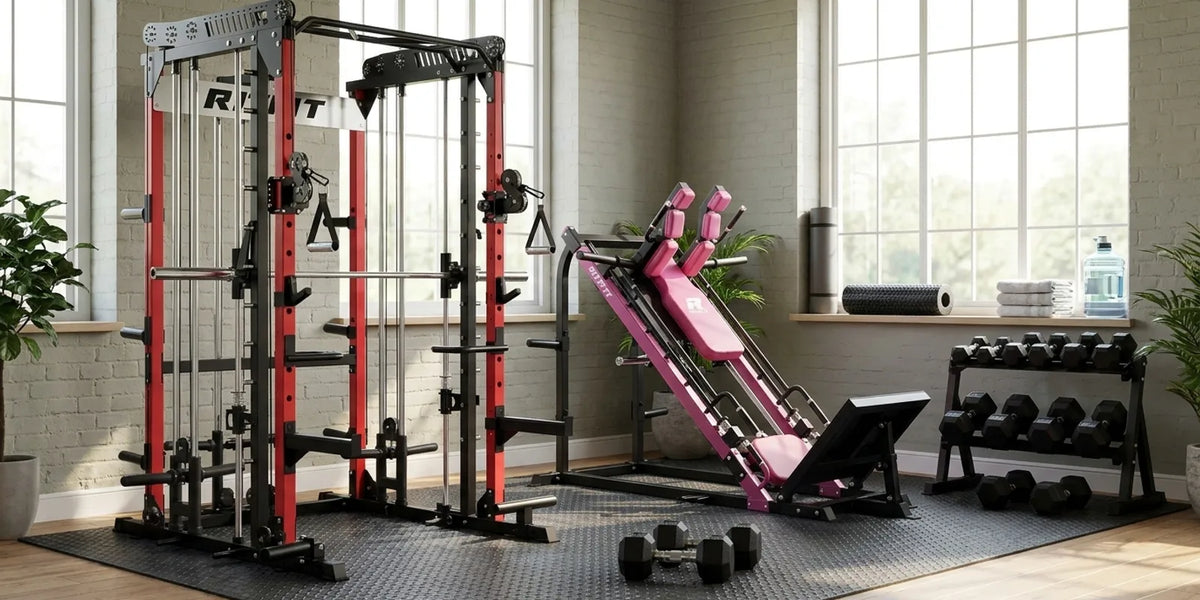
The best home gym equipment for runners is a short list: a Smith machine or power cage, a pair of dumbbells, a leg press and hack squat machine, and a back extension bench. Strength work transfers to running through better running economy and force production, not through extra cardio.
This guide covers the five strength pieces that actually change how you run, how heavy and how often to load them, and what to skip. Space, ceiling height, and setup order get covered too.
Quick Answer: A runner's home gym works best with five strength pieces: a Smith machine or power cage with a cable system, a leg press and hack squat machine, a pair of dumbbells, and a back extension bench. These cover squatting, single leg work, and posterior chain loading, which is where the transfer to running comes from.
Key Takeaways
- Five pieces cover every pattern: A Smith machine or power cage, dumbbells, a leg press and hack squat machine, and a back extension bench handle squatting, single leg work, and posterior chain loading.
- Heavy loading drives the transfer: Pools of runner training research link heavy strength work to better running economy, while light circuit style work adds far less.
- Two sessions a week is enough: Most published runner strength programs used one to four short sessions weekly rather than daily lifting.
- Bilateral first, then unilateral: Fixed path machines build the base load, and dumbbells expose the left to right differences that matter over long distances.
- Skip cardio machines: A treadmill adds little that outdoor running does not already provide, and it eats the floor space your squat station needs.
What Home Gym Equipment Do Runners Actually Need to Buy or Skip?
Runners need five strength pieces that cover squatting, single leg work, and posterior chain loading. A Smith machine or power cage, a leg press and hack squat machine, dumbbells, and a back extension bench handle all three patterns. Cardio machines add little, because running already supplies the aerobic stimulus, and running economy tracks closely with endurance performance at reported correlations around r = 0.8 to 0.9.[1]
| Equipment | Pattern it covers | Best for | RitFit pick |
|---|---|---|---|
| Smith machine or power cage | Squat, press, cable pulls | One anchored station for every heavy pattern | RitFit M1 PRO Multi-Functional Smith Machine |
| Leg press and hack squat machine | Heavy quadriceps loading | High mileage weeks when balance limits free weight squats | RitFit GAZELLE 3-in-1 Leg Press Hack Squat Machine |
| Dumbbell pair | Unilateral training and loaded carries | Small garages and runners rebuilding left to right symmetry | RitFit Rubber Hex Dumbbells |
| Back extension bench | Posterior chain and hip extension | Glute and hamstring strength without bar loading | RitFit BE01 Adjustable Back Extension Machine |
| Power cage with cable system | Progressive overload and pull downs | Long term setups where capacity matters | RitFit P3 Power Cage 1200lbs |
Pattern and best for notes come from the training purpose of each piece, and the RitFit picks map to the product pages linked in this guide.
- Skip treadmills and rowers: Running itself supplies the aerobic stimulus, so cardio machines mostly duplicate work you already do outdoors.
- Skip fixed path leg extensions: Split squats, step ups, and single leg squats load the same muscles while also training single leg stability.
- Skip buying the whole list at once: One anchored station plus dumbbells covers most of the transfer in your first year of lifting.
If you are laying out a new space, browse the functional and strength training equipment range before you commit to a floor plan. The order that works for most runners is station first, dumbbells second, and specialty benches last.
How Does Strength Training Transfer to Running?
Strength training transfers to running because heavier leg work raises the force your muscles can produce at a given pace. A 2024 systematic review of middle distance and long distance runners found that high load training produced a moderate effect on running performance (effect size -0.469) and combined training produced a large effect (effect size -1.035).[2]
- Running economy: The same pace costs less oxygen once your legs produce more force per stride.
- Rate of force development: Heavy sets train how fast you push into the ground, which shortens ground contact time.
- Neuromuscular adaptation: Your nervous system learns to recruit more fibers, so late race pace feels less expensive.
- Single-leg stability: Unilateral training keeps the weaker side from leaking force over a long run.
One trial in well trained distance runners found that complex training and heavy resistance training both improved neuromuscular adaptation, running economy, and 5-km performance in the same group of runners.[3]
Building that strength takes time. The programs pooled in that review ran six to forty weeks with one to four sessions per week, which is a reminder that a single block will not change your race pace.
1. RitFit M1 PRO Multi-Functional Smith Machine: Best Garage Gym Squat Base for Runners
The RitFit M1 PRO Multi-Functional Smith Machine is the best anchor for a runner's home gym because it combines a fixed bar path with a cable crossover station. A guided bar path lets you take squats and split squats close to failure without spending your session balancing a barbell.
- Repeatable heavy squats: The centered bar path keeps form identical rep to rep, which matters when your legs are already tired from midweek mileage.
- Single leg loading: The built in rack position supports split squats, step ups, and a single leg Romanian deadlift from one station.
- Cable work a barbell cannot do: The dual cable station covers anti rotation core work and rows, which a straight bar cannot load at all.
- Solo training: Fixed hooks and adjustable safeties mean you can train heavy without a spotter.
For runners, the practical win is recovery cost. You get the heavy stimulus with less stabilizer fatigue than free weight squats add on top of your running load, so the strength session does not quietly replace a quality run day.
"Few pieces of equipment in the home exercise industry are as comprehensive and versatile as this all-in-one gym system. The robust system provides a natural, centered bar path for compound lifts like squats, presses, and rows, and incorporates a dual cable crossover station with a full rack of precision-engineered attachments."
Tom Eskey, CF-L1, CPT, Home Gym Equipment Reviewer, Garage Gym Revisited, RitFit M1 Multi-functional Smith Machine: Our Review | Garage Gym Revisited
"Really solid product especially for the price. Some minor bends in the smith bars that don't affect functionality much. Fit perfectly in my space when I flipped the pullup bar upside down. Just need to buy myself some more floor mats and get some attachment storage."
Mason N. Verified Buyer, RitFit M1 PRO Multi-Functional Smith Machine with Cable Crossover System and Squat Rack for Home Gym
2. Best RitFit GAZELLE Leg Press and Hack Squat Machine for Home Gym Leg Loading
The RitFit GAZELLE 3-in-1 Leg Press Hack Squat Machine is the best way to keep heavy quadriceps loading in a runner's plan when mileage climbs. Supporting your back against the pad removes the balance demand that makes free weight squats costly to recover from.
- Hack squat for quadriceps: The shoulder pads let you push heavy without a bar across your back, which suits runners who already carry upper body tension.
- Leg press for volume: You can add controlled reps at the end of a session without the single leg stability demand of split squats.
- Consistent setup: Fixed footplate angles make week to week loading easier to track than free weight squat depth.
Use it as a supplement, not a replacement. Keep at least one Bulgarian split squat variation in the week so single leg stability stays trained alongside raw quadriceps strength.
"This machine completely upgraded my home gym. The transition between leg press and hack squat is smooth, and both movements feel solid and stable."
Emily Carter, Verified Buyer, RitFit GAZELLE 3-in-1 Leg Press Hack Squat Machine for Home Gym
3. Best Dumbbells for Single-Leg and Carry Work
A pair of RitFit Rubber Hex Dumbbells is the best low cost way to add unilateral training, because dumbbells expose side to side differences that a barbell hides. They are also the only piece on this list that travels to a hotel room or a park.
- Single leg squats and step ups: Loading one leg at a time shows which side gives out first over a long run.
- Loaded carries: Farmer walks build grip, trunk, and hip stability without adding fatigue to your quads.
- Eccentric loading: Lowering slowly on a rear foot elevated split squat builds tendon tolerance at running specific angles.
- Low space cost: A single pair takes less floor area than any machine in this guide.
Buy one pair at a weight you can split squat for eight clean reps per side, then add heavier pairs as your running block progresses. Runners rarely need a full rack of dumbbells to get the transfer.
"Great Quality I really like the quality of the pair of 30 lb dumbbells. They are a great compliment to my growing set of workout equipment."
Thomas Mueller, Verified Buyer, RitFit Rubber Hex Dumbbells Pairs and Sets
4. RitFit BE01 Back Extension Bench: Best Posterior Chain Piece for Runners
The RitFit BE01 Adjustable Back Extension Machine is the best posterior chain piece for a runner's home gym because it trains hip extension without a bar across your back. The adjustable pad positions let you shift emphasis between glutes and hamstrings without changing equipment.
- Glute and hamstring loading: Hip extension strength is what holds pace late in a long run.
- Adjustable positions: Lower pad settings bias the glutes, while higher settings bias the hamstrings.
- Low skill entry: The movement pattern is easy to learn, so it fits a runner who has never lifted before.
- Pairs with work you already do: Add it to these hamstring exercises you can do at home for a complete posterior chain week.
Two sets of twelve to fifteen reps at the end of a strength session is enough for most runners. Treat it as accessory work and keep the heavy loading on your squat or leg press day.
"Super great quality i love my new back extension machine."
Alexis B. Verified Buyer, RitFit BE01 Adjustable Back Extension Machine for Home and Gym
5. RitFit P3 Power Cage: Best for Progressive Overload and Cable Work
The RitFit P3 Power Cage 1200lbs is the best long term frame for runners who plan to keep adding load for years. RitFit lists the cage at a 1200 lb rating, and the integrated cable system covers the pulling and anti rotation work a rack alone cannot.
- Progressive overload: A rated frame lets you keep adding plates long after dumbbells run out.
- Cable system: Pull downs, rows, and single arm presses cover the upper body and trunk work runners usually skip.
- Attachment ecosystem: A cage accepts far more accessory types than a fixed path machine.
- Upgrade path: A cage holds its value and takes new attachments as your training changes.
Choose the cage over the Smith machine when your priority is barbell squat and deadlift strength. Choose the Smith machine when your priority is repeatable reps while training alone.
"It says two people to for assembly however I was able to do majority of it by myself then got help with the pulley system which wasn't as complicated as I thought it was going to be."
Davina, Verified Buyer, RitFit P3 Power Cage 1200lbs with Smooth Cable System & Aluminum Pulleys
How Heavy and How Often Should Runners Lift?
Runners get the most transfer from heavy loads, around 80 percent of a one rep max. Sessions work best at three to five sets of three to six repetitions, stopping short of failure on most sets.
- Frequency: Two sessions per week, spaced at least forty eight hours apart.
- Progression: Add load when you hit the top of the rep range on every set with clean form.
- Placement: Lift after an easy run or on a separate day, never before a hard workout.
- Deload: Cut volume by half during race week and the week after.
Pain is the one signal that overrides the plan. Sharp or one sided pain during a lift means stop the set, and ongoing pain that changes how you run is a reason to see a clinician rather than push through.
How to Set Up a Runner's Strength Corner in a Garage Gym
A runner's strength corner needs about a single car bay, one wall for the frame, and two feet of clearance on each side for loading plates. Measure ceiling height before ordering a cage, because garage ceilings limit overhead pressing long before floor space does.
- Measure first: Note ceiling height, door swing, and the slope of the garage floor before you buy.
- Buy in order: Anchored station first, dumbbells second, specialty benches last.
- Common mistake: Spending the budget on cardio equipment and then having no room for the squat station.
- Floor protection: Use rubber tiles under the rack to protect concrete and deaden noise.
- Stop condition: If a lift leaves you limping the next day, the load is too heavy for that training week.
If your space is tight, read more about leg machines worth bringing home before you commit to a footprint. Most runners end up happier with one complete station than with three partial ones.
FAQs About Home Gym Equipment for Runners
What home gym equipment do runners actually need?
Runners need five pieces that cover squatting, single leg work, and posterior chain loading. A Smith machine or power cage with a cable system anchors the setup. Dumbbells, a leg press or hack squat, and a back extension bench fill the remaining patterns. That combination covers every strength pattern that transfers to running.
How heavy should runners lift in a home gym?
Runners generally get the most transfer from heavy loads, roughly 80 percent of a one rep max or higher, for three to five sets of three to six reps. A 2024 review found high load training produced moderate effects on running performance. Lighter loads still help if you are new to lifting.
Can a Smith machine replace free weights for runners?
Yes. A Smith machine fixes the bar path, which lets runners load squats and split squats heavily without balancing a barbell. That fixed path is useful when one leg is noticeably weaker, because you can push closer to failure safely. Free weights still build more stabilizer demand, so many runners use both.
How often should runners do strength training at home?
Two sessions per week is enough for most runners, and the published programs in the 2024 review ran one to four sessions weekly for six to forty weeks. Keep sessions short and place them after easy runs rather than before hard workouts. Two quality sessions beat four rushed ones.
What home gym equipment should runners skip?
Runners can skip most cardio machines, because running itself already supplies the aerobic stimulus. Skip fixed path leg extension machines too, since single leg squats, split squats, and step ups load the same muscles while also training balance and stability. Buy the strength pieces first and add anything else only when a specific goal demands it.
How much space does a runner home strength setup need?
A Smith machine, a pair of dumbbells, and a back extension bench fit inside a one car garage bay. Most owners line the pieces along a single wall and keep two feet of clearance on each side for loading plates. Measure ceiling height before you order a cage.
Conclusion
A runner's home gym does not need much equipment, but it does need the right five pieces: a Smith machine or power cage, dumbbells, a leg press and hack squat machine, and a back extension bench. Together they cover squatting, unilateral work, and posterior chain loading, which is where the transfer to running comes from.
Start with the anchored station, add dumbbells as soon as you can, and check the RitFit discount guide before you order the rest.
Disclaimer
This article offers general fitness information and product guidance for building a home gym, not medical advice. Consult a qualified healthcare professional before starting a new strength program, especially if you have a current injury or a medical condition.
References
1. Šuc A, Šarko P, Pleša J, Kozinc Ž. Resistance Exercise for Improving Running Economy and Running Biomechanics and Decreasing Running-Related Injury Risk: A Narrative Review. Sports (Basel). 2022;10(7). doi:10.3390/sports10070098. PMCID: PMC9319953
2. Llanos-Lagos C, Ramirez-Campillo R, Moran J, Sáez de Villarreal E. The Effect of Strength Training Methods on Middle-Distance and Long-Distance Runners' Athletic Performance: A Systematic Review with Meta-analysis. Sports Med. 2024;54(7):1801-1833. doi:10.1007/s40279-024-02018-z. PMCID: PMC11258194
3. Li F, Wang R, Newton RU, Sutton D, Shi Y, Ding H. Effects of complex training versus heavy resistance training on neuromuscular adaptation, running economy and 5-km performance in well-trained distance runners. PeerJ. 2019;7:e6787. doi:10.7717/peerj.6787. PMCID: PMC6487184





