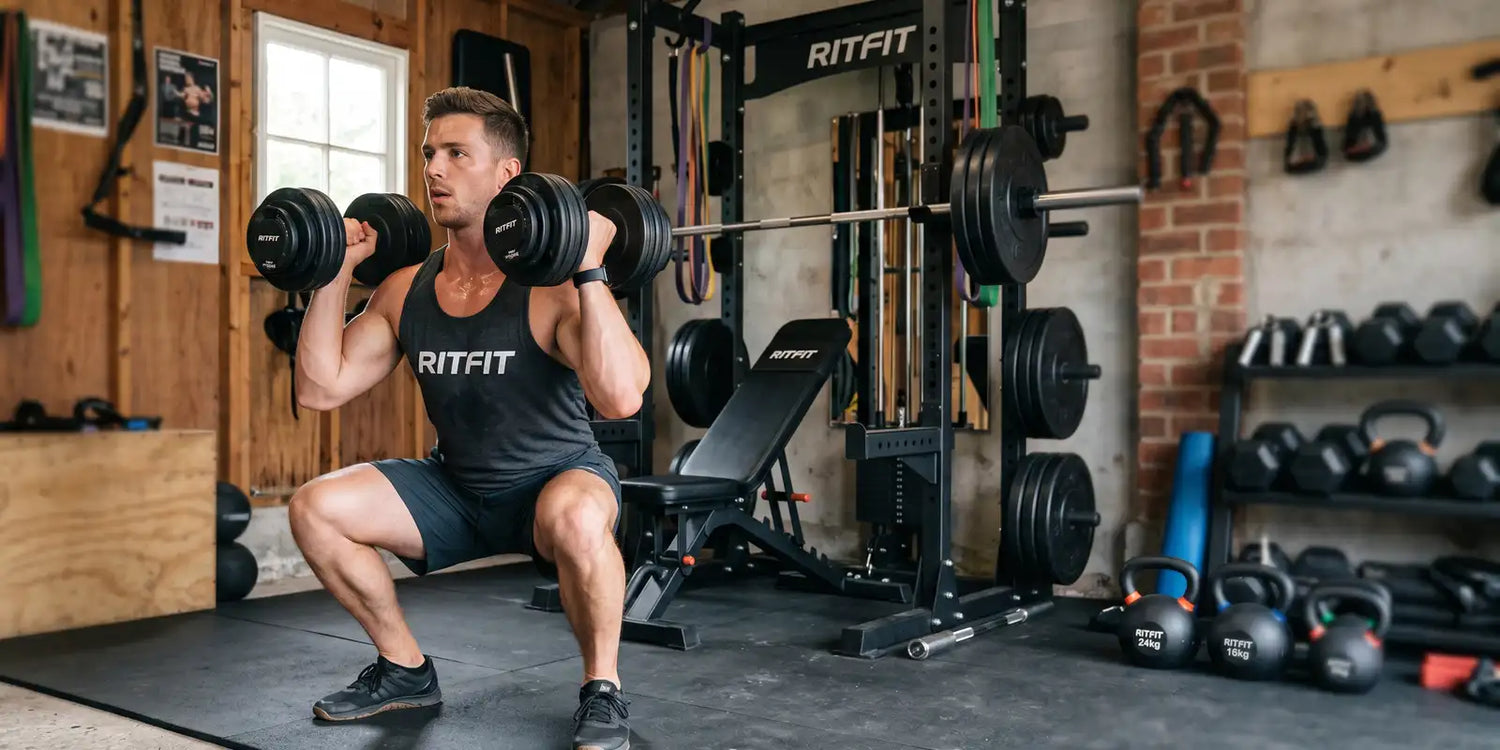
Wondering how many reps to build muscle is one of the most common questions in the gym, and the honest answer is more flexible than most people expect. Muscle grows across a wide rep range when each set is challenging.
This guide breaks down the rep ranges, sets, and weekly volume that actually drive growth, then turns the science into a simple plan you can run at home.
Quick Answer: Most people build muscle with 6 to 30 reps per set, because growth depends more on effort and weekly volume than on one perfect number. Aim for about 10 hard sets per muscle group per week, train close to failure, and choose heavier loads for strength.
Key Takeaways
- Range beats a magic number: Muscle grows across roughly 6 to 30 reps when each set is hard.
- Effort is the driver: Taking working sets close to failure tells the muscle to adapt.
- Volume matters: About 10 hard sets per muscle group per week supports solid growth.
- Heavy for strength: Lower reps with heavier loads build maximal strength best.
- Progress over time: Adding reps or weight steadily keeps forcing new adaptation.
Why Do Rep Ranges Matter for Muscle Growth?
Rep ranges matter because they shape how hard each set is and which adaptation it drives. The number of reps you can do reflects the load relative to your strength.
- Load and reps are linked: Heavier weights allow fewer reps, lighter weights allow more.
- Effort sets the stimulus: A hard set near failure tells the muscle to grow.
- Consistency compounds: Repeating challenging sets over weeks creates visible change.
Understanding what a rep actually means in strength training makes the rest of this guide far easier to apply.
What Is the Best Rep Range for Muscle Growth?
There is no single perfect rep number for building muscle, and growth happens across a wide range when effort stays high. A systematic review found that muscle hypertrophy occurs across loads from roughly 30 to 90 percent of one-rep max when sets are performed with high effort.[1]
- Moderate reps: About 8 to 12 reps is a practical, joint-friendly sweet spot.
- Lower reps: Heavier sets of 4 to 6 reps build size and strength together.
- Higher reps: Lighter sets of 15 to 30 reps grow muscle when pushed hard.
You can pick any range that suits the exercise and your joints, then focus on making each set genuinely hard.
How Many Sets and How Much Weekly Volume Do You Need?
Total weekly volume often matters more than the exact reps in one set, because volume is the running total of hard sets you give each muscle. An umbrella review found that higher weekly training volume is associated with greater hypertrophy.
That review points to at least about 10 sets per muscle group per week and roughly 2 to 3 sets per exercise.[2] Spreading those sets across two sessions usually beats cramming them into one.
- Count hard sets: Only sets taken near failure count toward useful volume.
- Split the week: Train each muscle twice for better quality and recovery.
- Add gradually: Begin lower and increase sets as recovery allows.
You can hit this volume at home with a quality set of hexagon dumbbells and a few basic movements.
"10+ sets per muscle per week elicited greater hypertrophy than <10 sets. Thus, this would be a good starting point."
Brad Schoenfeld, PhD, Exercise Science Researcher specializing in Muscle Hypertrophy, CUNY Lehman College
How Close to Failure Should Each Set Be?
Effort is the real engine of muscle growth, because how hard you push a set determines whether the muscle adapts. A study found that lighter and heavier loads build similar muscle when sets reach failure.
Strength gains remain more dependent on heavier loads, so match the load to your goal.[3] Stopping one or two reps short drives most growth with less fatigue.
- Leave a little in reserve: Stopping one or two reps short drives most growth with less fatigue.
- Save true failure: Reserve all-out sets for the last set of an exercise.
- Stay honest: A set with five easy reps left does little for size.
Pairing effort with weight bench workouts for muscle growth lets you push safely on pressing movements.
What Reps Build Strength Versus What Reps Build Size?
Strength and size overlap, but they respond best to slightly different rep ranges and loads. Heavier loads for one to five reps build maximal force, while moderate loads for six to fifteen reps grow muscle efficiently.
- Strength focus: Heavier loads for 1 to 5 reps build maximal force best.
- Size focus: Moderate loads for 6 to 15 reps are efficient for growth.
- Endurance focus: Lighter loads for 15 plus reps build work capacity.
Many lifters combine heavy compound work with moderate rep accessory sets, as seen in these best back and bicep workouts for muscle growth.
A simple split that mixes ranges, like the moves in these Smith machine chest workouts for muscle growth, covers both goals over a week.
How Do You Build a Simple Rep Plan at Home?
A workable plan turns the science into action without overthinking, and you can run it with dumbbells and a bench. Pick a few compound lifts, choose your rep ranges, and progress them steadily.
- Choose ranges: Use 5 to 8 reps on big lifts, 8 to 15 on accessories.
- Hit your volume: Build toward about 10 hard sets per muscle weekly.
- Progress weekly: Add a rep or a little weight whenever a set feels easier.
Round out your setup with hex rubber dumbbells, functional training equipment, or these best dumbbells for beginners to build muscle.
FAQs About How Many Reps Build Muscle
How many reps should I do to build muscle?
Most growth happens in a broad range of about six to thirty reps per set, as long as you push each set close to failure. Pick a weight that makes the last few reps genuinely hard, and the exact number matters far less than consistent effort and progression over time.
Is a higher rep range better for muscle growth?
Not necessarily, because moderate and higher rep sets build similar muscle when taken close to failure.
Heavier, lower rep work builds more raw strength, while lighter, higher rep work can be easier on the joints.
Choosing a comfortable range that you can progress on matters most.
How many sets per muscle group should I do each week?
Evidence points to at least about ten working sets per muscle group per week for solid growth.
Spreading those sets across two sessions usually works better than cramming them into one.
Beginners can start lower and add sets gradually as recovery and technique improve.
Do I need to train to failure to build muscle?
No, you do not need to hit total failure on every set.
Training close to failure, leaving one or two reps in reserve, drives most of the growth while limiting fatigue.
Reserve true failure for the final set of an exercise rather than every single set.
What rep range is best for strength versus size?
Strength responds best to heavier loads in lower rep ranges, often one to five reps. Size grows across a wider range when effort is high, roughly six to fifteen reps per set. Many lifters combine heavy work for strength with moderate rep sets for size in one program.
How long until I see muscle growth from my reps?
Visible changes usually take a couple of months of consistent training, adequate protein, and progressive overload.
Strength often improves first within a few weeks as your nervous system adapts.
Track your weights and reps so you can confirm steady progress even before the mirror shows it.
Conclusion
The best rep range to build muscle is the one you can train hard and progress on, anywhere from about 6 to 30 reps. Effort and weekly volume drive growth far more than chasing a single magic number.
Start with 5 to 8 reps on big lifts and 8 to 15 on accessories, then add a rep or a little weight each week. Browse the RitFit sale page to round out your home setup as you build the habit.
Disclaimer
This article is for general educational purposes only and is not medical advice. Consult a qualified healthcare or fitness professional before starting a new training program, especially if you have any injuries or health conditions.
References
1. Lacio M, Vieira JG, Trybulski R, et al. Effects of Resistance Training Performed with Different Loads in Untrained and Trained Male Adult Individuals on Maximal Strength and Muscle Hypertrophy. International Journal of Environmental Research and Public Health. 2021;18(21):11237. PMCID: PMC8582674.
2. Bernardez-Vazquez R, Raya-Gonzalez J, Castillo D, et al. Resistance Training Variables for Optimization of Muscle Hypertrophy: An Umbrella Review. Frontiers in Sports and Active Living. 2022;4:949021. PMCID: PMC9302196.
3. Fink J, Kikuchi N, Yoshida S, et al. Impact of high versus low fixed loads and non-linear training loads on muscle hypertrophy, strength and force development. SpringerPlus. 2016;5(1):698. PMCID: PMC4899398.