Table of Contents
- What is a Smith Machine?
- Different Types of Smith Machines
- Differences Between Smith Machines
- Why is Knowing the Smith Machine Bar Weight Important?
- Common Smith Machine Bar Weight
- How to Measure a Smith Machine Bar Weight Yourself
- Smith Machine Bar vs. Free Weight Olympic Bar
- Smith Machine Bar Weight FAQ
If you're planning to have intense workouts using a Smith machine, you must be wondering about the Smith machine bar weight. Working out on a Smith machine can put significant pressure on your body, which is why you need a clear idea about how much a Smith machine bar weighs. It’s more complicated than a standard barbell because there is no single “standard” Smith machine bar weight, which can be highly confusing.
Smith machines are highly popular, with their market expected to grow by 5.5% by 2030. Therefore, in this article, we'll tell you everything you need to know about Smith machine bar weight and how to use that knowledge to make your workouts better.
What is a Smith Machine?
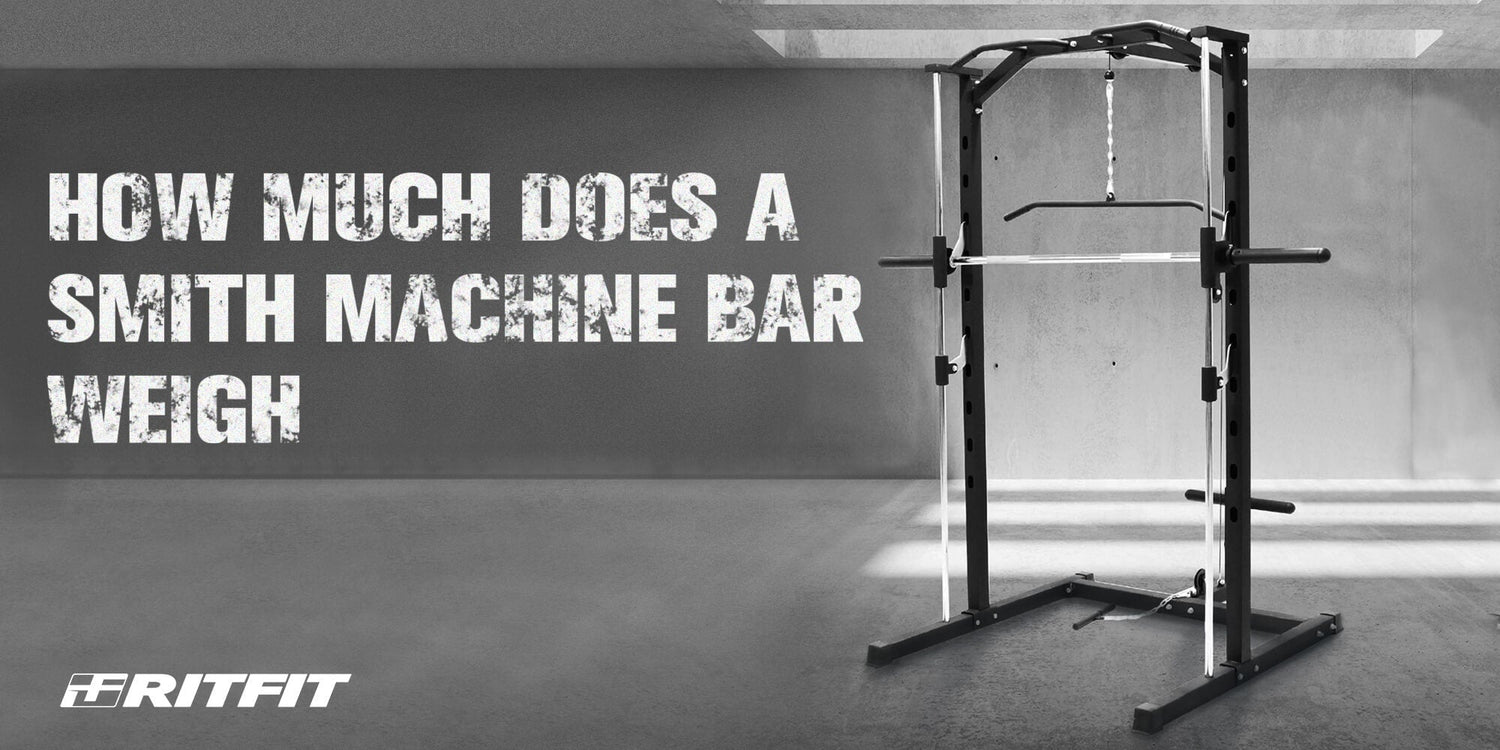
A Smith machine is a workout apparatus designed for specific exercises in which the barbell travels up and down along steel railings. The rails control the weight through vertical movement, differentiating Smith machine workouts from free-weight barbell workouts. Both ends of the bar have hooks and multiple lock-out points where you can hook the weight.

The hooks on the Smith machine make it safer because they turn it into a self-spotting device. There is also no need to stabilize the bar perfectly, as the Smith machine performs that function. As a result, you can focus on the primary muscles you want to train, which can be highly beneficial for mixing up different workout routines.
Different Types of Smith Machines
Before discussing Smith machine bar weight, it is crucial to know what types are available.
Let’s first discuss the two main types of commercial Smith machines.
Counterbalanced Smith Machine
A counterbalanced Smith machine uses a pulley and counterweight system, making the bar feel extremely light, sometimes as light as 6 lbs. Most commercial gyms use this type because many people find it easier to work with. The pulley system is usually hidden inside the front uprights of the machine.

However, you can still usually see parts of the pulley system poking out of the top frame of the machine. The effective bar weight in a counterbalanced Smith machine is always very low, usually falling between 6–20 lbs.
Linear Bearing Smith Machine
A linear bearing Smith machine provides the feel of a free-weight barbell rather than a heavily counterbalanced one. There is no pulley here to balance the weight, so you feel the true weight of the bar when you exercise. It is frequently used in home gyms because it costs less and does not require added counterbalance hardware.

The bar on this machine is considerably heavier than on the counterbalanced Smith machine. It is perfect for those who want intense workouts and want to exert as much as possible.
Now let’s move on to Smith machines commonly available for home gyms.
All-in-One Smith Machine
The all-in-one Smith machine is an advanced home gym apparatus for those who have been working out for some time. It adds an element of free weights to the mix through numerous stations that increase its height and footprint. Sometimes, these machines are offered with both selectorized and plate-loaded resistance options.

Selectorized Smith Machine
The selectorized Smith machine is less common but can still be found in some facilities and home gyms. It has a central rod connected to a weight stack with dual guide rods on both sides. It has an adjustable bar height, and the resistance can be lowered or increased through a selectorized weight stack pin.

Differences Between Smith Machines
Now that we have discussed the most prominent types of Smith machines, let us also understand the aspects that differentiate them and lead to different bar weights.
Bar Material
Smith machine bars tend to be lighter than a standard 45 lb Olympic bar, thanks to the support on either side of the bar. They are not always made of the same high-resistance steel used in Olympic bars because it is unnecessary. The usual bar weight lies between 30–40 lbs, but it can increase due to the addition of hooks, sleeves, and bearings.
Counterbalances
Usually, residential Smith machines do not have a counterbalance, while many commercial Smith machines do. High-end Smith machines can counterbalance the bar and make it easier to exercise by reducing the effective starting weight.
This happens due to a combination of counterweights, pulleys, and cables. The counterbalance is usually hidden under a cover, bringing the bar’s effective weight down to around 30 lb or even lower. In some models, the effective starting weight can be as low as 6 lb, depending upon the balancing system used in the machine.
Thanks to the reduced weight, counterbalanced Smith machines are perfect for those new to lifting or those who cannot yet exert much force.
Although you can technically counterbalance the bar to “zero,” doing so is unproductive and defeats the purpose of resistance training. If the bar is too aggressively counterbalanced, even the slightest touch will send it up quickly and can potentially damage the machine.
Angle of the Rails
Many people think that the bar on a Smith machine moves up and down in a perfectly straight, vertical line, but they’re mistaken. The rails are often fixed on a slight incline in many machines to better emulate the natural bar path for movements like squats and bench presses.
However, reducing weight is not the main purpose of this incline. Its primary function is to provide a more natural exercise path for maximum gains and joint comfort.
Why is Knowing the Smith Machine Bar Weight Important?
You might be wondering why it is important to know the bar weight in the first place. After all, you just want to lift and get stronger, even if you do not know the exact bar weight. However, going down that path is a mistake, as explained below.
Progressive Overload
Progressive overload is arguably the most fundamental aspect of resistance training, without which you cannot see consistent results. When you know the Smith machine bar weight accurately, you can make precise adjustments to your training load on a weekly or bi-weekly basis.
For example, if your Smith bar weighs 20 lb and you add a 45 lb plate on each side, your total load is 110 lb (20 + 45 + 45), not just “two 45s.” Those small math details are what keep your training log honest and your strength gains predictable.
Beginner Plan
Knowing the Smith machine bar weight also helps you as a beginner. Once you know the true starting weight, you can build a workable plan accordingly. For instance, if you bench press 120 lbs with a free barbell, you can adjust your Smith machine loading to match the same total resistance more accurately.
Once you know the real starting weight of your bar, you can also match your Smith machine numbers to a free-barbell program more safely instead of guessing or “rounding up.”
Common Smith Machine Bar Weight
Why does a Smith machine bar feel lighter?
The Smith machine bar feels lighter because it does not need as much tensile strength to carry weight. Thanks to the support from the clamps, bearings, and slides, the bar can be built lighter while still handling heavy loads. Usually, the bar itself weighs only 25–40 lbs, and Smith machines with counterbalance reduce the effective starting weight even further.
What is the starting weight of a Smith machine?
Smith machine bars can weigh as low as 6 lbs and as high as 45 lbs. However, the average effective starting range is 15–25 lbs. The net weight of the full Smith machine unit is usually around 50 kg or more, but that doesn’t directly tell you the bar weight.
Commercial counterbalanced units usually start in the 6–15 lb range, while most home and hybrid Smith machines without counterbalance tend to start around 25–35 lb at the bar.
Example Smith Machine Bar Weights (Including RitFit Models)
Here are some typical starting bar weights so you can see where your machine might sit on the spectrum:
- Commercial counterbalanced Smith machine (generic): usually around 6–15 lb at the bar.
- Non-counterbalanced commercial Smith with a thicker bar: typically 25–35 lb.
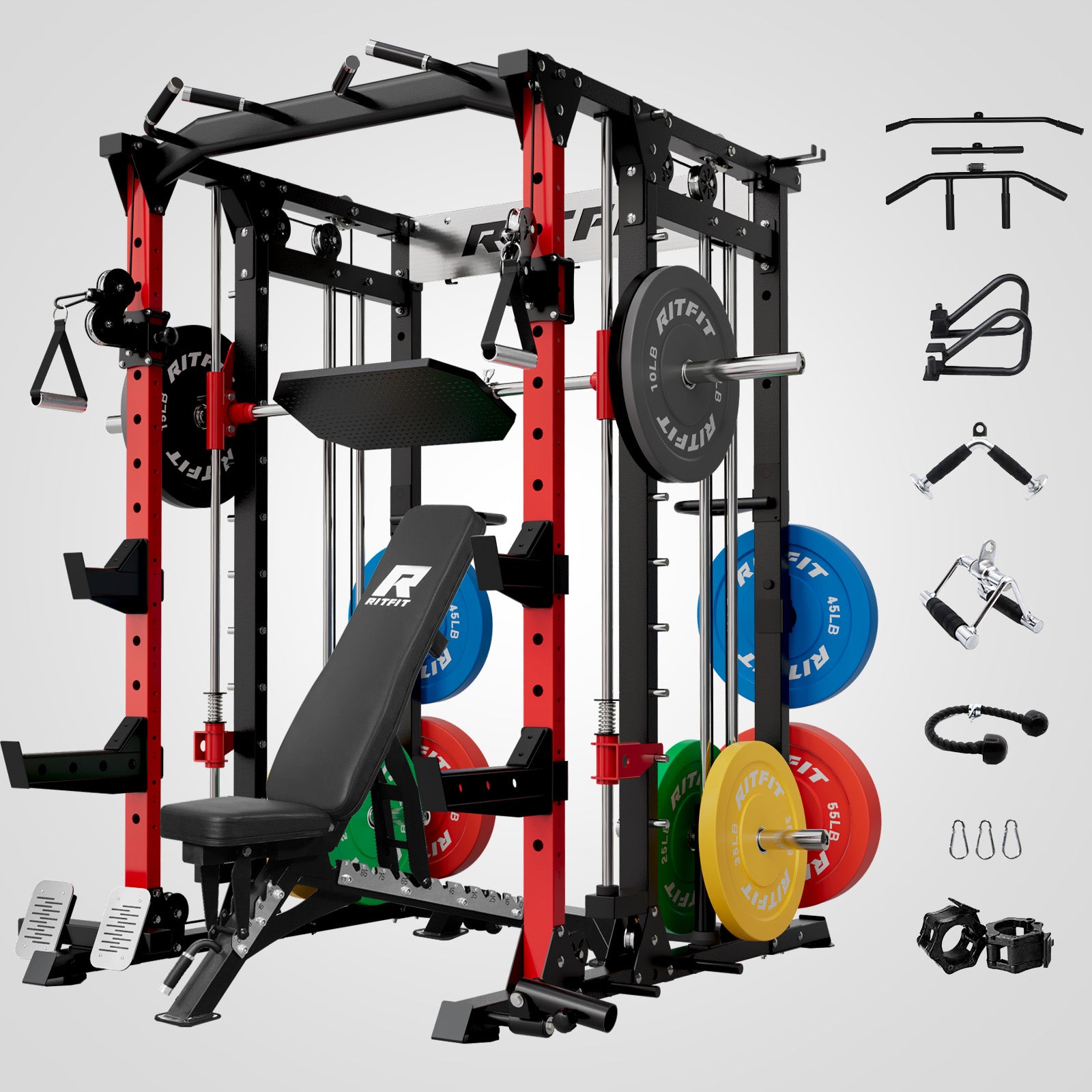
- RitFit BUFFALO multifunctional Smith machine: Smith bar weight about 30.75 lb.
- RitFit M1 PRO multifunctional Smith machine: Smith bar weight about 33 lb.
- Heavy-duty combo rack/Smith units from other brands can climb toward the top of the 45 lb range.
Even within the same category, there can be small differences in bar weight, so always confirm with the product’s spec sheet or measure your own machine with one of the methods below.
Smith Machine Bar Weight Key Takeaways
Here are some of the most important takeaways from this discussion:
- The average Smith machine bar weight is 15–25 lbs.
- Counterbalanced Smith machine bars often weigh even less than 15 lbs.
- Smith machines differ in design, but wear and tear affect all of them over time.
- The angle of the Smith machine rails has almost no effect on the actual bar weight.
- Use a scale or one of the methods below to weigh a Smith machine bar accurately.
How to Measure a Smith Machine Bar Weight Yourself?
If there is no mention of the Smith machine bar weight on the label or the manufacturer's website, you can measure it yourself using the following methods.
Floor Scale
The floor scale gives you two options to measure the Smith machine bar weight.
Option 1
- Weigh yourself by placing the scale on an even surface.
- Put the scale under the Smith machine, with no plates on the bar.
- Position the barbell on your shoulders and then step on the scale.
- Record the total weight.
- Subtract your bodyweight (from step 1) from the total (step 4); the difference is your bar weight.
Option 2
You'll need a plyo box and a scale to use this option. The plyo box is required to bring the scale into the Smith bar's range of motion.
- Place the box under the Smith bar.
- Put the scale on the box and bring the bar down to rest it on the scale (no plates).
- The reading on the scale is the bar weight.
Hanging Scale
You need a hanging scale or a fish scale for this method, which is probably the easiest.
- Wrap the scale's strap around the middle of the bar.
- Hook the strap to the hanging scale.
- Unrack the bar and let it hang fully from the scale; you’ll get an accurate weight reading.
Rope & Weight
- Tie one end of a thin rope around the middle of the barbell and throw the other end over the top crossbar of the rack.
- Hook the bar in place after setting it at about chest level.
- The loose end of the rope should almost touch the floor.
- Turn the setup into a balancing scale by tying weight plates to the loose end of the rope. Unhook the bar and see if it balances the weighted end of the rope.
- Keep adjusting the weight plates on the rope’s loose end until the bar and the plates balance. The total plate weight will approximate your bar weight.
Smith Machine Bar vs. Free Weight Olympic Bar
Olympic bars are made of high-strength steel because they must bear a lot of weight without additional support. Moreover, manufacturers design Olympic bars not to bend permanently when heavy weight is loaded onto them. Therefore, the tensile strength of an Olympic bar is much higher, which also increases its weight.
On the other hand, Smith machine bars can use slightly lighter materials and smaller diameters, thanks to the support they receive from clamps, bearings, and slides. So, a Smith machine bar is often lighter but can still handle similar loads to an Olympic bar. Many Smith machine bars are rated in the 600–1000 lb capacity range, on par with Olympic bars, as long as you stay within the manufacturer’s guidelines.
Summary
If you have reached this point, it means you have all the necessary information regarding Smith machine bar weight and how to measure it correctly. Knowing these details will help you understand what you need in a Smith machine and improve your workouts significantly.
From a safety perspective, always pair that knowledge with your machine’s rated Smith bar and rack capacity, and stay within those limits even as your strength climbs.
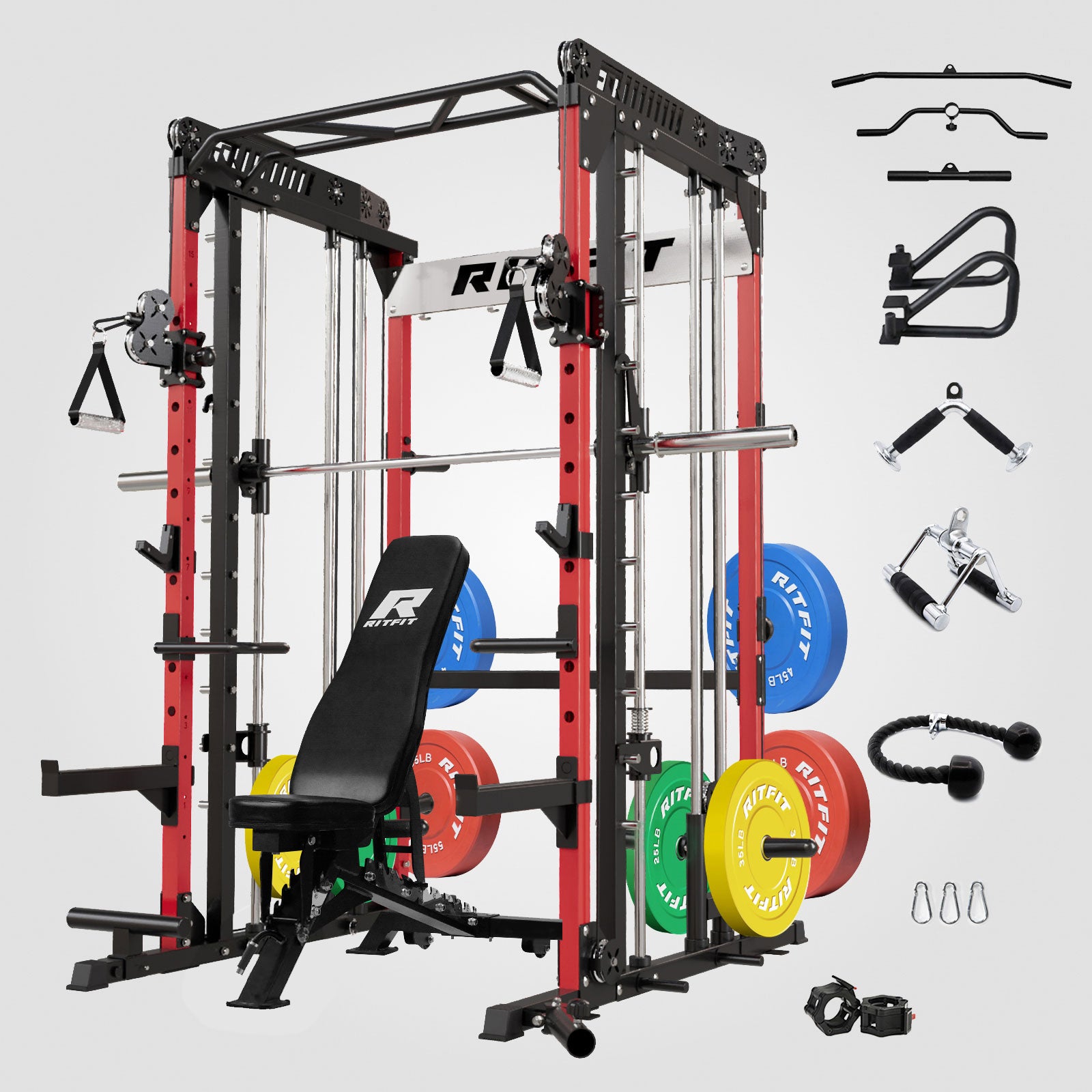
If you're looking for a high-quality Smith machine that provides amazing functionality, look no further than the RitFit Multifunctional Smith Machine with Lat Pulldown and Row. With a load capacity of 300 kg, left & right column hook design for added safety, thick steel pipe for durability, and a combination of double pulley and wire rope, it can be your perfect workout companion.
We at RitFit are offering it at unbeatable prices, so do not wait and book your order today. If you’ve any queries, please contact us at support@ritfitsports.com.
Smith Machine Bar Weight FAQ
Q: Is the Smith machine bar a weight?
A: Yes. The bar itself has a starting weight, so the total weight is the weight of the bar plus the weight of any plates you add. If you don't pay attention to the bar, you might think you're lifting less or more than you really are.
Q: Why does using a Smith machine seem easier than using a free barbell?
A: The fixed rails help you guide the bar and make it less likely to wobble. When combined with a lighter bar construction or counterbalance, the same plate load can feel easier than it does on a free Olympic bar.
Q: Is a 20-pound Smith bar “too light” to be useful?
A: Not at all. A lighter starting bar can actually help beginners learn proper technique as long as you gradually increase the total load over time and stay within the machine's limits.
Q: Is it possible to use the numbers from my Smith machine to figure out how strong I am with free weights?
A: Roughly, yes, but expect your free-bar numbers to be a bit lower at first because you have to stabilize the bar yourself. Use similar rep ranges and RPE (rate of perceived exertion), then slowly build up your free-bar loads.
Q: How often should I re-check my Smith bar weight?
A: If the machine is in good condition, you don’t need to re-weigh it frequently. Re-check after major service, repairs, or if something in the bar path feels noticeably different.